
Big Latte Mug Replacement Purchase Product Shortlist Guide: 3 Sizes
Reading time: about 12 minutes
There's a mug on our returns shelf with a hairline crack running up from the base, a handle that was always half a finger too tight, and a fill line its owner had quietly learned to live with. Nobody replaces a mug on purpose. They replace it the morning the crack finally reaches the rim — and by then they've forgotten the three things that annoyed them most. We built this big latte mug replacement purchase product shortlist guide around that exact amnesia: name the failure first, convert the capacity second, and only then look at the mugs.
Three sizes are in play here — 400 ml, 440 ml and 480 ml — and none of them is the "right" one in the abstract. The right one is the size that fixes what your last mug got wrong without creating a new problem in the cabinet, under the machine, or in your hand.
What did the mug you're replacing actually get wrong?
Before you open a single product page, write the failure down. In our experience handling returns and talking to people at the counter, replacement mugs get bought for a short list of reasons, and each one points at a different size.
- The drink never fit. You poured a full latte and stopped an inch below where you wanted to be. That's a capacity problem — go up a size rather than sideways into a different shape of the same volume.
- The handle pinched. Two fingers fit, three didn't, and you drank with your pinky floating. No capacity number on the box fixes this; only the handle opening does.
- It ate the counter. A wide base crowded the kettle, the grinder or the toaster. A taller, slightly narrower mug solves that better than a smaller one does — you keep the volume and lose the footprint.
- The last third went cold. A wide, shallow mug exposes more liquid surface, so the end of the drink cools sooner than it would in a narrower vessel. That's shape and fill level, not brand.
- It chipped at the rim. Usually a thin rim, a crowded dishwasher rack, or mugs nested inside each other in the cupboard. Rim chips tend to start exactly where two rims touch.
- The glaze crazed. That fine web of cracks across the surface isn't always a failure — but once it darkens with coffee oils, most people stop enjoying the mug. Crazing is a glaze-and-firing issue you can't wash out.
Pick the one failure that mattered most. If the honest answer is all six, you're not shopping for one mug — you're shopping for two, and the range of unique coffee mugs is the better place to browse shapes than forcing a single vessel to do everything.
Is your "16 oz" actually 480 ml? Convert before you shortlist
Listings round in both directions, so a mug printed as 440 ml and a mug printed as 15 oz can turn out to be the same vessel. Two figures are worth keeping in your head: NIST Handbook 44 lists 1 US fluid ounce as 29.57353 mL, and the packaging conversion in Handbook 130 gives 16.0 fl oz as 473.176 mL. Divide our listed capacities by that factor and the three mugs land here.
| Mug | Listed capacity | Approx. US fl oz | The drink it suits |
|---|---|---|---|
| The Flow | 400 ml | about 13.5 | A double-shot latte you actually finish hot |
| Morning and Night | 440 ml | about 14.9 | A mug used twice a day, coffee then tea |
| The Rock | 480 ml | about 16.2 | Long drinks, iced lattes, desk duty |
Those are the printed capacities converted, not a promise about usable fill. For scale, the FDA compliance guide for ceramic hollowware describes cups and mugs as normally holding about 240 mL (8 fl oz). All three of these sit well above that reference, and 480 ml is roughly double it — which is exactly why the fit questions further down matter more than the number on the box.
Brim capacity vs. the pour you actually get in a latte
Nobody drinks from a mug filled to the rim. The gap between the listed number and your real pour is where most replacement purchases go wrong.
- The foam cap. A latte finishes with a layer of microfoam, and that layer needs somewhere to sit. A centimetre or two of headroom is normal, not waste.
- Milk expansion. Steamed milk takes up more room than the cold milk you measured, so the volume you pour is not the volume that left the pitcher.
- Ice displaces. In an iced latte, ice takes a surprising share of the volume before the coffee and milk go in. If you build iced drinks, size up rather than trusting the printed figure.
- The shot goes in first. Espresso claims room before the milk arrives, so a mug that looks generous empty can feel tight by the time you finish pouring.
One practical rule from our own kitchen testing: a mug wants roughly 15–20% headroom above the volume you intend to drink. A 400 ml mug is comfortable for a 330–350 ml build; a 480 ml mug is comfortable for something close to a 400 ml pour, foam included.
Your big latte mug replacement purchase product shortlist guide, sorted by what broke
Three sizes, three different broken-mug stories. If none of them matches your failure, browse the wider collection rather than forcing a fit.
The Flow 400 ml — for the mug that was only a little too small
If your old mug was a café-style latte cup in the 300–355 ml range and a double-shot latte always landed an inch from the rim, this is the smallest sensible step up. It adds room without moving you into a different class of mug.
- Choose it if you make one hot latte a day, your cabinet shelf is shallow, and you want a mug you can carry one-handed without thinking about it.
- Skip it if you routinely build 16 oz iced drinks, or you want a wide bowl for pouring latte art — 400 ml with a double shot leaves limited surface to work with.
Check the current The Flow 400 ml listing for the handle opening and rim thickness before you commit; those are the two numbers the photos don't tell you.
Morning and Night 440 ml — for the mug used twice a day
At 440 ml (about 14.9 fl oz) this sits in the middle of the shortlist, which is where most people actually belong. It's the size that suits a household where the same mug holds coffee in the morning and tea at night.
- Choose it if your old mug was almost right — a bit tight for a latte, fine for tea — and you don't want two different mugs on the shelf.
- Skip it if you need one mug that clears a tall iced drink, or if the crack you're replacing came from stacking mugs inside each other and you plan to keep stacking.
One thing to confirm on the live page: whether the Morning and Night name means one mug for both ends of the day or a paired set. That changes the maths for a two-person kitchen. See what the Morning and Night 440 ml listing currently ships as.
The Rock 480 ml — for the 16 oz mug that never held 16 oz
This is the answer to a very specific complaint: the old mug was sold as 16 oz, and you never once got a full 16 oz drink into it because that capacity was measured to the brim. At 480 ml (about 16.2 fl oz) the listed capacity clears that line before foam.
- Choose it if you drink long lattes, build iced drinks with ice displacement, or park a mug on a desk for an hour.
- Skip it if your cabinet gap is tight, your car cup holder is narrow, your hands are small, or you like the coffee to lead the milk — a double shot in 480 ml is a milk drink with a coffee accent.
Read the current The Rock 480 ml listing and check the base diameter against your counter and your cup holder before ordering.
Will a 480 ml mug fit under the espresso machine, in the cabinet and in the car?
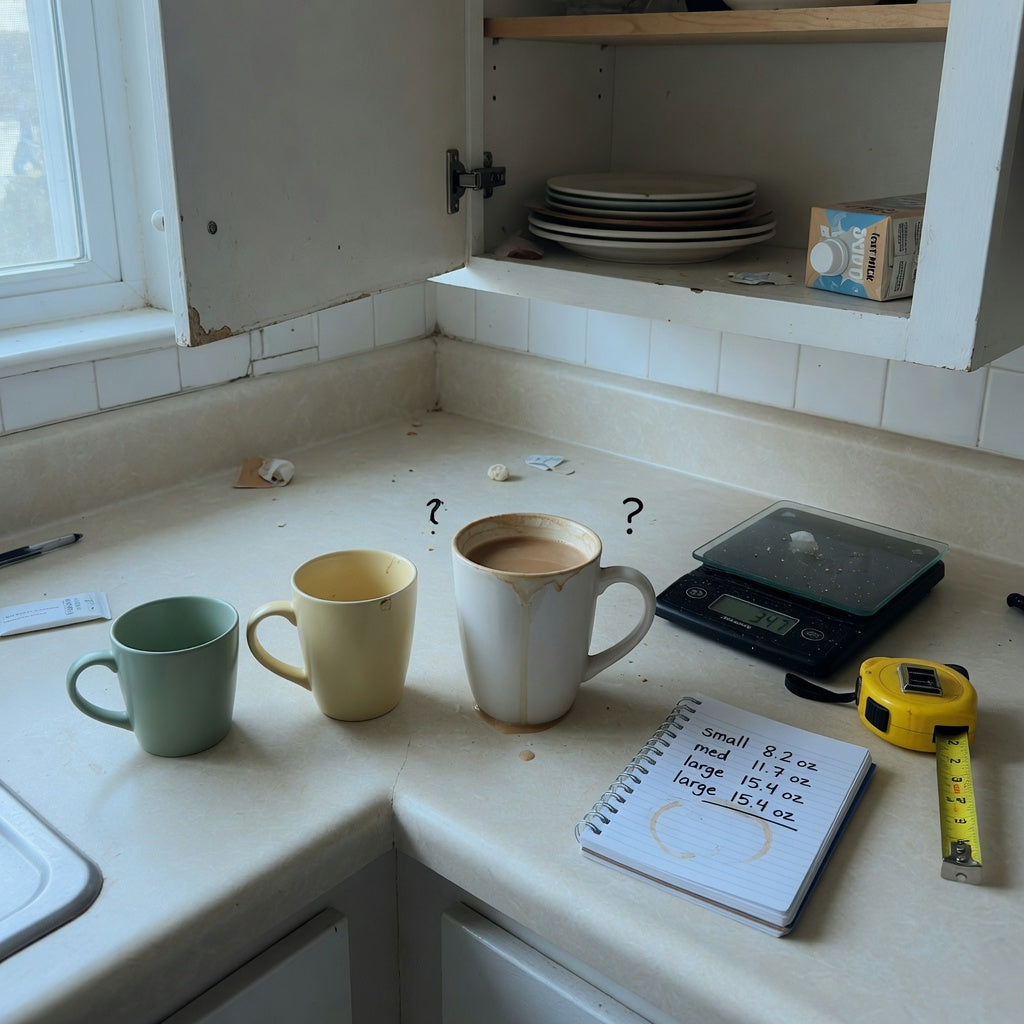
Fit failures are the most common reason a replacement mug comes back to us, and almost all of them are measurable in five minutes with a tape.
- Under the group head. Measure from the drip tray to the underside of the group head, then subtract your scale's height and the clearance the portafilter spout needs. Most "it doesn't fit" complaints are scale-plus-mug, not mug alone.
- Shelf height. Measure the gap between shelves, then remember the mug has to tilt out on an angle to leave the cupboard.
- Cabinet door swing. A wide base catches the hinge side of a shallow cabinet more often than the shelf above does.
- Car cup holder. Measure the inside diameter, not the rim. A wide, heavy base is the usual culprit here.
- Desk footprint. If the mug lives beside a keyboard, the base diameter matters more than the height — a wide mug crowds a mouse pad faster than a tall one does.
If any measurement comes back tight, step down one size in the shortlist rather than gambling on a product photo.
Handle opening, empty weight and filled weight: the one-hand test
"Large handle" is marketing language until you know the opening. Two things to check before buying:
- Opening, not length. Measure the inside width of your current mug's handle where your fingers pass through. That's the number to compare, not how far the handle sticks out from the body.
- Filled weight. 480 ml of coffee and milk is roughly 480 g of liquid — a bit over a pound — before the mug itself is counted. A full 480 ml mug carried one-handed across a kitchen is a different object from the empty one in the photo.
We keep a tape measure at the counter for exactly this reason, because handle comfort is the complaint people can't articulate until they hold the mug again. If you walk your coffee to a desk or up stairs, fill a large mug to about three-quarters for the trip and top it up when you sit down. Small habit, fewer chips.
Dishwasher, microwave and "lead-free": what to verify on a replacement mug
Care labels are where replacements quietly go wrong. A mug that survives six months of dishwasher cycles and then crazes or dulls wasn't mis-sold — it was asked to do more than the label promised.
On safety claims, keep the language precise. The FDA compliance guide for ceramic cups and mugs sets a lead action level of 0.5 micrograms per millilitre of leaching solution, applied to any one of six units tested, and the same guidance notes that some ceramic foodware can leach lead from food-contact surfaces. That means "lead-free" on a listing is a claim, not a test result. Ask the seller for documentation rather than the phrase.
For the rest, read the current product page: whether the mug is listed as dishwasher safe, whether it is listed as microwave safe, and whether any decoration is metallic. Metallic lustre bands are the usual casualties in a microwave even when the body of the mug handles it fine. We would rather you check the listing than assume from a photo.
When a bigger mug is the wrong replacement
- You want the coffee to lead. A 480 ml mug with a standard double shot is a milk-forward drink. Stay at 400 ml or pull a larger shot.
- You drink slowly. A large mug that's only half full is worse than a full small one — more surface, faster cooling.
- Grip is a concern. Full mugs are heavy. A smaller capacity with a generous handle opening beats a big mug you avoid lifting.
- The drink isn't espresso-based. Milk-forward drinks built on something else follow their own volume logic — our cappuccino mug replacement guide works through cup width and foam, the café au lait shortlist starts from a different fill, and the matcha latte replacement guide sizes around a drink with no espresso at all.
Frequently asked questions
Does a 480 ml mug hold the same as a 16 oz paper cup?
480 ml converts to roughly 16.2 US fluid ounces, so it's slightly more than a 16 oz cup on paper. In practice a café paper cup is also filled below the rim, so the difference you notice is smaller than the numbers suggest. Compare the mug against the cup you actually drink from.
Will a big latte mug fit under my espresso machine?
Often it will, but only once you account for the scale. Measure drip tray to group head, subtract the scale height, and leave room for the portafilter spout. If the total comes in under your mug height, the 400 ml size is the safer pick.
Is a wider mug better for latte art, and does this big latte mug replacement purchase product shortlist guide cover shape?
A wider surface gives foam somewhere to spread, which is why art cups tend to be bowl-shaped rather than tall. Width alone won't rescue a mug that's too large for your shot, though — in a 480 ml mug a double shot leaves a lot of milk to pour before the surface is close enough to work on.
How do I check whether a ceramic mug is actually lead free?
Ask for the test result rather than the marketing phrase. The FDA's cup-and-mug lead action level is 0.5 micrograms per millilitre of leaching solution across six tested units, and that's the benchmark a real test is measured against. A seller who can't share documentation is asking you to take the phrase on faith.
Which size suits an iced latte rather than a hot one?
The Rock 480 ml, because ice takes up volume before the coffee and milk go in. The 400 ml size works for iced drinks only if you're building a smaller serve or using less ice. For hot lattes, tea and cocoa, match the size to the drink you make most often.
Write your one failure on a sticky note, then take three measurements — group-head clearance with the scale in place, shelf gap, and handle opening — and set them beside the capacity table above. If you land between two sizes, size down for coffee-forward drinks and up for milk-forward ones. Then start with the three mugs on this shortlist, or browse the full collection of unique coffee mugs with those numbers in hand instead of a feeling.
Read more
Ceramic Mug Shapes Home Coffee Station Practical Purchase Checklist
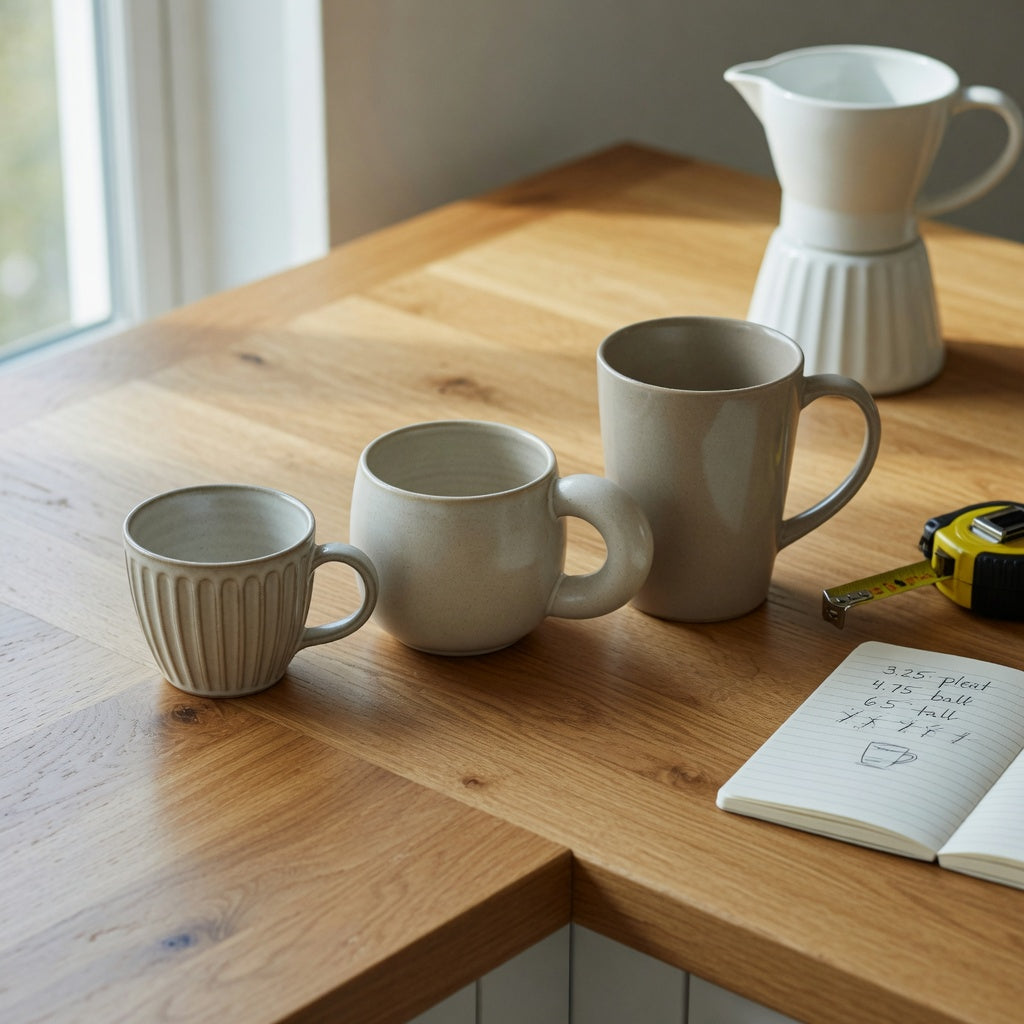
The mug that ends up at the back of the cabinet usually failed a measurement, not a beauty contest. This checklist covers capacity, rim comfort, handle room, spout clearance, stacking and glaze so ...
Read more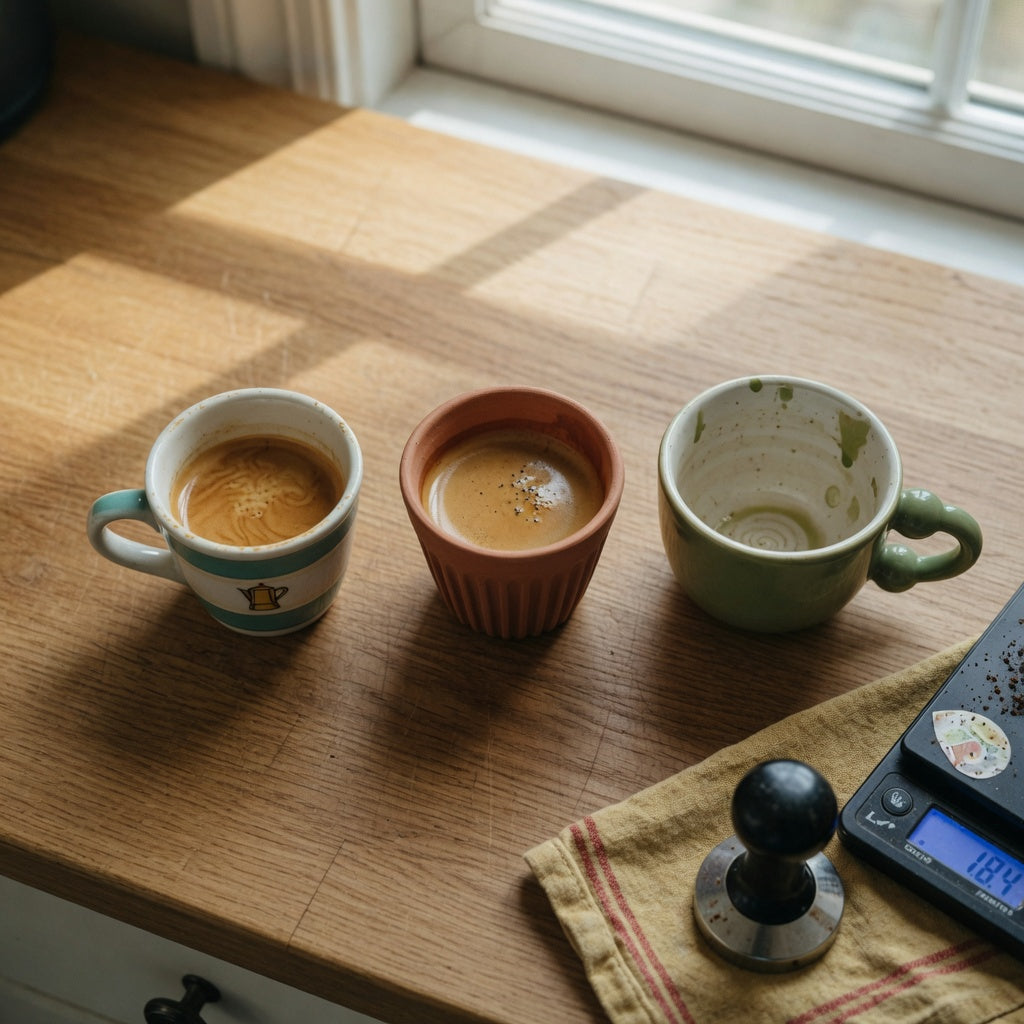
Unique Espresso Cups Replacement Purchase Product Shortlist Guide
A replacement shortlist built from what the old cup got wrong: three ceramic espresso cups at 170 ml, 200 ml and 250 ml, with the scenario each one suits and the case for skipping it.
Read more
Leave a comment
This site is protected by hCaptcha and the hCaptcha Privacy Policy and Terms of Service apply.