



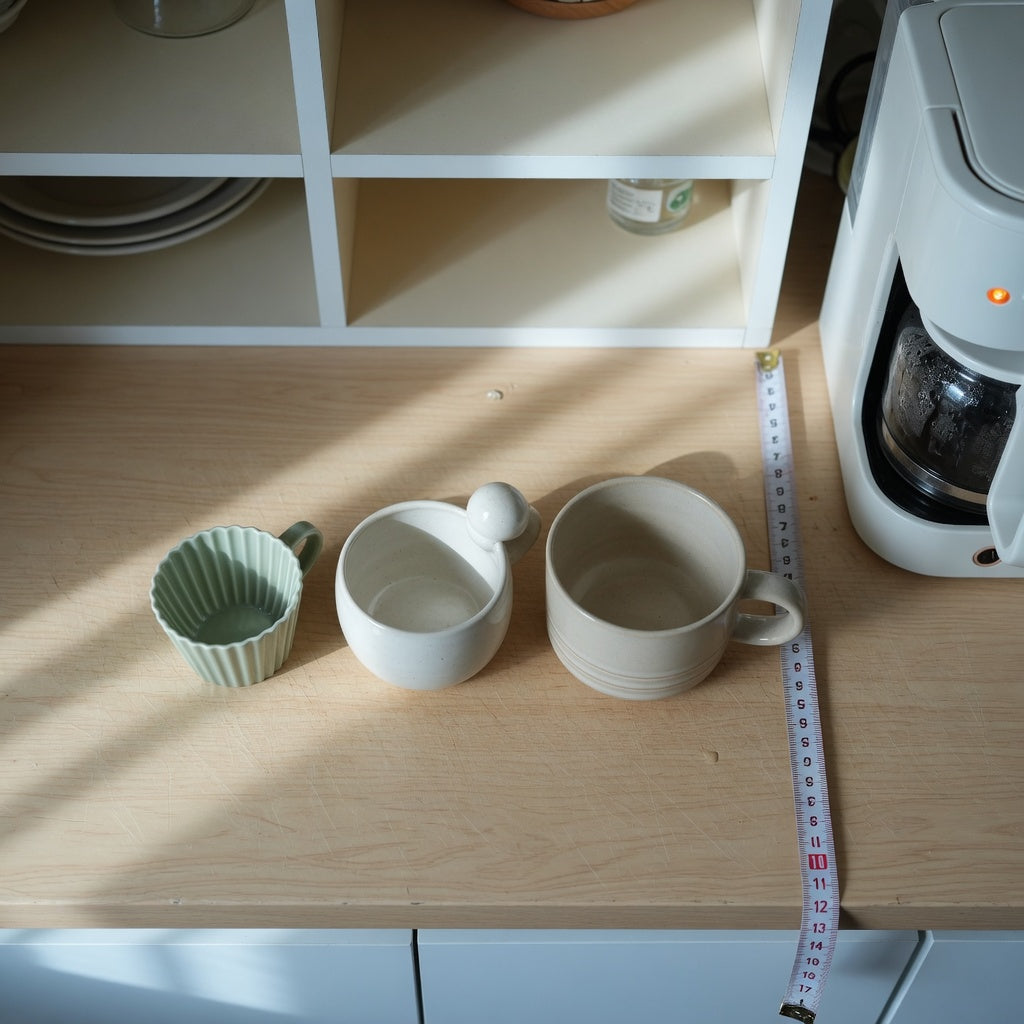
Ceramic Mug Shapes: Compact Kitchen Practical Purchase Checklist
Reading time: about 10 minutes
A 24-inch stretch of counter, a drip machine with a fixed spout, and one shelf above it. That is the space most of our customers are actually shopping for. Last month a shopper told us she had returned three mugs and not one of them was the wrong color — two handles fouled the machine housing, and one was too tall to lift off the shelf without tilting. Silhouette is the first thing you notice in a product photo and the last thing anyone measures before checkout, so this ceramic mug shapes compact kitchen practical purchase checklist is built around the numbers that decide whether a mug earns counter space or goes back in the box.
In our store we keep three silhouettes on the shelf, and we have watched people pick each one up in the same order: grip the handle, check the height against the machine, then ask how much it holds. That order is worth copying.
Cup or mug? What the FDA wording actually tells you
The FDA's ceramicware guidance draws a line that most product listings ignore. In that document, a cup normally has a base and curved sides, while a mug has cylindrical sides. Both are described as small ceramic hollowware for hot drinks such as coffee or tea, both normally hold about 240 mL (8 fl oz), and both normally have a handle.
That distinction is useful at the shelf, not in a lab. A product named "cup" usually arrives with a curved or bowl-like profile; a product named "mug" usually arrives with straighter walls. Neither word tells you the real volume, the wall thickness, or whether the glaze is rated for food use. You still have to read the listing.
Volume is where buyers get caught. NIST's approximate conversion treats 1 fluid ounce as 29.57 mL, and its kitchen table rounds that to about 30 mL with 1 cup as 240 mL. So an "8 oz" mug and a "240 ml" mug describe the same vessel. The gap between a 200 ml mug and a 250 ml mug is under one fluid ounce — often smaller than the visual difference a thick rim creates when you look into the mug.
Which four kitchen measurements should you take first?
- Shelf depth, front to back. Measure it, then leave a finger's width behind the mug so you can actually reach in and lift it out.
- Height under the shelf above. A mug can fit depth-wise and still be too tall to clear the shelf edge without tilting.
- Spout to drip tray. On pod and espresso machines this gap sets your maximum mug height with the handle clear of the housing.
- Stack height, if you nest mugs. Measure your own tallest stack rather than guessing; a protruding handle or a wide belly breaks the stack and adds height fast.
How do our three listed silhouettes compare on capacity and handle geometry?
Here is the arithmetic from the capacities published on each product page. Nothing in this table adds a specification we do not hold:
| Mug | Listed capacity | Approx. US fl oz | What the silhouette and handle suggest | Confirm on the listing |
|---|---|---|---|---|
| Pleated Coffee & Tea Cup | 200 ml | ≈ 6.8 | Pleated body, named a cup rather than a mug | Rim diameter, overall height, wall thickness |
| Ball Handled Coffee & Tea Mug | 250 ml | ≈ 8.5 | Ball-shaped handle that projects outward from the body | Handle opening, total width including handle |
| The Flow Coffee & Tea Mug | 400 ml | ≈ 13.5 | Largest of the three by listed volume | Height under your spout, handle clearance |
The fluid-ounce column is our own arithmetic from the NIST conversion, not a second product specification. Height, diameter, wall thickness and weight are not part of the capacity data we hold, so treat them as open questions and check the current listing before ordering — especially if your cabinet gap is tight.
How much finger room does a handle need when the mug is full?
Watch anyone pick up a mug and they do the same thing: hook the handle and lift. If only two fingers fit, they switch to a pinch grip. That grip is fine on a 200 ml cup and genuinely unpleasant on a 400 ml one, because the load moves from the handle into your fingertips.
- Measure your index finger across the middle knuckle, then want at least that much clearance inside the opening, plus a little slack, so the mug hangs instead of pinching.
- Look at the gap between the handle and the body. If your knuckles graze the wall while the mug is empty, they will press into it when the mug is full.
- Weigh the balance point in your head. A handle mounted low makes a full mug hang level; a handle set high tips the load forward.
Ball handles are the interesting case here. The Ball Handled Coffee & Tea Mug pairs a rounded, thicker handle with a 250 ml body, and that geometry pushes outward — so total width matters more than rim diameter when you are judging shelf fit. A ball handle also refuses to nest inside another mug, which changes how you store a pair in a small cabinet.
Rim width and opening size: where drips start and heat escapes
A wide opening cools a drink faster and puts more aroma under your nose. A narrower opening holds heat and concentrates what you smell. That single trade-off is why tea drinkers and latte drinkers often end up on different shapes even when they pour the same volume.
Rim comfort is a separate variable, and it is the one buyers notice last. Thin, rounded lips tend to shed liquid cleanly. Thick, blunt rims let a drop ride over the edge and down the outside. Flared rims — where the wall opens outward at the top — are easier to drink from when the mug is full, but the flare adds width exactly where two mugs sit shoulder to shoulder on a shelf.
On a small cup like the 200 ml Pleated Coffee & Tea Cup, the opening accounts for a larger share of the drink's total surface than it would on a 400 ml body, so the contents cool faster. That is a feature if you finish a coffee in five minutes and a limitation if you like to nurse one for an hour. Slow drinkers are usually better served by a taller, narrower vessel.
Can a silhouette keep coffee hot? What shape can and cannot do
Heat leaves a mug three ways: through the walls, through the base, and off the open top as evaporation. More surface area and thinner walls move heat faster, and a wide mouth exposes more liquid to air. At the same silhouette, a larger mug generally holds temperature longer than a small one simply because it has less surface area per unit of volume.
What shape cannot do is change flavor. Claims that a named silhouette makes coffee sweeter, more acidic or more floral get repeated by a lot of sellers and are not established by the standards and reference material we reviewed. Temperature and fill level do most of that work. A preheated mug beats a clever silhouette almost every time — fill it with hot tap water while the coffee brews, then dump it and pour.
Wall thickness is the practical variable and it is rarely listed. Thick diner-style walls feel substantial and hold heat once warm, but they pull more heat out of the first pour, so preheating matters more. Thin-walled porcelain warms quickly and gives that heat back just as quickly. Neither is better in the abstract; they suit different drinking speeds.
Which silhouette suits your pour, your hand and your shelf?
- You pull one short, strong drink and finish it standing up. The 200 ml pleated cup behaves like a cup in the FDA sense: quick to warm, quick to cool, and the smallest footprint on a crowded counter. This is also the size that suits a cortado-style pour rather than a full morning mug.
- You pour a standard 8-ounce coffee or tea and lift it by the handle. At 250 ml, the ball-handled mug sits right at the typical size the FDA describes. Check the total width with the handle attached before you commit to a narrow shelf.
- You fill once and carry it to a desk. The Flow Coffee & Tea Mug lists 400 ml — roughly 13.5 fl oz — so verify height under your spout first. This is the one most likely to be returned for clearance rather than capacity.
- You want all three side by side. Our unique coffee mugs collection groups the range in one place so you can compare silhouettes without jumping between tabs.
For a wider comparison of how these shapes behave with different brews, our buying guide to ceramic mugs for coffee and tea drinkers covers drink-type matching in more depth than a fit checklist can.
Glaze, lead and cleaning: the checks a silhouette cannot fix
Shape has no bearing on food-contact safety, and this is where budget listings get vague. The FDA compliance guide for ceramic cups and mugs sets a lead guideline of 0.5 micrograms per milliliter of leaching solution in any one of six units tested, and cites ASTM C738 among the accepted methods — an acetic-acid extraction that the standard itself describes as severe and unlikely to be matched in ordinary use. Ware sold as decorative is held to different expectations than ware sold for food use, so if a listing will not say food safe or food use, treat it as decorative.
Cleaning is where geometry genuinely bites. Sharp interior corners, deep facets and sculpted feet trap coffee oils and milk residue that a smooth round interior sheds in one rinse. If a mug goes through the dishwasher daily, favour a smooth interior and a rim with no thin, unsupported edge to chip. Faceted or pleated bodies are not a reason to walk away — they are a reason to keep a soft brush by the sink and know what you are signing up for.
The ceramic mug shapes compact kitchen practical purchase checklist
Run these eight checks before checkout:
- Measure shelf depth, shelf-to-shelf height, and spout-to-tray clearance with a tape, not by eye.
- Convert listed capacity to fluid ounces (mL ÷ 29.57) and compare it with what you actually pour in a sitting.
- Measure total width with the handle included, not just the rim diameter.
- Confirm the handle opening takes your index finger with slack.
- Decide whether you want heat held (narrower opening, thicker wall) or fast cooling (wider opening, thinner wall).
- Check whether the shape nests or stacks — ball handles and wide flares usually do not.
- Look for a food-safe or food-use statement on the listing, not just a glaze name.
- Confirm height and diameter on the current product page, because capacity alone will not give you either.
Frequently asked questions
Is a 200 ml ceramic mug too small for coffee?
Not for a short, strong drink. At roughly 6.8 fl oz it suits a cortado-sized pour or a small filter coffee you plan to finish while it is hot. It is too small for anyone who fills to the brim and sips for an hour.
Will a 400 ml mug fit under my coffee machine spout?
We cannot answer that for your machine, and a product photo cannot either. Measure the gap from spout to drip tray, then confirm the mug's height and handle clearance on the current listing. If that gap is tight, a 250 ml body is the safer bet.
Do ceramic mug shapes stack in a small cabinet?
Straight-walled and gently tapered mugs stack. Mugs with a ball handle, a wide flare or a strongly rounded belly generally do not, because the handle or the widest point stops them nesting. If stacking is your main storage method, buy one silhouette and repeat it.
Where does the ceramic mug shapes compact kitchen practical purchase checklist start if I only have room for one mug?
Start with your tightest dimension — usually spout-to-tray clearance or shelf depth — then work through capacity, handle room and food-safety wording in that order. With a single mug there is no second option to cover a bad fit, so measure before you fall for a finish.
Are handleless or faceted ceramic cups practical for very hot drinks?
Handleless cups work for tea served slightly cooler and for anyone who wraps both hands around the body. For a drink poured straight from a kettle or a machine, a handle is the safer choice, and faceted interiors need a brush rather than a quick rinse.
More from our blog
Ready to pick your mug? Two ways to save on today's order:
Ordering 1–3 mugs? Get an extra 10% off your 1st order with code 10_OFF Apply 10% Off & Shop Wooden-Handle Mugs →
Gifting 4+ mugs? Buy 3, Get the 4th Free applies automatically at checkout (no code needed; offers do not stack) · Free standard shipping (Nov pre-Christmas delivery: 15–20 calendar days US) · Free replacement if chipped in transit.
Popular mug buying guides: Ceramic Tea Cups & Infuser Mugs · Ceramic Mugs with Lids Compared · Wooden-Handle Tea Infuser Mugs Compared · Christmas & Secret Santa Mugs 2026 · Espresso & Cortado Cups Guide · Cup & Saucer Gift Sets · All 25 Mugs Spec Table · Mug Size Guide · Shipping & Promo FAQ
FIRST ORDER 10% OFF (CODE: 10_OFF) · OR BUY 3, GET THE 4TH FREE


Read more

Big Latte Mug Compact Kitchen Practical Purchase Checklist: 400–480 ml
A checklist built around the measurements that actually decide the purchase: shelf gap, group-head clearance, handle opening, brim versus usable fill, and what 400, 440 and 480 ml pour in fluid oun...
Read more
Big Latte Mug Compact Kitchen Product Shortlist Guide: 3 Sizes
This big latte mug compact kitchen product shortlist guide matches three listed capacities — 400, 440 and 480 ml — to real constraints: shelf gaps, desk footprints, handle room and filled weight, p...
Read more
Leave a comment
This site is protected by hCaptcha and the hCaptcha Privacy Policy and Terms of Service apply.