
Ceramic Tea Mug Compact Kitchen Practical Purchase Checklist: Fit First
Reading time: about 11 minutes
A mug can sit inside a cabinet and still be the wrong mug for a compact kitchen. The handle clips the door frame on the way out, the widest curve crowds the cup beside it, or the base occupies the only clear landing spot next to the kettle. Our ceramic tea mug compact kitchen practical purchase checklist starts with those small daily frictions, because they matter more than how roomy a shelf looks in a product photo.
In our store, we handle these ceramic coffee and tea mugs by the body and handle, set them beside other vessels, and review the same details shoppers can verify on the current listings. For this comparison, we stay within firm claim boundaries: ceramic material, listed capacity, visible form, and visible handle shape. We do not guess exterior dimensions from photography or add claims about stacking, hanging, care, appliance use, temperature performance, or included items when a listing does not state them.
Using the ceramic tea mug compact kitchen practical purchase checklist
Before browsing by color or design, write down four practical constraints: the usable cabinet opening, shelf depth, available width, and volume of your ordinary tea serving. Compact-kitchen fit is decided by the smallest of those limits, not by the total empty space inside the cabinet.
- Clear the exact shelf position where the mug will live. Measure the opening height at its lowest obstruction, such as a shelf lip or cabinet frame.
- Measure usable depth from the front obstruction to the back of the shelf. Confirm that the cabinet door can close with the mug in its normal orientation.
- Measure the width of the available slot and the width of the access opening. A cabinet can be roomy inside but narrow at the frame or hinge.
- Measure your usual tea pour with a kitchen measuring cup, then compare that amount with the capacity stated on the live product listing.
- Use exterior measurements only if the listing publishes them. Include the handle and the widest part of the body rather than checking the base alone.
- If exterior dimensions are not listed, treat exact cabinet fit as unknown. A photograph can show form, but it cannot provide a dependable scale.
This order prevents a common buying mistake: treating capacity as a complete measure of mug size. Capacity describes how much liquid the vessel holds. It does not establish its height, total width, handle projection, or counter footprint.
Which cabinet clearances decide whether the mug fits?
Four cabinet measurements matter in daily use. We check them separately because one generous measurement does not compensate for a tight one elsewhere.
- Opening height: Measure from the shelf surface or liner to the lowest edge above it. Do not rely on the taller space farther back in the cabinet.
- Usable depth: Check the depth with the door closed. A door panel, inner rail, or hinge can reduce the space available near the front.
- Occupied width: Allow for the widest curve of the body and the full handle projection. The base may be narrower than the rest of the mug.
- Removal path: Make sure your hand can lift and turn the mug through the opening without striking the frame or the neighboring cup.
A mug that fits only after being rotated, tilted, or moved behind another item may technically clear the shelf, but it is a weak choice for a vessel used every morning. In our experience, the best compact-kitchen position is one you can reach without reorganizing the row.
How does handle shape change shelf and counter use?
At our packing table, a mug often looks compact until it is turned handle-forward. The handle can determine the total occupied width, the space needed for your fingers, and the direction the mug must face in a cabinet.
Review each listing photo with your intended storage pattern in mind:
- For mugs stored side by side: Look at how far the handle appears to project beyond the body. Confirm the total width from published measurements if they are available.
- For a mug kept beside the kettle: Decide which way the handle will point during normal use. A handle facing into the preparation area consumes different space than one facing the wall.
- For a tight grip: Inspect the visible loop opening and attachment points, but remember that a photo cannot confirm finger or knuckle clearance.
- For rail or peg storage: Do not assume an open-looking handle will fit. That requires handle-opening and rail measurements that may not be stated on the listing.
The practical trade-off is simple. A visually expressive handle may be part of why you want the mug, but it can also require a dedicated slot. If storage width is your hardest constraint, a handleless cup or a mug with explicitly published total-width measurements may suit the space better.
How should listed capacity guide an ordinary tea serving?
Start with the amount you actually pour, not the largest capacity available. Fill your current cup to its normal level, transfer that liquid to a measuring cup, and compare the result with the capacity listed for the mug you are considering. Choose enough capacity to keep the liquid below the rim during an ordinary serving.
A larger listed capacity can reduce the need for a refill, but it does not prove that the mug will fit a narrow shelf. A lower capacity can work well for a shorter tea break, yet it may be inconvenient if your normal serving is larger. Because vessel shapes differ, two mugs with similar capacities can still occupy space differently.
We therefore use capacity as a serving decision and published exterior dimensions as a storage decision. If the listing gives capacity but no exterior measurements, you can confirm serving volume while cabinet fit remains unresolved.
Which CoffeifyMug form matches your available space?
The current unique coffee mugs collection is the practical starting point if you have not chosen a silhouette. Compare only what each live listing supports: ceramic material, listed capacity, visible body form, and visible handle shape.
| Reader situation | Why this option belongs on the shortlist | Product next step |
|---|---|---|
| You prefer the visible Flow form and can give one mug a defined shelf or counter position. | A dedicated position lets you assess the distinctive outline on its own rather than assuming it will pack tightly into a row. Check the current capacity and inspect the visible body and handle against your space notes. | Review The Flow Coffee Tea Mug. |
| You want the Morning Night design as one regular-use mug rather than part of a tightly stacked set. | Choosing a designated everyday mug reduces the need to rely on unconfirmed stackability. Compare its listed capacity and visible handle shape with your ordinary serving and storage position. | Check the Morning Night Coffee Tea Mug. |
| You prefer a visibly round body and store mugs beside one another. | A round form makes the widest curve especially relevant. Use published exterior measurements if present, and do not substitute the apparent base width for the total occupied width. | Compare the Round Coffee Tea Mug. |
| You have measurements but have not selected a shape. | Viewing the collection lets you compare visible silhouettes and handles before opening individual pages for current capacity details. | Browse the ceramic mug forms in the collection. |
None of these product names alone proves that a mug is the smallest or best-fitting option. The right match is the listing whose confirmed details work with your measured slot and usual serving.
Will the mug work in the clear space beside your kettle?
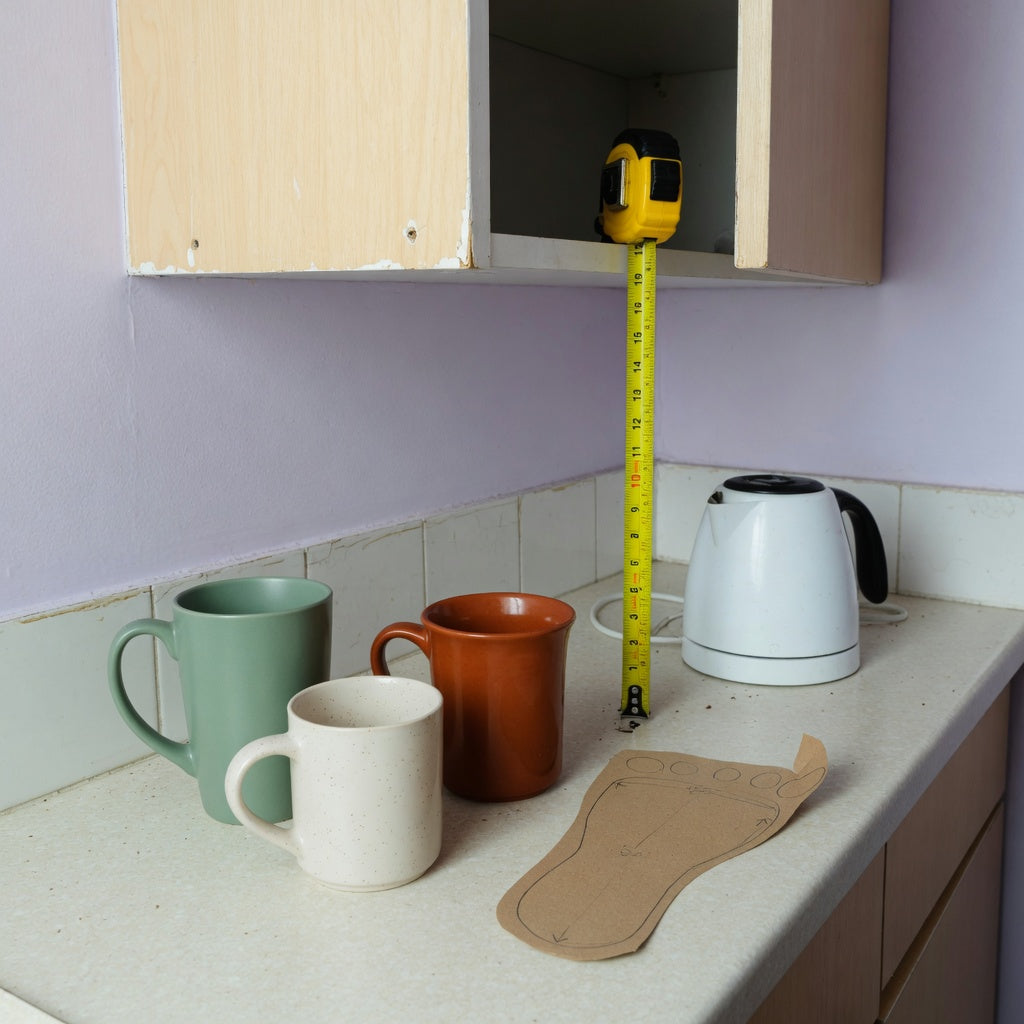
Cabinet fit is only half the decision if the mug spends most of the day on the counter. Test the actual landing spot near the kettle, tea container, sink, or preparation board. If the listing provides maximum exterior width and depth, mark that footprint with removable tape or a paper rectangle.
Place the template in the mug's normal orientation. Turn the imaginary handle toward the side you use, open the nearby cabinet, and pull out any drawer that shares the space. You should be able to reach the mug without moving another container or leaving the handle over the counter edge.
If the product page lists only capacity, do not create a scaled template from the photo. Camera angle, cropping, and nearby props can make a vessel appear smaller or larger than it is. For an extremely tight counter position, a product with published exterior dimensions is the more defensible purchase.
What can the current listings confirm?
Trustworthy comparison depends on separating product facts from visual impressions. We use the live product page as the source of truth at checkout because listing details can be revised.
| Reasonable to verify from the listing | Do not infer unless expressly stated |
|---|---|
| Ceramic material | Impact resistance or a particular durability level |
| Positioning as a coffee and tea mug | Performance for a use outside ordinary serving |
| The capacity printed on the product page | Exterior height, width, or depth when those measurements are absent |
| Visible body form and visible handle shape | Exact hand clearance, peg fit, or stacking compatibility |
| Any feature explicitly written on the current page | Care methods, appliance compatibility, or included items not stated there |
This boundary matters in a compact kitchen. A shopper with a generous open shelf can accept some dimensional uncertainty. A shopper working with a cabinet opening that has almost no spare clearance should not.
When is this ceramic mug style the wrong fit?
A ceramic coffee and tea mug is not automatically the right choice just because you like its appearance. Skip these options, or delay the purchase, if your setup depends on a feature that the current listing does not confirm.
- Your cabinet works only with a purpose-built stackable set, but stackability is not stated.
- Your only storage is a peg or rail, and no handle-opening measurements are provided.
- Your available shelf space has almost no tolerance, and the listing does not publish the required exterior dimensions.
- You need documented care, appliance, or impact-performance information that is absent from the page.
- Your normal serving exceeds the listed capacity or would require filling the mug too close to the rim.
For those situations, an explicitly stackable mug, a straight-sided vessel with complete published dimensions, or a handleless cup may suit the kitchen better. If documented impact performance is the priority, choose a product category that states that performance rather than assuming it from ceramic material.
A five-minute check before checkout
The purpose of this ceramic tea mug compact kitchen practical purchase checklist is not to declare one model universally smallest. It is to remove preventable uncertainty before a mug reaches your shelf.
- I measured the cabinet opening at its lowest and narrowest points.
- I checked usable depth with the door closed.
- I allowed for the widest body point and the complete handle projection.
- I compared the listed capacity with my ordinary tea serving.
- I used only exterior measurements stated on the live listing.
- I reviewed the visible form and handle in the orientation I will use.
- I am not relying on unconfirmed stacking, hanging, care, appliance, or included-item claims.
- I know the exact shelf or counter position where the mug will live.
If every line has a clear answer, open the relevant product page and verify the current listing once more. If several answers are still unknown, return to the CoffeifyMug unique coffee mugs collection and compare another visible form.
Frequently asked questions
How do I use a ceramic tea mug compact kitchen practical purchase checklist?
Measure the usable cabinet opening, shelf depth, available width, and your ordinary tea serving. Compare those notes with the current listing's capacity and any published exterior measurements, then inspect the visible body and handle shape. Treat any unstated fit detail as unknown.
Can I tell if a ceramic tea mug will fit my cabinet from a product photo?
No. A photo can help you assess the visible form and handle shape, but it cannot provide dependable scale. Exact fit requires your cabinet measurements and corresponding exterior dimensions from the product listing.
Should I choose capacity or exterior size first for a small kitchen?
Confirm the available physical space first, then choose a listed capacity that supports your normal serving. Capacity does not establish external height, width, or depth. If those dimensions are not published and your space is extremely tight, fit remains uncertain.
Which CoffeifyMug option should I compare for a round body?
Start with the Round Coffee Tea Mug. Inspect the current listed capacity and visible handle, and use exterior measurements only if they appear on the live page. For cabinet planning, account for the widest curve rather than judging the base alone.
Are The Flow, Morning Night, and Round mugs stackable?
Do not assume stackability from the photographs or body names. If your cabinet plan depends on stacking, look for an explicit statement and relevant measurements on the current product page. Otherwise, plan for each mug to occupy its own shelf position.
Measure the shelf opening, usable depth, available width, and your usual pour now. Then open the unique coffee mugs collection and keep only the listings whose confirmed details fit those notes. That gives you a practical next step without turning a product photo into a promise.
More from our blog
Read more
Minimalist Ceramic Mug Compact Kitchen Product Shortlist Guide: 3 Picks
A practical three-product comparison for shallow cabinets, open shelves, and shared counter space. Match each ceramic mug's shape, handle, and listed capacity to your measurements before buying.
Read more
Art Coffee Mugs Compact Kitchen Practical Purchase Checklist: 7 Checks
Measure cabinet openings, shelf depth, handle clearance, and your usual pour before comparing the Mountain-Sea, Koi Fish, and Crane mugs. This checklist separates listing-backed facts from details ...
Read more
Leave a comment
This site is protected by hCaptcha and the hCaptcha Privacy Policy and Terms of Service apply.