



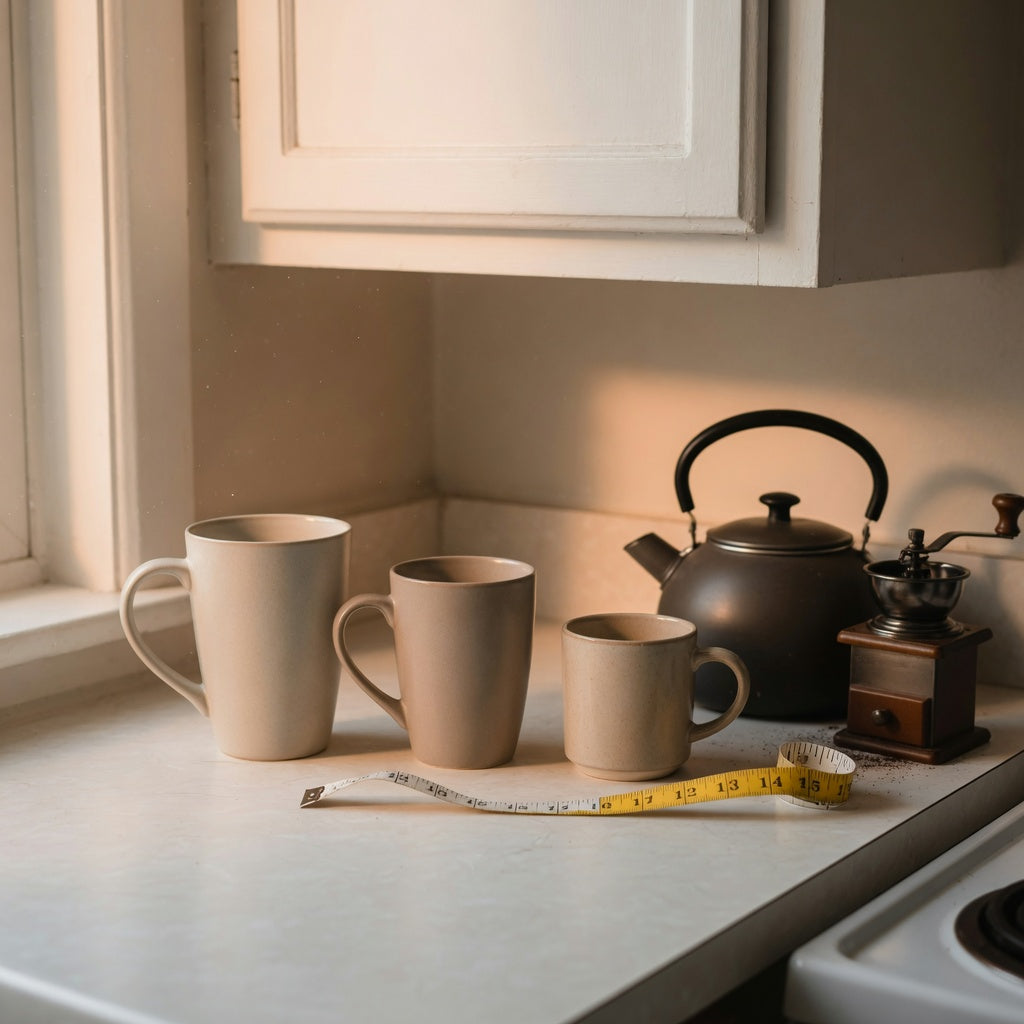
Big Latte Mug Compact Kitchen Product Shortlist Guide: 3 Sizes
Reading time: about 10 minutes
Clear a patch of counter and look at what is actually there. A kettle, a grinder, a drying rack, maybe a toaster — and whatever sliver of worktop survives. That sliver, not the ounce count on the box, is what decides which big latte mug you should buy. This big latte mug compact kitchen product shortlist guide is built around those constraints — footprint, shelf gap, handle room and filled weight — rather than capacity alone.
We sell mugs for a living, and the same conversation plays out most weeks: someone wants a big latte mug, then measures the gap under the cabinet and realises the oversized mug they had in mind would end up living on top of the fridge. There is no single legal capacity for a latte mug; the phrase covers café-style cups and much larger home mugs. Our range covers three listed capacities: 400 ml, 440 ml and 480 ml. Three numbers, three quite different jobs. Here is how to pick between them without buying twice.
Counter real estate: what a big latte mug actually costs you
A mug takes up space in two directions, and a compact kitchen punishes both.
- Width. A wide, bowl-shaped mug spreads across the worktop. Set a side plate where the mug will live; if the plate overlaps the kettle base or the sink edge, the mug will get shifted every morning, and shifted mugs get chipped.
- Height. A tall, straight-sided mug uses less worktop but needs clearance above it. Measure the gap between one shelf and the shelf above it, not the shelf alone. Handles count too — a mug with a modest body diameter can still foul a cabinet door because the handle sticks out.
There is a third cost most listings ignore: the saucer. If you use one, add its diameter to your footprint. In a kitchen where the counter is a shared resource, a mug-and-saucer set is a different purchase from a bare mug.
The listed millilitres convert like this, using the NIST factor of 29.57353 ml per US fluid ounce: 400 ml is about 13.5 fl oz, 440 ml is about 14.9 fl oz, and 480 ml is about 16.2 fl oz. Two caveats. Listings rarely say whether that figure is to the brim or to a comfortable fill, so ask if it matters. And a mug holds a drink plus a foam cap or ice, so the usable pour is always a little under the printed number.
Big latte mug compact kitchen product shortlist guide: three jobs, three mugs
Match the mug to the job it will do most often, not the drink you make occasionally. All three sit in the same unique coffee mugs collection, so the real decision is size and shape.
| Mug | Listed capacity | Approx. US fl oz | Best fit | Skip if |
|---|---|---|---|---|
| The Flow | 400 ml | 13.5 | Desk mug, narrow shelf, tight cabinet | You routinely make 16 oz iced drinks |
| Morning and Night | 440 ml | 14.9 | One-mug kitchen that switches hot to iced | Shelf gap is the binding constraint |
| The Rock | 480 ml | 16.2 | Single-vessel household, long drinks, soup | Small hands, low cabinet, cup-holder fit matters |
The desk mug or narrow-shelf mug: The Flow, 400 ml
The Flow is listed at 400 ml, roughly 13.5 fl oz, which makes it the smallest of the three and the easiest to live with when space is the binding constraint. If the mug sits beside a keyboard, or goes into a cabinet whose shelf gap you have already measured and found tight, start here.
Choose it because: it is the least demanding of the three in a shared space, and 400 ml is a sensible pour for a double shot with a normal milk ratio.
Skip it if: you routinely drink 16 oz iced lattes, or you want a mug that doubles as a soup bowl. Add ice and cold milk and the headroom disappears fast.
The one-mug kitchen: Morning and Night, 440 ml
Morning and Night is listed at 440 ml, about 14.9 fl oz. That extra 40 ml over The Flow is the difference between a mug that only handles hot coffee and one that can take a foam cap in the morning and a handful of ice in the afternoon.
Choose it because: it is the middle of the range, which is usually where one-mug households land — big enough for an iced drink, not so big that a standard latte looks lost in it.
Skip it if: your constraint is shelf gap rather than capacity. Forty millilitres will not change whether a mug fits, and a smaller mug does the same job with more clearance. Skip it too if you want a genuinely oversized vessel for soup or cereal — go up to the 480 ml.
The only-vessel household: The Rock, 480 ml
The Rock is listed at 480 ml, about 16.2 fl oz — the largest of the three and the closest to a 16 oz café takeaway cup. This is the mug for people who own one mug, not a shelf of them.
Choose it because: it gives the most room for ice, milk and a long drink, and it has the most headroom for soup, cereal or a very large tea.
Skip it if: you have small hands, a low cabinet, or a car cup holder you care about. A full 480 ml mug is roughly half a kilogram of drink before the mug itself is counted. Check the base diameter on the listing rather than assuming it will sit in a cup holder.
Handle comfort and filled weight: the part of the spec sheet nobody prints
Capacity is easy to compare. Handle room is not, and it is what decides whether you enjoy using a mug or merely own it.
- The finger test. You want two fingers, ideally three, through the opening with your knuckles clear of the body. If they will not fit, you end up gripping the mug by its side — exactly what you do not want with a hot drink.
- The weight maths. Milk is close to water in density — about a gram per millilitre — so a full 480 ml mug holds roughly 480 g of drink before the mug counts; at 400 ml it is about 400 g. That gap is what you feel on a one-handed carry from kitchen to desk.
- Balance. A handle set high on the body tips the drink toward you. A handle set low feels steadier but can bring your knuckles close to the counter. Neither is wrong — it is simply a reason to read the product photos properly instead of skimming them.
Most listings do not publish handle opening or empty weight. If those numbers decide your purchase, treat the current product page as the source of truth and ask before ordering rather than assuming one mug behaves like another.
Dishwasher, microwave, and the lead question a lead-free sticker does not answer
Dishwasher safe and microwave safe are manufacturer claims, not certifications, and they are worth reading in context. In our experience, repeated dishwasher cycles gradually dull glazes and stress the joint where a handle meets the body; if a mug has metallic decoration or a rim band, hand washing keeps it looking new for longer.
On safety, the FDA compliance guidance for ceramic hollowware is the reference worth knowing. It defines cups and mugs as small ceramic hollowware, normally though not exclusively holding around 240 ml or 8 fl oz and made with a handle, and it treats anything under 1.1 litres as small hollowware — so a 400 to 480 ml latte mug sits squarely inside the category the guidance covers. The FDA lead action level for ceramic cups and mugs is 0.5 micrograms per millilitre of leaching solution, applied to any one of six units tested. The agency also notes that some ceramic foodware can leach lead from food-contact surfaces.
What that means at checkout: lead-free is a claim, and a leach test result is evidence. For daily use, stick to listings that publish care instructions, and if you are buying heavily decorated or handmade-glazed ceramics, it is fair to ask the seller for documentation.
When a big latte mug is the wrong purchase
Three situations where we would steer you away from the biggest option.
- Your machine clearance is tight. Measure from the drip tray to the group head with your scale already in place. If a tall mug only just fits, every dose becomes a juggling act, and a mug you cannot brew straight into is a mug you stop using.
- You mostly drink small milk drinks. A 150–200 ml flat white or cortado in a 480 ml mug goes cool quickly and tastes thin. Our cappuccino mug shortlist for compact kitchens covers that end of the range.
- You want to pour latte art. A wide, bowl-shaped mouth gives you surface to work with; a tall, narrow mug does not. If art is the goal, prioritise mouth width over capacity — the café au lait mug shortlist walks through the shape trade-off in more detail.
Frequently asked questions
Is 400 ml enough for a latte?
For a double shot with steamed milk and a thin foam cap, yes — 400 ml is about 13.5 fl oz and leaves workable headroom. It stops being enough once you add a lot of foam, a syrup and ice, which is when the 440 ml or 480 ml makes better sense.
How do I convert the listed millilitres into ounces?
Divide by 29.57353, the NIST figure for one US fluid ounce. That gives roughly 13.5 fl oz for 400 ml, 14.9 fl oz for 440 ml and 16.2 fl oz for 480 ml. If a listing rounds differently, the printed millilitres are usually the more precise figure.
Will a 480 ml mug fit under my espresso machine?
Only your machine can answer that. Measure the clearance from the drip tray to the group head with your scale in place, then compare it against the mug height published on the listing. If no height is published, treat it as unknown rather than assuming a large mug is short because it is wide.
Are these mugs dishwasher and microwave safe?
Check the care section on each current product page, because finishes and decoration differ between them. Treat both labels as manufacturer expectations rather than proven test results, and hand wash anything with metallic detailing.
Which matters more for latte art, width or height?
Width. Art needs a surface to pour onto, and a wide mouth gives you one. A tall, narrow mug of the same capacity gives you less surface and a longer drop for the milk, which makes clean shapes harder. That is why this big latte mug compact kitchen product shortlist guide ranks the three by space first — shape is the second decision, not the first.
The 90-second fit check before you add to cart
Run these four checks in order. The first one to fail ends the shortlist for that mug.
- Shelf gap. Measure between shelves, then add the handle's protrusion.
- Counter patch. Mark the footprint with a plate; if it overlaps the kettle or the sink, size down.
- Clearance. Drip tray to group head, with the scale in place.
- Hand and cup holder. Two or three fingers through the handle, and the base diameter against your car cup holder.
If more than one mug passes all four, buy the one that matches your most common drink — not the largest. You can compare all three side by side in the collection, and if you are still torn between the 400 ml and the 440 ml, tell us what you drink on a normal Tuesday and we will point you at one.
More from our blog
Ready to pick your mug? Two ways to save on today's order:
Ordering 1–3 mugs? Get an extra 10% off your 1st order with code 10_OFF Apply 10% Off & Shop Wooden-Handle Mugs →
Gifting 4+ mugs? Buy 3, Get the 4th Free applies automatically at checkout (no code needed; offers do not stack) · Free standard shipping (Nov pre-Christmas delivery: 15–20 calendar days US) · Free replacement if chipped in transit.
Popular mug buying guides: Ceramic Tea Cups & Infuser Mugs · Ceramic Mugs with Lids Compared · Wooden-Handle Tea Infuser Mugs Compared · Christmas & Secret Santa Mugs 2026 · Espresso & Cortado Cups Guide · Cup & Saucer Gift Sets · All 25 Mugs Spec Table · Mug Size Guide · Shipping & Promo FAQ
FIRST ORDER 10% OFF (CODE: 10_OFF) · OR BUY 3, GET THE 4TH FREE


Read more
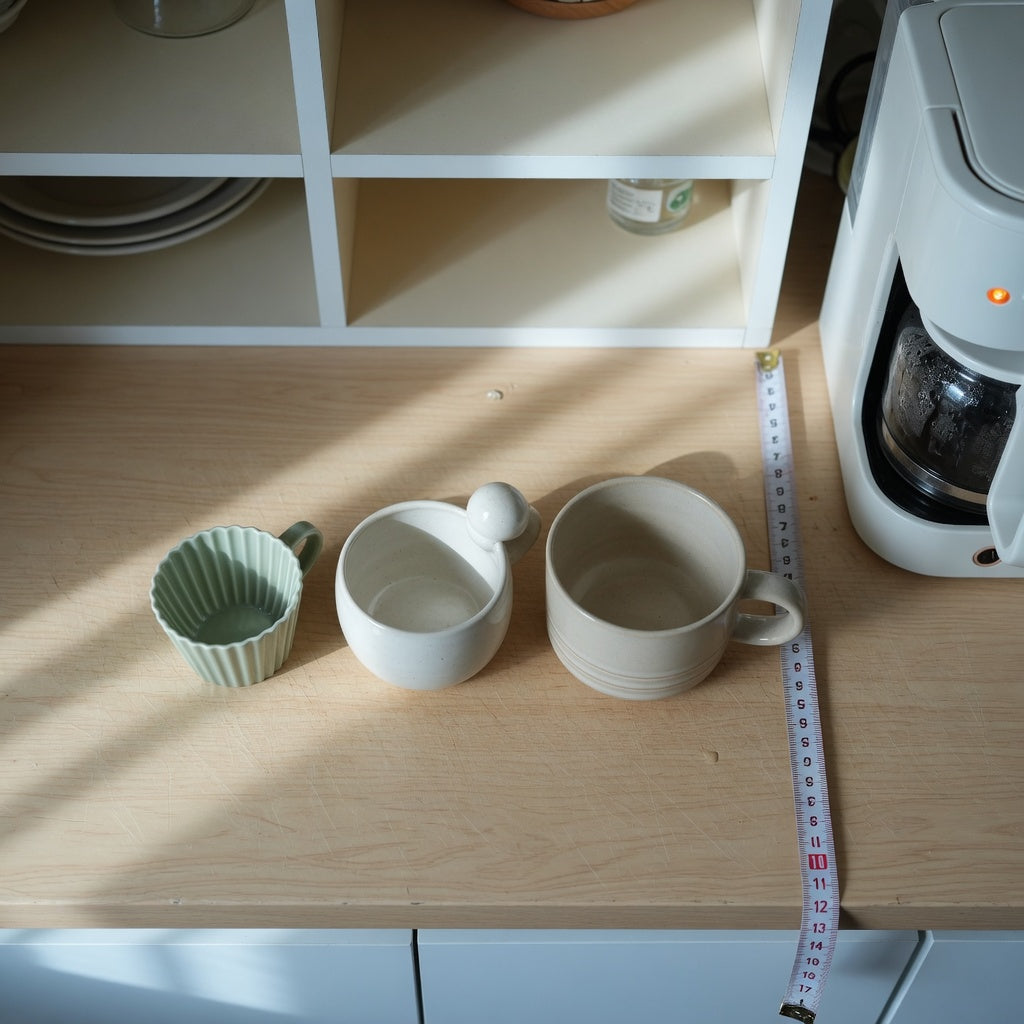
Ceramic Mug Shapes: Compact Kitchen Practical Purchase Checklist
A measurement-first checklist for choosing ceramic mug shapes that clear a shallow shelf and a fixed machine spout, using listed capacity, handle geometry and rim behaviour instead of style claims.
Read more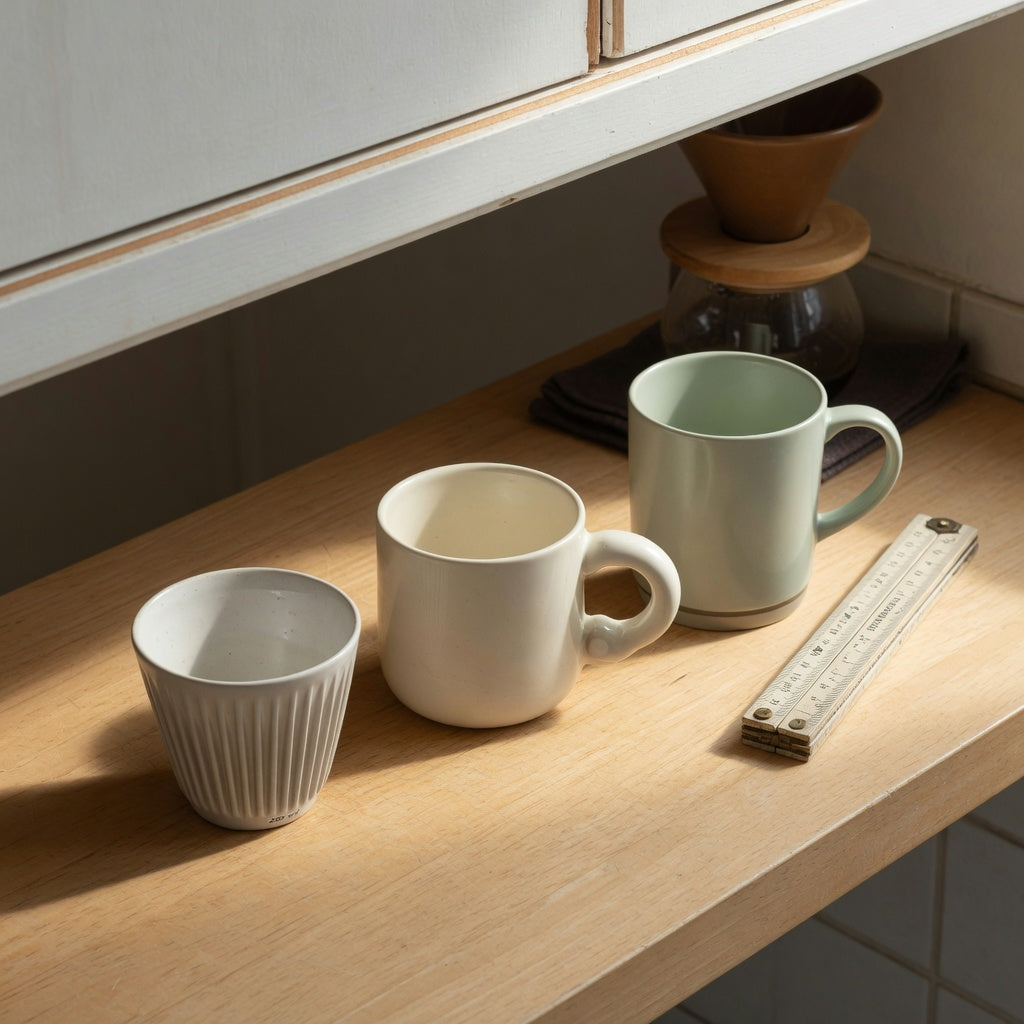
Ceramic Mug Shapes Compact Kitchen Product Shortlist Guide
Three ceramic mug shapes from our own shelves, sized against real compact-kitchen limits: a 200 ml pleated cup, a 250 ml ball-handle mug and a 400 ml Flow mug. Each gets a reason to buy, a reason t...
Read more
Leave a comment
This site is protected by hCaptcha and the hCaptcha Privacy Policy and Terms of Service apply.