




Big Latte Mug Compact Kitchen Practical Purchase Checklist: 400–480 ml
Reading time: about 11 minutes
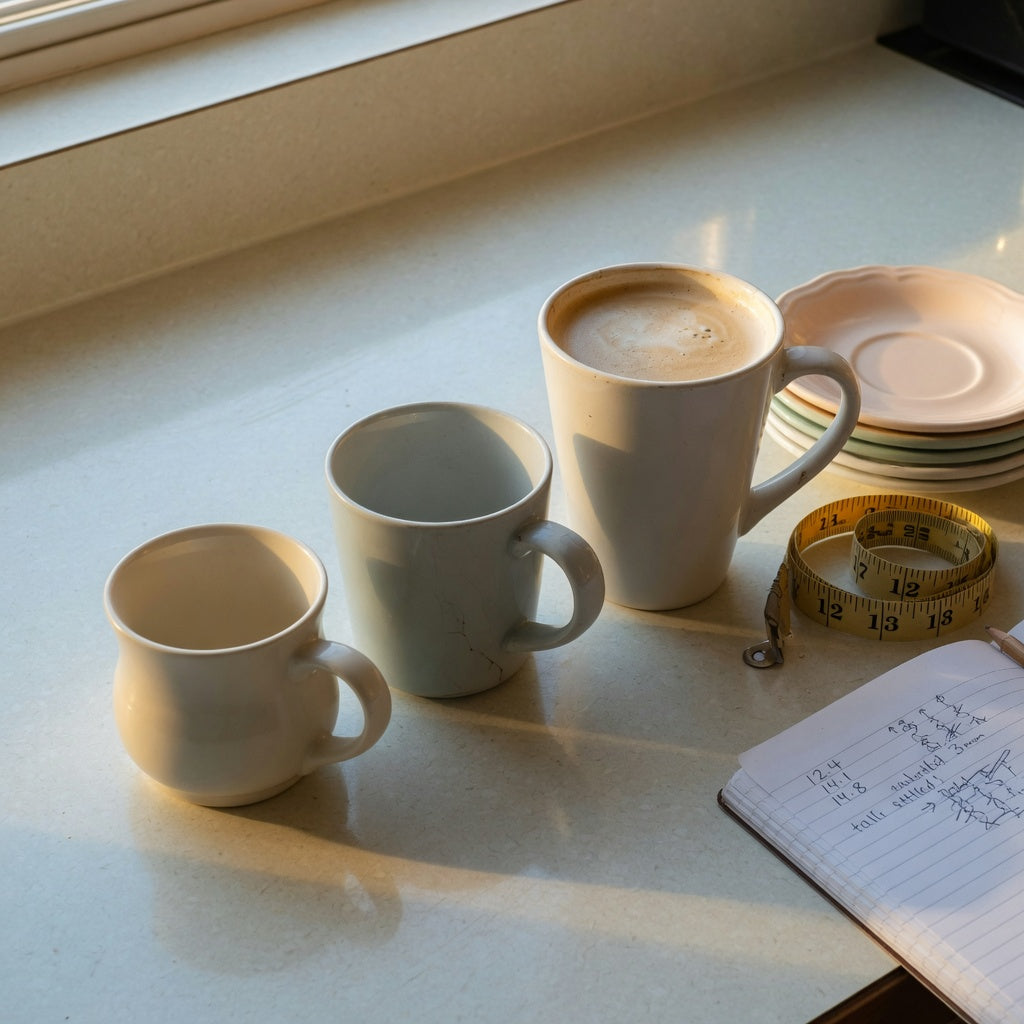
On our shop counter we keep a retractable tape measure next to the mugs. It gets more use than the scale. The returns that come back to us rarely involve someone who misjudged capacity; they involve someone who bought a big latte mug that cleared the cabinet door but not the shelf above the espresso machine. This big latte mug compact kitchen practical purchase checklist follows that order: fit first, capacity second, label last.
There is no single standard capacity for a latte mug, which is why the number on the base tells you less than you think. A specialty café latte cup and an oversized home mug can both be sold under the same name. What follows is the sequence our team runs through with customers buying for a galley kitchen, a studio apartment, or a desk with one shelf above it.
What does a 400, 440 or 480 ml label actually pour?
Start with a reference point. FDA guidance describes cups and mugs as small ceramic hollowware that normally holds about 240 ml, or 8 fl oz, and has a handle. A mug listed at 400 ml is already roughly one and two-thirds of that everyday reference. Anything above 440 ml is genuinely oversized by that standard, not just generously poured.
U.S. fluid ounces and printed millilitres are often rounded differently, so convert before you compare. Using the NIST factor of 29.57353 ml per U.S. fluid ounce, our three listed capacities work out like this:
| Mug | Listed capacity | Approximate U.S. fluid ounces |
|---|---|---|
| The Flow | 400 ml | about 13.5 fl oz |
| Morning and Night | 440 ml | about 14.9 fl oz |
| The Rock | 480 ml | about 16.2 fl oz |
Notice how close 440 and 480 ml sit in ounces: 14.9 versus 16.2. A shopper comparing a '15 oz' listing against a '16 oz' listing may be looking at vessels that differ by a few millimetres of height. That is why we tell people to pick a capacity band first, then decide on shape and handle, rather than hunting for a one-ounce upgrade that does not exist in practice.
Brim capacity versus the pour you can actually carry
Almost no listing says whether the millilitres are measured to the rim or to a comfortable fill line. Assume brim until you can confirm otherwise. A mug filled to the very top leaves no room for a foam cap, no room for a spoon, and no margin when you walk from the counter to the sofa. In practice, treat roughly the top centimetre or two of any mug as unusable for a hot milk drink. If the practical fill matters to you, ask before ordering; do not infer it from a product photo.
Which clearance fails first: cabinet shelf, group head, or cup holder?
These are the four measurements worth taking before you spend anything. None takes longer than a minute.
- Cabinet shelf gap. Measure at the front edge and again at the back — shelves sag, and the clearance is rarely identical across the span. Add the mug's height plus a finger's width of lift room, or you will be sliding mugs out at an angle forever.
- Group-head clearance. If you pull espresso at home, measure from the drip tray to the underside of the group head with your scale already in place. A tall mug plus a scale is the combination that fails, and it fails on the machine you already own.
- Counter or desk footprint. A bigger mug usually means a wider base. Check how far it sits forward under an upper cabinet, and whether it leaves you room to work. On a desk, footprint usually matters more than height: a wide base can crowd a keyboard and a mouse.
- Car cup holder diameter. If the mug travels, measure the holder. Wide, bowl-shaped mugs often do not sit in one at all.
If any of these is borderline, a slightly smaller capacity is the safer buy. A 400 ml mug that fits gets used daily; a 480 ml mug that lives in the cupboard does not.
Does extra volume make a latte weaker, not stronger?
A latte is espresso, steamed milk, and a thin cap of foam. The espresso does not scale up when the mug does. Pull the same shot into a 400 ml mug and a 480 ml mug and the difference is 80 ml of extra milk, which is exactly why a bigger mug reads as milder rather than stronger. If you like a coffee-forward drink, a large vessel works against you unless you pull a second shot.
This is the trade-off we mention most often in the store. People buy a big latte mug expecting more coffee and get more milk. If your ideal latte is small, intensely flavoured and drunk in four minutes, you want something closer to a specialty café cup — our ceramic latte cups checklist for compact kitchens covers that size range in more detail. If you want a long drink to last through a meeting, the extra volume is the point.
Wide bowl or tall cylinder: which shape earns its counter space?
Shape changes three things at once: how easy it is to pour into, how stable it feels in your hand, and how much of the cabinet it occupies.
- Wide, bowl-shaped cups give you room to pour milk and draw latte art, and the lower centre of gravity feels steadier on a counter. They are also the shape most likely to foul a cup holder and the shape that takes up the most shelf width.
- Taller, narrower mugs are easier to grip one-handed and easier to slot into a crowded cabinet, and they suit iced drinks and long teas. The trade-off is that a partly filled tall mug can lose heat faster than a wide one at the same volume — an observation regulars have made to us more than once, and a reason to fill closer to the top.
In a compact kitchen, height is usually the scarcer resource than width, so measure vertically first and let that decide the shape. If you mainly drink iced lattes, a tall mug with a handle that fits your hand is easier to carry; if you mainly pour hot milk, a wider opening gives you room to work.
How much does a full big latte mug weigh in your hand?
Handle comfort is not about how big the loop looks. It is about the internal opening — the clear distance between handle and body — and whether it fits your fingers when the mug is heavy. A mug you can only hold with two fingertips is a mug you will stop using. If a listing does not show the handle opening from the side, ask; front-on product photos tell you almost nothing.
Then do the weight arithmetic. A milk-based drink is close to one gram per millilitre, so 480 ml is roughly 480 g of liquid before the mug's own weight is added. A ceramic body at that size is not light. We have seen more mugs rejected for carry weight than for any other reason. Pick the mug up empty in your head: if 480 ml of liquid plus the mug is more than you can carry one-handed while walking, size down.
What do 'lead-free' and 'microwave safe' mean on a ceramic mug label?
Ceramic foodware is regulated, but the wording on retail listings is marketing, not certification. FDA compliance guidance for ceramic cups and mugs sets a lead action level of 0.5 micrograms per millilitre of leaching solution, applied to any one of six units tested — and the same guidance notes that some ceramic foodware can leach lead from the food-contact surface. A 'lead-free' badge is a claim. A test to that cup-and-mug protocol is a result. If food-contact safety drives your decision, ask which one you are looking at.
Microwave and dishwasher wording deserves the same scepticism. Those labels describe what the manufacturer expects the glaze and body to withstand; they are not guarantees, and metallic decoration or a crazed glaze can change the answer. Where a listing is silent, hand-wash and keep the mug out of the microwave. Avoid thermal shock either way — pouring boiling liquid into a cold, thick-walled mug is a common way a good mug cracks.
A big latte mug compact kitchen practical purchase checklist you can run in ten minutes
- Convert every listing to one unit so you are comparing like with like.
- Measure the cabinet shelf gap at the front and the back.
- Measure group-head clearance with your scale on the drip tray.
- Confirm whether the stated capacity is brim or usable fill.
- Check the handle opening from a side-on photo, or ask.
- Estimate filled weight before you commit to the largest size.
- Read the care instructions and treat 'lead-free' as a claim to verify.
- Decide which shape you need — wide for pouring, tall for carrying and iced drinks.
When we map the checklist to the three capacities we list, the decision usually looks like this:
- The Flow, 400 ml — about 13.5 fl oz. If your shelf gap is the tightest constraint, or you drink a coffee-forward 10–12 oz latte, this is the safer starting point. It sits well above the 240 ml reference without pushing you toward the largest capacity.
- Morning and Night, 440 ml — about 14.9 fl oz. The middle capacity, and the one we suggest when the same mug has to do coffee in the morning and tea at night. Check the handle opening if you have larger hands; a 440 ml body plus a full pour may be a two-hand carry for some people.
- The Rock, 480 ml — about 16.2 fl oz. The largest listed capacity. Buy it if you have the vertical clearance and want one long drink rather than two short ones, and test the filled weight before you commit.
We list capacities plainly; confirm height, footprint, and handle dimensions on each product page, because those are the numbers that decide fit. If none of the three suits the shelf you actually have, browse the full unique coffee mugs collection and compare heights rather than capacities.
When a big latte mug is the wrong buy
It is the wrong buy if you drink 150–200 ml flat whites, if your cabinet gap is under about 11 cm, if you want the mug to sit in a car cup holder, or if you regularly pour latte art and have trained on a narrower café cup. It is also a poor fit for anyone who finds a full mug heavy after a shoulder injury or with arthritis in the hands — a smaller vessel you can lift safely beats a larger one you cannot.
And it is not a substitute for a bowl. A big mug can hold soup or cereal, but a tall mug with a handle is not a bowl; check the opening width if spoon access matters. If that is your plan, buy it as a mug and keep a bowl for soup. Readers weighing a milk-heavy coffee drink instead may find our cappuccino coffee mug checklist closer to the shape they need, and the matcha latte mug comparison is useful if your big mug is going to do double duty with tea.
Frequently asked questions
Is 400 ml big enough for a latte?
For most home drinkers, yes. At about 13.5 fl oz it is roughly one and two-thirds the 240 ml mug that FDA guidance treats as a typical cup, and it leaves a sensible gap below the rim for foam. If you routinely order 16 oz café lattes, it will feel modest rather than large.
What should I measure before buying a big latte mug for a compact kitchen?
Four numbers: the cabinet shelf gap at the front and back edge, the group-head clearance with your scale on the drip tray, the counter or desk footprint under any upper cabinet, and your car cup holder diameter if the mug travels. The smallest of those four numbers decides your mug. That is the short version of this big latte mug compact kitchen practical purchase checklist.
Will a 480 ml mug fit under my espresso machine?
That depends on your machine, so measure rather than assume. Put your scale on the drip tray and measure up to the underside of the group head. Tall mugs fail this test more often than wide ones. If the number is close, a 400 ml mug is the safer order.
Does a bigger mug make latte art harder?
Often, yes, but shape and milk volume matter more than capacity. A wide, bowl-shaped mug gives you room to pour; a tall narrow mug pours awkwardly with a standard pitcher. If art is the goal, choose width over height and match your pitcher to the volume you actually steam.
Are these mugs dishwasher and microwave safe?
Check the care wording on each individual product page rather than assuming it applies across the range, because glaze and decoration can vary. Where a listing does not state it, hand-wash and keep the mug out of the microwave. If you are still choosing, start with the capacity that fits your shelf, then confirm handle and care details on the listing before you add to cart.
Ready to pick your mug? Two ways to save on today's order:
Ordering 1–3 mugs? Get an extra 10% off your 1st order with code 10_OFF Apply 10% Off & Shop Wooden-Handle Mugs →
Gifting 4+ mugs? Buy 3, Get the 4th Free applies automatically at checkout (no code needed; offers do not stack) · Free standard shipping (Nov pre-Christmas delivery: 15–20 calendar days US) · Free replacement if chipped in transit.
Popular mug buying guides: Ceramic Tea Cups & Infuser Mugs · Ceramic Mugs with Lids Compared · Wooden-Handle Tea Infuser Mugs Compared · Christmas & Secret Santa Mugs 2026 · Espresso & Cortado Cups Guide · Cup & Saucer Gift Sets · All 25 Mugs Spec Table · Mug Size Guide · Shipping & Promo FAQ
FIRST ORDER 10% OFF (CODE: 10_OFF) · OR BUY 3, GET THE 4TH FREE


Read more
Big Latte Mug for Shared Households: Practical Purchase Checklist
A decision-first checklist for homes where one person wants a café-sized latte and another wants a mug they can hold with both hands. Compare 400 ml, 440 ml and 480 ml, plus the handle, footprint a...
Read more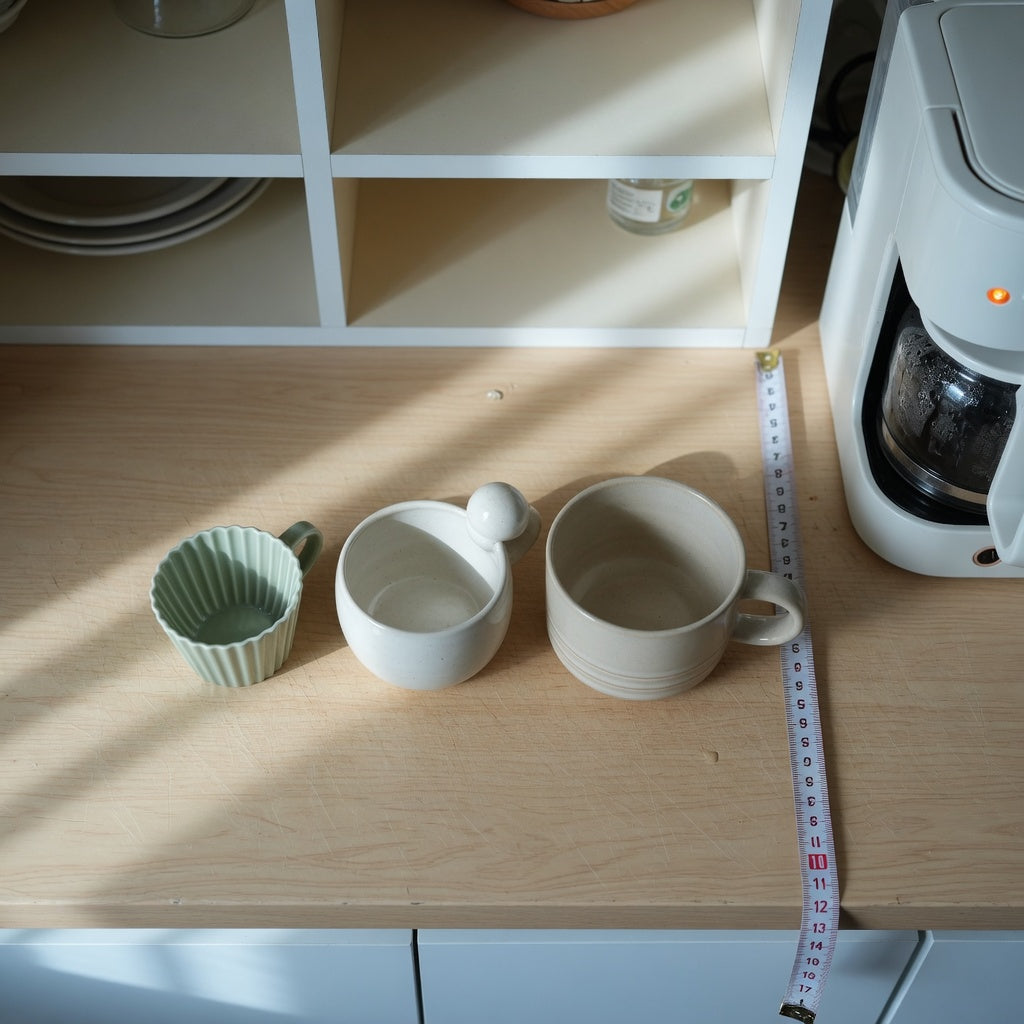
Ceramic Mug Shapes: Compact Kitchen Practical Purchase Checklist
A measurement-first checklist for choosing ceramic mug shapes that clear a shallow shelf and a fixed machine spout, using listed capacity, handle geometry and rim behaviour instead of style claims.
Read more
Leave a comment
This site is protected by hCaptcha and the hCaptcha Privacy Policy and Terms of Service apply.