
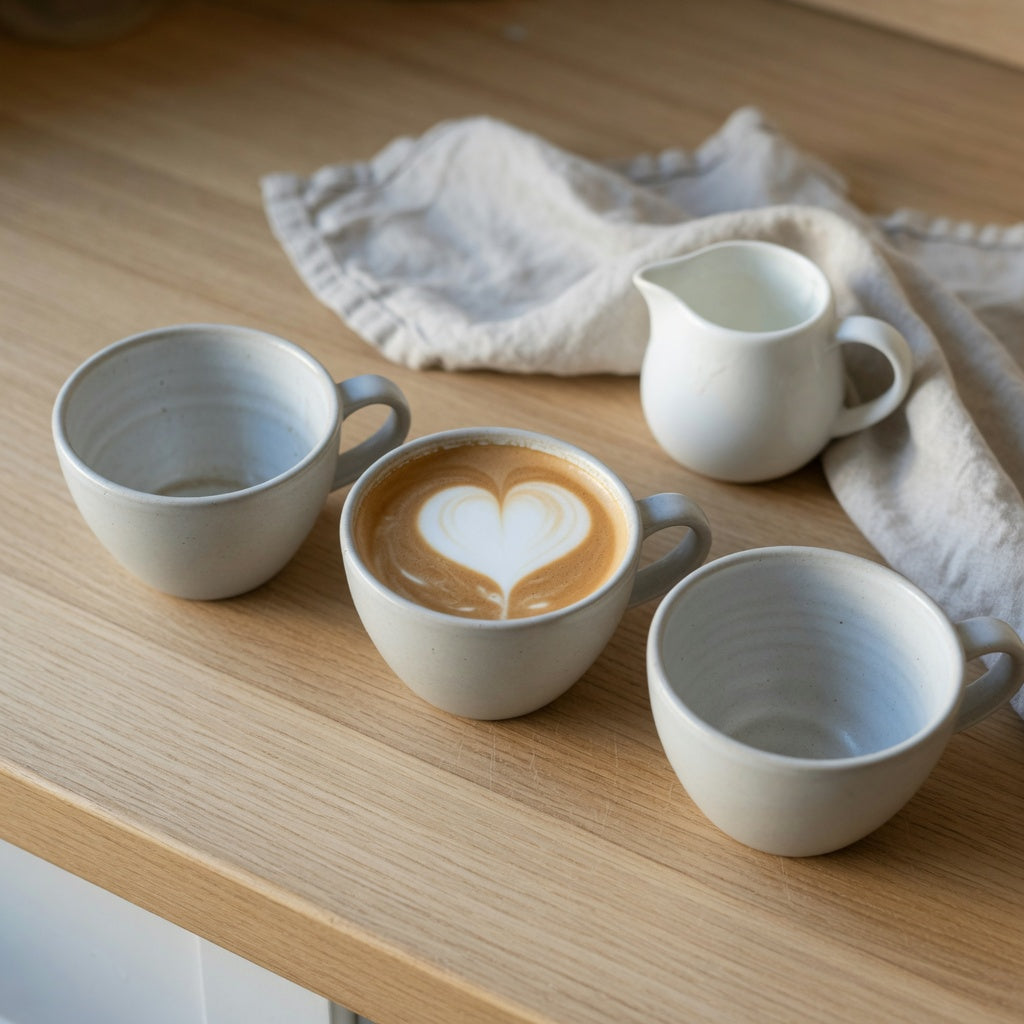
Ceramic Latte Cups Shape and Handle Guide: 250, 400, 440 ml
Reading time: about 9 minutes
Last month a customer sent us a photo of her desk: a latte poured into a cup labeled 10 oz, the foam dome sitting level with the rim, a keyboard roughly one elbow away. The drink was fine. The cup was the wrong shape for the way she actually works. Nearly every question we field about ceramic latte cups comes back to two things you can spot in a listing photo before you order — what the vessel holds once foam goes on top, and whether the handle still behaves when the cup is full and heavy.
So this ceramic latte cups shape and handle guide stays narrow on purpose. We sell three ceramic latte cups, and we would rather you pick the one that matches your morning than buy two and return one. Everything below sticks to what we can point at on a product page: listed capacity in milliliters, vessel silhouette, and handle geometry. Where an answer would need a number we do not have, we name the gap instead of filling it.
What does a listed capacity actually measure?
A capacity figure is closer to a ceiling than a serving size. It is normally measured to the brim, with nothing reserved for a foam head — and nobody fills a latte to a meniscus. Between the foam dome and a fill line you are happy carrying across a room, you lose real volume, and how much depends on your milk texture and your pour speed.
The FDA's ceramicware guidance is worth reading for a different reason. It defines cups and mugs as small ceramic hollowware for hot drinks, normally holding about 240 ml (8 fl oz) and normally made with a handle, and it separates a cup — base plus curved sides — from a mug with cylindrical sides. That is a testing and labeling description, not a rule about your breakfast. No standards body publishes an official ideal latte volume; café practice and buyer guides scatter across roughly 6 to 16 oz.
Two cups carrying identical numbers can still drink differently. A tall narrow body and a short wide one hold similar volume, but the wide one gives up more of it to a shallow fill line and places your nose closer to the crema. That is geometry, not quality.
Ceramic latte cups shape and handle guide: our three current sizes side by side
These are the listed capacities on each product page. The fluid-ounce column is an approximate unit conversion, not a second specification, and we make no claim about how long any cup keeps a drink hot.
| Model | Listed capacity | Approx. US fl oz | Usually suits |
|---|---|---|---|
| Ball Handle | 250 ml | about 8.5 | One classic-size latte, a flat white, or tea; smaller hands and shallow desks |
| The Flow, listed at 400 ml | 400 ml | about 13.5 | A 12 to 14 oz milk drink with surface left over for a pattern |
| Morning and Night | 440 ml | about 15 | The largest fill we carry; a long morning coffee or a big tea |
Read that as a ladder, not a ranking. A 440 ml cup is not a better latte than a 250 ml cup — only a bigger one. Wall thickness, rim width, and base diameter differ across the three, so study the listing photos for silhouette and handle rather than assuming they are scaled copies of one another. If you would rather see the range on a single page, the unique coffee mugs collection lays it out.
Rounded interior or straight wall — which shape helps a pour?
A rounded, bowl-like interior is the shape most baristas reach for once a pattern matters. The curve lets milk sink and fold instead of running up a hard wall, and that interior usually arrives with the wider rim that is the other half of the equation. Straight-sided cups are easier to stack, easier to line up in a row on a shelf, and easier to wrap as a gift; they also feel steadier in the hand because the mass sits in a column rather than spreading outward.
Here is a claim we will not make: that ceramic itself changes how a latte tastes next to glass. That idea circulates through retail copy without a cited study behind it, and we are not going to launder it into a spec sheet. What you can judge from photos is glaze evenness, rim smoothness, and whether the interior wall looks uniformly fired rather than blotchy near the base.
Handle geometry: the part that lets you down once the cup is full
Handles are where latte cups quietly disappoint. A loop that feels fine on an empty 250 ml cup can pinch once that cup is carrying milk and coffee across a room. Before you order, look for three things in the listing photos:
- Opening size. Can a thumb and one finger pass through, or two fingers, or your whole hand?
- Height above the base. Does the handle lift your knuckles clear of the counter when the cup is full, or do they graze it on the way down?
- Where it attaches. A handle that meets the body across a thick shoulder spreads load better than one joined at a thin stress point — the first place a cup chips is often that seam.
The 250 ml Ball Handle cup takes its name from a ball-style handle, so check the listing image for the actual loop opening rather than assuming your grip fits through it. Smaller capacity does mean less mass to support, which is the quiet advantage of the smallest cup in any lineup.
Glaze, lead, and the care line: what to verify before the first wash
This is where vague language costs the most. The FDA's action level for leachable lead in ceramic cups and mugs is 0.5 micrograms per milliliter of leaching solution, applied to any one of six units tested. Cadmium has its own limits: 0.5 micrograms per milliliter for small hollowware and 0.25 for large hollowware. The method the agency's compliance guides reference, ASTM C738, uses acetic-acid extraction and is described as a severe test — harsher than ordinary use.
- Lead-free is a regulated claim, not a marketing mood. Ceramicware that leaches lead above the action level should not carry the label, and the FDA can treat that labeling as misleading.
- Washing does not fix it. The FDA states that washing, boiling, or other consumer processing cannot remove lead from pottery.
- Looks are not proof. Under 21 CFR 109.16, decorative ceramicware that appears suitable for food use is treated as food use unless it carries a conspicuous Not for Food Use warning plus a permanent version on the base.
- Some categories carry more risk — handmade, antique, damaged, flea-market pieces, and bright orange, red, or yellow decoration. Everyday factory-made commercial pottery is described as much less likely to be a problem, which is what a modern café-style cup is.
If an unmarked vintage or handmade cup is in your daily rotation, move it to a shelf. That decision costs nothing.
Care follows the same piece-by-piece logic. The FDA explains that microwaves pass through ceramic and are reflected by metal, which resolves most of the confusion here. Plain glazed ceramic is the kind of material the appliance is built around; a gold rim, metallic luster, or painted trim is metal sitting on the surface. Read the care line on the specific listing rather than letting the word ceramic answer for it. One rule is not piece-specific — retire any cup with a crack, a chip, or a crazed glaze, the fine web of lines that eventually appears across older glazes. A compromised glaze is no longer a clean barrier, and no amount of scrubbing restores it.
Match the cup to your counter: three real buying situations
- You pour one small latte, or you mostly drink tea. The Ball Handle mug lists 250 ml, close to what most cafés pour for a classic latte, and it takes the least counter space of the three. Trade-off: if your normal fill is 12 oz of milk and espresso before foam, this one will feel crowded, and technique will not fix that.
- You pour 12 to 14 oz and want room for a pattern. The Flow lists 400 ml, which leaves surface area after the foam head. Trade-off: a wider rim is a bigger target if you drink at a keyboard, and the body claims more desk than the 250 ml cup does.
- You want one large cup and you top up coffee more often than you pull espresso. Morning and Night lists 440 ml, the biggest fill we carry. Trade-off: filled, it is the heaviest of the three and the most demanding on both handle capacity and cabinet clearance, so measure the spot before you commit.
If none of those three describes your morning, work through the full range of unique coffee mugs instead of forcing a fit.
Five checks before you add to cart
- Measure the liquid volume you actually pour, before foam. That number is your minimum listed capacity.
- Measure the shelf, cabinet, or desk corner the cup will live in — base diameter matters as much as height.
- Zoom the listing photos in on the handle and ask whether your normal grip passes through the opening.
- Find the care line: microwave, dishwasher, metallic trim.
- For a secondhand, handmade, or brightly decorated cup, ask about lead and cadmium test results before it becomes a daily cup.
Frequently asked questions
Is 250 ml too small for a latte?
For a classic small latte, no — 250 ml is roughly 8.5 fl oz and sits near the size most cafés pour for that drink. It is too small if you normally pour 10 oz of milk before foam, because the foam head eats volume you need for the drink itself.
Does the interior shape really change latte art, or is that a myth?
It matters more than handle style. A rounded, bowl-like interior with a reasonably wide rim gives the milk somewhere to fold instead of bouncing straight up a wall, while a narrow straight-sided cup makes a clean pattern harder to place. That is why interior geometry leads this ceramic latte cups shape and handle guide.
Can I microwave a ceramic latte cup with a gold handle?
Keep metallic trim out of the microwave. Microwaves pass through ceramic but are reflected by metal, so gold rims, lusters, and painted trim belong on the shelf when the microwave runs. Plain glazed ceramic is the material the appliance is designed to work with.
Do double-wall ceramic cups leak?
Not by design — the whole point of a double wall is the sealed air gap, and a failure shows up as moisture trapped between the two layers. If a bonded assembly is not for you, choose a single-wall cup and accept the denser feel in the hand. Double-wall is a different product class, not a thicker mug.
Which of your three cups should I start with?
Start from volume, not aesthetics: note what you pour, then take the closest listed capacity above it. See the Ball Handle, The Flow, and Morning and Night together on the collection page before you decide.
More from our blog
Read more

Ceramic Latte Cups Morning Routine Practical Purchase Checklist
A practical checklist for matching 250 ml, 400 ml, and 440 ml ceramic latte cups to your real morning pour, refill tolerance, handle comfort, and counter space. Includes FDA-based glaze and care ch...
Read more
Ceramic Latte Cups for Small Coffee Setup: What to Compare
Counter depth decides which ceramic latte cups for small coffee setup survive daily use. We compare 250, 400, and 440 ml options by pour fit, handle clearance, glaze safety, and care.
Read more
Leave a comment
This site is protected by hCaptcha and the hCaptcha Privacy Policy and Terms of Service apply.