
Ceramic Coffee Mug With Handle: Morning Routine Purchase Checklist
Reading time: about 10 minutes
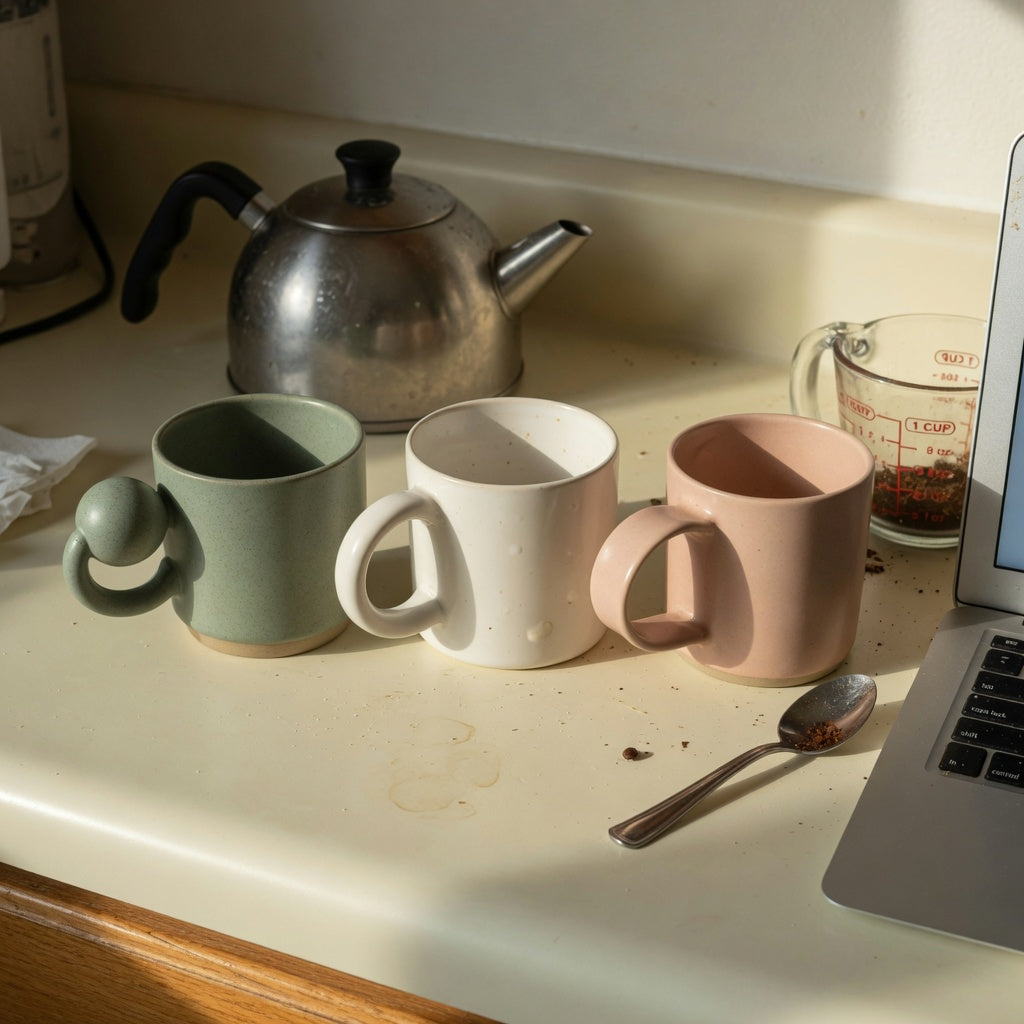
At 6:45 a.m., a mug is competing for space with the kettle, a spoon rest, and the edge of a laptop. It needs to hold the drink you actually make, survive the walk from counter to desk without an overfilled rim, and avoid forcing an unwanted refill during the first meeting. We call the worksheet behind that decision our ceramic coffee mug with handle morning routine practical purchase checklist.
In our store, the fastest buying decisions come from four facts a shopper can verify: the listed ceramic material, the capacity shown on the product page, the visible handle form, and the vessel shape. We do not turn product photos into promises about ergonomic comfort, hand-size fit, strength, heat retention, care ratings, or dishwasher and microwave safety. If a detail is not stated, we treat it as unknown.
Apply the ceramic coffee mug with handle morning routine practical purchase checklist before 8 a.m.
Start with the sequence around the mug, not its color. Note when you pour, where you carry it, how long you normally sip, and when you are willing to refill. A mug that works for a quick drink at the kitchen island may be a poor match for an hour beside a keyboard.
- Quick counter drink: You finish before leaving the kitchen. Capacity still matters, but cabinet clearance and counter footprint may decide between similar options.
- Long desk drink: You carry the mug once and want to avoid interrupting focused work. Compare your full finished drink with the listed capacity, while keeping enough unfilled space for carrying.
- Repeat refiller: You prefer a fresh smaller pour and already expect to return to the kettle or coffee maker. A large vessel may add unused volume and occupy more desk or shelf space than you need.
Write down your refill limit as a number: zero, one, or more than one before your first break. That small detail prevents an attractive mug from becoming the one you leave in the cabinet on busy mornings.
Does the listed capacity cover your finished drink and carrying space?
Measure the beverage after you prepare it normally. For coffee, include milk, cream, or added water. For tea, account for the level you use while steeping and the space needed to remove a tea bag or infuser without pushing liquid over the rim. A marked measuring cup gives you a more useful number than estimating from a mug you already own.
Listed capacity is a volume figure, not an external dimension or a guarantee of a spill-free fill line. Unless a product page explains how capacity was measured, do not assume the stated number represents the amount you would comfortably carry to another room. Leave practical headspace in your comparison.
| Morning pattern | Measure this | Buying consequence |
|---|---|---|
| Black coffee in one pour | The liquid in your usual finished serving | A capacity below that amount means an earlier refill or a smaller first pour. |
| Coffee with milk or cream | The complete drink after additions | Measuring coffee alone can lead you to choose too little listed capacity. |
| Coffee poured over ice | Liquid plus the space displaced by ice | An open ceramic mug may hold the drink, but it adds no lid or insulation claim. |
A larger listed capacity can reduce refills only if it matches the volume you want to drink. It does not establish better heat retention. If you routinely leave part of a large drink unfinished, a smaller planned pour and one acceptable refill may suit your routine better.
Which visible handle form matches the way your mug moves?
When our team handles mugs for merchandising, we look at the handle in profile, the space it adds beside the body, and the two points where it meets the vessel. Those details affect the silhouette and the room the mug occupies. They do not establish comfort for every hand.
- The ball-handle ceramic coffee and tea mug uses a pronounced ball form. It fits shoppers who want the handle to be a visible design feature rather than a conventional loop.
- The round ceramic coffee and tea mug presents a continuous loop and rounded vessel profile. It is the logical first comparison for someone who wants familiar visual proportions.
- The Flow coffee and tea mug shows a smoother transition between the vessel and handle. It suits shoppers who prefer a more continuous body-and-handle line.
Use side-view product images to identify those forms, then look for listed dimensions if finger clearance or handle projection is critical. A styled photograph can show shape, but it cannot prove how a handle fits a small or large hand. If exact fit is a non-negotiable requirement and no measurements are supplied, choose a product with documented dimensions or test the mug in person.
Will the vessel shape fit the counter, desk, cabinet, and coaster?
A morning mug rarely occupies an empty surface. It may sit beside a coffee maker, toast plate, notebook, monitor stand, or phone cable. Vessel shape determines how it shares that space, while the handle adds width beyond the ceramic body.
- Base footprint: Check whether the visible foot or base is likely to sit fully on the coaster or tray you use.
- Overall height: Compare any listed height with the shelf opening in your cabinet and the clearance beneath your coffee machine.
- Handle projection: Leave room for the handle without pushing the mug against another object or over the edge of a desk.
- Rim and body profile: A rounded, straight-sided, or flowing outline changes how the mug looks and occupies space, but appearance alone does not reveal exact dimensions.
Product photos are useful for comparing proportions across the Ball Handled, Round, and Flow designs. They are not a measuring tool unless the page provides a scale or dimensions. Office users should also remember that these are open ceramic vessels, not sealed travel containers for carrying beside electronics.
Which CoffeifyMug option fits each first-pour scenario?
All three options below are presented as ceramic coffee and tea mugs, show a distinct handle form, and provide a listed capacity to check against your measured drink. The current product page should remain your source of truth for capacity and any stated care information.
| Reader situation | Why it fits the comparison | What still needs verification | Product next step |
|---|---|---|---|
| You want the handle to stand out during a gift unboxing or on an open kitchen shelf. | The spherical ball element is an obvious visual feature. | Listed capacity, exact dimensions, hand fit, and care instructions. | View the Ball Handled Coffee Tea Mug |
| You prefer a familiar loop and rounded mug silhouette for a daily coffee station. | The continuous round handle provides the most conventional visual reference of the three. | Finger clearance, cabinet fit, listed capacity, and appliance guidance. | Compare the Round Coffee Tea Mug |
| You want a smoother visual line from the vessel into the handle. | The Flow design emphasizes that transition rather than a separate ball or classic loop. | Handle dimensions, surface footprint, capacity, and stated care. | Check The Flow Coffee Tea Mug |
| You know your pour volume but none of these three shapes feels settled. | A wider selection lets you keep the same capacity, material, handle, and shape filters while comparing other silhouettes. | Every fact on the individual product page. | Browse unique coffee mugs |
Do not select a product solely because its handle looks distinctive in a front-facing photo. Match the product to a complete situation: your measured drink, accepted number of refills, available surface space, and preference for ball, round, or flowing handle form.
What should you verify before the first drink or wash cycle?
Unboxing is the point where photographs give way to the actual piece. In our experience, bright side lighting makes the rim and handle attachment points easier to inspect than overhead kitchen light alone. This matters for a personal mug and even more for a gift that will be opened later.
- Inspect the rim, foot ring, and both handle attachment points for chips, hairline cracks, sharp burrs, or an interrupted surface finish. Contact our store before use if something appears damaged.
- Place the empty mug on a dry, flat counter and check for unexpected rocking. This verifies how the individual piece meets the surface without making a general stability claim about its shape.
- Read the product page, packaging, and included instructions for care guidance. The word ceramic does not automatically confirm dishwasher or microwave safety.
- Before using any appliance, look for an explicit statement covering that appliance. We do not turn missing care information into permission.
- For a gift, complete the inspection before wrapping and retain the original packaging until you know the piece is acceptable.
The ceramic label confirms the listed material category. It does not, by itself, tell you wall thickness, firing method, impact strength, heat retention, thermal-shock resistance, or a care rating. Those are separate claims and should be treated separately.
When is a handled ceramic mug the wrong morning tool?
- A sealed travel tumbler is a better match if the drink goes into a bag, car cup holder, or long walking commute.
- A product with explicit appliance instructions is the better choice if dishwasher or microwave use is mandatory and the mug page does not confirm it.
- A documented larger-capacity vessel makes more sense if your measured drink exceeds the listed capacity and you refuse morning refills.
- A handle-free cup or bowl suits shoppers who dislike side projection or want a different holding style.
- A product with full dimensions is preferable if cabinet height, coaster diameter, or exact hand clearance leaves no room for uncertainty.
A ceramic mug with a handle is strongest as an open counter, table, or desk vessel. It is not a substitute for a leak-resistant commuter cup, and a distinctive handle shape is not proof of universal ergonomic comfort.
Your 60-second add-to-cart check
Run the ceramic coffee mug with handle morning routine practical purchase checklist once for each product instead of comparing from memory.
- Measure the volume of your finished morning drink.
- Decide how many refills you will tolerate before your first break.
- Compare that drink volume with the capacity stated on the current product page.
- Identify the visible handle as ball, continuous round, or flowing.
- Check the vessel profile, base footprint, handle projection, and any listed dimensions against your counter, desk, coaster, and cabinet.
- Confirm that ceramic is the stated material without inferring strength or heat performance.
- Look for explicit dishwasher, microwave, and other care guidance if those details affect the purchase.
- List any unanswered requirement. If it is essential, resolve it before ordering rather than guessing from a photograph.
For a side-by-side decision, open the CoffeifyMug unique mug collection and compare each candidate using the same four product facts: material, listed capacity, visible handle form, and vessel shape.
Frequently asked questions
How do I use a ceramic coffee mug with handle morning routine practical purchase checklist?
Measure your normal finished drink, write down your refill limit, and compare both with the listed capacity. Then check the visible handle form and vessel shape against your counter, desk, cabinet, and carrying route. Treat comfort, strength, heat retention, and unlisted care details as unknown.
What mug capacity should I choose if I add milk or ice?
Measure the complete drink after adding milk, cream, water, or ice rather than measuring the coffee alone. Compare that amount with the listed capacity and allow unfilled space for carrying. If the page does not define how capacity was measured, do not assume the listed figure is a comfortable fill line.
Does ceramic automatically mean a mug is dishwasher and microwave safe?
No. Ceramic identifies the material category, not an appliance rating. Check the individual product page, packaging, or included care instructions for an explicit statement before using a dishwasher or microwave.
Is a ball, round, or flow handle better for small hands?
No visible handle form guarantees fit for a particular hand size. Product photos can establish whether the form is ball-shaped, a continuous loop, or a flowing transition, but exact clearance requires dimensions or direct handling. Choose a documented option if hand fit is essential.
Which CoffeifyMug should I compare first for a morning routine?
Start with the Ball Handled mug if the spherical handle is the main visual draw. Compare the Round mug for a continuous loop, or The Flow mug for a smoother body-to-handle line. Verify the listed capacity and remaining unknowns on each page. Then use the unique coffee mugs collection to compare additional shapes with the same checklist.
More from our blog
Read more
White and Gold Coffee Mug Morning Routine Practical Purchase Checklist
Measure your normal pour, account for milk, foam, tea tools, or ice, and decide how many refills you will tolerate. This checklist compares the current listings by stated capacity and visible form ...
Read more
Geometric Coffee Mug Morning Routine Product Shortlist Guide: 3 Picks
Measure your usual morning pour, decide how many refills you will tolerate, and compare three ceramic mugs by visible shape, listed capacity, storage fit, and care needs.
Read more
Leave a comment
This site is protected by hCaptcha and the hCaptcha Privacy Policy and Terms of Service apply.