
Big Latte Mug Home Coffee Station Practical Purchase Checklist
Reading time: about 10 minutes
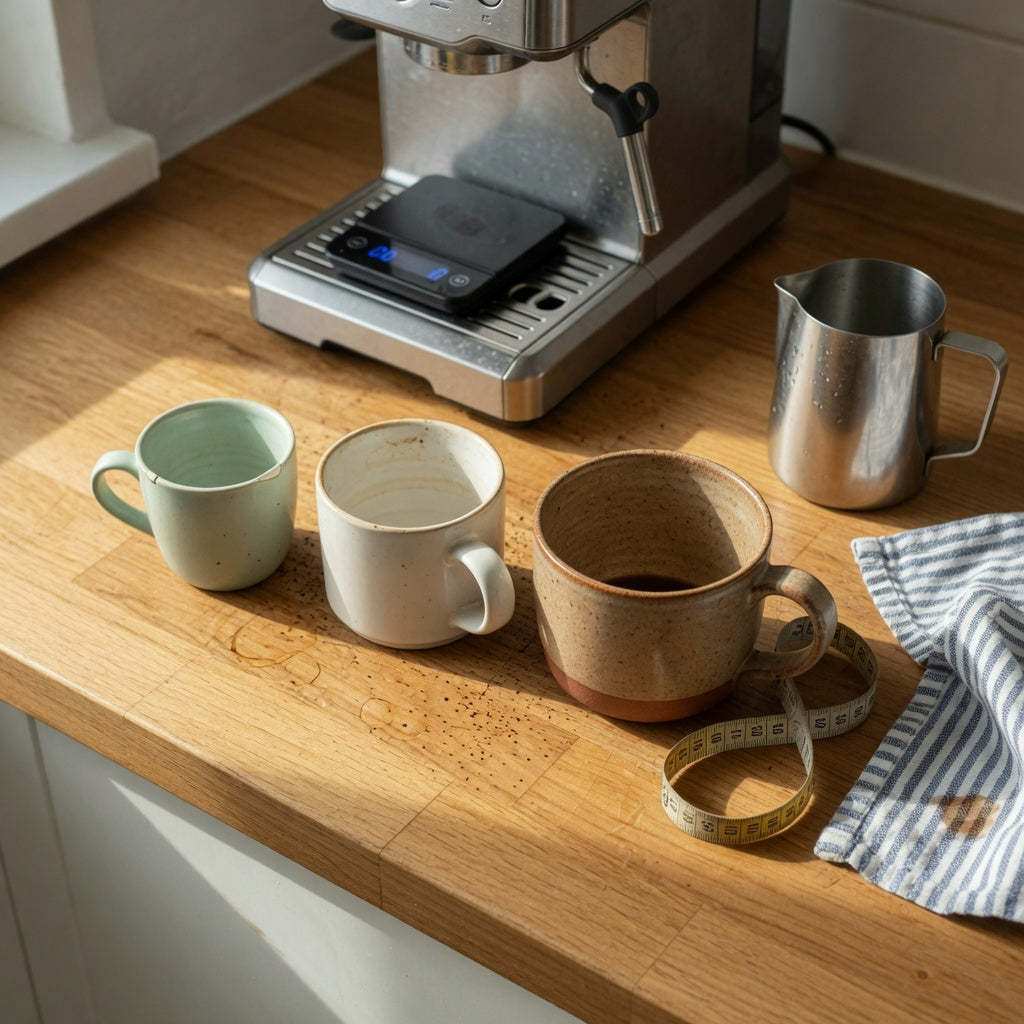
A customer emailed us a photo of her drip tray last month. She had bought a 480 ml mug, set it under the group head, and found it cleared the shower screen by a sliver with an empty tray — and not at all once her scale was sitting on it. The mug was perfectly good. The setup wasn't.
That gap is why we walk buyers through a big latte mug home coffee station practical purchase checklist that puts capacity fourth or fifth, not first. Volume is the easiest number to read off a listing and the least likely to ruin your morning. Clearance, finger room and the fill level you genuinely pour decide whether a mug earns permanent counter space.
What do 400, 440 and 480 ml actually pour into a latte?
Every capacity we list is a vessel measurement, not a promise about how much milk drink you get. Fill any mug to the rim and you cannot carry it. Milk foams up, a cap of microfoam sits on top, and the surface needs to sit below the lip so the pour does not slosh over your knuckles on the walk to the desk.
| Mug | Listed capacity | Approximate US fluid ounces |
|---|---|---|
| The Flow | 400 ml | ≈ 13.5 fl oz |
| Morning and Night | 440 ml | ≈ 14.9 fl oz |
| The Rock | 480 ml | ≈ 16.2 fl oz |
Do the conversion once with the figures NIST publishes and the rounding stops being mysterious. NIST lists one US fluid ounce as 29.57353 ml, and its packaging table gives 8 fl oz as 236.588 ml and 16 fl oz as 473.176 ml. That last figure is instructive: a mug sold as 16 oz and one listed at 480 ml are close, but they are not the same vessel. 480 ml works out to roughly 16.2 fl oz, so the two numbers were rounded at different stages and a shopper comparing them is comparing labels, not volumes.
For a sense of scale, the FDA compliance guide for ceramic hollowware describes cups and mugs as small ceramic hollowware normally holding about 240 ml, or 8 fl oz, with small hollowware running up to 1.1 litres. All three of our sizes sit near double that reference point, which is why the phrase big latte mug covers everything from a 300 ml café cup to a 600 ml novelty mug.
Do not estimate the headroom. Fill the mug you use now to the level you genuinely fill it, tip that water into a measuring jug, and write the number down. If it reads 320 ml, a 400 ml mug leaves you a working gap and a 480 ml mug leaves a lot of empty air above the foam.
The big latte mug home coffee station practical purchase checklist we run in-store
Work down this list in order. The first three checks eliminate more mugs than any style preference, and none of them require you to trust a product photo.
- Measure your real pour. Water in the old mug, then into a jug. Whatever that number is, the new mug's listed capacity has to clear it with visible room to spare. This one step prevents most it looked bigger online returns.
- Clear the group head with the scale in place. Measure from the drip tray surface to the underside of the group head while your scale sits where it sits when you brew. Then compare that against the height stated on the product page. If height is not shown, ask us and we will measure the unit rather than guess from a photo.
- Check the shelf gap, cupboard door open. If mugs live under a wall cabinet, measure the gap with the door swung open. If you reheat, measure the microwave interior with the turntable fitted — a tall mug can foul the ceiling even when the body handles heat fine.
- Look at the handle opening, not the handle. A description that says large handle tells you nothing measurable. You want an opening that takes two or three fingers plus your thumb, and enough height that your knuckles clear the body when the mug tips toward your mouth.
- Read the care line and the food-contact wording. Dishwasher and microwave statements belong on the individual listing. If the wording is vague or missing, that is a question for us, not something to assume from a similar-looking mug.
Wide bowl or tall body — which shape makes the latte you actually order?
Specialty coffee tends to treat a latte cup as something near 300–355 ml, wide and fairly shallow, because a broad surface gives a milk pitcher room to draw. Our sizes sit above that band, so the shape question becomes about the drink in front of you rather than a rule borrowed from a café.
A wide, open mug is the friendlier canvas for latte art: the pitcher has space to move and the foam spreads instead of stacking. It also exposes more liquid to air, which matters if you nurse a drink for 45 minutes — a wide mug at half full sheds heat faster than a tall one. That is surface area, not a lab result, but it is predictable enough to plan around.
A taller, straighter body is easier to build a long drink in. Ice, cold milk and espresso stack rather than spread, and the mug reads as a desk mug rather than a cup and saucer. The trade-off is that tall bodies are the ones that collide with cabinet shelves and group heads first.
Then there is the ratio nobody warns you about. A bigger mug does not give you more coffee — it gives you more milk. Move from a small cup to a 480 ml mug on a single shot and you have made a milk drink with a coffee memory. Match the mug to your shot count first and let the drink size follow.
Can you carry it one-handed when it is full?
480 ml of liquid weighs roughly half a kilogram before the mug's own weight is added. That is the load your wrist takes at 7 a.m., and it is why a mug that feels lovely empty can feel like a mistake by the second sip.
- Lift the empty mug by the handle using only two fingers. If they slide or the mug rotates, the opening is generous enough for decoration only.
- Fill it, hold it over the sink, and carry it across the kitchen the way you actually walk — not with a second hand under the base.
In our experience the most common fit complaint is not weight at all; it is a handle opening that only takes two fingers because the design spent its space on the outer scroll. Slot handles look sharp and pinch; round loops are more forgiving for big hands and for anyone carrying a full mug up stairs.
Where The Flow, Morning and Night and The Rock land on a real counter
We list three capacities — 400 ml, 440 ml and 480 ml — and those are the only specifications we would ask you to take from this article. Dimensions, weight, finish and care instructions belong on the individual product page, and if something you need is not shown there, message us and we will check the unit in stock.
- The Flow, 400 ml (≈ 13.5 fl oz) is the one for a shallow counter, a cabinet that hangs low over the machine, or a drinker who pulls one or two shots and wants the milk to stay in proportion. It is the smallest listed capacity of the three, so it is also the easiest to clear under a group head with a scale in place. It is not the right pick if you routinely build a tall iced latte over a full glass of ice.
- Morning and Night, 440 ml (≈ 14.9 fl oz) suits the middle ground most home setups land in: a double shot with milk and a foam cap, with room left for the pour. It is the size we suggest for a mug doing double duty — latte in the morning, tea at night — because it is generous without demanding extra shelf height. Study the handle photo closely at this size; mid-range mugs vary most in how much finger room the opening actually gives.
- The Rock, 480 ml (≈ 16.2 fl oz) is built for long drinks, iced lattes and bigger hands. It carries the largest listed capacity, which makes it the one to measure for shelf gap, group-head clearance and cup-holder diameter before you commit. Bigger is not better here — it is a different job, and it will make a single-shot drink taste thin.
Still torn between silhouettes? Browse the collection of unique coffee mugs and compare mouth width and handle style side by side instead of opening one product page at a time.
Do dishwasher safe, microwave safe and lead-free labels mean what shoppers think?
A microwave-safe label is about the body and glaze surviving heat. It is not a promise that the handle stays cool — assume it will not, and use a cloth. Dishwasher results depend on glaze durability and on loading: a heavy mug braced against a thin-rimmed one chips the thin one, and a crowded rack does more damage than any cycle setting.
On food contact, the FDA compliance guide for ceramic hollowware sets a lead action level of 0.5 micrograms per millilitre of leaching solution, applied to any one of six units tested. Read that carefully: it describes a leach test on finished ware, not an ingredient list. The same guidance notes that some ceramic foodware can leach lead from food-contact surfaces. So when a listing says lead-free, the fair follow-up is whether that means a tested result or a formulation claim — particularly for a mug you will use twice a day. We would rather answer that directly than have you assume it.
Frequently asked questions
What is the most common mistake on a big latte mug home coffee station practical purchase checklist?
Buying on capacity alone. Shoppers compare the listed millilitres to their old mug and skip the group-head measurement, the handle opening and the care line — the three things that actually decide whether the mug gets used every day.
Will a 480 ml mug fit under my espresso machine?
Only your own measurement settles it. Put your scale on the drip tray, measure from the tray surface to the underside of the group head, and compare that to the mug's height rather than its capacity. A tall mug plus a scale is the clearance failure we hear about most.
How many ounces is a 400 ml latte mug?
About 13.5 US fluid ounces, using the NIST figure of 29.57353 ml per fluid ounce. That is a realistic double-shot latte size for most home setups, with enough headroom left for a foam cap.
Is a big latte mug good for latte art?
A wide mouth helps because the pitcher has room to move, but an oversized mug paired with a small milk pour produces thin, wobbly art. Match the pitcher to the cup: pouring into 400 ml is far easier with a small pitcher than a large one.
Do I need a double shot for the largest size?
If you want to taste coffee rather than milk, yes. The same single shot spread through 480 ml reads weak, while a double shot holds its own. Single-shot drinkers are usually happier starting at 400 ml.
If you take one thing from this page, take the tape measure: tray to group head, shelf to shelf, and the handle opening against your own hand. Then match capacity to the shot you pull most often. You can browse all three sizes in one place, and if a dimension is missing from a listing, ask us before you order — we would rather measure a mug than process a return.
More from our blog
Read more

Ceramic Mug Shapes Replacement Purchase Product Shortlist Guide
A complaint-first shortlist for replacing a mug: name what the old one got wrong, match it to a silhouette, then confirm capacity and handle clearance. Three specific pieces, each with a clear reas...
Read more
Big Latte Mug Home Coffee Station Product Shortlist Guide: 3 Picks
A big latte mug is not one product. We map three listed capacities — 400, 440 and 480 ml — to the drink you make, the clearance you actually have, and how the mug feels in one hand, with reasons to...
Read more
Leave a comment
This site is protected by hCaptcha and the hCaptcha Privacy Policy and Terms of Service apply.