
Matcha Latte Mug Home Coffee Station Practical Purchase Checklist
Reading time: about 8 minutes
The kettle, milk pitcher, matcha tin, and scale can leave only one clear landing spot on a kitchen counter. A mug may hold your drink yet still be the wrong purchase if its listed capacity is too close to your recipe volume or its outside dimensions are unknown. The matcha latte mug home coffee station practical purchase checklist below separates the facts we can verify from the details a shopper still needs to confirm.
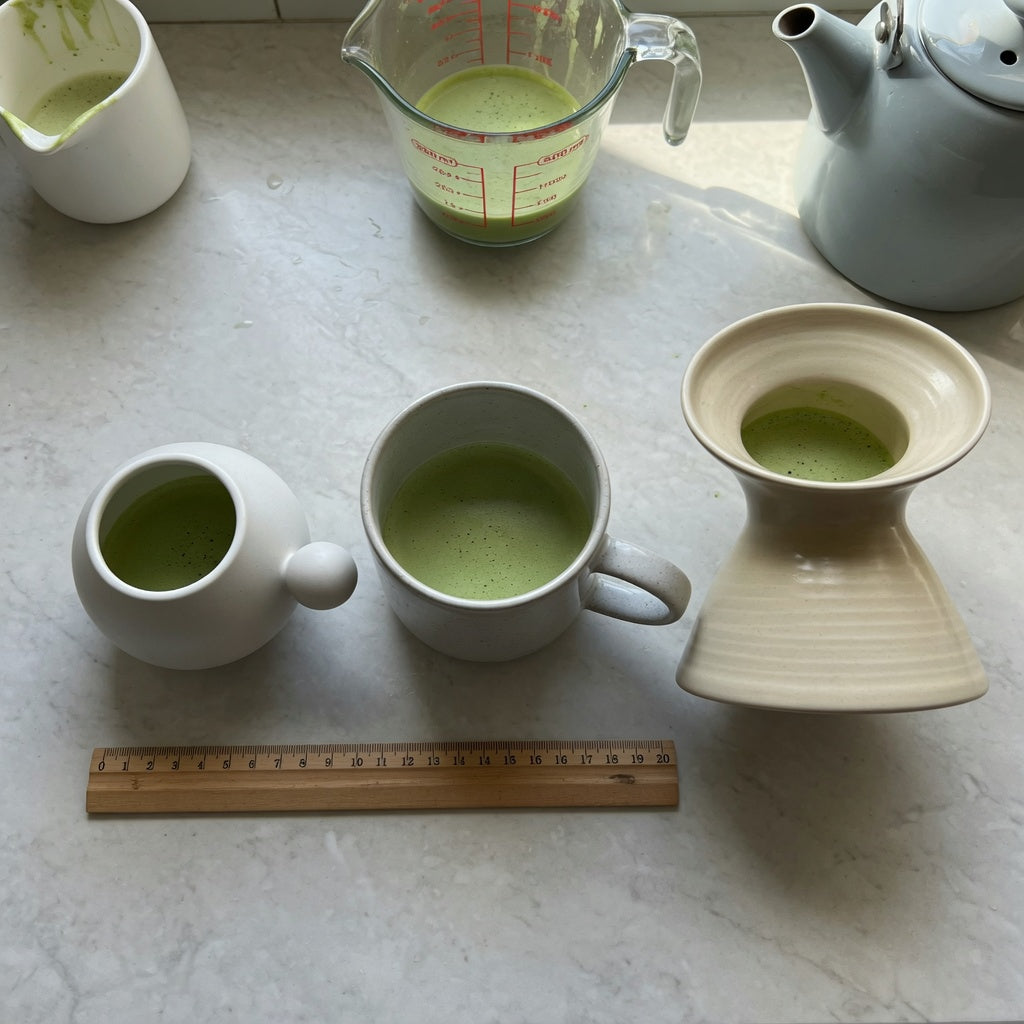
Because we sell these three options in our store, we do not treat a product photo as a performance test. Our verified comparison covers the Ball Handle mug at 250 ml with a listed 11.2 cm diameter, the Round mug at 390 ml, the Spittoon mug at 400 ml, and the opening shapes visible in their current product photography. We make no assumptions about material, whisking performance, heat retention, ceremonial authenticity, included tools, or appliance-safe care.
Use the matcha latte mug home coffee station practical purchase checklist before checkout
Start with your own drink and counter rather than choosing the largest capacity by reflex:
- Measure the finished recipe. Record the combined matcha and milk volume in milliliters. For an iced drink, leave additional room for the ice you normally add.
- Choose comfortable headroom. Do not match a recipe exactly to a listed capacity unless the listing explains how that capacity was measured.
- Measure the station. Note the available width, depth, and height with the kettle and other equipment in their normal positions.
- Write down care requirements. If dishwasher or microwave use is essential, confirm that guidance before ordering.
- Check the opening evidence. Compare the visible shape, then request an exact internal opening measurement if a particular whisk, spoon, or frother must fit.
This process exposes unknowns early. Capacity does not establish external footprint, handle clearance, usable fill level, or compatibility with equipment already on the counter.
250 ml, 390 ml, or 400 ml: which listed capacity fits your recipe?
The three capacities create two distinct groups: one compact-volume option and two larger options separated by only 10 ml. That difference matters more than a vague small, medium, or large label.
| Product | Listed capacity | Published or visible comparison | Practical decision cue |
|---|---|---|---|
| Ball Handle coffee and tea mug | 250 ml | 11.2 cm listed diameter and a circular opening shown in photos | Your finished recipe sits comfortably below 250 ml |
| Round coffee and tea mug | 390 ml | Rounded opening visible in listing photography | You need more listed capacity than the 250 ml option |
| Spittoon coffee and tea mug | 400 ml | Flared-looking, spittoon-style opening visible in listing photography | You want the largest listed capacity of the three |
We have not established whether each capacity is measured to the brim or to a recommended fill level. Leave the amount of headroom that suits how you carry and serve a latte rather than assuming every listed milliliter is comfortable working volume.
If your measured drink is comfortably below 250 ml, the Ball Handle mug is the first product to inspect. Its reason for making the shortlist is specific: you do not need to buy 390 ml or 400 ml of listed volume for a smaller recipe. It is not a sound choice for a drink that approaches or exceeds 250 ml, and its listed diameter does not reveal total width including the handle.
If your recipe needs more than the Ball Handle option can provide but sits comfortably below 390 ml, review the Round mug next. It offers 140 ml more listed capacity than the Ball Handle. Confirm its outside dimensions and care guidance on the current listing before treating it as a fit for a tight counter.
The Spittoon mug is the relevant next step when 400 ml is the better capacity target and you prefer the flared-looking profile shown in its photos. Its listed capacity is only 10 ml above the Round mug, so that small numerical difference is a weak reason to choose it by itself. Let the visible opening style and confirmed external measurements settle that comparison.
What can the visible opening shape actually tell you?
A top-view product photo can show whether an opening looks circular, rounded, or flared. It can help you choose the visual profile you want at a coffee station. It cannot prove that one mug whisks faster, catches a milk stream more reliably, or spills less than another.
- The Ball Handle mug provides one additional numeric reference: a listed diameter of 11.2 cm. Unless the current listing identifies that figure as the internal opening, do not assume that is what it measures.
- The Round mug's photography provides a visible shape comparison, but the facts supplied for this article do not establish a numeric opening diameter.
- The Spittoon mug shows a more flared-looking profile, but appearance alone does not establish usable internal width or whisk clearance.
In our product comparisons, we call this photo evidence rather than performance evidence. If your routine depends on a particular tool entering the mug, compare that tool's widest working point with a confirmed internal opening measurement before buying.
Counter width, handle clearance, and shelf height need separate checks
Listed capacity describes volume, not the space a mug occupies. A 250 ml mug is not automatically the narrowest option once its handle is included, and a 400 ml mug is not automatically the tallest. For a station beside a kettle, below a cabinet, or on a narrow cart, record three maximums:
- Overall side-to-side width, including the handle
- Front-to-back depth or widest body diameter
- Total height and the clearance needed to lift the mug from its spot
Use your current mug to identify dimensions that already work, then compare those numbers with confirmed product measurements. If your station has very tight clearance and the required dimensions are unavailable, none of these mugs is a responsible recommendation yet. Ask for the missing measurements rather than using capacity as a footprint estimate.
Which material and care details must be confirmed separately?
Material and care requirements affect daily ownership, but they are not established by the verified facts used here. We will not infer them from color, surface appearance, or product shape. The point of this matcha latte mug home coffee station practical purchase checklist is to mark those details as unknown until you verify them.
- Confirm the exact material and finish stated on the current product page or packaging.
- Look for explicit microwave and dishwasher guidance. Do not put a mug through a dishwasher cycle based on appearance alone.
- Read any first-use, washing, and temperature-change instructions supplied with the item.
- Check the listing contents if an included spoon, whisk, lid, or other accessory affects your decision.
- Review the current returns and damage process before ordering a gift.
For gift unboxings, inspect the delivered mug in good light before wrapping it. Confirm that the correct item arrived, check the rim, body, base, and handle area for visible transit damage, and keep the packaging until the inspection is complete. A shopper who requires verified dishwasher use, microwave use, heat retention, or ceremonial matcha credentials should not select any of the three from this comparison alone.
Frequently asked questions
What belongs on a matcha latte mug home coffee station practical purchase checklist?
Record your finished drink volume, preferred headroom, available counter dimensions, required care method, and preferred visible opening shape. Match those notes to the published 250 ml, 390 ml, and 400 ml capacities. Confirm any missing dimensions or care instructions before ordering.
Is a 250 ml mug large enough for a matcha latte?
A 250 ml listed capacity can suit a finished recipe that sits comfortably below that figure. We have not verified whether the Ball Handle mug's capacity represents a brim-full measurement, so a recipe totaling exactly 250 ml is not a reliable match. Measure your usual drink and allow the headroom you prefer.
What is the capacity difference between the Round and Spittoon mugs?
The Round mug is listed at 390 ml and the Spittoon mug at 400 ml, a difference of 10 ml. That narrow gap makes visible opening style and confirmed outside dimensions more useful deciding factors than capacity alone. Neither capacity proves better mixing or pouring performance.
Are these matcha latte mugs dishwasher-safe or microwave-safe?
This article does not make either claim because the verified comparison facts do not establish appliance-safe care. Check the current product page and the instructions supplied with the mug. If the guidance is absent, ask before placing the mug in a dishwasher or microwave.
Does the Spittoon mug's flared-looking opening make whisking easier?
We do not claim that it does. The product photography supports a comparison of visible opening shape, not a conclusion about whisking performance. Confirm internal dimensions if tool clearance is central to your purchase.
Take your measurements to the product shortlist
Write down five facts: recipe volume, preferred headroom, maximum station width, maximum station height, and non-negotiable care needs. Start with the 250 ml Ball Handle listing for a drink comfortably below that capacity; compare the 390 ml Round and 400 ml Spittoon listings for a larger recipe. Then review our unique coffee mugs collection with those notes beside you, and pause on any option whose dimensions or care guidance still needs confirmation.
More from our blog
Read more
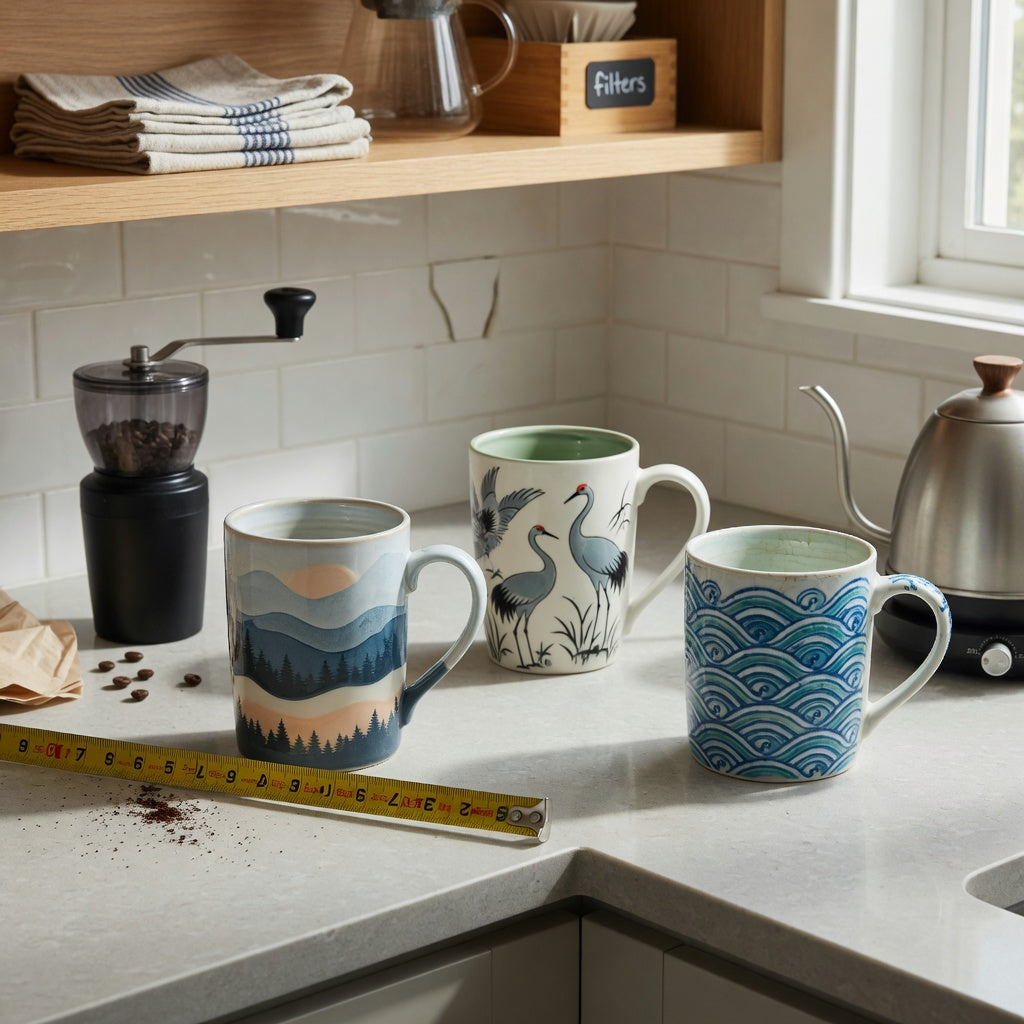
High Quality Ceramic Coffee Mugs: Home Station Purchase Checklist
Measure the mug parking space, inspect glaze and handle details, and confirm care instructions before buying. This checklist maps three CoffeifyMug designs to compact counters, taller storage, disp...
Read more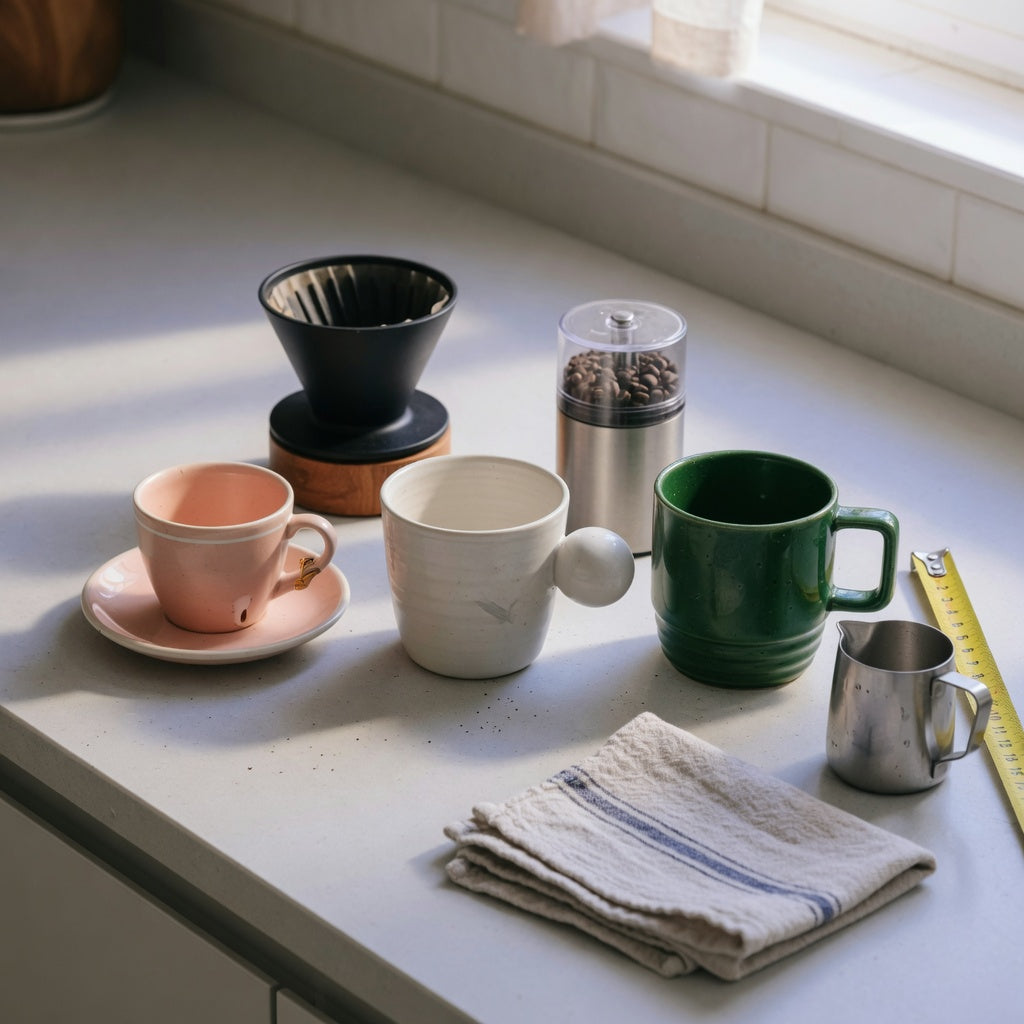
Piccolo Cup Home Coffee Station Product Shortlist Guide: 3 Sizes
Compare three verified capacities for a compact coffee station: Retro 170 ml, Ball Handle 250 ml, and Emerald 270 ml. Each pick includes the routine it suits, reasons to skip it, and fit and care c...
Read more
Leave a comment
This site is protected by hCaptcha and the hCaptcha Privacy Policy and Terms of Service apply.