

Ceramic Mug Shapes Replacement Purchase Product Shortlist Guide
Reading time: about 11 minutes
The mug beside your sink has a chip on the rim, and you are one click away from replacing it with something that will annoy you in exactly the same way. That is the pattern we see most weeks in our store: a shopper compares ceramic mug shapes from product photos, picks the one that photographs best, then rediscovers the original complaint three weeks later — a rim that dribbles, a handle that fits two fingers, a body so wide that a 150 ml flat white reads as half-empty. This ceramic mug shapes replacement purchase product shortlist guide works backwards from the failure instead. Name what broke, match it to a silhouette, then confirm capacity and handle clearance before you pay.
It is a shorter process than a full buying guide, and a more useful one. You are not choosing from every mug on the market. You are choosing from the handful of forms that fix the specific thing your last mug got wrong.
What did the mug you are replacing actually fail at?
Write the failure in one sentence before you compare anything. Most shoppers skip this step, which is why replacement mugs reproduce the same irritation.
- It dribbles. Liquid tracks down the outside after every sip. That is a rim problem — thickness, and whether there is a defined lip — more than a body problem.
- It goes cold before you finish. Usually thin walls, a wide open top, and more liquid than you drink in one sitting.
- The handle pinches. Two fingers where three should fit. Opening size and wall-to-handle clearance matter more than handle style.
- It swallows the drink. A big body under a small pour looks empty and cools faster because of the headspace above it.
- It will not stack or store. A wide-set handle and a flared rim fight every shelf and cupboard.
- It is hard to clean. Sharp interior corners, deep facets and sculpted feet trap coffee oils and milk residue.
One vocabulary point that shows up in listings and confuses people. FDA guidance on ceramic hollowware describes cups as normally having a base and curved sides, and mugs as having cylindrical sides, with a typical capacity of about 240 ml (8 fl oz) — a norm, not a rule. Cup versus mug is therefore a shape distinction, not a size one. If you are replacing a straight-sided mug, a curved latte cup is a different animal even when the volumes match.
Which silhouette answers each complaint on your list?
Four families cover most of what sits on a shelf. We are comparing visible profile and handle geometry here — not the claim that a given shape makes coffee sweeter or less acidic, which sellers repeat widely but the authoritative sources we reviewed do not establish.
Straight-sided cylinders
Vertical walls, even diameter top to bottom, usually a C-handle. They stack predictably, clear most machine spouts, and the interior is a plain cylinder, so a sponge reaches the base without corners. Choose one when the old problem was cleaning, storage or a tippy feel. Skip it if you want a broad surface for milk art; a vertical wall gives you a small canvas.
Belly and barrel bodies
A belly bulges at the middle and narrows toward the rim; a barrel is more evenly rounded. Both put volume low, which changes how the mug balances in your hand when it is full. Choose one for hand-wrapping comfort or if the old mug felt unstable. Skip it if cabinet space is tight, and think twice if your complaint was a dribbling rim, since a narrowing top concentrates the pour.
Tapered and flared forms
Wide at the rim with a narrower base, or the reverse. A flared rim gives your lower lip somewhere to sit and gives milk a broader surface to work on. Good for milk drinks you sip slowly. Poor for tea you nurse for twenty minutes, because a wide opening sheds heat, and awkward on a crowded shelf.
Handleless cups
The yunomi-style form. Comfortable for tea and for small volumes you finish quickly. Not comfortable with a freshly boiled drink, and awkward to carry one-handed across a room. Choose it for a tea station where the cup stays put; skip it if you drink at a desk and move the mug constantly.
The ceramic mug shapes replacement purchase product shortlist guide at a glance
Three pieces from our own range, matched to complaints rather than to photographs. Capacities are the listed ones on each product page — we are not padding the numbers.
| Piece | Listed capacity | Shape and handle | Best for | Skip if |
|---|---|---|---|---|
| Pleated Coffee and Tea Cup | 200 ml | Pleated body with vertical ridges | Small milk drinks, tea, a cup that reads as a cup | Your usual pour is a large office coffee |
| Ball Handled Coffee and Tea Mug | 250 ml | Rounded body, ball-style handle | Everyday coffee when a C-handle pinches | You nest mugs tightly in a low cabinet |
| The Flow Coffee and Tea Mug | 400 ml | Largest of the three | Lattes, iced coffee, long desk sessions | You drink 150 ml at a time |
If the complaint is a mug that swallows a small drink, the Pleated Coffee and Tea Cup is listed at 200 ml. That lands in the band where a cappuccino or flat white looks like a full cup instead of a puddle. The pleated body adds vertical ridges that sit pleasantly in the hand, and each ridge is a place where foam and coffee oils collect, so rinse it rather than leaving it in the sink overnight.
If the complaint is handle comfort, the Ball Handled Coffee and Tea Mug is listed at 250 ml with a ball-style handle. That geometry changes where your fingers rest: instead of hooking through a C, your hand closes around a rounded grip. Whether it suits your hand depends on the opening size and the clearance between handle and body — confirm both on the current listing before you buy. Skip it if you nest mugs tightly; a projecting handle is the first thing to catch on a shelf edge.
If the complaint is capacity, The Flow Coffee and Tea Mug is listed at 400 ml. That covers a latte, an iced coffee with room for ice, or a long working session. It is the wrong pick for a cortado: the fill line sits low, and the headspace above the drink speeds cooling. Skip it if most of your pours are espresso-sized.
Once you know which of those three complaints is yours, the rest of the range is easier to read in the unique coffee mugs collection — filter by capacity first, style second.
Handle geometry: how much finger room do you actually have?
Body shape gets the attention. Handle geometry decides whether you reach for the mug on a Tuesday morning. Three things to check before you commit.
- Finger room. Relax your hand into a loose claw. On a mug you intend to use daily, the grip should close without your knuckles pressing into the body.
- Wall-to-handle clearance. A thick body with the handle set close to it traps knuckles. Thin walls forgive a tight handle; thick ones do not.
- Balance point when full. A 400 ml mug with a high-set handle feels heavier than the same mug with the handle at mid-height, because the load hangs below your grip instead of beside it.
None of that is printed on most listings. Measure a mug you already like and use those numbers as your reference, or ask us before you order — it is the question we answer most often.
200 ml, 250 ml and 400 ml against what you actually pour
Metric labelling and US pouring habits do not line up, and that mismatch causes more disappointing purchases than silhouette does. NIST gives an approximate conversion of 1 fluid ounce = 29.57 ml, with a household cup treated as 240 ml. So:
- 200 ml is roughly 6.8 fl oz — a small mug, closer to a generous teacup
- 250 ml is roughly 8.5 fl oz — just above the familiar 240 ml mug
- 400 ml is roughly 13.5 fl oz — travel-mug volume in a ceramic body
Then match the number to the drink. Espresso is served small, often well under 100 ml. Milk drinks — cappuccino, flat white, latte — commonly land in the 150 to 240 ml band in cafés, where the milk-to-foam ratio does more differentiating than volume. A 200 ml body flatters a flat white. A 400 ml body flatters a latte or an iced drink. A 250 ml body sits between them and is the safer everyday size if your pours vary.
One honest caveat: if you sip tea slowly over an hour, no silhouette here solves heat loss, because the open top is where most of it escapes. A smaller body and a narrower opening slow it down; a lid does more. That is a different product category, and we will say so rather than sell you a shape that cannot fix it.
Will it stack, clear the spout and rinse clean?
Three practical checks eliminate options fast, and they are worth doing before you fall for a silhouette.
- Stacking. Cylinders stack. Bellies and flared rims do not, and a tall handle stops them nesting. In a one-shelf cabinet this decides the purchase on its own.
- Machine clearance. Measure from the drip tray to the spout on your espresso machine, then add the mug height plus a finger of slack. A 400 ml body is often taller than the clearance under a compact machine.
- Cleaning. Look inside the mug, not at it. Rounded interior transitions rinse clean; sharp corners at the base, deep pleats and sculpted feet hold residue. Rinse milk out before loading a dishwasher, since heat sets it, and read the care line on the listing before the first wash rather than after.
Does a sculpted or faceted shape make a mug less safe to drink from?
Buyers ask us whether a heavily contoured or decorative mug is safe for hot drinks. Shape is not the variable. The glaze, and how it was fired, is.
FDA guidance for ceramic cups and mugs used with food sets a lead guideline of 0.5 micrograms per millilitre of leaching solution in any one of six units tested, and cites ASTM C738 among the accepted examination methods. That ASTM method uses an acetic-acid extraction which its own description calls a severe test, unlikely to be matched in ordinary use. FDA also states that improperly fired glaze can leach lead into food or drink, and that there is no known safe level of lead exposure, with developing fetuses, infants and children particularly vulnerable.
What that means at checkout: a piece sold as decorative may not be intended for hot drinks, and handmade is not a safety claim either way. If a listing does not say food use and does not mention testing, ask before you buy. We would rather answer that question than have you assume.
Frequently asked questions
Is 400 ml too big for a latte?
No — a latte is the drink a 400 ml body suits best, especially with ice or when you want room to carry it without sloshing. It is too big for a cappuccino or flat white, which typically sit around 150 to 240 ml.
Do I need a wide bowl-shaped cup to pour latte art?
A wider, shallower opening gives the milk more surface and makes patterns easier. A straight-sided mug still works for a simple heart or rosetta; you just have less room before the design runs into the wall.
Does the mug shape keep coffee hotter?
Silhouette alone is not a reliable ranking. What actually matters is open surface area, wall thickness and the empty headspace above the drink. A narrow opening and a smaller fill slow heat loss more than any particular named profile.
How many fingers should fit through a mug handle?
Enough that your grip closes without knuckles pressing the body — for most adults, that means the whole hand fits comfortably. Confirm clearance on thick-walled or ball-handled designs instead of assuming, because that is where pinching shows up.
When does this ceramic mug shapes replacement purchase product shortlist guide stop helping?
When your constraint is no longer shape. If you need a lid, a vacuum wall, or something that survives a commute in a bag, none of the silhouettes here solve that — those are different products entirely.
Your two-minute check before you add to cart
- Write the old mug's failure in one line.
- Pick the silhouette that fixes it, not the one that photographs best.
- Compare listed capacity in millilitres against what you actually pour.
- Confirm handle opening and wall clearance on the listing, or ask.
- Measure cabinet height and machine spout clearance.
- Read the care line before the first wash.
If that process lands you on a curved, pleated or sculpted body, browse the full collection of unique coffee mugs and filter by capacity first, style second. Start with the piece that matches your usual pour, then check the handle — in that order, the mug you choose tends to stay in rotation instead of migrating to the back of the cupboard.
More from our blog
Read more

Unique Espresso Cups Home Coffee Station Product Shortlist Guide
Three ceramic cups, three morning routines: 170 ml for doubles, 200 ml for cortados, 250 ml for longer drinks. Each pick comes with an honest reason to skip it, plus the fit checks most listings le...
Read more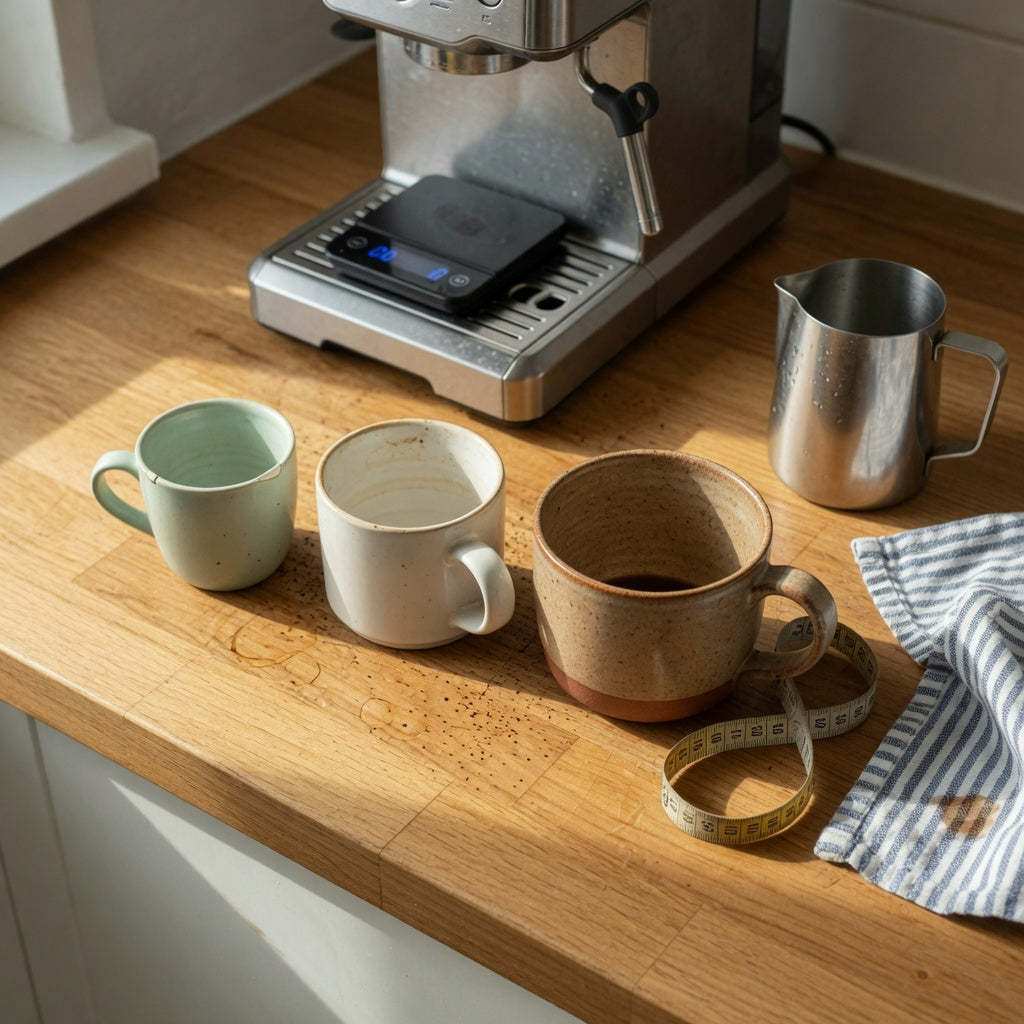
Big Latte Mug Home Coffee Station Practical Purchase Checklist
Most mug disappointments start with a number nobody checked — the clearance under the group head, not the capacity on the box. Here is the order we use in our own store to match a big latte mug to ...
Read more
Leave a comment
This site is protected by hCaptcha and the hCaptcha Privacy Policy and Terms of Service apply.