



Best Cup Size for Flat White at Home: ml to Compare
Reading time: about 13 minutes
The mug beside the kettle is often the vessel that stretches a flat white into warm milk. Espresso goes in, steamed milk follows, and the drink only looks done when a large breakfast mug is nearly full. The coffee is already a background note. If you want the best cup size for flat white at home, decide the pour first, then pick a cup that looks finished at that line.
There is no single required size. In our store we do not treat one cafe style as law. A published New Zealand tourism description places a stronger flat white in about a 175 ml vessel, with the same coffee dose used for other menu drinks and a thinner, shinier milk surface than a latte. Specialty makers often sell compact cups around 150 ml. A BBC recipe uses a 150-200 ml cup. Those are other publishers' reference points, not a trial we ran, and not a Specialty Coffee Association standard. Home kitchens and cafe menus still disagree.
What is the best cup size for flat white at home?
Shoppers who want the drink to stay espresso-forward usually land on a finished pour around 150-200 ml. We use 175 ml as a practical midpoint taken from that New Zealand description, not as a rule. Listed capacity should sit a little above the pour so the surface rests below the rim. A vessel that only looks right near 300 ml is doing a different job. In US fluid ounces, 150-200 ml is about 5 fl oz to just under 7 fl oz. A 175 ml pour is just under 6 fl oz.
Size is part of the build because the cup invites milk. Many home routines keep the coffee dose steady and let the mug decide the rest. More milk softens the shot. A short pour in a small cup stays lively in a way a mug of warm milk does not. None of that locks you to a fixed espresso-to-milk ratio. Taste is the check. If you need a second jug of milk before the cup looks full, the vessel is steering you.
Buyers comparing cups on a real counter usually weigh five things:
- Finished pour versus brim capacity. The number on a listing is often a filled-to-the-lip figure.
- Headroom for a thin milk surface, so the pour does not crest the rim.
- Whether you will actually stop, or a tall empty band makes you top up.
- Handle comfort at that lower fill, not only when the mug is full.
- One job or two: a short milk coffee now, or the same cup for a large tea later.
Ordering a larger size on a chain menu is a different request from stopping a short pour at home. We have not verified chain recipe cards, so we will not pretend those milk doses are settled fact. A bigger menu size and a drink you choose to keep short are not the same decision.
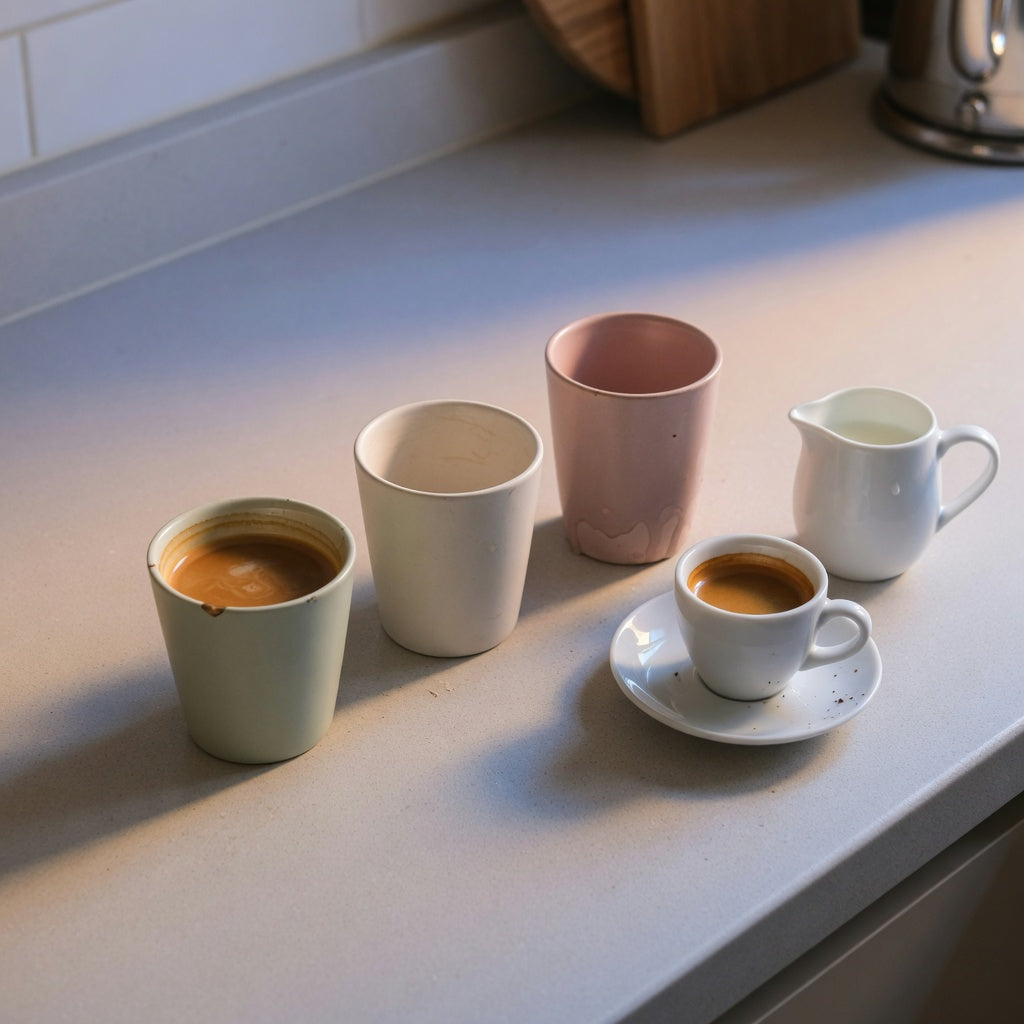
Pleated 200 ml, Ball Handle 250 ml, Emerald 270 ml: headroom on a short pour
Three capacities on our current listings are enough to see the spread. The Pleated coffee and tea cup is listed at 200 ml. The Ball Handle mug is listed at 250 ml. The Emerald mug is listed at 270 ml. Confirm those figures on the page you are viewing before you order. We are comparing stated capacity and the gap under the rim, not a purpose-built bowl and not a cafe trial.
| Listing | Stated capacity | Pour stopped near 175 ml | Poured near the rim |
|---|---|---|---|
| Pleated cup | 200 ml (about 6.8 fl oz) | Short gap under the lip; the cup looks occupied | Close to the compact published range, little spare room if foam climbs |
| Ball Handle mug | 250 ml (about 8.5 fl oz) | Clear unused band above the drink | A longer, milkier cup than a 175 ml pour |
| Emerald mug | 270 ml (about 9.1 fl oz) | The most empty wall above the surface | Easiest of the three to drink like a small latte by habit |
Headroom is that unused band. A thin microfoam cap needs a little of it. A brim-full cup spills on the walk from machine to table, and the foam has nowhere to sit. Do not treat listed capacity as the volume you should drink. A 175 ml pour uses most of the height in the 200 ml Pleated cup. The same pour in the 270 ml Emerald mug leaves about 95 ml of listed capacity unused. Same drink, different signal to the person holding it. The larger mug feels unfinished, and unfinished mugs get more milk.
Wall thickness, rim profile, glaze, and wash steps are not details we will invent from a product name. Read the current listing. If you want more shapes than these three, start with our unique coffee mugs and compare stated capacity before color.
When a weekday desk habit turns the 270 ml Emerald into a longer milk drink
You can match a short pour in a mug rated 250 or 270 ml. The liquid can be right. The habit often is not. A wide mug next to a laptop looks unfinished until the surface rises, so weekday repeats drift longer. We hear this from customers who love one large mug and do not want another item in a small cupboard.
Underfilling is reasonable when you mark a line and keep it. A strip of removable tape on the outside, lined up with where 175 ml of water actually sits, beats a guess at the handle. It also works when you are the only person pouring. It works poorly when guests read the gap as a stingy serve, or when you steam a full pitcher because that is how a larger milk drink is usually taught. Extra textured milk has to go somewhere. It usually goes into the cup.
That home choice is still not the same as ordering a large flat white on a chain menu. A bigger menu size and a short pour you stop yourself are separate decisions. For a sense of how quickly millilitres jump once you leave short cups, our guide to breakfast cup sizes at 170, 200, and 350 ml shows why a morning mug and a flat white cup should not be forced into one job.
The 270 ml Emerald mug is the one we would not hand someone who fills every cup to the lip and still wants a stronger, shorter drink. The 200 ml Pleated cup is the one we would not hand someone who wants a long milky coffee or a generous tea in the same vessel. The Ball Handle at 250 ml sits between them: spare room if you stop early, and a clearly bigger drink if you do not.
Kitchen scale, wet hands, and rim chips before the first milk drink
Brim capacity and usable pour get mixed up in almost every buying chat we have. Our team would rather you measure a mug you own than memorize a single number. A kitchen scale settles it.
- Set the empty, dry cup on the scale and tare it to zero.
- Fill with cool water to the brim, stopping before the water domes over the lip. At normal kitchen temperature, 1 gram of water is close enough to 1 millilitre for cup shopping. It is not a lab measurement.
- Write down that brim weight. That is the number to compare with a listing.
- Pour water out until the surface sits where you want the finished drink: a modest gap under the rim, enough that a small tilt does not spill.
- Read the scale again. That second number is your usable pour.
If the usable pour lands around 150-200 ml, the cup you own already fits the compact range those published references describe. If you only reach that number by leaving a deep empty well, a smaller cup will be easier to live with. While the cup is still full of water, lift it. Wet hands off a steam wand are a fairer test than a dry handle in a photo. We will not quote grip dimensions for the Ball Handle or wall thickness for the Pleated cup. The listing and a water test tell you more than a guess.
Before the first hot drink, check the rim for chips and the handle join for a hairline crack. Those are the faults we tell people to catch on unboxing. A chip at the lip is what you feel on every sip. A cracked join is what fails when the cup is full and hot. After a few weeks of milk drinks, watch the glaze for stain-prone crazing, the fine crackle that holds a brown film even after a rinse. Dishwasher, microwave, and hand-wash steps stay on the product page. Do not assume one rule covers every glaze.
If the machine, pitcher, and cups have to share one tray, the flat white cup checklist for a home coffee station walks through size choices in that tighter space.
Pitcher fill and microfoam when the cup is only 200 ml
Cup size sets the ceiling. Texture decides how fast you hit it.
Microfoam is not free volume. Dry, stiff foam takes more height than glossy, paint-like milk. If you chase a tall cap, you will run out of a 200 ml cup sooner than the espresso alone would suggest. Stop when the surface looks right, not when the rim is wet. A modest gap is enough. You do not need a half-empty showpiece, and you do not need a special rim geometry for the drink to be a flat white.
Alternative milks complicate the same step. Some foam hard and some fall flat, so equal amounts of cold milk will not finish at the same line. In our experience we cannot keep an honest brand-by-brand chart that would pretend otherwise. Steam less than you think, then add only if the cup still looks short.
Build the drink backward. Pull the espresso you already like. Then steam only enough milk to finish the cup you chose. A pitcher filled for a large latte will overshoot a 175-200 ml finished drink once the milk stretches. Published recipes rarely state a cold-milk starting weight, because expansion depends on how you texture it. The practical version is simple: smaller finished drink, less milk in the pitcher before the wand goes in. If the pitcher still has a lot left, the next cup is where it belongs, not a top-up of this one.
Heat is the other quiet variable. A short drink has less liquid to hold warmth, so a cold, heavy cup steals more of the sip. Rinse the vessel with hot water and tip it out before the shot. That is ordinary counter practice, not a lab claim, and it matters on all three sizes. It does not make a 270 ml mug behave like a 200 ml cup.
Iced coffee is where these capacities are a bad fit. Ice occupies the room you were saving for milk, and a 200 ml cup becomes a few sips of watered coffee. Use a larger glass for that. A desk mug in the 12-16 oz range solves a different problem: wanting a lot of coffee nearby. That is not this drink.
Short flat white, long tea, or one mug that has to do both
Match the morning you actually have, not a slogan.
You want the cup to limit the milk. Choose the Pleated listing at 200 ml. A finished drink near 160-180 ml still leaves a slim gap, so the cup looks properly filled without a long milky serve. It is a poor match if thick foam regularly crowds the rim, if you share one cup across a long tea and a short coffee, or if you simply prefer more liquid in the hand. Two hundred millilitres is not too small for the compact references above. It is too small for a 300 ml habit.
You want one everyday mug and you trust your stop point. The Ball Handle at 250 ml can hold a 175 ml pour with obvious headroom, or a longer milk drink on days you choose that. It is a weak match if an unused band annoys you into topping up, and it is more mug than you need if every drink you make is a short one. The ball handle is part of the product name. Comfort still depends on your hand and on details printed on the listing, which you should read rather than infer.
You want spare capacity for a bigger sip or for tea later the same morning. The Emerald at 270 ml gives you the most room of the three. Use it for a flat white only if the pour stays short on purpose. Filled near the rim, it is the furthest of these listings from a 150-200 ml cup. Extra wall above a short pour does not make the drink weaker by itself. The top-up does.
None of these is offered as a competition cup. We are not claiming a tulip profile, a tested milk ratio, or barista-standard geometry. Wide bowl versus a taller wall can change how the surface looks, but that talk is mostly maker opinion. On our pages, use the written capacity and the photos you can verify, then decide. Shoppers comparing more than millilitres can read what else to compare on flat white cups before they add another mug to the shelf.
Stop-point check before you choose 200, 250, or 270 ml
- Measure your current favorite with water. Note brim capacity and the usable line below the rim.
- Decide the finished pour you want, using 150-200 ml as the compact reference band and 175 ml as one published midpoint, not as a rule.
- If that pour should nearly fill the cup, look at the 200 ml Pleated listing.
- If you will leave headroom on purpose and sometimes want a longer drink, look at 250 ml.
- If the same mug must hold a clearly larger tea or milk drink later, look at 270 ml and accept that a rim-full pour is no longer a short flat white.
- Confirm material and washing instructions on the live product page. Do not guess glaze or dishwasher safety from the name.
- Skip any cup you will fill out of habit. Check the rim and handle join when it arrives.
Order the listing that matches the stop point you can keep, or browse the collection if none of the three capacities is quite right.
Frequently asked questions
What is the best cup size for flat white at home in ml or ounces?
For an espresso-forward flat white, we use a finished pour around 150-200 ml, with about 175 ml as a published midpoint rather than a requirement. That band is roughly 5 US fl oz to just under 7 fl oz, not an 8-12 oz mug filled to the top. A listed 200 ml cup can sit at the top of the compact range. Cups at 250 ml (about 8.5 fl oz) and 270 ml (about 9.1 fl oz) match only when you leave real headroom.
Is a 200 ml cup too small for a flat white?
Not if you want the drink in that compact range. It is too small if you regularly want a long milky coffee, if very thick foam plus espresso already crowds the rim, or if the same cup has to serve a large tea. Leave a slim gap under the lip. Do not treat 200 ml as an instruction to fill until it spills.
If I fill a 270 ml mug, have I just made a small latte?
You have made a larger milk drink. Many people will taste a rim-full 270 ml cup as closer to a latte than to a short flat white, even when the espresso dose did not change. The name on the menu does not cancel the extra milk. Stop nearer 150-200 ml if the stronger, shorter profile is the point.
Can I use a bigger mug if I only fill it partway?
Yes. The liquid can match a short pour in a 250 or 270 ml mug. The risk is the empty band, which invites a top-up on busy mornings. A marked fill line helps. A smaller cup helps more if you already know you will fill whatever you pick up.
Do I need headspace for microfoam, or should the cup be full?
Leave a modest gap below the rim. Brim-full cups spill when you turn from the machine, and the foam has nowhere to sit. You do not need a huge empty well. On a 200 ml cup that gap is small. On a 270 ml cup the same pour leaves a much taller band, which is a handling choice, not a better drink.
Shop Popular In-Stock Mugs — Extra 10% Off 1st Order (10_OFF) + Free Shipping
 Pleated Ceramic Coffee Cup, Crumpled Paper Cup Style, 200 ml
Default color: Green
 Christmas Tree Coffee Mug with Lid and Spoon, 460 ml
Default color: Red
 Handbag Shaped Coffee Mug with Saucer and Spoon, 310 ml
Default color: Pink
 Elk & Moon Deer Coffee Mug with Tea Infuser & Lid, 420 ml
Default color: Dark Blue
Browse by budget & style: Cute & Gift Cups (10% Off Applied) · Wooden-Handle Bestsellers · Large 14–15.5 oz Mugs · Holiday Gift Mugs · 8–9 oz & Espresso Cups
Popular mug buying guides: 2026 Mug Gift Ideas · 4-Piece Mug & Espresso Cup Sets · 8 oz & 9 oz Mugs · Cute & Aesthetic Mugs · Ceramic Tea Cups & Infuser Mugs · Ceramic Mugs with Lids Compared · Wooden-Handle Tea Infuser Mugs Compared · Christmas & Secret Santa Mugs 2026 · Espresso & Cortado Cups Guide · Cup & Saucer Gift Sets · All 25 Mugs Spec Table · Mug Size Guide · Shipping & Promo FAQ
1ST ORDER: EXTRA 10% OFF (CODE: 10_OFF) · OR BUY 3, GET 1 FREE


Read more

Reading Nook Coffee Mug Gift: Size, Print, and Care
Shoppers looking for a reading nook coffee mug gift usually want a bookish cup for a home library, not furniture. Compare size, flat versus sculpted art, wash care, and food-contact claims before y...
Read more
Everyday Coffee Mug Size Comparison: Rim vs Pour
The ounce printed on an everyday mug is usually a brim-full number, not the pour you can carry to a desk. Compare 8 to 16 fl oz against milk, foam, brewer height, and the listing fields that actual...
Read more
Leave a comment
This site is protected by hCaptcha and the hCaptcha Privacy Policy and Terms of Service apply.