



Everyday Coffee Mug Size Comparison: Rim vs Pour
Reading time: about 13 minutes
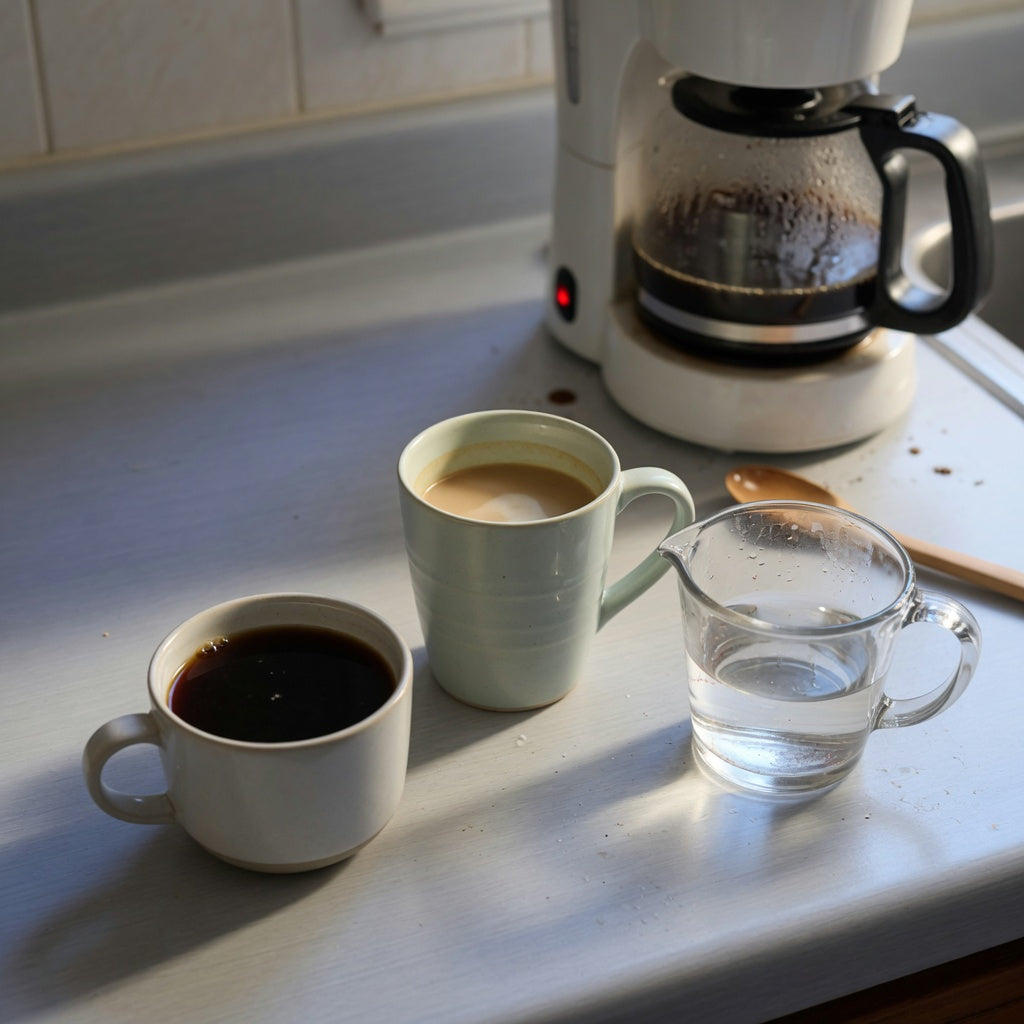
A customer set two mugs on our packing table last week and asked which one was a normal cup. Both product photos were cropped tight. Both captions said 12 ounces. One mug was short and wide, the kind that sits low under a cabinet. The other was a tall straight wall. Filled with the same pour, they did not behave the same. The wide rim cooled faster while she took a call. The tall one needed more air under a single-serve spout and felt less steady once the liquid sat high. That mismatch is the everyday coffee mug size comparison we end up doing in the store: the printed number is only the start.
People writing in are not chasing a trophy mug. They want tomorrow morning to work: black coffee, coffee with a splash of milk, or tea, without a spill between the brewer and the desk. Capacity, wall shape, and the empty gap under the rim decide that. Glaze color does not.
A measuring cup, a brew mark, a cafe name, and brim capacity
Four numbers get treated as if they were one measure. They are not, and mixing them up is how a so-called standard cup turns into the wrong mug.
- A U.S. measuring cup is a kitchen volume. For approximate home cooking, NIST lists 240 mL as 1 cup and about 30 mL as 1 fluid ounce. That cup is a measuring tool. It is not a coffee serving, and it is not your mug's comfortable fill.
- A brew mark on a coffee maker belongs to that machine. It is often smaller than an 8 fl oz measuring cup. NIST's household table is only a converter here: 6 fluid ounces is about 180 mL, and 1 cup is 240 mL. If the carafe says 10 cups, open the manual and find fluid ounces per setting before you assume you need ten full mugs.
- A cafe size name, such as small, medium, tall, or grande, is a menu label. It is not a home-mug standard. A hot size on one menu is not automatically the matching cold size.
- Brim capacity is what a mug listing usually means by ounces: liquid filled until the next drop would spill. That line is larger than the level you can stir, carry, or top with milk.
There is no single mandatory everyday-mug capacity in the public references we rely on. This guide lines up 8, 10, 12, 14, and 16 fl oz because those are the brim sizes buyers put side by side. None of them is a required standard.
One official figure is easy to misuse. In 21 CFR 101.12, the FDA reference amount customarily consumed for coffee or tea that is flavored and sweetened is 360 mL prepared, with the label statement 12 fl oz (360 mL). That is a nutrition-label reference for that category. It is not a rule that every unsweetened black-coffee mug should hold 12 ounces.
Everyday coffee mug size comparison from 8 to 16 fl oz
Keep two conversions in separate columns. For home cooking, NIST treats about 30 mL as 1 fluid ounce, 240 mL as 1 cup, and 480 mL as 16 fluid ounces, which is 1 pint or 2 cups. Those are approximate household equivalents, not exact legal conversions. Separately, NIST Handbook 44 lists 1 U.S. fluid ounce as 29.573 milliliters. Use the 30 mL rule when you are standing at the counter with a measuring cup. Use 29.573 when you are checking a milliliter claim on a listing.
| Labeled brim | Household approx. | Closer conversion | What changes in the hand |
|---|---|---|---|
| 8 fl oz | about 240 mL (1 cup) | about 237 mL | A short black coffee or plain tea. Tight once a full pot pour or milk shows up. |
| 10 fl oz | about 300 mL | about 296 mL | A modest pod pour with a splash. Little room left for foam or a real pour of cream. |
| 12 fl oz | about 360 mL | about 355 mL | What many buyers mean by a regular mug, if they leave the rim empty. |
| 14 fl oz | about 420 mL | about 414 mL | Headspace for cream, crema, or foam. Heavier when full. Tall shapes can miss a low spout. |
| 16 fl oz | about 480 mL (1 pint) | about 473 mL | Ice, a lot of milk, or a long sitting cup. Easy to over-pour and harder to carry one-handed. |
The closer column is our rounding of 29.573 mL times the ounce figure. It will not match the 30 mL column, and that gap is normal. The FDA label statement pairs 12 fl oz with 360 mL for flavored, sweetened coffee or tea, which tracks the approximate kitchen conversion rather than 29.573 times 12. A listing that says 350 ml is not exactly 12 fluid ounces and not exactly one measuring cup. Read both units, then check height and width. The same ounces in a tall body and a round body are a different object. That is why a photo with no scale keeps misleading people.
A 16 fl oz brim is not a small step up from 12. It is 4 fluid ounces more: about 480 mL against about 360 mL, a pint against a cup and a half on the household scale. That extra room is where milk, foam, or ice can live if you stop the coffee itself nearer 10 or 12 fl oz. It is also where a black-coffee drinker can pour more than they meant. If you already finish a short black cup, the 16 oz mug mostly adds weight. If your usual drink is a milky mix, hot chocolate, or iced coffee, a 12 oz brim is often gone before the drink looks finished.
How much air do milk, crema, and ice need under the rim?
Buyers ask the cream question in different words. If the box says 10 ounces, can they brew 10 ounces and still add cream? Usually no. Brim capacity is a spill line. Stirring, a milk splash, crema from a pod, or milk foam all need air under that line. Ice claims space before any coffee does.
Public dietary measuring guides from the CDC NHANES program make the gap concrete without turning into a shopping law. They used three mug models with rim capacities of 8 oz (a Carlisle KL111), 10 oz (a Carlisle 43052), and 14 oz (a Kroger mug). The first marked fill below the rim was 6.5 oz, 8.5 oz, and 12 oz. Reported amounts were supposed to stay inside rim capacity. We do not print those marks on the mugs we pack. The pattern is the useful part: on those models the practical line sat about 1.5 to 2 ounces under the rim.
Treat the listed ounces as a spill line. Your drinking line is that number minus milk, foam, or ice, and minus a small gap you can walk with.
Match the brim to the drink you actually make. One size is not best for every counter.
- Black drip or plain tea. An 8 to 12 fl oz brim often works when the machine's real pour sits under the rim with a little shake room. Eight ounces is frequently too small for a full coffee-maker pour. Check the manual's fluid ounces, not the word cup on the panel.
- Coffee plus a splash of milk. A 10 oz brim is the wrong tool for a 10 oz brew plus cream. The coffee already owns the spill line. A 12 or 14 fl oz brim gives the milk and a carry gap somewhere to go.
- Foam, crema, or a latte-style top. Bubbles take space the coffee ounces never included. A 10 oz mug can crown over on a pod with a thick crema. A 14 fl oz brim is the safer everyday choice when that is your usual drink. It is not automatically better if you drink a short black cup and hate a heavy lift.
- Iced coffee or a milky hot chocolate. Cubes and a large milk pour eat capacity first. A 16 fl oz brim can still look like a serving after the ice. Skip it if you wanted a light hot cup. A full 16 fl oz pour, plus the mug itself, is a lot to walk across a kitchen one-handed.
Width changes the same headspace. A wide rim makes 1.5 ounces of air look shallow, so people overfill and then blame the mug. A tall narrow wall hides the liquid level until crema hits the lip. If a page will not list ounces because the picture is supposed to show the size, that is a missing fact. Two mugs can share a capacity and fail opposite fit tests.
Handle clearance, filled weight, spout height, and the rack
Ounces do not tell you whether Tuesday morning will be comfortable. These are the checks we walk through when someone is choosing a daily driver rather than a shelf piece.
- Handle clearance. A finger should pass between the handle and the wall without a scrape. A large brim with a skimpy opening pinches wider hands and anyone wearing a ring. A thick loop and a thin handle change that gap even when capacity matches. In our experience this is the complaint that shows up after the first week, not on unboxing day.
- Empty weight and full weight. Listings rarely publish both. Clay thickness and a heavy base never appear in the ounce rating. NIST's household table treats 16 fluid ounces as a pint. That pint of liquid is already in your hand before you add whatever the mug weighs. If empty weight is missing, do not assume a bigger brim will still feel light between the kitchen and a desk.
- Height versus the brewer. Measure from the drip tray to the spout, then compare that with mug height plus a little air so the rim does not kiss the outlet. Tall everyday mugs fail here even when the capacity is right. Some machines let you drop or remove a tray for a taller cup. Confirm that in the machine manual, not from a mug photo.
- Footprint with the handle. Cabinet shelves and dishwasher tines care about width including the handle, not rim diameter alone. A smaller brim with a wide handle can block the rack while a taller mug with a tight handle slides in. Stack height only matters if that exact mug is meant to nest. Many glazed rims are not.
- Care is piece-specific. A glass mug can be labeled dishwasher-safe and still be a poor choice for boiling water or the microwave. A metallic rim can rule out the microwave even when the body is ceramic. Read the care line on that listing. Do not copy it from a different mug in a similar glaze.
Caffeine follows how much coffee is actually in the mug, not the brim rating. A larger mug is not a stronger cup if you stretched the brew with water and then added a lot of milk. If you are watching intake, measure the coffee you pour. Do not treat the ounce figure as a dose.
Does a tall landscape mug fit the pour you make?
Shape is the decision after ounces. A low, round cup sits under a cabinet and feels steady when you set it down half-asleep. A taller wall gives a tea bag or a crema layer vertical room and keeps the drink off the desk when an elbow nudges the mug. Tea also needs a rim you can lift a bag over without pinning it. A short wide cup can do that with diameter. A taller wall does it with depth. Those are different tools. Same brim ounces do not make them interchangeable.
If a taller coffee-and-tea format is what you are comparing against a shorter everyday cup, open the landscape tall coffee tea mug and read the live listing before you decide it is the big one. Confirm brim capacity in ounces or milliliters, height, rim diameter, width including the handle, material, and any dishwasher or microwave note. Those details have to come from that page. We will not guess them from a cropped photo or from a similarly named mug. If a field is blank, the fact is unverified. A tall outline can hold the same liquid as a wide mug, or less.
This is the wrong next step if you need a lidded travel cup and the page does not show a lid plus a leak claim you can verify. It is the wrong next step for a short stack in a shallow cabinet, and for a wide bowl where you judge foam by surface area. In those cases the tall format fights the job before capacity enters the conversation.
Once the ounce range is settled and you want something less plain than a diner cup, browse unique coffee mugs and compare the capacity printed on each listing. Ignore how large the product photo is cropped. A dramatic crop is not a size.
Brim ounces, height, and care notes to read on the listing
Run this on any everyday mug, including pieces from our store. A missing answer means the size comparison is not finished.
- Brim capacity in fluid ounces and, if you think in metric, milliliters.
- Whether that number is to the rim. Assume it is until the maker says otherwise.
- Your real pour: the brewer's fluid ounces, plus milk, foam, or ice, plus about 1.5 to 2 oz of carry room. That gap is the pattern on the CDC mug models, not a mark printed on your mug.
- Height, rim diameter, and width including the handle.
- Empty weight, if the listing publishes it. If it does not, plan on judging the piece in hand or staying with a size you already know you can lift full.
- Care limits for dishwasher, microwave, and hot liquid, matched to the material named on that listing.
- Clearance under your brewer and on the shelf or dishwasher row where the mug will actually live.
Frequently asked questions
What belongs in an everyday coffee mug size comparison?
Compare brim capacity, a realistic fill below the rim, and the shape that holds those ounces. Then check handle clearance, how heavy the mug is once filled, brewer height, and shelf or dishwasher width including the handle. A single ounce number cannot tell you whether milk, foam, or ice will fit, or whether the rim will clear your spout.
Is the ounce capacity on a mug filled to the rim?
Treat a listed capacity as brim-full unless the current listing says it is a practical drinking line. You still need space to stir and to add milk or foam. On the CDC NHANES mug models, the first mark under an 8, 10, or 14 oz rim was 6.5, 8.5, and 12 oz. Your mug will not carry those exact marks, but do not plan to drink at the lip.
Should I buy a 10 oz or a 14 oz mug if I brew about 10 oz and add cream?
A 10 oz brim leaves almost no room once 10 oz of coffee is already in the mug. Cream, crema, or foam needs extra volume, and you still want a gap so the walk to the table does not slosh. A 14 oz brim is the more practical of those two for a 10 oz brew plus a dairy splash. If you drink it black and the pour is truly under about 8 oz, the smaller mug is lighter and easier to store.
Why do people call a coffee cup 6 oz when a measuring cup is 8 oz?
Those phrases are not one unit. NIST household equivalents set a U.S. cup at 240 mL, or 8 fluid ounces, and list 6 fluid ounces as about 180 mL. A mug listing is usually brim capacity, and a coffee maker's cup button is defined by that machine. Use the manual's fluid-ounce settings, then choose a mug whose comfortable fill can take that pour.
Is a taller mug always a larger everyday mug?
No. Height is not capacity. A tall narrow mug and a short wide mug can share the same brim ounces and fail different fit tests. Read capacity, height, and width with the handle on the current listing. For a tall coffee-and-tea option, start from the tall coffee and tea mug listing and confirm those figures there before you assume it out-holds a round cup.
Know the pour you make most mornings, then pick the brim that clears that pour plus headspace. Confirm height, handle width, and care notes on the live page before you trust a crop. Use the tall coffee-and-tea listing when that shape is the format you want, and keep comparing inside our unique coffee mug collection once capacity is non-negotiable.
More from our blog
Shop Popular In-Stock Mugs — Extra 10% Off 1st Order (10_OFF) + Free Shipping
 Pleated Ceramic Coffee Cup, Crumpled Paper Cup Style, 200 ml
Default color: Green
 Christmas Tree Coffee Mug with Lid and Spoon, 460 ml
Default color: Red
 Handbag Shaped Coffee Mug with Saucer and Spoon, 310 ml
Default color: Pink
 Elk & Moon Deer Coffee Mug with Tea Infuser & Lid, 420 ml
Default color: Dark Blue
Browse by budget & style: Cute & Gift Cups (10% Off Applied) · Wooden-Handle Bestsellers · Large 14–15.5 oz Mugs · Holiday Gift Mugs · 8–9 oz & Espresso Cups
Popular mug buying guides: 2026 Mug Gift Ideas · 4-Piece Mug & Espresso Cup Sets · 8 oz & 9 oz Mugs · Cute & Aesthetic Mugs · Ceramic Tea Cups & Infuser Mugs · Ceramic Mugs with Lids Compared · Wooden-Handle Tea Infuser Mugs Compared · Christmas & Secret Santa Mugs 2026 · Espresso & Cortado Cups Guide · Cup & Saucer Gift Sets · All 25 Mugs Spec Table · Mug Size Guide · Shipping & Promo FAQ
1ST ORDER: EXTRA 10% OFF (CODE: 10_OFF) · OR BUY 3, GET 1 FREE


Read more
Best Cup Size for Flat White at Home: ml to Compare
A flat white poured into a breakfast mug often turns milky. Compare the 200 ml Pleated cup, 250 ml Ball Handle mug, and 270 ml Emerald mug by stated capacity and the headroom you leave under the rim.
Read more
Tall Ceramic Coffee Tea Mug Size: What Buyers Compare
A tall mug can mean a high silhouette, a bigger ounce claim, or a cafe drink name. We compare usable fill, exterior height, base and handle fit, full weight, and the safety labels to verify on the ...
Read more
Leave a comment
This site is protected by hCaptcha and the hCaptcha Privacy Policy and Terms of Service apply.