
Flat White Cup Home Coffee Station Practical Purchase Checklist by Size
Reading time: about 9 minutes
A cup can hold your drink and still be wrong for the counter. Its handle may meet the milk pitcher, the cup may be awkward to lift from beneath the brew area, or your normal pour may reach the rim before you carry it to a desk. Our flat white cup home coffee station practical purchase checklist starts with those practical problems, then uses verified capacity as the first filter.
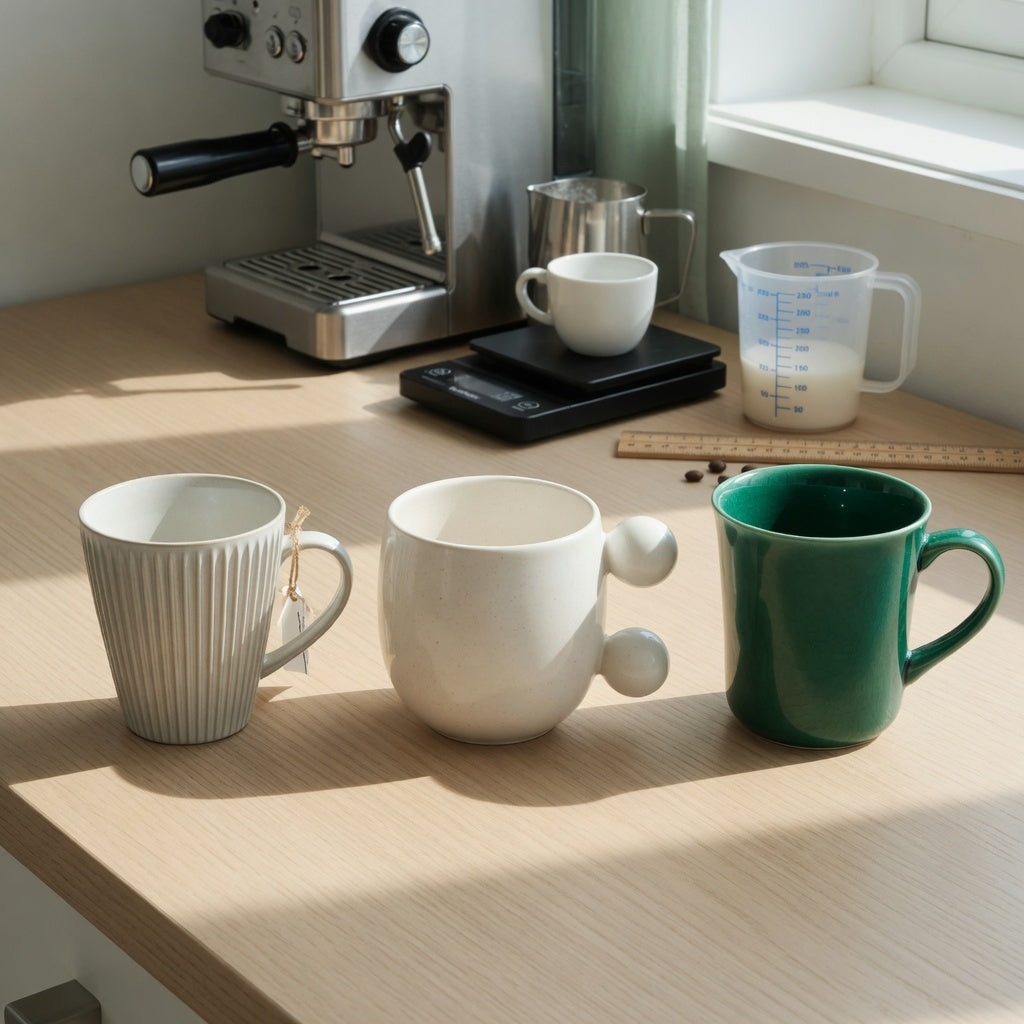
At CoffeifyMug, the catalog facts we can support for this comparison are specific but limited: the Pleated cup is listed at 200 ml, the Ball Handle mug at 250 ml, and the Emerald mug at 270 ml. Capacity does not establish external dimensions, weight, material, wall thickness, usable fill level, care instructions, heat retention, or compatibility with a particular appliance. We will not turn those unknowns into product promises.
The best cup for a flat white is therefore not one universal size. It is the option that gives your measured serving enough empty space for pouring and carrying while still fitting the station where you make it.
Flat white cup home coffee station practical purchase checklist: measure your pour
Start with the drink you already make rather than a prescribed cafe ratio. A short pour, a milk-heavy drink, and an occasional tea serving create different capacity requirements, even when each person calls the result a flat white.
- Place removable tape on the outside of your current cup at your preferred finished fill line. After the cup is empty and cool, refill it with water to that mark and transfer the water to a graduated measuring jug.
- Repeat the check on a normal weekday if your pours vary. Use your common serving, not the largest drink you might make once a month.
- Decide how much empty space you need. A drink consumed beside the machine can sit closer to the rim than one carried past a keyboard or across a carpet.
- Measure the maximum cup height, widest footprint, and handle-inclusive width your station can accept. Record those limits in millimeters before opening a product page.
A listed capacity may describe volume close to the brim rather than a comfortable carrying level. The available source information does not confirm how the three catalog capacities were measured, so a 200 ml listing should not automatically be treated as a comfortable 200 ml serving. That distinction between nominal capacity and usable capacity is one of the most useful checks for any flat white coffee cup.
200 ml, 250 ml, or 270 ml: which leaves sensible headroom?
The three verified capacities create clear comparison points. The 250 ml Ball Handle provides 50 ml more listed capacity than the 200 ml Pleated cup, while the 270 ml Emerald adds another 20 ml. Use those differences against your measured pour, not as evidence of a required flat white recipe.
| Product | Reader situation | Why it fits | Trade-off to check |
|---|---|---|---|
| Pleated cup, 200 ml | Your usual serving is comfortably below 200 ml after allowing the empty space you prefer. | It has the lowest listed capacity of the three, limiting excess unused volume for a shorter drink. | It offers the least capacity tolerance for an inconsistent pour. Confirm external dimensions, material, and whether 200 ml is a brim or usable measurement. |
| Ball Handle mug, 250 ml | The 200 ml option is too close to your fill line, but your serving does not call for the largest listed capacity. | Its middle position adds 50 ml over the Pleated cup and remains only 20 ml below the Emerald mug. | The product name identifies the styling, but it does not prove handle clearance or grip dimensions. Compare measurements rather than inferring fit from the name. |
| Emerald mug, 270 ml | You recorded the largest pour, want the most nominal headroom, or expect occasional longer milk drinks. | It provides the highest verified capacity in this three-product comparison. | A shorter drink leaves more unused volume. Its visual fill height and cooling behavior cannot be predicted from capacity alone because geometry and material also matter. |
Two people sharing one machine do not necessarily need matching capacities. If one measured serving fits comfortably below 200 ml and the other needs more room, a smaller and larger cup may be more useful than an identical pair. These recommendations concern capacity only; they do not claim barista standards, a required drink ratio, or purpose-built cup geometry.
Will the cup clear the machine, scale, and milk pitcher?
Capacity is an internal volume, not an external measurement. A lower-capacity cup is not automatically shorter or narrower than a larger one, so machine fit and counter footprint need their own test.
- Vertical opening: Configure the drip tray and scale exactly as you use them. Measure from the cup surface to the lowest fixed obstruction, then reserve enough room to lift the cup without scraping or tilting it.
- Counter footprint: Mark the largest acceptable cup area with removable tape. Leave the milk pitcher, tamper, and grinder where they normally sit during a morning workflow.
- Handle sweep: Check the full width needed when a handle points sideways and the space required to grasp it. This matters beside a steam wand, wall, or neighboring mug.
- Removal path: Test how the cup moves into and out of the brewing area. A cup can fit while parked yet remain awkward to remove once it contains a hot drink.
We use this lift-out check because a stationary measurement misses the movement your hand actually makes. The source facts for these products do not include verified height, diameter, or handle reach, and we make no model-specific espresso-machine compatibility claim. Compare your recorded limits with the current product page; if a required measurement is not stated, ask our store before ordering.
Which material and care details need confirmation before checkout?
The provided catalog evidence verifies capacity, not composition or care status. Do not assume that a cup is ceramic, porcelain, stoneware, dishwasher safe, or microwave safe from its photograph or finish. Those properties should appear explicitly on the current listing or be confirmed by the seller.
- Body material and finish: Confirm the exact material. If the surface is glazed, check the maker's instructions for cleaning and temperature changes rather than treating every glazed cup alike.
- Daily cleaning: A cup entering frequent dishwasher cycles needs an explicit dishwasher-safe statement. If hand washing is required, decide whether that routine is realistic for a busy shared station.
- Temperature changes: Confirm any guidance about preheating, microwave use, refrigeration, or contact with ice. Capacity alone says nothing about resistance to thermal shock.
- Contact points: The rim, foot ring, base, and handle junction deserve attention because chips, uneven feet, and hairline cracks affect everyday use more than decorative details do.
When we assess a cup after unboxing, we set it on a clean, known-flat counter and press lightly at opposite sides to detect rocking. We inspect the rim and handle junction in strong light and look for chips or hairline cracks. On glazed ware, a network of fine glaze lines is known as crazing. These are general inspection points for the category, not a claim that the CoffeifyMug products commonly have those defects; if damage is present, stop using the cup and contact the seller.
Follow the product's stated washing instructions before first use. A glossy surface does not, by itself, confirm dishwasher or microwave suitability.
Shared counters, office desks, gifts, and iced drinks
Two different morning pours
Measure each person's normal fill line separately. The Pleated 200 ml option suits the person whose serving remains comfortably under its nominal capacity, while the 250 ml or 270 ml choice gives the larger pour more listed room. This is more practical than choosing a matched size solely for appearance.
Coffee carried to an office desk
Prioritize the empty space above the drink and a verified stable footprint. Capacity does not make a cup spill-proof, lidded, or insulated. If the drink must survive a commute or stay hot through a long call, a travel vessel with explicitly stated lid and insulation features is a better category.
Gift selection and mixed drink use
For a gift, the recipient's machine clearance, usual serving, and cleaning routine may be unknown. Confirm those details rather than guessing from color alone, then compare visual options in our unique coffee mugs collection. If the cup will also hold tea or iced coffee, remember that ice takes up capacity and confirm the material's care and temperature guidance first; even 270 ml may be too small for a large iced drink.
When is this 200-270 ml cup range the wrong purchase?
- Your measured serving reaches or exceeds 270 ml before adding the carrying space you want.
- You need a lid, verified insulation, or a shape designed for a vehicle cup holder.
- You mainly drink straight espresso and want the smaller scale of a demitasse.
- You require exact appliance clearance, dishwasher safety, or microwave safety that has not yet been confirmed on the listing.
In those situations, a different cup style is the more defensible purchase. Our store would rather separate a capacity match from a complete use-case match than imply that one of these three options solves requirements its verified facts do not cover.
The two-minute checkout decision
- Write down your usual fill volume in milliliters and the empty rim space you want to retain.
- Record maximum height, footprint, and handle-inclusive width at the station.
- Select 200 ml, 250 ml, or 270 ml only after comparing the measured pour with nominal capacity.
- Confirm product dimensions, material, dishwasher status, microwave status, and temperature guidance where those details matter to you.
- Pause the purchase if a non-negotiable specification remains unstated. Capacity cannot substitute for that missing fact.
Start with the 200 ml Pleated cup for a shorter measured serving, the 250 ml Ball Handle mug when 200 ml is too close to your preferred fill line, or the 270 ml Emerald mug for the largest pour or most nominal headroom. Each next step follows a measured situation rather than an assumed recipe.
Frequently asked questions
What size flat white cup is best for a home coffee station?
The best size is the one that exceeds your measured finished serving while preserving the empty space you prefer for pouring and carrying. The flat white cup home coffee station practical purchase checklist compares verified options at 200 ml, 250 ml, and 270 ml without imposing a drink ratio. Confirm external measurements and care details separately.
Is a 200 ml flat white cup too small?
It is too small if your normal drink approaches 200 ml before accounting for comfortable headroom, or if the stated capacity is a brim measurement. It can be a sensible option for a shorter measured serving, but the current product page should confirm how capacity and dimensions are defined.
Will these cups fit under my espresso machine and go in the dishwasher?
Capacity does not answer either question. Measure your machine with its usual tray and scale installed, then compare that limit with verified cup dimensions. Use a dishwasher only if the current listing or seller explicitly confirms dishwasher-safe care.
Which CoffeifyMug flat white cup should I compare first?
Open the Pleated 200 ml page if your serving is shortest, the Ball Handle 250 ml page if you need 50 ml more listed room, or the Emerald 270 ml page for the highest verified capacity. Take your pour volume and station measurements to the CoffeifyMug cup collection and compare only the options that satisfy both.
More from our blog
Read more

Ceramic Coffee Mugs With Large Handles: Gift Purchase Checklist
Match a mug to the recipient's grip, cupboard space, drink routine, and care habits. This checklist compares three CoffeifyMug handle styles while identifying the product details you still need to ...
Read more
Ceramic Wide Bottom Coffee Mugs: Practical Rotation Checklist
Compare wide-bottom ceramic mugs by actual shelf footprint, daily use frequency, shape, care requirements, and handling details. This checklist also identifies the product information to confirm be...
Read more
Leave a comment
This site is protected by hCaptcha and the hCaptcha Privacy Policy and Terms of Service apply.