
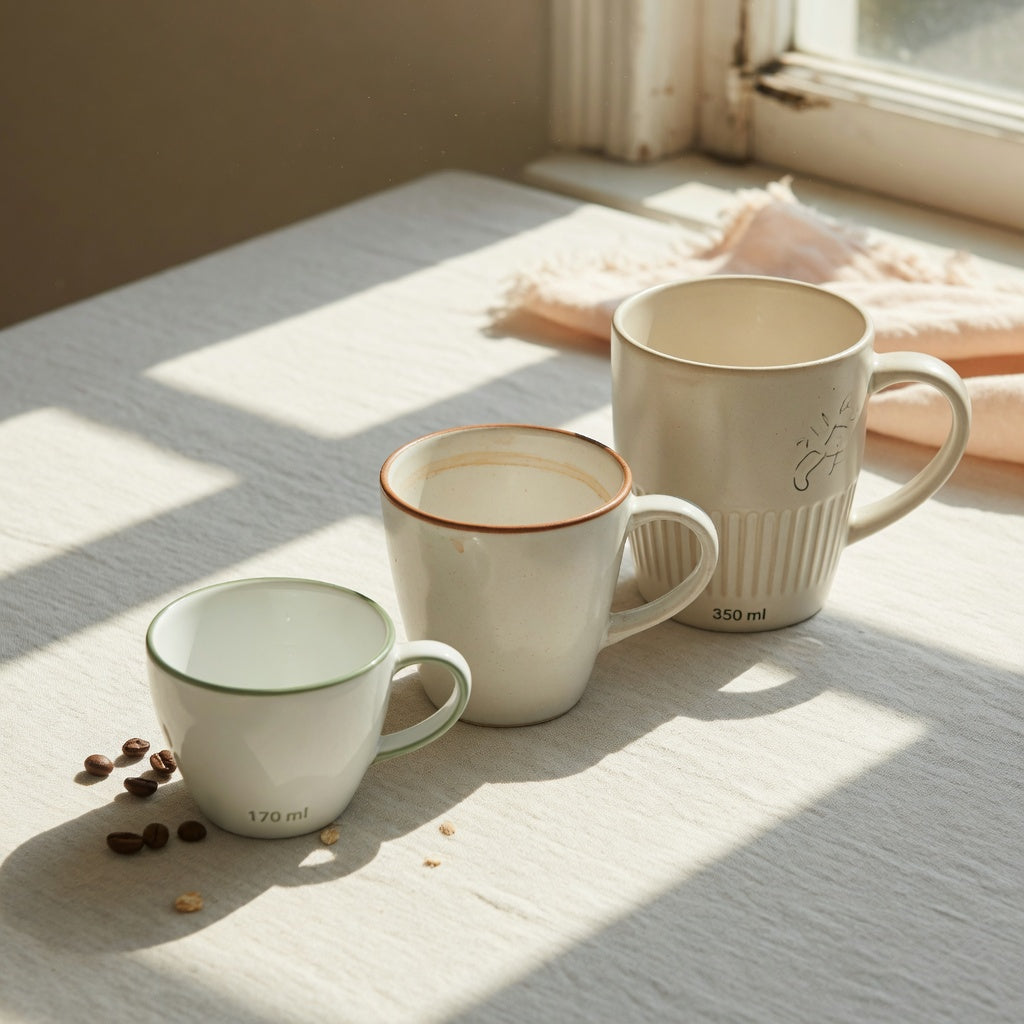
Breakfast Coffee Cup Size Guide: 170 vs 200 vs 350 ml Compared
Reading time: about 8 minutes
The size question lands in our inbox almost every week, and it is rarely about milliliters. A shopper eyeing the Landscape Tall wants to know whether 350 ml will crowd a two-person breakfast table. Another wonders if the 170 ml Retro means walking back to the coffee maker before the toast is gone. Both worries are fair, and both are really footprint and refill questions hiding behind a size label. This breakfast coffee cup size guide works through them using the three capacities we currently list — 170 ml, 200 ml, and 350 ml — and shows you where the numbers stop telling the whole story.
Does table footprint or cup capacity decide breakfast fit?
Start with the table, not the cup. A real breakfast already claims a plate, cutlery, a juice glass, maybe a small bowl. Whatever flat surface is left beside the plate is the space your cup has to win. A compact cup protects that space. A taller design spends less of it — the Landscape Tall takes its extra room vertically — but that height then has to clear the space under your brewer's spout and any shelf hanging over the table.
We ask every size-question customer the same two things before recommending anything: where the cup will sit, and how it gets filled. A cup that lives on a crowded table for forty minutes has different demands than one that gets filled at the counter and carried to a desk. Neither habit is wrong. They just point at different capacities, and that is exactly what the next section sorts out.
What this breakfast coffee cup size guide compares: 170 ml vs 200 ml vs 350 ml
Capacity is the one spec we can state with confidence for each listing, so start there:
- 170 ml — Retro Coffee Tea Cup. The smallest capacity in the lineup. It matches short, concentrated pours: a cappuccino-style milk drink, or hot tea taken alongside the meal. The upside is temperature — a smaller volume gets finished while it is still hot. The trade-off is refills; a drip-coffee drinker will be back at the pot before the plate is cleared. Exact dimensions, material, and care details live on the current Retro Coffee Tea Cup listing.
- 200 ml — Pleated Coffee Tea Cup. The middle option and the closest thing to a classic morning cup. Two hundred milliliters holds a standard mug of black coffee or a modest milk drink with enough headspace to carry it from counter to table without sloshing over the rim. The Pleated Coffee Tea Cup listing carries the current spec sheet.
- 350 ml — Landscape Tall Coffee Tea Mug. The large-capacity, tall-profile option — the name is a hint, and the listing confirms the exact height. Three hundred fifty milliliters covers a full pour of drip coffee, a generous latte, or a drink meant to last through a slow breakfast. Fewer refill trips, but the height needs clearance under low spouts and cabinets, and on a busy table a taller vessel's handle naturally sits higher in your reach path. See the Landscape Tall Coffee Tea Mug listing for the measurements that matter.
Shapes, colors, and finishes change over time, so for everything beyond these three, our collection of unique coffee mugs is the fastest way to see the current lineup in one place.
170 ml vs 200 ml vs 350 ml at a glance
We keep a version of this table near the sample shelf because it settles most questions in one pass:
| Capacity | Product | Best morning fit | The catch |
|---|---|---|---|
| 170 ml | Retro Coffee Tea Cup | Concentrated drinks, tea with breakfast, hot-and-done sippers | Repeat refill trips for drip coffee; fills fast under large brew settings |
| 200 ml | Pleated Coffee Tea Cup | A standard mug of black coffee or a flat white | Little room for ice or tall foam; reads small if you like oversized mugs |
| 350 ml | Landscape Tall Coffee Tea Mug | One-pour breakfasts, slow mornings, milk-heavy drinks | Needs spout clearance; tall shapes tip more easily on tray edges |
The capacities above are the listed specs. Exact dimensions, material, and care instructions live on each product page — we would rather you verify them there than take a blog's word for it.
How many refill trips is your breakfast worth?
Refill preference is the variable shoppers underestimate, and in our experience it decides more purchases than capacity math does.
“I just want a normal cup of coffee — is 200 ml normal?” A question we hear often enough that we keep a measuring jug next to the sample shelf.
- Coffee should last the whole meal. Point yourself at the 350 ml Landscape Tall. One pour, no interruptions, no lukewarm half-cup waiting for you.
- You drink one hot cup, fast. The 170 ml or 200 ml cup suits you better. Smaller volumes get finished at their best temperature instead of going stale at the halfway mark.
- Tea alongside breakfast. Smaller cups pair naturally with shorter steeps and top-ups of hot water, which is why tea drinkers lean toward the 170 ml Retro.
One more variable: what fills the cup. Before pouring any hot drink into any of these, check your machine's smallest dispense setting against the capacity — single-serve brewers in particular often put out more than a 170 ml cup can hold at default settings. For a deeper dive into matching volume to routine, our breakfast coffee cup capacity guide covers daily fit in detail, and the size decision guide explains when stepping up or down a capacity makes sense.
Where each size falls short
No cup in the lineup does everything, and pretending otherwise is how a mug ends up in the back of the cupboard:
- 170 ml Retro: the wrong tool for iced coffee, large lattes, or any brew setting that exceeds its capacity. Overfilling is the obvious failure mode for the smallest cup — pour from a carafe or dial the machine down.
- 200 ml Pleated: if your current favorite mug holds noticeably more, this will read small at first. There is also little room for ice or a tall layer of foam.
- 350 ml Landscape Tall: the height demands clearance under spouts and cabinets, and tall shapes carry more tipping risk on tray edges or soft placemats. A full-to-the-brim pour of very hot coffee also means waiting before the first sip — leave headspace instead.
What should you confirm on the listing before you buy?
This guide sticks to the facts we can stand behind — the listed capacities — and leaves the rest to the product pages, where specs stay current. Before checkout, open each listing and check:
- Material and finish — what the cup is actually made of, and whether it matches the rest of your tableware.
- Exact height and rim diameter — the two numbers that decide whether the tall mug clears your brewer and whether the smaller cups look lost on a large placemat.
- Care instructions — dishwasher and microwave guidance varies across drinkware, and we will not guess at it here.
- Handle and weight — comfort is personal. If a detail is missing from the page, ask us before ordering rather than after unboxing.
Frequently asked questions
Is 350 ml too big for a breakfast coffee cup?
It depends on pace and clearance. If your coffee is meant to last the whole meal and the mug fits under your brewer, 350 ml is the right call. If you finish coffee in ten minutes or your table sits under a low shelf, the 200 ml cup is the more practical pick.
How do I use a breakfast coffee cup size guide to choose between 170 ml and 200 ml?
Match your typical pour. Concentrated drinks and tea point at the 170 ml Retro; a standard mug of drip coffee points at the 200 ml Pleated. A quick home test settles it: fill the mug you use now, pour it into a measuring jug, and compare the number to the two capacities.
Will the 170 ml Retro cup overflow under a pod coffee machine?
It can. Many single-serve machines dispense more than 170 ml at their default setting, which is more than this cup holds. Check your machine's smallest dispense option first, or brew into a carafe and pour — that keeps you in control of the fill line.
Are the Retro, Pleated, and Landscape Tall dishwasher safe?
We keep care guidance on each product listing rather than in this guide, because materials and finishes can differ across a range and change over time. Check the care section on the cup's page, and if the detail is not listed, contact us before checkout.
Which size works best as a gift?
Match the recipient's routine rather than the size you would pick for yourself. A big-coffee person gets real use from the 350 ml Landscape Tall; tea and flat-white drinkers fit the 170 ml and 200 ml cups. Browse the unique coffee mugs collection to see current colors and styles before deciding.
Your 60-second size check before checkout
- Pour and measure. Empty your usual morning mug into a measuring jug and note the milliliters — that number is your real capacity, not the one you guess at.
- Measure the table. Confirm the flat space beside your breakfast plate leaves room for both cup and handle.
- Check the clearance. If the tall mug is in play, measure from your brewer's drip tray to the underside of the spout.
- Open the listings. Confirm dimensions, material, and care on the Retro, Pleated, or Landscape Tall page — whichever capacity your measurements point to.
Run those four checks and the right capacity picks itself. When you are ready to compare shapes and finishes alongside size, the full range is waiting in our current lineup of coffee cups and mugs.
More from our blog
Read more
Matcha Mug: Compare Capacity, Opening Shape, and Fit Before Buying
We compare the 250 ml Ball Handle, 390 ml Round, and 400 ml Spittoon mugs on listed capacity, mouth width, and desk behavior — plus the care and tool-fit details to verify on the listing before you...
Read more
Rustic Ceramic Mugs For Gifts: 7 Things To Compare Before You Buy
A store-side guide to rustic ceramic mugs for gifts: how to judge clay body, glaze food safety, capacity-to-drink matching, handle comfort, and care rules — plus what to verify on each listing befo...
Read more
Leave a comment
This site is protected by hCaptcha and the hCaptcha Privacy Policy and Terms of Service apply.