



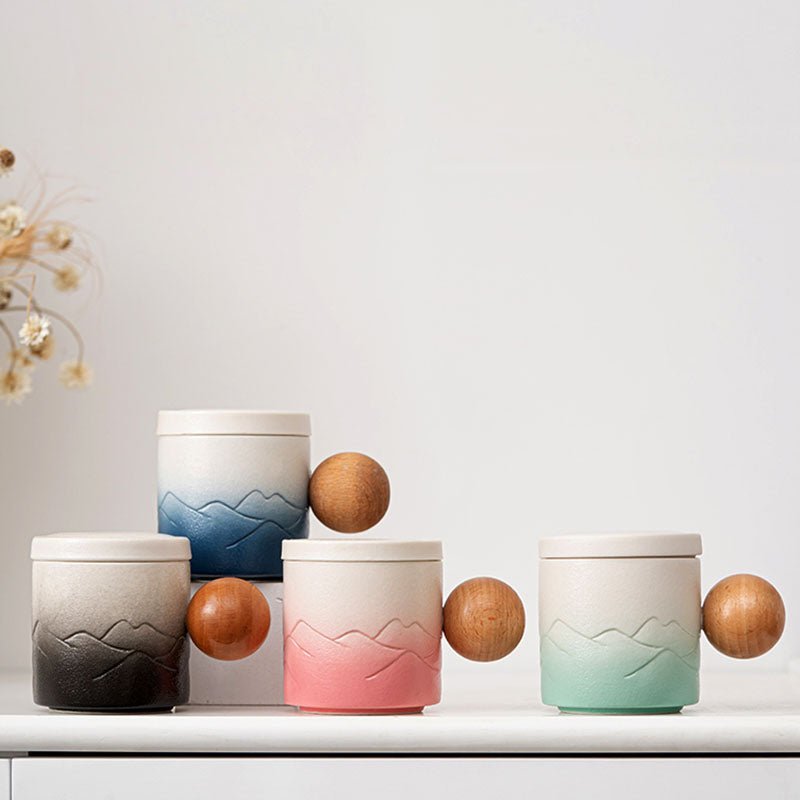
Ball Handled Ceramic Tea Mug Gift: What Buyers Should Compare
Reading time: about 12 minutes
The box opens, the recipient wraps a thumb and forefinger around a solid knob instead of sliding a finger through a loop, and three seconds later you both know whether the gift landed. A ball handle is a sculptural decision — a rounded knob or sphere joined to the cup wall — and it changes grip, balance, and how the piece survives a courier. In our store, the questions that arrive before a ball handled ceramic tea mug gift purchase are almost never about color. They are about heat, capacity, glaze testing, and what is actually inside the box.
Which “ball handle” is actually in your cart?
Search results for this phrase pull at least four different objects into one grid, and shoppers compare them as if they were interchangeable:
- A solid ceramic knob or sphere, thrown or cast in the same clay body as the cup — what most people mean by “ball handle.”
- A turned wooden ball, fixed to a ceramic stub with adhesive and sometimes pinned through for strength.
- A sports-ball print — soccer, golf, or tennis graphics on an ordinary loop-handle mug.
- Ball-brand glass jars, which are mason-style drinkware and have nothing to do with handle shape.
By title, our ball-handled coffee and tea mug sits in the first family: a ceramic mug with a ball handle, not a printed sports graphic. What the ball itself is made of — glazed clay or a turned wood knob — is the detail to confirm on the current listing before you order, because those two materials behave very differently in a dishwasher and in a microwave.
Is a ball handled ceramic tea mug gift the right fit for your recipient?
Gift buyers reach this decision from three directions, and the answer is different for each one.
- The desk tea drinker. Loose leaf in a basket infuser, the mug parked beside a keyboard, two or three steeps a day. The knob question matters less than whether a lid and infuser come with the mug and whether the handle clears the rim line.
- The housewarming or holiday gift. Here the sculpture is the point — the mug has to look considered before it is ever filled. Gift boxing and how the protruding handle is packed in transit matter more than capacity.
- The daily-use replacement. Someone whose current mug has a chipped rim and who will carry a full mug from the kitchen to the sofa. Grip and heat retention matter more than looks.
Recipients in the first two groups get real pleasure out of a sculptural shape. For the third, read the grip section below before you commit. Our collection of unique coffee mugs mixes sculptural bodies with conventional loop handles, which helps when you are buying for a household rather than one person.
Does the knob stay cool enough to pinch when the mug is full?
This is the question buyers send us most often, and almost no listing answers it. Ceramic conducts heat, so a knob bonded directly to a hot wall will warm up. How fast depends on how much clay sits between the tea and your fingers, how chunky the knob is, and how long you hold on. A knob that stands further out from the body gives heat more distance to travel and generally feels cooler longer than a stubby one pressed close to the wall.
Two habits from our own morning routine help. Preheat the mug with hot tap water for about thirty seconds before the first steep, so the ceramic is not pulling heat out of your tea, and lift a full mug by the knob from the side rather than from the top — you get more skin contact and better leverage, and the mug stays level.
Grip mechanics matter as much as temperature. Most people hold a ball handle with a pinch — thumb on top, index finger underneath — rather than hooking a finger through a loop. That is a small contact patch, and the mug is carried partly by friction, so it has to stay level. A loop hangs from a finger and lets you carry two mugs at once. A ball asks for a light, deliberate squeeze instead.
For a desk mug that travels from counter to keyboard and back, the pinch is fine. For stairs, a brimming mug, and one free hand, it is a genuine difference. If a weaker grip is the deciding factor, say so out loud rather than buying the sculpture and hoping.
What has to be in the box before the tea gift works?
Gift buyers get caught by the same six details over and over. Work through this list before checkout:
- Two capacity numbers. A “12 oz” claim usually means to the brim, not a comfortable fill. FDA’s own definition of a cup or mug as small hollowware cites roughly 240 mL (8 fl oz) as the typical size — a useful benchmark when a listing quotes a big number. Ask whether the figure is brim-full or working volume.
- Rim diameter and handle height. If the ball rises above the rim line, a flat lid will not seat and a basket infuser can tilt. Ask for a side-on photo with the lid on.
- Infuser and lid, included or not. A tea gift without a strainer is a mug gift. Loose-leaf drinkers need to know whether the basket is ceramic, stainless, or absent altogether.
- A named glaze statement. “Non-toxic” is a word, not a test result. More on that below.
- The actual box. A retail gift box is a different object from a poly bag and a hang tag, and it decides whether you still need to wrap.
- How the handle joint is packed. A handle protruding sideways is the first thing to take a hit in transit. Ask whether the mug ships in a molded insert or is double-boxed.
Is “food safe” a leach test result or a marketing word?
Both get used, and the difference matters for drinkware holding hot, slightly acidic tea every day. FDA sets an action level for lead in ceramic cups and mugs at 0.5 micrograms per milliliter of leaching solution, judged on any one of six units tested, and applies the same 0.5 µg/mL threshold to cadmium in small hollowware. Those are the numbers a real leach test is measured against.
Firing is the variable. Pottery fired at the right temperature for the right time binds essentially all the lead into the glaze, and migration to food becomes insignificant. Underfired ware can leave lead unfused and leachable — and no amount of washing, boiling, or scrubbing at home removes it. FDA guidance also states that ceramicware containing extractable lead should not carry a “Lead Free” label, so a lead-free badge only means something if the maker can point to the test behind it.
FDA consumer guidance flags specific categories as higher risk: crudely made or irregular handmade pottery, antiques, damaged or worn pieces, flea-market and unknown-maker ware, and pieces decorated in bright orange, red, or yellow, where lead pigments are common. Everyday factory-made commercial pottery is far less likely to be a problem. One labeling rule is worth knowing too: ornamental ceramicware that looks food-safe is treated as food use unless it carries both a stick-on warning (“Not for Food Use. May Poison Food”) and a permanent version on the base, or a hole through the food-contact surface.
The practical move for a gift is one email: ask for the glaze statement and whether the maker names the leach test behind it. Our own buyer-side comparison of ball-handled ceramic tea mugs walks the same checklist from the other side of the transaction.
Microwave-safe and dishwasher-safe are two separate answers
Buyers treat these as a matched pair. They are not, and a mug can easily be one without the other. USDA food safety guidance is blunt: use only cookware specially made for microwave use, and glass or ceramic that is microwave-safe is usually labeled as such. China with metallic paint or trim is not safe to microwave, because microwaves react to the metal — USDA calls the resulting sparks arcing, and prolonged arcing can damage the oven or the dish.
A few habits prevent most of the problems we hear about:
- Pull the infuser out. A stainless basket left in the mug during heating is metal in a microwave, full stop.
- Check the trim. A gold or platinum rim is decorative, and decorative means not microwave-safe no matter what the rest of the page says.
- Run the one-minute test. USDA’s check for an unlabeled piece is to heat it for one minute beside — not touching — a cup of water; if the mug itself feels warm or hot, it is not microwave safe.
- Trust the more cautious instruction. If the product page says microwave safe but the care card in the box says otherwise, follow the card and ask the seller to reconcile the two.
- Heat in short bursts. One minute, not five, then check the knob temperature before committing a full mug to a bare hand.
A wood ball and a ceramic ball age differently
This is the care split buyers overlook most often, and it is the one that decides whether a gift still looks new in a year. An all-ceramic ball is one material from cup to knob, so it dries at the same rate and tolerates the same washing as the body — subject to whatever the maker says about glaze and trim.
A wooden ball is a joint between two materials that expand and contract at different rates. Whether it is only glued or also pinned changes how much you should worry. Hand wash it, dry it promptly, and keep it out of long dishwasher cycles and the microwave entirely; prolonged soaking is what softens adhesive and dulls an oiled finish.
| Handle style | How it is held | Washing | Microwave | Best fit |
|---|---|---|---|---|
| All-ceramic ball | Pinch between thumb and forefinger | Follow the maker’s glaze and care statement | Only if the maker labels the piece microwave safe and there is no metallic trim | Sculptural gift, desk use, slow morning tea |
| Wooden ball | Same pinch, on an oiled surface | Hand wash and dry promptly; avoid soaking | Not a good idea — wood and adhesive do not belong in a microwave | Dry-handed drinkers who will hand wash |
| Loop handle | Weight hangs from one or two fingers | Same as the mug body | Same as the mug body | Weaker grip, carrying two mugs, commuters |
We would rather say this now than process the return later: if you are gifting someone who runs everything through the dishwasher on a hot cycle, a wooden handle is the wrong pick.
Who should get a loop handle or a sealed travel mug instead?
A ball handle is not a universal upgrade:
- Anyone with limited grip strength, arthritis, or a tremor. A loop spreads load across several fingers; a knob concentrates it into a sustained pinch. Ask the recipient which they prefer before deciding for them.
- Commuters and travel-mug users. A sealed stainless tumbler wins on spill risk every time.
- Someone who stacks mugs. The knob protrudes and blocks clean stacking in a cupboard.
- Two-mug carriers. Walking to a meeting with a mug in each hand is easier with a loop to hook.
- Anyone who microwaves with the strainer still in. That is a metal-in-microwave habit rather than a mug flaw, but it is worth naming out loud.
If none of those describe your recipient, the shape is a genuine pleasure to use, and it reads as a considered gift rather than a default one.
Match the mug to a hand and a routine, then check the listing
The mug that gets used every day is the one that fits a specific hand and a specific habit. Loose-leaf drinkers need the infuser question answered. Desk workers care whether the knob stays cool through a second steep. Gift-givers care about the box and the shipping insert. None of that shows up in a hero image.
Before you buy, confirm five things: the ball material, the comfortable capacity, whether the lid and infuser are included, the glaze statement, and how the handle is protected in transit. Silence on any of them is an open question, not a yes.
Start with the ceramic mug with a ball handle if sculpture is the point of the gift, then browse the unique handle ceramic tea mugs in our collection if you need a loop for a weaker grip or a shape that stacks. Buy the one that matches the hand you are gifting to, not the one that photographs best.
Frequently asked questions
Does the ball handle get hot when the mug is full of hot tea?
It warms up, because ceramic conducts heat from the tea through the wall and into the knob. How quickly depends on the thickness of the knob and how far it stands out from the body. Test it with two fingers before carrying a full mug across a room.
Is a ball handled ceramic tea mug gift usually microwave and dishwasher safe?
Treat those as two separate questions and check the specific listing for each — one does not guarantee the other. Never microwave a mug with a stainless infuser basket or metallic trim inside, and if the care card contradicts the product page, follow the more cautious instruction.
Is a ball handle easier to hold for someone with arthritis?
Often not. A loop handle lets the weight hang from several fingers, while a ball asks for a sustained pinch between thumb and forefinger. For a recipient with limited grip strength or a tremor, a loop or a two-finger side handle is usually the safer gift.
How do I verify the glaze is actually lead-free?
Ask the seller for a named glaze statement and the leach test behind it, not just the phrase “non-toxic.” FDA’s action level for lead in ceramic cups and mugs is 0.5 micrograms per milliliter of leaching solution on any one of six tested units, and ware containing extractable lead should not be labeled lead free.
Will a tea infuser or lid sit flat if the ball handle rises above the rim?
Only if the handle sits below or clear of the rim line. A knob that arches above the rim will lift a flat lid and can tilt a basket infuser. Ask for a side-on photo of the mug with the lid on before you buy it as a tea gift.
More from our blog
Ready to pick your mug? Two ways to save on today's order:
Ordering 1–3 mugs? Get an extra 10% off your 1st order with code 10_OFF Apply 10% Off & Shop Wooden-Handle Mugs →
Gifting 4+ mugs? Buy 3, Get the 4th Free applies automatically at checkout (no code needed; offers do not stack) · Free standard shipping (Nov pre-Christmas delivery: 15–20 calendar days US) · Free replacement if chipped in transit.
Popular mug buying guides: Ceramic Tea Cups & Infuser Mugs · Ceramic Mugs with Lids Compared · Wooden-Handle Tea Infuser Mugs Compared · Christmas & Secret Santa Mugs 2026 · Espresso & Cortado Cups Guide · Cup & Saucer Gift Sets · All 25 Mugs Spec Table · Mug Size Guide · Shipping & Promo FAQ
FIRST ORDER 10% OFF (CODE: 10_OFF) · OR BUY 3, GET THE 4TH FREE


Read more
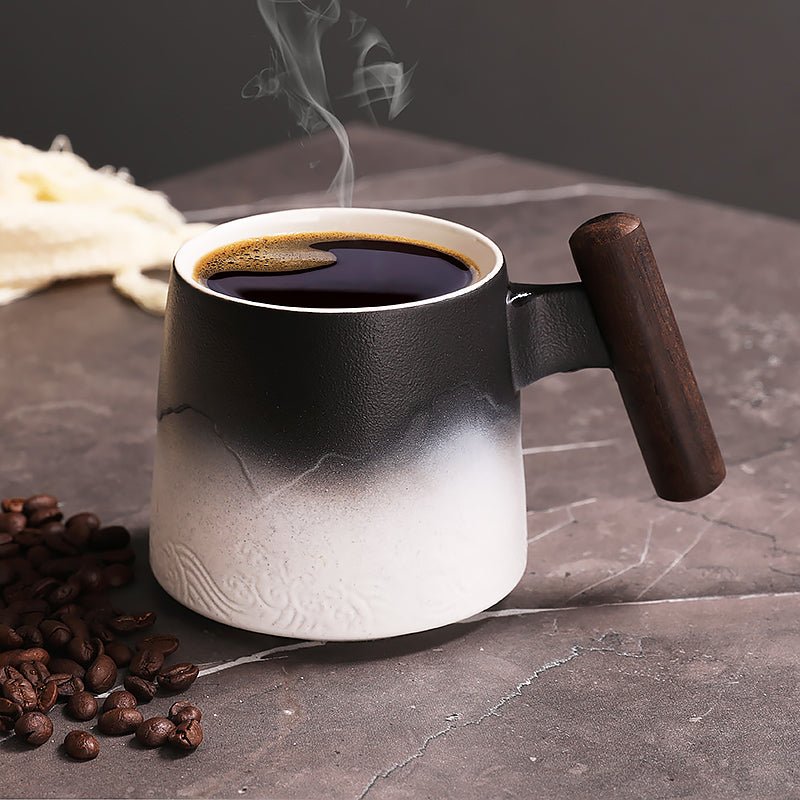
Mountain Mug vs Coffee Mug vs Tea Mug Differences Buyers Need
A mountain mug can be a mountain-scene tabletop mug or a camp mug, and coffee mugs and tea mugs are not standardized either. Here is how capacity, material, lead safety, residue, lids, and care act...
Read more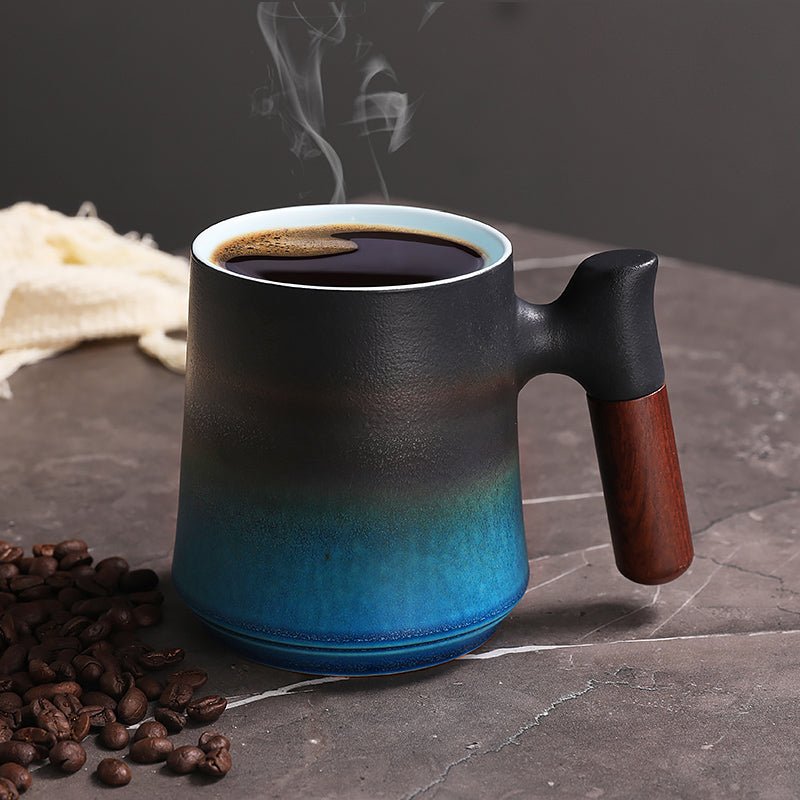
Gradient Mug Gift Checklist: What to Compare Before You Buy
A working gradient mug gift checklist from a store that ships these pieces: how the color was applied, food-contact labeling, the real meaning of dishwasher and microwave claims, capacity versus fi...
Read more
Leave a comment
This site is protected by hCaptcha and the hCaptcha Privacy Policy and Terms of Service apply.