

Ball Handled Coffee Tea Mug Buying Checklist: 8 Checks
Reading time: about 9 minutes
A ball handle can feel comfortable while a mug is empty, then awkward once the drink shifts the weight away from your hand. We see the same sequence when shoppers first handle this shape: they wrap their palm around the sphere, check whether their knuckles touch the cup, and inspect the narrow connection between handle and body. This ball handled coffee tea mug buying checklist focuses on those practical details, not just how distinctive the mug looks in a product photo.
The item currently appears in our catalog as the Ball Handle Ceramic Coffee Mug. That title identifies the mug as ceramic, but it does not establish its capacity, dimensions, ball material, attachment method, care requirements, or appliance compatibility. Those details must be checked on the live listing. Shoppers still deciding between handle shapes can also compare the options currently shown in our unique coffee mugs collection.
Ball handled coffee tea mug buying checklist: test grip before style
A traditional loop lets your fingers support the mug from inside the handle. A spherical handle uses a different grip. You may wrap your palm around it, pinch it between your fingers and thumb, or support it from below. The best method depends on hand size, the surface finish, and how far the ball sits from the hot cup wall.
For online buying, examine three points before deciding that the handle is comfortable:
- Ball scale: Look for a hand-held photo or listed diameter. If a dimension is provided, trace that circle on paper and compare it with the grip you naturally make.
- Knuckle clearance: A short stem may place fingers close to the mug body. A longer stem offers more space but holds the drink farther from the wrist.
- Surface texture: A polished sphere may feel smooth and attractive, but wet or lotion-covered hands can have less purchase than they would on a matte or lightly textured surface.
Do not assume that a round grip is automatically ergonomic. Someone who likes holding a cabinet knob may enjoy it; someone who relies on locking two fingers through a loop may not. For reduced grip strength, hand pain, or uncertain fit, dimensions and the return terms matter more than decorative styling.
Which handle details reveal balance and attachment quality?
The center of the drink sits inside the cup while your hand sits outside it. As capacity and fill weight increase, the wrist has to manage that offset. Product photos taken straight from the side are useful because they show the ball's position relative to the mug body, base, and rim. Angled lifestyle photos can hide a cramped stem or unusually high handle position.
The attachment deserves a separate check. A ball may be formed as part of a ceramic handle or added as a separate component using a stem, pin, dowel, or adhesive. The exact construction of the linked mug is unconfirmed unless the current product page states it. Look for a close photograph of the joint and inspect these areas after delivery:
- A ball that rotates or wobbles when it is not designed to move
- A visible gap where the stem enters the ball or cup
- Hairline cracks around a ceramic connection point
- Adhesive residue, rough edges, or misalignment
- A handle that causes the empty mug to rock on a flat counter
Test the joint dry before adding a hot drink. Hold the mug over a counter, support the body with your other hand, and apply only light pressure. A loose connection is a reason to stop using the mug rather than testing it under a full load.
How do ceramic and mixed materials change cleaning?
The word ceramic does not settle the care question. The ball, internal pin, stem, finish, and adhesive may have different limits from the cup itself. In our store, we treat dishwasher and microwave claims as exact-product facts: the current listing must state them clearly. An appliance-safe claim from a similar-looking mug does not transfer to this one.
Before ordering, confirm all four care points:
- Dishwasher use: Check for written guidance, including whether a top rack or low-heat cycle is specified.
- Microwave use: Verify the complete mug, not only the ceramic portion. An unlisted internal component can change the answer.
- Cleaning around the stem: Narrow joints can collect coffee, tea, or dishwater. Check whether the shape is reachable with a soft sponge or small cleaning brush.
- Material-specific care: If the listing identifies a wooden ball, follow its drying or conditioning directions. Do not soak or oil it based on advice for another product.
If appliance compatibility is missing, ask before purchase rather than treating silence as approval. A one-piece loop mug is usually a better fit for a household where every cup goes directly from the breakfast table into a high-heat dishwasher cycle.
What capacity fits coffee, tea, and desk use?
Capacity should match the drink you actually make, not the largest number that looks useful. Measure your current favorite mug by filling it to your normal drinking line and pouring that water into a measuring cup. Compare the result with the listed usable capacity, and check whether the seller's number represents a comfortable fill or a brim-full measurement.
Use case changes the buying decision:
- Coffee with milk: Leave headroom for milk, foam, stirring, and carrying the mug from the kitchen counter.
- Loose-leaf tea: Compare the rim diameter and cup depth with your basket infuser. A hanging chain or tea-bag string cannot rely on a ball in the same way it can rest against a loop.
- Long office sessions: A larger pour reduces refills but adds weight at the end of the spherical handle. Check base stability and desk clearance.
- Iced coffee: Condensation can make a smooth ball harder to grip. A tumbler with a lid may be more practical if you walk between rooms or commute.
A ball-handled ceramic mug is not a substitute for a sealed travel mug. If your priorities are a lid, cup-holder fit, one-handed opening, or carrying a drink on stairs, choose a purpose-built travel style instead.
What should the listing say about food contact and durability?
Food-contact language should apply to the exact mug and its glaze. The FDA guidance for pottery and ceramics lists an action level of 0.5 micrograms per milliliter for leachable lead in cups and mugs when tested using the methods in CPG Sec. 545.450. That regulatory action level is not a certification for the CoffeifyMug product, and we will not present it as one.
Look for a clear food-contact statement on the current listing. If the page uses terms such as food-safe or lead-free, those statements should refer to this exact product rather than the seller's general category. Questions about testing should go to customer support before the mug becomes a daily coffee or tea cup.
On arrival, inspect the inside, rim, base, and handle joint under bright light. Chips at the drinking edge, sharp glaze ridges, deep cracks, an unstable base, or movement at the ball attachment are practical reasons not to use the mug with hot liquid. Keep the packaging until the inspection is complete, especially when the mug is intended as a gift.
Which buyers gain from a ball handle, and who needs a loop?
A spherical handle makes the most sense for a shopper who values tactile design, has shelf storage, and is willing to verify the care instructions. For that situation, open the ball-handled coffee tea mug product page and compare every available specification with your normal drink and cleaning routine.
Choose another handle style if you need to hang mugs on hooks, lock your fingers through a loop, use a dishwasher without special handling, or carry a full cup through a busy workplace. Gift buyers should also consider the recipient's hand size and habits. A visually unusual mug can make a memorable unboxing, but it is a poor match for someone who only uses lidded tumblers or oversized pours.
If the ball shape is appealing but grip or care remains uncertain, use the unique mug collection to compare the handle shapes currently available. The right next step is the option that fits the recipient's routine, not simply the most unusual silhouette.
Eight listing checks to complete before checkout
Run this table against the live product page. In this ball handled coffee tea mug buying checklist, a missing detail remains unconfirmed until the listing or seller answers it.
| Buyer check | Detail to confirm | Reason it matters |
|---|---|---|
| Grip | Ball diameter, texture, and hand photo for scale | Shows whether you can wrap or pinch it securely |
| Clearance | Stem length and distance from the cup wall | Helps prevent cramped knuckles |
| Balance | Handle height, cup shape, and stated capacity | Changes wrist leverage when the mug is full |
| Materials | Cup, ball, stem, pin, and finish materials | Determines which care questions need answers |
| Appliances | Explicit dishwasher and microwave guidance | Prevents assumptions based on ceramic alone |
| Attachment | How the ball connects and whether it should move | Makes wobble easier to identify as a defect |
| Drink fit | Usable capacity, rim width, and infuser clearance | Matches the mug to coffee, milk, or loose-leaf tea |
| Storage | Base footprint and shelf space | Ball handles may not work with hooks or mug trees |
Frequently asked questions
Is a ball handle more comfortable than a regular mug handle?
There is no universal winner. A sphere suits people who like wrapping or pinching a solid grip, while a loop gives the fingers a more defined hold. Compare ball size, stem clearance, surface texture, and full-mug balance before deciding.
Can a ball-handled ceramic mug go in the dishwasher or microwave?
Only use either appliance if the exact product listing says the complete mug is compatible. Ceramic construction alone does not answer questions about the ball, stem, pin, finish, or adhesive. If the guidance is absent, contact the seller before purchase.
Will a ball handle work with a tea infuser?
A basket infuser may work if its diameter and depth match the mug's rim and interior. Check those measurements on both products. Tea-ball chains and bag strings may be less convenient because there is no loop opening to hold them in place.
What should a ball handled coffee tea mug buying checklist include?
A useful ball handled coffee tea mug buying checklist should cover grip scale, knuckle clearance, balance, stated capacity, materials, appliance limits, attachment construction, food-contact language, infuser fit, and storage. Treat any missing product detail as unconfirmed rather than borrowing a specification from another mug.
Open the live product listing, complete all eight checks, and compare the answers with the mug you already use most. If grip, care, or capacity remains a mismatch, return to the unique coffee mugs collection and choose a handle shape that better suits the kitchen, desk, or recipient.
More from our blog
Read more
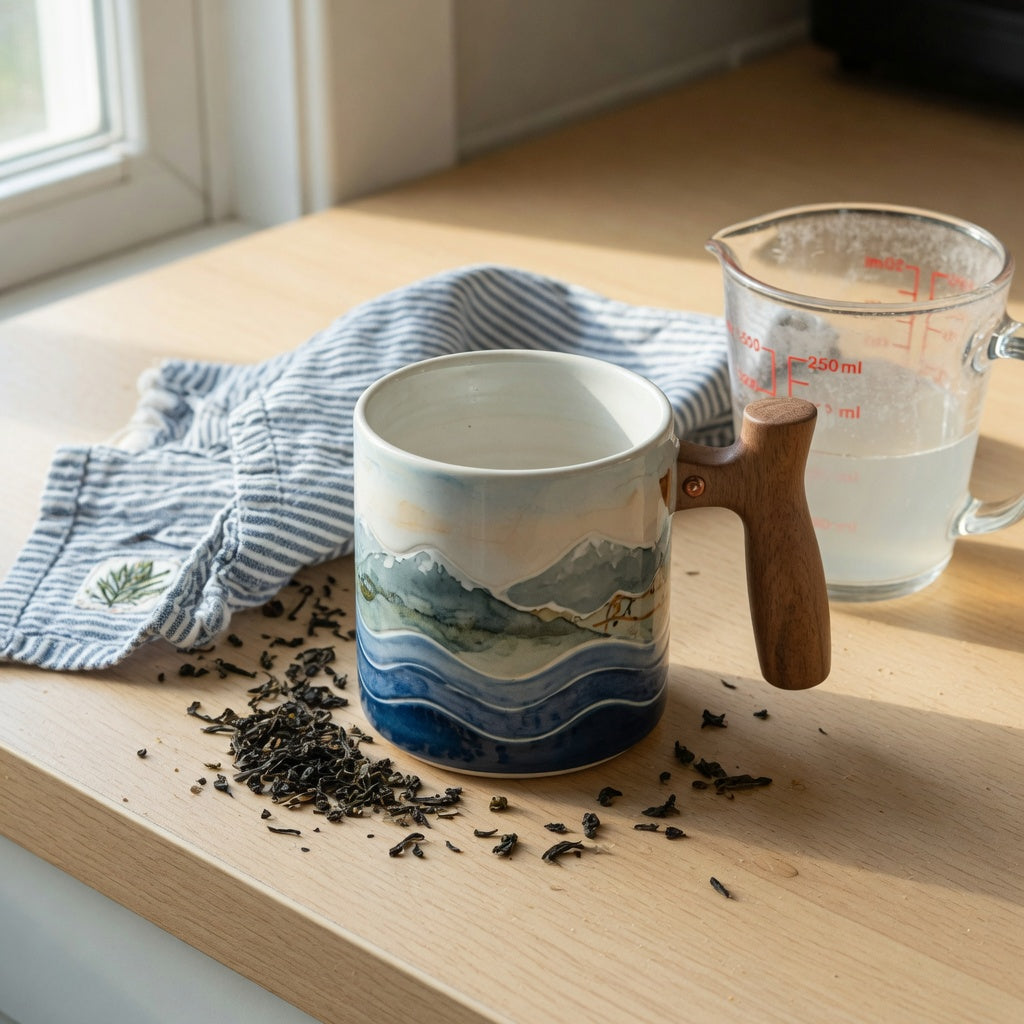
Mountain Sea Coffee Mug Wooden Handle: Buyer Checklist
Compare the details product photos often hide: body material, handle clearance and attachment, usable capacity, included pieces, and realistic wood care. This guide shows how to verify the current ...
Read more
Unique Ceramic Mug Gift Checklist: 9 Checks Before Buying
Compare the details that decide whether a ceramic mug becomes a daily favorite or shelf clutter: food-use status, genuine uniqueness, capacity, handle comfort, care, glaze condition, and shipping p...
Read more
Leave a comment
This site is protected by hCaptcha and the hCaptcha Privacy Policy and Terms of Service apply.