
Ball Handled Ceramic Tea Mug: What Buyers Should Compare
Reading time: about 10 minutes
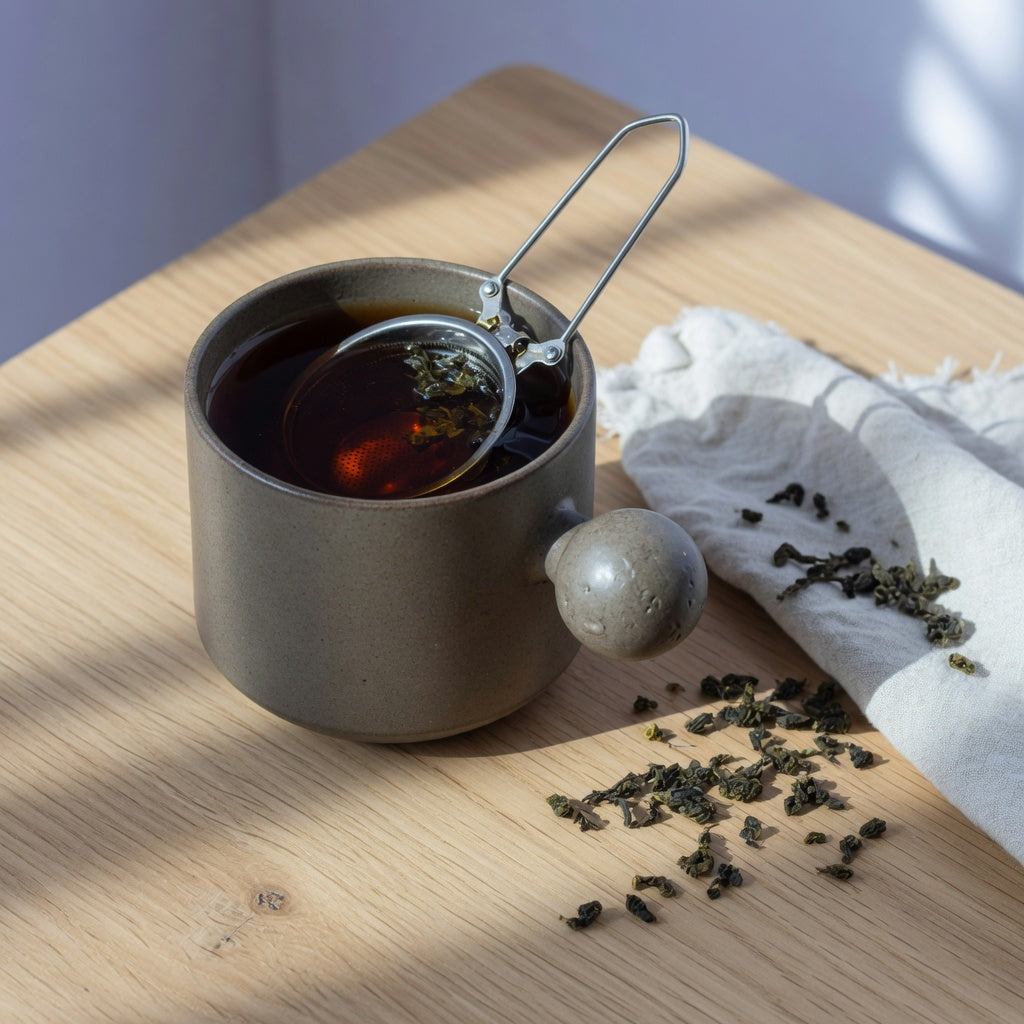
Most mugs get held the same way: three fingers through a loop, thumb on top. A ball handled ceramic tea mug breaks that habit. You pinch a rounded knob between your thumb and forefinger while your remaining fingers cradle the body — a grip that looks sculptural on a shelf and feels genuinely different once the mug is full of steaming tea.
We handle these mugs constantly in our store: unboxing them, packing them as gifts, testing how they balance on a counter or desk. Photos can't show grip comfort, how heat moves through a handle, or how a vessel behaves when it's heavy with liquid. This is the comparison we'd walk a customer through before they commit — grip mechanics, clay and glaze choices, infuser fit, care, and the trade-offs that make this style wrong for some hands.
What exactly is a ball handled ceramic tea mug — and how does the grip differ?
A ball handle is a solid, rounded knob attached to the side of the body rather than an open loop you slide fingers through. The term creates real confusion, because vintage tavern and diner mugs also get called “ball handle” styles — those had thick, partially closed loops set low on the body. The knob-style mug buyers search for today is the modern sculptural version: a single spherical grip point, most often on porcelain or handmade stoneware, frequently paired with a stainless infuser and lid for loose-leaf brewing.
Side by side with the handles you already know:
- D-handle: an enclosed loop that accepts two or three fingers. Familiar and secure, but a thin loop concentrates the mug's weight on small contact points.
- C-handle: an open curve — easy to hang on a hook, with less enclosure around the fingers.
- Ball handle: a pinch grip. Thumb and index finger control the knob while the rest of the hand supports the body from below.
How does a knob grip feel when the mug is full of hot tea?
The physics matter more than the look. A compact ball with a narrow neck presents less surface to the hot liquid inside than a large loop pressed flat against the wall, so the knob warms more slowly — in our experience it stays comfortable through a normal steep. No ceramic handle stays cool indefinitely, though. After several minutes with freshly boiled water, heat migrates through any clay, and most people shift naturally to supporting the base with a flat palm.
The honest trade-offs:
- Grip strength: pinching a knob demands more finger force than sliding fingers through a D-handle. If arthritis or a weak grip is part of your daily reality, a traditional loop handle is the better choice.
- Carry confidence: a knob is made for sipping at a desk or kitchen table, not for one-handed carrying while walking or driving. This is not a travel mug.
- Hand size: larger hands usually prefer cupping the body alongside the knob; smaller hands find the pinch naturally comfortable.
- Handle joint: the neck where the sphere meets the wall is the structural stress point on any ceramic knob handle. Give it a quick check after every hard knock.
Stoneware, porcelain, or celadon: which clay body fits your tea habits?
Ball-handle tea mugs are typically high-fired stoneware or porcelain, with celadon glazes common on Chinese-influenced designs. Each behaves differently in daily use:
- Stoneware: dense and sturdy, with wall thickness that keeps tea warm longer at your desk. The trade-off is weight — you'll notice it when the mug is full.
- Porcelain: refined white clay that allows thinner walls and crisper detail around the handle attachment. Lighter in the hand, but tea cools a little faster.
- Celadon glaze: a translucent, green-toned finish over porcelain or stoneware. Pale celadon interiors show black-tea tannin rings more readily, which matters if you drink strong black tea daily.
Glaze safety is worth one direct question to any seller: confirm the glaze is lead-free and cadmium-free and rated food-safe for hot beverages, especially on decorated or imported pieces. A smooth, fully covered interior also resists tannins settling into microscopic pores and prevents flavor carryover between a smoky black tea and a delicate green. If a listing doesn't state food-safety clearly, ask — any maker producing mugs for hot drinks should answer in a sentence.
Will your infuser and lid actually fit a ball handle mug?
Loose-leaf drinkers should judge the top of the mug before the handle. Most stainless infuser baskets rest on broad arms across a flat, circular rim, and ceramic lids sit the same way. A knob that rises above the rim line can tilt the basket or lid, so look for handle placement at or below rim height, and check whether an infuser is included or sold separately. Our Ball Handle Ceramic Coffee Mug draws exactly these questions — verify its current capacity, included accessories, and care instructions on the listing itself, because those details vary between variants and production runs.
Capacity is the other half of the fit. Ceramic tea mugs in this category commonly run from about 10 oz (300 ml) toward 16 oz (470 ml). Below 9 oz you're hiking back to the kettle constantly; a 20-ounce vessel gives delicate greens time to oversteep and cool before you finish them. If you already own an infuser basket, measure its diameter against the mug's rim instead of guessing — our ball-handled mug buying checklist walks through those measurements step by step.
Ball handle vs. D-handle vs. glass vs. gaiwan: which earns your daily slot?
Here's how the styles compare on the criteria buyers raise most often. Treat the entries as describing typical examples of each style — individual listings vary, so verify specifics before buying.
| Criterion | Ball Handled Ceramic | D-Handle Stoneware | Double-Wall Glass | Gaiwan |
|---|---|---|---|---|
| Grip | Pinch knob, palm cradle | Enclosed finger loop | Loop or handleless | Lid and saucer pinch |
| Heat at the grip | Warms slowly, shifts to base over time | Thin loops can pass heat quickly | Air gap keeps hands cool | Handled only via saucer |
| Tea heat retention | Good in thick-walled stoneware | Good to very good | Moderate; liquid cools faster | Lower; built for short multi-steeps |
| Chip behavior | Stoneware resists; porcelain chips show sharply | Similar to ball-handle stoneware | Thin glass fractures | Delicate rims |
| Loose-leaf workflow | Rim infusers work well | Rim infusers work well | Needs non-scratch strainers | Built-in lid straining |
| Best for | Desk sipping and slow mornings | Everyday utility, weaker grips | Watching leaves unfurl | Ceremony-minded sessions |
If a knob grip sounds wrong for your hands, let the table disqualify it — a comparison should rule styles out, not just sell one. If the sculptural route appeals, the Ball Handle Ceramic Coffee Mug is our direct match, and you can compare it against our full unique coffee mugs collection to weigh other handle shapes and glazes side by side.
Care questions we hear weekly: dishwashers, tannin stains, and thermal shock
Even when a ceramic mug is labeled dishwasher safe, hand washing protects the finish long-term. Dishwasher detergents are mildly abrasive, and repeated cycles gradually dull reactive, matte, or hand-painted glazes — the shine softens over months rather than in one wash, which is why the change is easy to miss until you set an old mug next to a new one.
Tannin rings are the most common cosmetic complaint we hear, especially from readers who drink black tea or chai at an office desk every day; our office tea mug comparison covers that daily routine in more depth. Skip steel wool and abrasive pads — they scratch clear glaze and leave microscopic grooves where the next round of stains settles faster. This method lifts rings instead:
- Sprinkle about a tablespoon of baking soda into the damp mug.
- Add a few drops of warm water to form a soft paste.
- Gently rub the interior with a soft sponge or cloth.
- Rinse well — the mild alkalinity lifts tannins without scratching the glaze underneath.
Thermal shock is the quieter mug-killer. Pouring boiling water into cold ceramic, or setting a hot mug on a cold stone countertop, stresses the body. Warm the mug first with hot tap water, use a wooden or silicone coaster on granite, and let a mug that traveled in a cold car reach room temperature before filling it from the kettle.
Gifting a ball handled ceramic tea mug without a shipping disaster
This style gifts well for a specific reason: the spherical handle reads as deliberate design rather than default drinkware. It suits loose-leaf tea drinkers, home-office workers who want one mug worth keeping on the desk, and people who collect sculptural ceramics. It suits a commuter far less — most ceramic tea mugs in this style aren't sealed travel vessels, so check what the listing includes before wrapping one for someone who drinks in the car.
The handle also changes shipping. The knob extends sideways from the body, so the joint between sphere and wall is what cracks when a box gets crushed. Order gifts from sellers who pack with molded inserts or a snug corrugated matrix rather than loose bubble wrap, and have the box come to you first if you want to inspect the handle joint before handing it over. Paired with a tin of loose-leaf tea and a stainless infuser, the mug becomes a complete brewing kit instead of a single object.
Frequently asked questions
Does the ball handle on a ceramic tea mug get hot?
The knob warms more slowly than a large loop because less of its surface contacts the mug wall, and it usually stays comfortable through a normal steep. Heat still migrates through any ceramic given time, so after several minutes with boiling water most people support the base with a flat palm. Wall thickness on the specific mug affects this, so check the material details on the listing.
Is a ball handled ceramic tea mug microwave and dishwasher safe?
It depends on the clay body, glaze, and any metallic luster accents, so treat the listing's care section as the final word rather than general category advice. Glazes with metallic decoration should never go in a microwave, and hand washing with mild soap protects reactive or hand-painted finishes far longer than repeated dishwasher cycles.
How much tea does a ball handled ceramic tea mug hold?
Most ceramic tea mugs in this style fall roughly between 10 and 16 oz (300–470 ml), though the range shifts by design. Confirm the exact capacity in the product listing before buying, especially if you're matching an infuser basket or teapot you already own.
Can I use a loose-leaf infuser with a ball handle mug?
Yes, provided the rim is flat and circular and the handle stays at or below rim height so the basket or lid sits level. Some ball-handle mugs ship with a stainless infuser and lid; others are the mug alone. The listing for the Ball Handle Ceramic Coffee Mug states what's currently included.
Is a ball handle mug a good gift for someone with arthritis or a weaker grip?
Usually not, and we say that plainly. Pinching a knob takes more finger strength than sliding fingers through an enclosed loop, and a full mug amplifies the effort. For those recipients we'd steer you toward a traditional loop-handle stoneware mug instead.
A five-point checklist before you order
Run through this before checkout and you'll avoid the surprises we most often see:
- Capacity: confirm exact ounces or milliliters on the listing, not from product photos.
- Glaze safety: look for an explicit lead-free, cadmium-free, food-safe statement for hot beverages.
- Infuser and lid: verify what's included and whether the handle clears the rim line.
- Care instructions: check microwave and dishwasher guidance for the specific glaze.
- Packing method: molded inserts protect the handle joint far better than loose wrap.
If the knob grip matches how you actually drink tea — seated, unhurried, loose-leaf in the basket — our Ball Handle Ceramic Coffee Mug is the straightforward place to start. If you'd rather weigh other handle shapes and glazes first, the unique coffee mugs collection is built for exactly that comparison.
More from our blog
Read more

Landscape Coffee Mug Gift: What Buyers Should Compare
A practical comparison of landscape coffee mug gifts: capacity (350 ml vs. 15 oz), print durability, glaze safety, microwave rules, and shipping protection — written by the team that packs and ship...
Read more
Best Flat White Cups for Home: What Buyers Should Compare
A practical comparison of capacity, group-head clearance, heat retention, and glaze safety for home flat whites — plus how our 200 ml, 250 ml, and 270 ml cups match different coffee routines and ma...
Read more
Leave a comment
This site is protected by hCaptcha and the hCaptcha Privacy Policy and Terms of Service apply.