
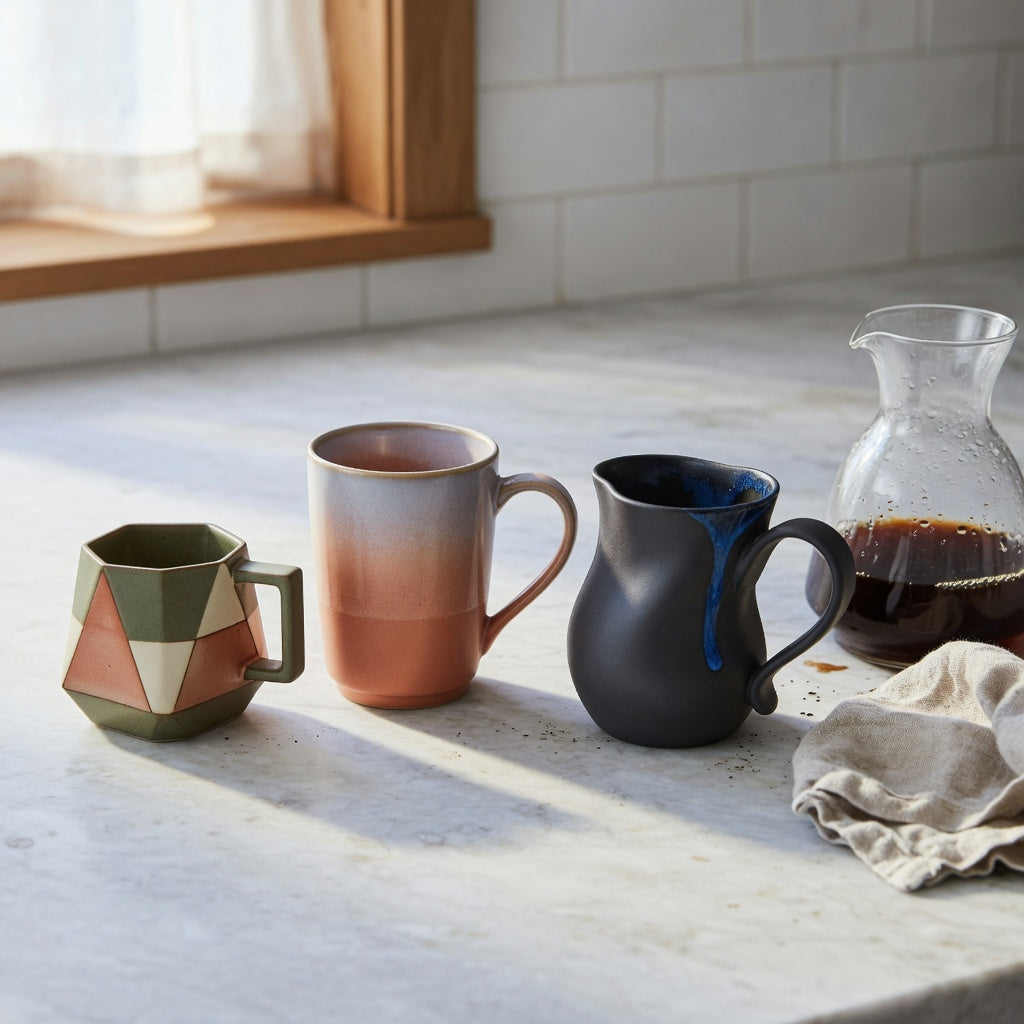
Abstract Geometric Ceramic Mug: Form, Fill, and Care
Reading time: about 12 minutes
A customer will set two phones on our packing counter and ask which screen shows the real abstract geometric ceramic mug. One listing is a straight cup with triangles printed across the wall. The other changes shape between the fingers. Same search, two objects, and two ways a mug disappoints beside a kettle. In our store we settle that split before color or gift wrap. The care rules do not travel with the search phrase.
Is the abstract geometric ceramic mug a print or a form?
A printed mug keeps the geometry in the picture. The body is usually a familiar cylinder. The design may sit on one face or travel the full turn. You are buying the image, plus whatever process holds it to the surface. If the page never names that process, treat the method as unknown.
A form mug puts the geometry in the body or the finish. A rhombus-like outline, or a curve you can feel, is the design. There may be no printed motif at all. Color can move across the wall instead of drawing a line.
Three listings in our store answer that split differently. Handle room, weight, and care still have to come from the current page:
- Rhombus coffee and tea mug: 250 ml, geometric form. This is the piece for someone who wants the shape itself to read as geometry, not a picture of polygons on a standard cup.
- Gradient coffee and tea mug: 400 ml, color-transition finish. The visual is the shift in color, not a hard line drawing. Choose it when volume and that color shift matter more than angles.
- The Flow coffee and tea mug: 400 ml, sculptural curves. Abstract in the hand, softer than a hard-edged geometric form. If geometric means repeating angles you can count, this one will feel too fluid.
If you are still sorting silhouette from print, compare outlines in our unique coffee mugs collection before the artwork wins. We use abstract as a shopper lens: less slogan, more shape and surface. It is not a named art movement, and it is not a maker biography.
| Listing | Verified fill | Where the design lives | A poor fit when |
|---|---|---|---|
| Rhombus | 250 ml | Geometric form | You want a large milky pour or printed line art |
| Gradient | 400 ml | Color-transition finish | You want crisp polygons or one flat color |
| The Flow | 400 ml | Sculptural curves | You want countable angles or a travel lid |
Does 250 ml or 400 ml match the pour on your desk?
Pretty geometry disappoints people at the fill line. FDA guidance on lead in cups and mugs describes that category as small ceramic hollowware commonly used for coffee or tea above room temperature. Those cups normally, though not exclusively, hold about 240 ml (8 fl oz) and are usually made with a handle. That figure describes a typical cup in the guidance. It is not a size recommendation, and it is not a test result for any mug we sell.
Shoppers often arrive comparing an 11 fl oz printed mug, roughly 325 ml, with a 15 fl oz mug, roughly 444 ml. The Rhombus at 250 ml sits near that typical-cup description. It suits a short coffee, a concentrated pour, or tea you do not want sitting in a wide bowl. It is a poor match for a large coffee-shop order, a milky drink that needs headroom, or a morning you refill once and nurse until lunch.
Gradient and The Flow are both 400 ml. That is a fuller desk pour than the Rhombus, and a step under those common 15 fl oz printed listings. Filled, they carry more liquid. A geometric or sculptural wall can also feel bulkier than a straight cylinder at the same fill, because the silhouette can stick out past the liquid. We cannot quote height, diameter, or handle opening from the catalog note. Those numbers decide whether the mug clears a low shelf, sits in an office drawer, or leaves room for fingers when the wall is thick. Read them on the current page.
Gold lines, luster, and a microwave that was never promised
USDA guidance on microwave cooking is plain. Use only cookware made for the microwave. Glass and ceramic marked safe for microwave use are usually labeled that way. China with metallic paint or trim is not safe in a microwave. Gold luster, silver grids, and metallic geometric lines sit in that caution. A photo of shining lines is not a microwave claim.
Catalog notes for Rhombus, Gradient, and The Flow do not describe metallic trim. That silence is not a yes on microwave use. Appliance compatibility has to be written on the current listing. If the page does not say it, do not guess from the style name.
For an unlabeled utensil with no visible metal, USDA describes a check: microwave one cup of tap water in a glass measure placed beside the empty utensil, not touching it, on high for one minute. If the utensil feels warm or hot, it is not microwave safe, because the material or glaze is taking on energy. Skip that test if you can already see metal paint or trim. Do not drink from a cracked, crazed, or chipped glazed surface. A fine crackle network and pinholes are not just cosmetic on a cup that meets your mouth every morning. Retire it.
In our experience the mishap is rarely dramatic on day one. It is a hot handle after a rushed reheat, or a mug that was only ever meant to be washed by hand. If you reheat coffee every morning, buy the piece whose page states microwave use. If it does not, keep a plain microwave-safe cup for reheating and pour this one fresh.
Will the geometric print fade, or is there no print to fade?
Fading questions almost always refer to a picture on the outside, not to a shaped body. Many sellers never say whether a design is a kiln-fired decoration, a print held in a polymer coating, or a surface transfer. That missing sentence is what people are asking when they worry the triangles will peel after a month of dishwasher cycles.
Read the care line as a durability signal:
- A decoration fired with the glaze is the usual reason a maker allows a dishwasher. Only that maker's label counts. Crisp lines in a photo do not prove the firing.
- Hand wash recommended often means the image sits in a coating or transfer that can dull, blister, or lift in a hot cycle with strong detergent.
- If the geometry is the body, or the interest is a color-transition finish, there is no printed image to wash off. The risks move to chips on edges, a finish that differs from the photo, and texture that holds coffee film.
Raised cubes and deep grooves look sharp on a shelf and take longer to wipe. A color-transition finish usually has fewer high points to chip than deep relief, but it will not satisfy someone hunting a black-and-white line pattern. When a handmade page mentions variation, it is warning you not to expect a pixel match. Confirm how far color and texture can drift. We are not assigning a production method to our own mugs. If the page does not name the decoration process, leave it unknown.
What lead-free and food-safe badges leave out
FDA states that lead in a glaze or decoration can leach into food or drink if ceramicware is not made properly. Washing, boiling, or another household process cannot remove lead from pottery. A badge in a product photo is not a lab report.
For cups and mugs, FDA Compliance Policy Guide Sec. 545.450 uses an action level of 0.5 micrograms of lead per milliliter of leaching solution. The level is applied to any one of six units, using the test methods named in that guide, ASTM C738 among them. A separate guide, Sec. 545.400, sets a cadmium action level of 0.5 micrograms per milliliter for small hollowware, also applied to any one of six units. These are enforcement thresholds for leach testing. They are not a certification we stamp on a style.
FDA guidance also says ware that shows extractable lead under the cup-and-mug method should not be labeled lead free. Using that term when extractable lead is present may misbrand the piece. Under 21 CFR 109.16, ornamental ceramicware that looks suitable for food is treated as food-use ware unless it carries the specified not-for-food-use warning, both as a permanent mark and on a temporary label, or a hole is bored through the potential food-contact surface. If you see that warning, it is a display object. Do not drink from it.
On our pages, use the food-contact and care statements that are actually written there. Do not infer safety from the words geometric, abstract, or color-transition. If a listing is silent on food use, ask before you buy it for daily coffee or tea. BPA-free language on ceramic does not answer the lead or cadmium question. Those are different materials issues.
Kitchen shelf, office desk, or a gift on the counter
Match the place the mug will live, then the silhouette. A style you like on a screen still has to survive the sink and the hand that holds it.
- Short pour on a kitchen shelf. The Rhombus at 250 ml is the geometric form. It is not the mug for a large-drink habit. Confirm handle clearance and care on the listing, then decide if the smaller fill is what you actually drink.
- Daily coffee or tea at a desk. Gradient at 400 ml gives more volume, with the color-transition finish as the design. It is the wrong pick if you want crisp printed linework or a one-color set that matches plain white cups. Check that the base sits flat. A rocking base next to a laptop is an everyday annoyance. Handle comfort once the mug is full is another listing check the catalog note cannot settle.
- Abstract form without hard edges. The Flow, also 400 ml, uses sculptural curves. Buy it for that softer silhouette. Skip it if geometric means polygons.
- Gift for home or office. An abstract piece reads as a design gift more than a slogan mug. It is a weak gift if the recipient microwaves every refill and the page never states microwave safety, or if they only drink from a matched plain set. Put capacity and care in the note you write with the box. None of these three is a lidded travel mug.
Raised texture is a separate decision from these three forms. If another listing shows deep relief, expect more chip risk on the high points and more scrubbing in the grooves. Sculptural curves and a color-transition finish avoid that kind of relief, and they also hide less of a stain. Confirm on each page whether the surface is actually smooth. One style is easier at the sink. The other is what you buy when you want to feel the pattern.
Seven checks before the mug joins the cart
We use the same short list with customers torn between a printed pattern and a shaped cup:
- Name the object: printed image, geometric form, color-transition finish, or sculptural curve.
- Match fill to the drink. 250 ml for a short pour. 400 ml for a longer desk cup. Ignore the photo's scale until you have read the milliliters.
- Read dishwasher and microwave lines on this listing, not on a similar mug from another brand.
- If you see gold, silver, or luster, treat microwave use as off unless the page explicitly allows it.
- Look for a not-for-food-use warning. If it is there, do not buy the piece to drink from.
- For a print, ask what a hot wash does to the image. For a form or finish, ask how far color and texture can drift from the photo, and whether edges are raised enough to chip.
- Check handle opening, weight when full, and whether the base sits level on the desk you actually use.
Start with the listing that matches the pour and the kind of geometry you can live with, then confirm care on that page. If none of the three shapes is right, the unique coffee mugs collection is the faster way to keep comparing without mixing printed art into a form decision.
Frequently asked questions
Is an abstract geometric ceramic mug dishwasher safe and microwave safe?
Only if that exact listing says so. Printed geometric art, a color-transition finish, and a shaped ceramic body do not share one care rule. Metallic paint or trim is not microwave safe under USDA guidance unless the piece is specifically marked for microwave use. If the page is silent, do not assume either appliance is fine.
Will the geometric print fade or peel in the dishwasher?
It can, when the design is a coating or surface transfer rather than a decoration fired with the glaze. Hand wash recommended is the usual signal to keep it out of a hot cycle. A mug whose geometry is the form, or whose interest is a color-transition finish, has no printed image to peel. Its risks are chips, crazing, and a finish that does not match the photo exactly.
Can I microwave a geometric mug with gold lines or luster?
Do not, unless the current listing specifically says that piece is microwave safe. USDA notes that china with metallic paint or trim is not safe in a microwave. Skip any home test once you can see metal on the surface. Use a separate cup that is marked for reheating.
Should I buy the 250 ml geometric form or a 400 ml mug?
Choose 250 ml, the Rhombus geometric form, for a short coffee or tea when you want the shape to carry the design. Choose 400 ml, Gradient or The Flow, for a longer pour. The Flow is sculptural curves, not polygons, and Gradient is a color-transition finish, not line art. The 250 ml mug is too small for a large milky drink, and neither 400 ml mug is a lidded travel cup.
How do I know a geometric ceramic piece is meant for coffee, not display?
Look for a permanent and temporary not-for-food-use warning, or a hole through the food-contact surface. Those mark ornamental ware under FDA rules even if the object looks like a mug. Household washing does not remove lead from a glaze. A lead-free badge is only meaningful if the ware does not show extractable lead under the cup-and-mug test. When a product page does not address food contact, ask before you use it for daily drinking.
More from our blog
Read more
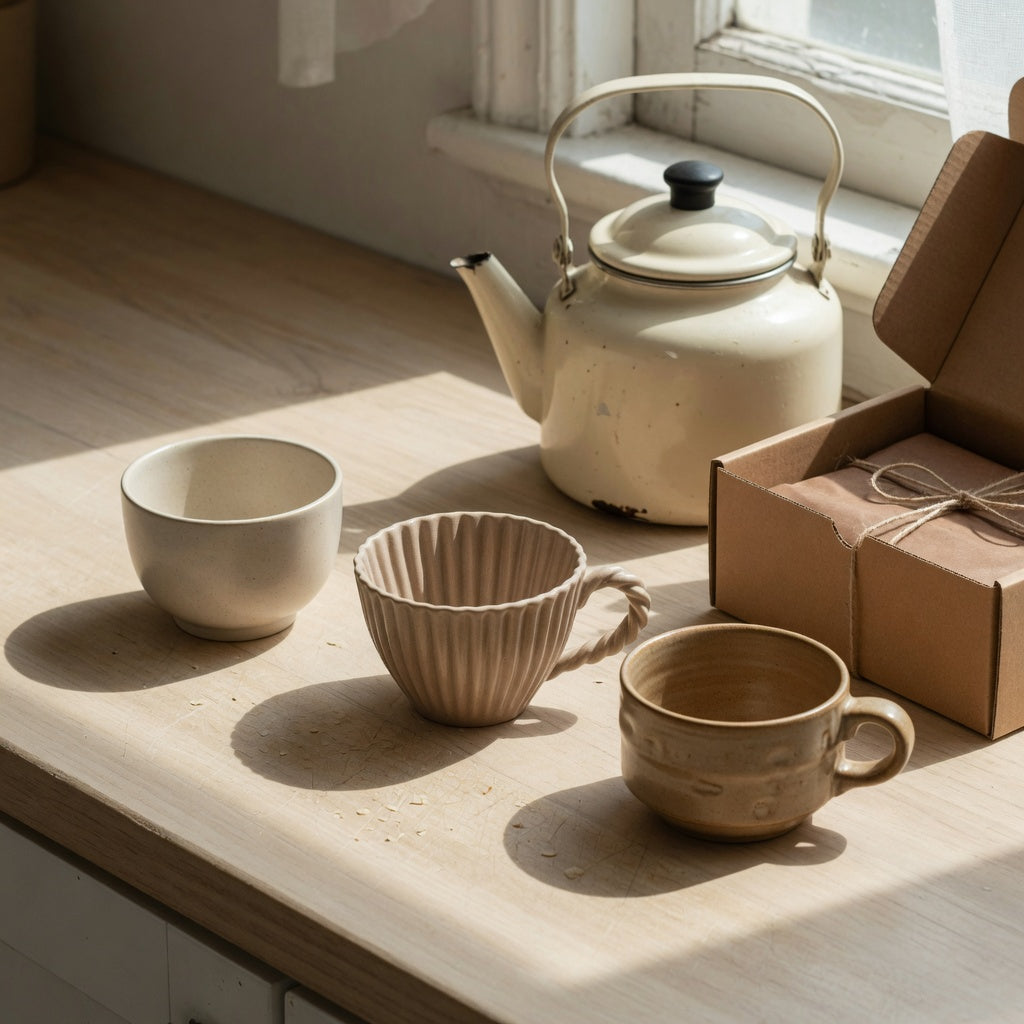
Minimalist Mug Gift: What Buyers Should Compare
A minimalist mug gift works when listed capacity, material, and handle match the drinker, not just a calm photo. Check ceramic safety notes before you pick a round, pleated, or retro form.
Read more
Office Desk Mug Gift: What to Compare Before Buying
An office desk mug gift sits beside a keyboard, so compare open ceramic with a lidded tumbler, then check stated capacity, handle, print direction, microwave and dishwasher claims, and what lead or...
Read more
Leave a comment
This site is protected by hCaptcha and the hCaptcha Privacy Policy and Terms of Service apply.