
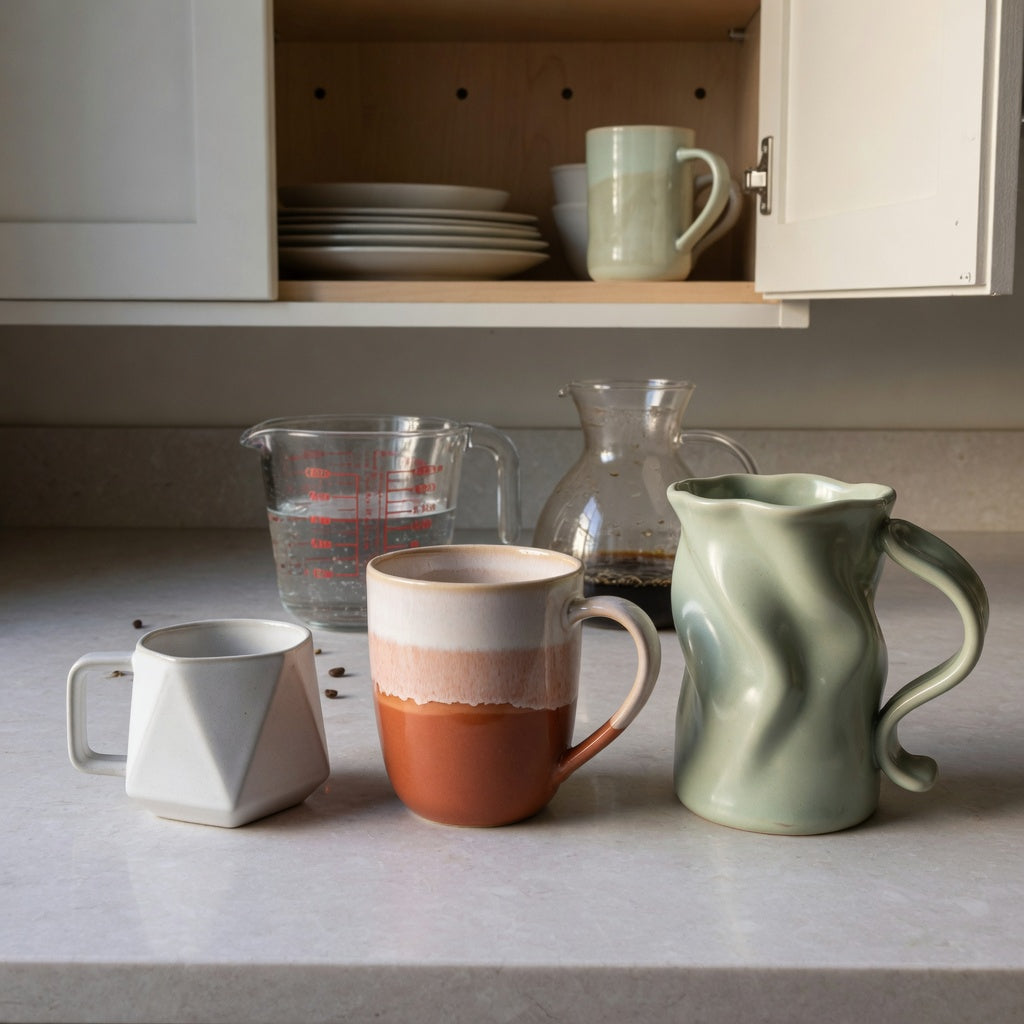
Ceramic Abstract Coffee Mug: Compare Size, Glaze and Care
Reading time: about 10 minutes
A close product photo can make a 250 ml mug look as roomy as the 400 ml cup already beside your kettle. Then the first pour leaves no space for milk. A sculptural cup can create the opposite surprise: its volume works, but its curves need more clearance in your hand, dishwasher rack, or cabinet. A ceramic abstract coffee mug needs to work through those ordinary moments, not only in the listing image.
At CoffeifyMug, we compare this category through practical use: filling the cup without crowding the rim, carrying it from the kitchen to a desk, storing it beside simpler mugs, and cleaning a decorated surface after coffee has dried. The strongest choice is not automatically the boldest design. It is the mug whose capacity, form, food-use information, and care limits match your routine.
What does abstract styling actually tell you about the mug?
Abstract is a useful style description, but it is not a manufacturing standard. It can describe geometric planes, flowing curves, color transitions, or nonrepresentational decoration. It does not, by itself, prove that a mug is handmade, tied to a named art movement, produced as a limited edition, or fired by a particular method.
Move past the label and inspect the parts that affect daily use:
- Profile and footprint: Projecting angles or curves can require more shelf and dishwasher space than a straight-sided cylinder.
- Rim shape: A dramatic exterior still needs an even, comfortable drinking edge. Top and side photos are more useful here than a single front view.
- Handle relationship: Capacity tells you how much liquid the mug holds, not how much finger clearance or leverage the handle provides.
- Finish placement: Check whether decoration stays on the exterior or reaches the rim and interior, where food-contact information matters most.
Start by comparing silhouettes in our unique coffee mugs collection. Keep your current favorite mug nearby while browsing. Its capacity and handle opening give you a more reliable scale reference than a styling prop in a photograph.
Which ceramic abstract coffee mug capacity fits your daily pour?
The verified capacity difference in this group is substantial: Rhombus is 250 ml, while The Gradient and The Flow are both 400 ml. That 150 ml gap affects milk room, ice, refill frequency, and how much beverage is cooling while you work.
| Product | Capacity | Listed design detail | Useful starting point |
|---|---|---|---|
| Rhombus | 250 ml | Geometric form | Smaller-volume coffee or tea |
| The Gradient | 400 ml | Color-transition finish | Fuller drink with color as the visual focus |
| The Flow | 400 ml | Sculptural curves | Fuller drink with shape as the visual focus |
Measure the drink you already make before choosing. Pour your normal coffee, tea, milk, or creamer into a marked measuring cup, stopping at the level you actually use rather than the brim. For iced coffee, include the space displaced by ice. A listed capacity does not tell you how much headroom you prefer while walking from the counter to your desk.
A 250 ml mug is not inherently too small. It suits a shorter serving and can encourage a fresh refill instead of leaving a larger drink to cool. It is a poor fit for someone who routinely adds a generous amount of milk or pours a large filter coffee. A 400 ml mug provides more room, but buyers who prefer short drinks may find that extra volume unnecessary.
Which form fits a desk, a gift, or a crowded cabinet?
- For a smaller desk drink: Start with the Rhombus coffee and tea mug. Its verified 250 ml capacity and geometric form suit a shopper who wants abstract structure without moving to a 400 ml serving. It is not the right choice for a large drip coffee habit.
- For a fuller drink led by color: Consider The Gradient coffee and tea mug. Its 400 ml capacity gives milk, tea, or ice more room, while the color-transition finish supplies the visual interest. Check the current care instructions before assuming how that finish handles repeated dishwasher cycles.
- For a shape-focused gift: Consider The Flow coffee and tea mug. It combines a 400 ml capacity with sculptural curves, making form the main reason to choose it. Before buying, decide whether the recipient has room for a less conventional silhouette.
We do not rank one of these as universally more comfortable because verified handle clearance, weight, and full dimensions are not part of the supplied product facts. If easy stacking, a uniform matching set, or maximum cabinet efficiency matters most, a plain cylindrical mug may serve you better than an abstract or sculptural design.
How should you read glaze and food-use claims?
Ceramic describes the broad material category, but it does not answer every question about the glaze or decoration. The FDA explains that lead may be present in ceramic glazes or decorations and may leach into food or drink if pottery is not manufactured and fired correctly. The concern is especially relevant to acidic drinks such as coffee and tea.
The FDA generally treats ceramicware that appears suitable for food as intended for food use unless it carries conspicuous ornamental or decorative-only labeling. Its compliance policy for ceramic cups and mugs sets an action level of 0.5 micrograms per milliliter for extractable lead under a specified laboratory test method. That number is a regulatory testing threshold, not something a shopper can confirm by touching the glaze or judging its color.
Bright decoration is not automatic evidence of a problem. The FDA does identify some brightly decorated traditional pottery, particularly orange, red, or yellow pieces, as deserving additional caution when manufacturing controls are uncertain. Color alone still cannot identify pigment composition or firing quality.
Use these questions on any decorated mug listing:
- Is the piece clearly sold as functional drinkware rather than ornamental decor?
- Does the seller provide food-use information for the glazed interior and rim?
- Are microwave and dishwasher instructions stated separately?
- Does the design include metallic-looking paint, luster, gold, or silver accents?
- If testing or certification is claimed, does the seller identify what was tested rather than relying on a vague label?
In our store, we would rather identify a detail as unverified than turn listing silence into a certification. Apply the same rule while shopping. A ceramic abstract coffee mug with unclear food-use information belongs on a display shelf, not in a daily coffee routine.
Why can dishwasher and microwave guidance disagree?
Dishwashers and microwaves create different stresses. A dishwasher exposes a mug to repeated hot water, detergent, spray pressure, and contact with nearby dishes. Microwave suitability depends on how the ceramic body, glaze, and decoration respond during heating. Passing one type of use does not establish the other.
- Dishwasher-safe does not mean fade-proof: A decorated surface may remain usable while gradually losing gloss or contrast. Product-specific cycle data is needed for a stronger durability promise.
- Microwave-safe does not mean chip-proof: The rating does not protect a rim or handle from impact in the sink or dishwasher rack.
- Metallic decoration needs special caution: Do not microwave a mug with metallic-looking accents unless the manufacturer explicitly approves that use.
A hand-wash-only instruction may be there to protect the finish rather than signal poor ceramic quality. Likewise, a mug can be genuine ceramic and still be unsuitable for microwave reheating. If the listing does not provide a microwave rating, use another vessel for reheating instead of running a home experiment.
What should you inspect during the first unboxing?
Inspect a mug before the first coffee and before wrapping it as a gift. Packaging dust can be washed away; a glaze defect or impact chip needs a different response.
- Set it on a dry, flat counter. Check for obvious rocking. An unglazed foot ring is common in ceramic drinkware, but it should not have a sharp burr that could mark a table.
- Trace the rim with a dry fingertip. Look and feel for sharp chips, rough exposed ceramic, or a glaze edge where your mouth will rest.
- Inspect the interior under direct light. Pinholing appears as small openings in the glaze. Crazing appears as a network of fine lines. If either is open, rough, or unexplained on a food-contact surface, photograph it and ask the seller before use.
- Check both handle joins. Hairline cracks where the handle meets the body can widen under the weight of a full mug.
- Confirm the working volume. Use measured cool water to see where your normal serving sits and how much room remains below the rim.
Do not continue using a mug with a sharp rim chip, a spreading crack, flaking interior decoration, or exposed ceramic on the drinking edge. Those are different from minor variations in color or glaze pattern.
How do you protect a color-transition or sculptural finish?
The listed facts for The Gradient and The Flow describe appearance, not repeated-cycle durability testing. We cannot responsibly promise that a finish will never fade, haze, or chip without product-specific evidence. Current care instructions on the product page should control how you use each mug.
- When dishwasher guidance is absent, use warm water, mild dish soap, and a soft sponge.
- Avoid abrasive powders and scouring pads on a color-transition surface.
- Limit thermal shock. Let a mug brought in from a cold car approach room temperature before adding very hot liquid.
- If dishwasher use is approved, load the mug so its rim and handle cannot knock against cutlery or another ceramic piece.
- Stop using the mug for drinks if the interior glaze begins flaking, a crack grows, or the rim becomes chipped.
The same care trade-off applies to many artistic mugs: a design that earns attention on the counter may require more deliberate washing than a basic solid-glaze cup. Buyers who want zero-thought cleanup should prioritize explicit dishwasher guidance over a delicate-looking finish.
Frequently asked questions
Is a ceramic abstract coffee mug microwave safe?
Not automatically. Microwave suitability depends on the ceramic body, glaze, decoration, and the manufacturer's instructions. If the listing does not explicitly approve microwave use, or the mug has metallic-looking accents, use another container for reheating.
Why can a ceramic mug be dishwasher safe but not microwave safe?
The two appliances expose the mug to different conditions. Dishwasher guidance addresses repeated washing, detergent, heat, and movement, while microwave guidance addresses behavior during direct reheating. One rating should never be used as a substitute for the other.
Is a 250 ml ceramic mug too small for coffee?
It depends on your normal recipe. Rhombus holds 250 ml, making it a better starting point for a shorter coffee or tea than for a large filter coffee with milk. Measure your usual drink and include headroom before deciding.
Are colorful abstract ceramic mugs food safe?
Color alone cannot confirm or disprove food safety. Look for a mug clearly intended as drinkware, food-use information for the glazed interior and rim, and specific care instructions. Avoid using ornamental-only pottery or pieces with unclear food-contact status for coffee or tea.
Should I choose The Gradient or The Flow as a gift?
Both have a verified 400 ml capacity, so choose according to the recipient's design preference. The Gradient fits someone drawn to a color-transition finish, while The Flow fits someone who values sculptural curves. For a smaller serving and geometric form, compare Rhombus instead.
Use this checkout sequence before you buy
- Measure the drink you make most often, including milk or ice.
- Choose 250 ml for a shorter serving or 400 ml for more working room.
- Confirm that the product is intended for food use, not ornamental display.
- Read microwave and dishwasher instructions as separate claims.
- Check rim, handle, cabinet, and dishwasher-rack fit in the available photos.
- Decide how much hand-washing and finish care you will realistically do.
Open the unique coffee mugs collection and compare capacity first: 250 ml Rhombus or 400 ml Gradient and Flow. Then choose between geometric form, color transition, and sculptural curves. That order keeps the artwork from hiding a poor everyday fit.
More from our blog
Read more
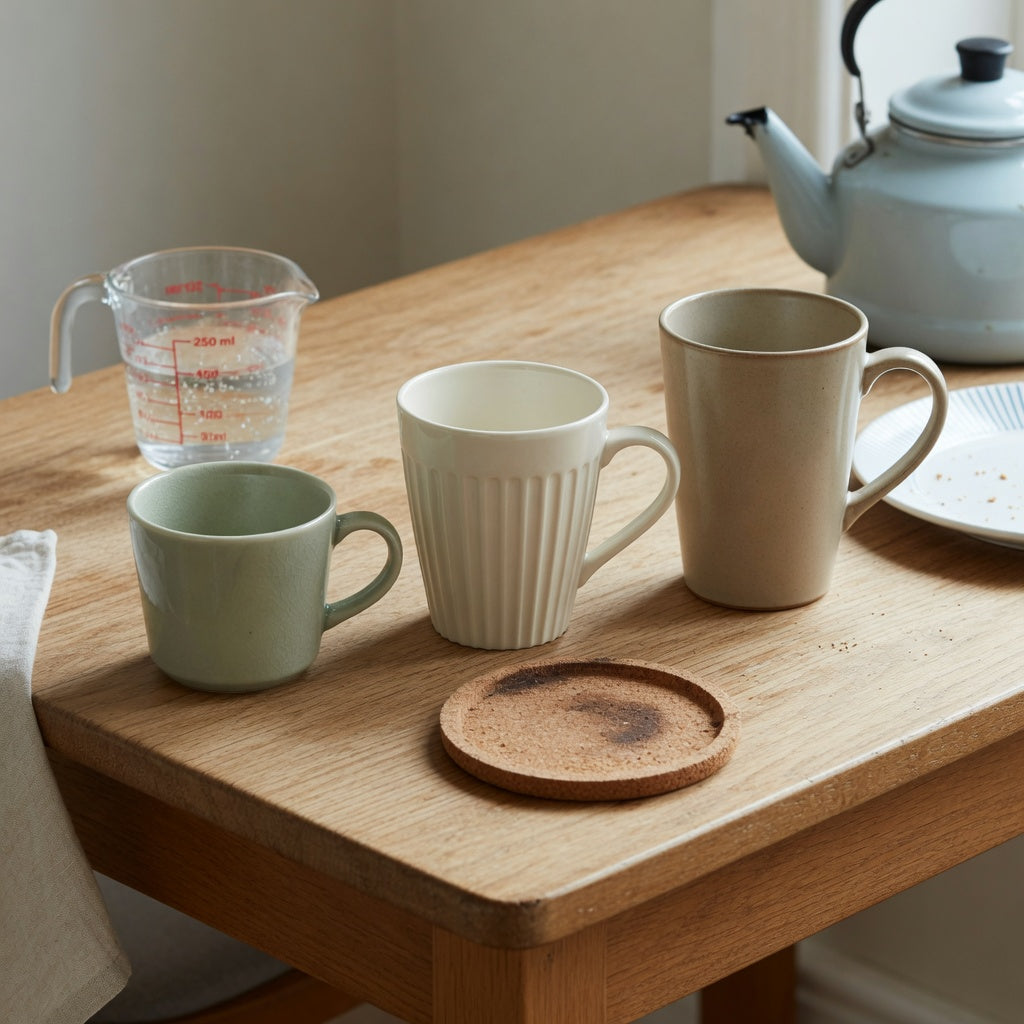
Ceramic Breakfast Mug: Compare Capacity, Glaze, and Fit
Compare CoffeifyMug's listed 170, 200, and 350 ml capacities against your usual pour, table space, and refill habits. We also explain glaze documentation, ceramic body terms, handle checks, microwa...
Read more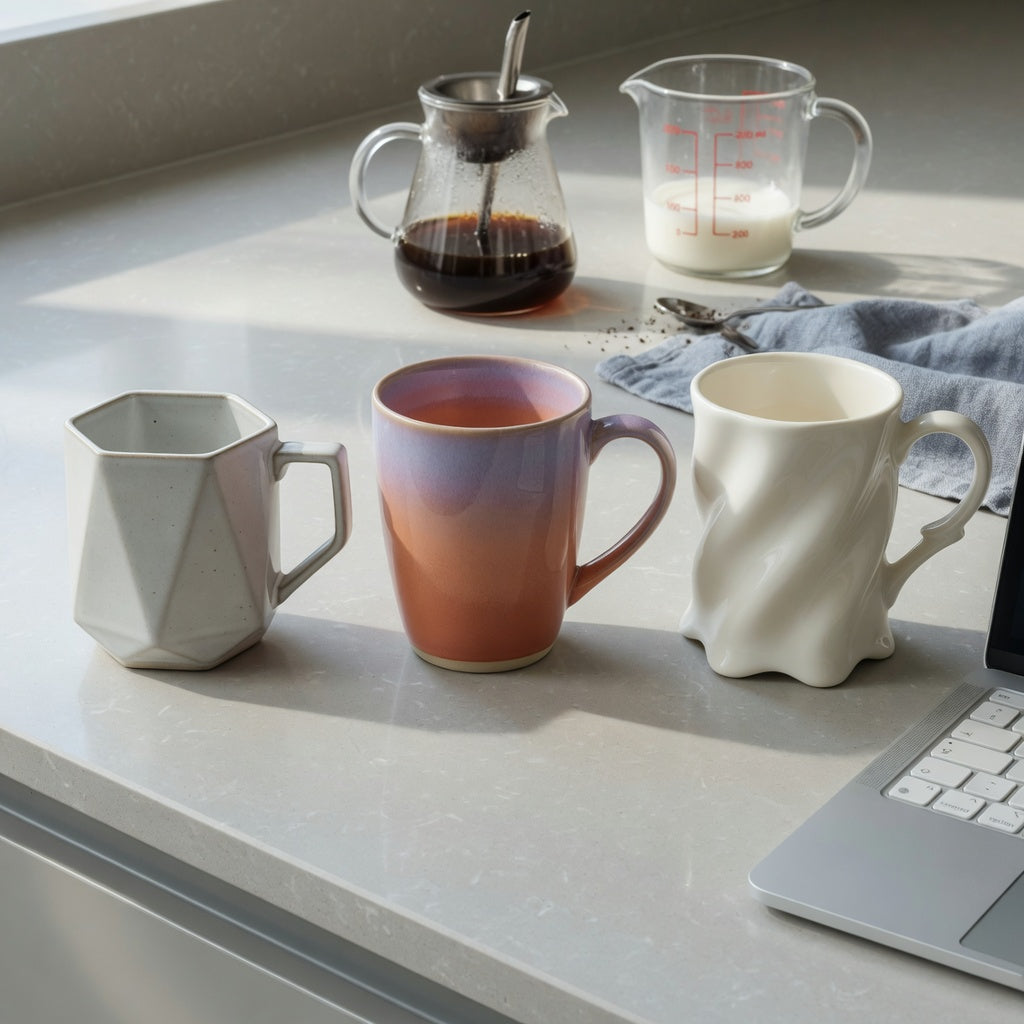
Unique Abstract Coffee Mug: Compare Size, Grip, and Care
Compare 250 ml and 400 ml abstract mugs by usable capacity, handle comfort, cupboard fit, glaze condition, and care. See which geometric, gradient, or sculptural option best fits your drink and rou...
Read more
Leave a comment
This site is protected by hCaptcha and the hCaptcha Privacy Policy and Terms of Service apply.