



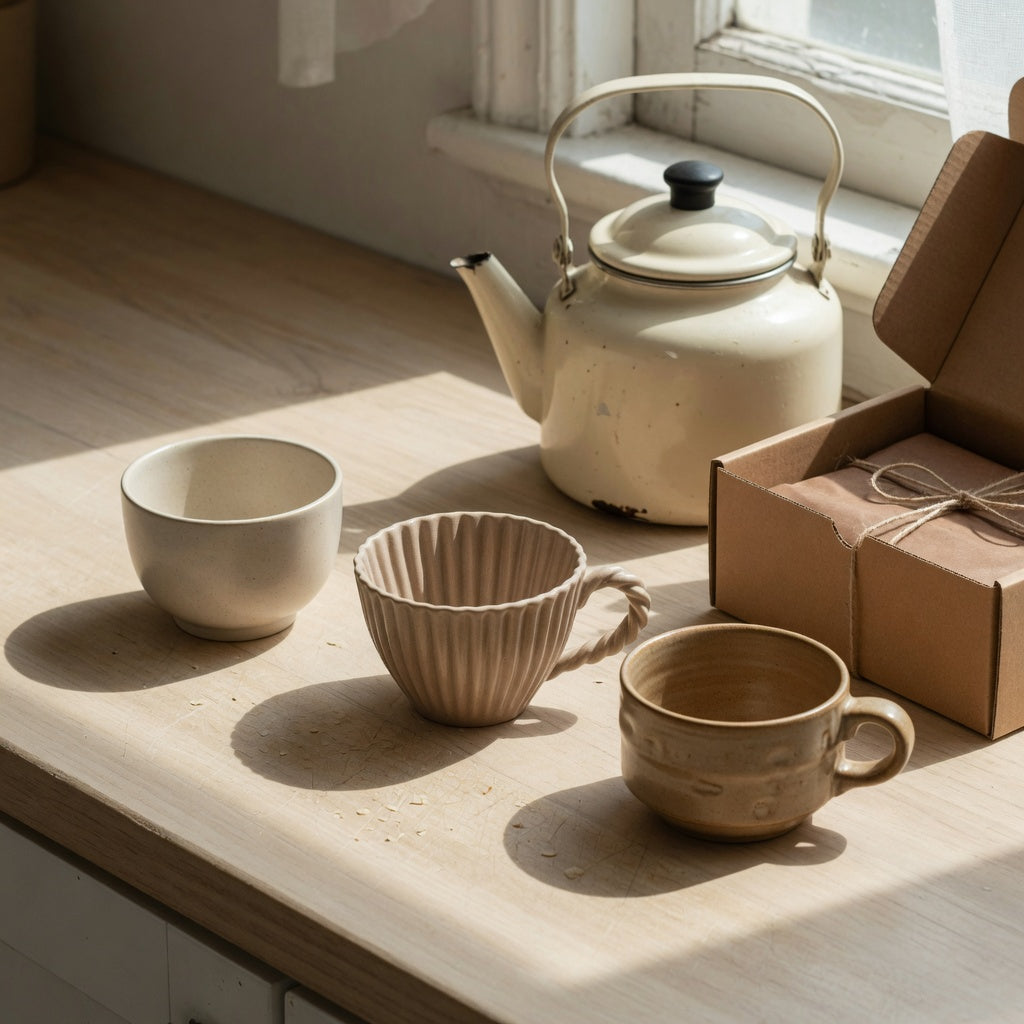
Minimalist Mug Gift: What Buyers Should Compare
Reading time: about 12 minutes
The slogan mug gets a laugh at the housewarming, then it slides behind the blender. The notes on gift orders we pack often say the same thing: no quotes, the counter is already full. The cup that stays by the kettle is quiet. Little lettering. A shape you can read from across the room. A size that matches how that person drinks. That is the job of a minimalist mug gift. It has to earn a spot on a kitchen counter, an office desk, or a wedding-registry shelf.
In our store, minimalist is a style brief, not a quality grade. It is not a formal design classification, and it is not proof that a cup is thicker, safer, or longer lasting. It means less print and a form you can compare on the listing. Listed capacity, material, shape, and handle are the comparison. If a line is missing, our team treats it as unknown.
Who is a quiet cup for: a new kitchen, a desk, or a shared kettle?
Four situations cover most of the orders we pack for this look.
- Housewarming. The new kitchen already holds a mismatched set. One calm cup can replace a chipped one without becoming the centerpiece.
- A couple or a wedding. Two people share a kettle. A pair usually lands better than one loud mug and a duplicate still in the box.
- An office desk. The cup sits beside a keyboard all afternoon. A huge graphic gets old by Wednesday. A plain form does not compete with the rest of the desk.
- A known drink habit. They already want a shorter tea pour or a larger coffee fill. Palette will not fix the wrong volume.
This style is a poor match for punchlines, photo prints, or holiday graphics. It is also wrong for someone who only uses a lidded travel tumbler and will not wash an open cup. A calmer look will not change that routine.
Round, pleated, or retro: which silhouette belongs in the cupboard?
The page name tells you which form to open. It does not tell you ounces, clay body, glaze, or whether a finger fits the handle. Those facts have to be on the current listing. A tight crop is not a measurement.
- Round, when they want the plain form. Open the round coffee tea mug if they asked for a round cup and did not ask for pleats or a retro shape. Read stated capacity, material, shape, and handle on that page. Do not decide those facts from the picture.
- Pleated, when texture replaces a slogan. The pleated coffee tea cup is the page for someone who wants pleats and still wants the cup visually quiet. Pleats are a surface choice. Only that listing can describe them, and only that listing can say whether care differs from a smooth wall. We do not copy those details from a similar cup.
- Retro, when they named that silhouette. Set the retro coffee tea cup beside the round page and compare listed shape and handle. A styled image hides height and the gap inside the handle. The listing text is the comparison.
A round form is the weaker gift if they already own several plain cups and wanted one quiet change of surface. Pleats or a retro shape are the weaker gift if every mug in the cupboard should match. None of the three suits a recipient who asked for a punchline.
If the note only says something calm, and they will choose after seeing more shapes, use the unique coffee mugs collection and stay with pages that publish capacity and material. A calm thumbnail is not a spec sheet.
What capacity fits tea, breakfast coffee, or a larger pour?
U.S. Food and Drug Administration guidance describes cups and mugs as small ceramic hollowware commonly used for coffee or tea above room temperature. The size it calls normal, though not the only size, is about 240 milliliters, or 8 fluid ounces, and the piece usually has a handle. It describes a mug as having cylindrical sides. That is a regulatory description of ceramic beverage ware. It is not an instruction that every gift should hold 8 ounces, and it is not the capacity of a cup on our site unless that listing says so. Plenty of gift pages advertise more. A larger fill can be right for one drinker and wrong for yours.
- A shorter pour. Tea, or anyone who reheats a small cup more than once, usually fits a listed capacity under a brimming latte size. Check ounces and milliliters together. Pages mix the units, and a rounded marketing number is easy to misread.
- Breakfast coffee. If the habit is one mug with breakfast, start near that common 8 fl oz description, then read the number this page prints. Do not assume the round, pleated, or retro form matches that figure.
- A larger desk pour. A bigger listed mug suits someone who fills once and leaves the cup out. It is a poor match for repeated small teas. A wide cup and a taller cup can share a similar volume and still feel different at the lip. Some buyers think a wide cup cools faster. Treat that as a preference, not as heat retention we can prove from a photo.
If capacity is missing, do not invent it from the handle in the picture. Ask, or choose another listing. Filled weight depends on stated capacity and the material the page names. When empty weight is unpublished, you cannot honestly say how heavy a full cup will feel in the hand.
Will the handle, rim, and base still work when the mug is full?
Gift photos hide the three things people notice on a Monday morning, after the tissue paper is in the bin.
- Handle clearance. Fingers have to pass through once the cup is full. Larger hands, and anyone gripping through a sleeve or a napkin, need more room. If the listing gives no clearance and no interior handle width, you do not know. A three-quarter photo is not a measurement.
- Rim. A thick rim feels steady to some drinkers and clumsy to others. A thinner lip can feel precise for tea. Neither is a defect by itself. Only the listing, or the cup in hand, can describe that edge.
- Base. The foot should sit flat on a coaster, a wood desk, or a slightly uneven rental counter. Pages rarely publish foot height or filled weight. A missing line is a gap, not proof the base is stable.
In our experience packing these orders, the follow-up is rarely that the color was too quiet. Knuckles hit the wall of the cup, or the mug feels top-heavy once it is filled. Those are fit problems.
Buyers also ask what a matte or smooth surface looks like after repeated dishwasher cycles. Answer only from the care line on this listing, not from another maker's stoneware. Staining and scratching show up in care copy across the category, and we cannot tie those words to one durability standard. Do not call a matte finish tougher, or more fragile, than a gloss unless this page says what to do and what to avoid.
Which lead, cadmium, and metal-trim details should you read first?
A calm glaze is not a tested food-contact surface. The points below apply to ceramicware in general. They are not a lab result for any mug we sell, and no official source we use defines a minimalist look as its own safety class.
For ceramic cups and mugs, FDA lead compliance guidance is 0.5 micrograms of lead per milliliter of leaching solution, applied if any one of six tested units exceeds that level.
FDA also reports that some ceramic foodware can release a meaningful amount of lead from the surface that touches food, that food can draw the metal out, and that keeping the piece in food use can harm health, including chronic lead poisoning. Read the detail in the FDA lead guidance for ceramicware.
Cadmium is a separate figure. For ceramicware used with liquid foods, guidance is 0.5 micrograms per milliliter for small hollowware and 0.25 micrograms per milliliter for large hollowware, again if any one of six units exceeds it. Small hollowware is under 1.1 liters. Large hollowware is 1.1 liters or more. That volume split does not tell you the capacity printed on the cup in your cart. FDA has reported significant extractable cadmium on both imported and domestic ceramicware, notes that acid foods can pull the metal out, and warns that continued food use could cause chronic cadmium poisoning. The FDA cadmium guidance for ceramicware is a different document from the lead file. Methods FDA identifies for examining both metals include ASTM C738, specified AOAC methods, and FDA laboratory bulletins.
Lead-free or food-safe on a product page is seller wording. It is not a leach test. If this listing cites no method and no result, the honest status is not shown. Ask when the household wants the report. We do not turn a marketing line into a certification.
Metal trim is a different risk from lead in a glaze. The U.S. Consumer Product Safety Commission has recalled ceramic mugs labeled microwave safe because metallic print or a gold metallic handle can spark and pose a fire hazard. One recalled design was reported to smoke while microwaving. Gold, silver, or metallic lettering is a poor default if the recipient reheats coffee in the cup. A microwave-safe badge does not cancel metal you can see. Read the badge and the decoration together. If either is unclear, do not plan on microwave use.
Should the gift be one plain cup, a pair, or a short initial?
A new kitchen usually needs a useful object, not a centerpiece. One neutral mug replaces a chipped everyday cup. A pair fits two people who share a kettle. We would rather see two quiet cups by the kettle than a quote mug still in the tissue beside a duplicate.
Personalization is where these gifts slip. An initial, or a very short mark, can stay spare. A paragraph, a bold inside joke, or a full name in large script usually cannot. Shoppers sometimes say Japandi or Scandinavian when they mean a neutral color and little ornament. Those are browsing cues. They are not a test of the clay, and they are not a promise on our pages.
Other makers treat glaze variation and a visible foot ring as part of handmade work. Variation is not automatically a flaw, and it is not automatically a feature. If this page says nothing about matching pieces, do not tell the recipient that each cup is supposed to look different. Do not promise handmade character for the round, pleated, or retro forms unless the current listing says so. Packaging is the same kind of fact. If the page does not describe a box or a wrap, do not assume the cup arrives ready to hand over at the door.
What should you verify on a minimalist mug gift listing?
Before you pay, keep the product tab open and tick these rows. A blank row means ask, or pick a different page. This is the same pass we use when a customer sends two links and asks which one to wrap.
| Check on the current page | Why it changes the gift | What we do not assume |
|---|---|---|
| Capacity in fl oz and mL | Tea, breakfast coffee, and a large desk pour are different fills | That the photo scale equals 8 oz or any other size |
| Material named in the description | The body has to be stated, not guessed from a neutral photo | Stoneware, porcelain, or any specific clay |
| Shape and handle | Round, pleated, and retro names are different things to hold | Finger clearance, filled weight, or rim thickness |
| Care lines | Dishwasher and microwave use are yes or no only when printed | That every quiet glaze shares the same care |
| Metal decoration | Gold, silver, or metallic print can spark in a microwave | That a microwave-safe label overrides visible metal |
| Food-contact wording | Lead and cadmium guidance is about leaching, not about how quiet the cup looks | That lead-free equals a six-unit leach test |
Then open the form that matches the cupboard and finish the same rows on that listing. If you are still choosing a shape, stay in the unique coffee mugs collection until capacity, material, handle, and care are actually written on the page.
Frequently asked questions
What size minimalist mug gift should I give for tea versus coffee?
Match the listed capacity to the drink, not the style word. A shorter stated size usually suits tea or a small pour. Everyday coffee often sits near the FDA description of about 8 fl oz (240 mL), and a larger stated mug suits someone who fills once and leaves the cup on a desk. If the page gives only one unit, or no capacity at all, do not convert from the picture.
Are matte or handmade mugs dishwasher and microwave safe?
Only the current listing can say that for the cup in the cart. Matte, speckled, and handmade wording on other sites does not create a shared rule for our pages. Read the dishwasher and microwave lines, then look again if the glaze or print includes gold, silver, or another metal. A microwave-safe label has not stopped recalls when metal decoration sparked.
How do I know a ceramic gift mug is lead-free rather than just labeled that way?
FDA lead compliance guidance for ceramic cups and mugs is 0.5 micrograms per milliliter of leaching solution if any one of six units exceeds it. Cadmium guidance for small hollowware under 1.1 liters is 0.5 micrograms per milliliter. A seller line that says lead-free or food-safe is not the same as citing ASTM C738 or another method FDA identifies. If no test is shown, treat the claim as unverified and ask.
Is a wide cup a bad gift for someone who likes hot coffee?
Width and height change the lip and the grip even when the stated volume is similar. Some drinkers prefer a taller cup and associate a wide bowl with faster cooling. That cooling idea is a preference, not a result we can claim from a listing photo. Compare the stated shape and capacity, and skip any page that promises heat holding without explaining how it was checked.
Should I order one plain cup, a pair, or a short initial?
Choose one plain cup to replace a chipped everyday mug, and a pair when two people share the kettle. A single initial can stay visually quiet. A long quote or bold humor usually fights the reason you wanted a spare, useful cup. If a checklist row is blank, do not guess. Compare the round, pleated, and retro listings, or keep browsing until capacity, material, handle, and care are on the page you plan to order.
More from our blog
Ready to pick your mug? Two ways to save on today's order:
Ordering 1–3 mugs? Get an extra 10% off your 1st order with code 10_OFF Apply 10% Off & Shop Wooden-Handle Mugs →
Gifting 4+ mugs? Buy 3, Get the 4th Free applies automatically at checkout (no code needed; offers do not stack) · Free standard shipping (Nov pre-Christmas delivery: 15–20 calendar days US) · Free replacement if chipped in transit.
Popular mug buying guides: 8 oz & 9 oz Mugs · Cute & Aesthetic Mugs · Ceramic Tea Cups & Infuser Mugs · Ceramic Mugs with Lids Compared · Wooden-Handle Tea Infuser Mugs Compared · Christmas & Secret Santa Mugs 2026 · Espresso & Cortado Cups Guide · Cup & Saucer Gift Sets · All 25 Mugs Spec Table · Mug Size Guide · Shipping & Promo FAQ
FIRST ORDER 10% OFF (CODE: 10_OFF) · OR BUY 3, GET THE 4TH FREE


Read more

Office Christmas Mug Gift Ceramic: Desk Checks to Make
A ceramic office Christmas mug for a coworker has to fit a desk, survive a shared dishwasher, and still look right in March. Compare size, metallic trim, glaze questions, and which listing fits a w...
Read more
Abstract Geometric Ceramic Mug: Form, Fill, and Care
Shoppers searching for an abstract geometric ceramic mug often land on two different objects: a printed pattern on a straight cup, or a body whose shape or color shift carries the design. Compare 2...
Read more
Leave a comment
This site is protected by hCaptcha and the hCaptcha Privacy Policy and Terms of Service apply.