

Office Desk Mug Gift: What to Compare Before Buying
Reading time: about 13 minutes
A plain white mug on a shared desk is gone by Thursday. We hear that whenever someone is choosing an office desk mug gift for a coworker, a manager, a farewell, or Secret Santa. The cup will sit beside a keyboard, not in a commute bag. That changes the comparison. Does the drink stay put? Does the office microwave enter the morning? Do the handle and the print face the person who actually holds them? And will anyone else treat the mug as community property?
Who gets this mug, and does the coffee stay on the desk?
Start with the person, not the pattern. A peer who refills at the same pod machine needs a cup that is easy to grab, steady on laminate, and obvious as theirs. A boss, or a skip-level, is a different gift. An inside joke that feels harmless in a group chat can read as a comment on their management once the mug sits where a client can see it. A farewell should still make sense six months later, after the team joke has expired. Secret Santa is the thin-context case. You may not know how they take humor, and a gag about their habits is the present people remember for the wrong reason.
A remote coworker adds a carton. Ceramic is rigid. It chips at the rim and can crack at the handle join when a box is crushed. If the listing does not describe protective packaging, plan on a real box and padding, not a padded mailer by itself.
If they carry coffee on a train or in a car, this is no longer a desk gift. An open mug has no reliable seal, and a chip is likely in a backpack. In our store we sell coffee and tea mugs meant to stay on a surface. We would rather steer someone toward a lidded tumbler than pretend an open cup is commute gear.
Open ceramic or a lidded tumbler if the drink never leaves the building?
Keep a mug that lives on a desk separate from a commute tumbler, a shared break-room cup, and bulk logo swag. Those are different jobs. The comparison below is category guidance. It is not a spec sheet for any single product on our site.
| Desk question | Open ceramic mug | Lidded tumbler |
|---|---|---|
| Drink stays beside the keyboard | Matches a refill-and-sip routine, including a reheat only if that exact mug is labeled microwave-safe and has no metal | Works, but you may be buying commute hardware for a desk job |
| Train, car, or backpack | Poor fit. No reliable seal, and a chip is likely | The better gift |
| Spill into a keyboard | Real risk without a lid | Lower risk when the lid actually seals |
| Coffee or tea taste | A ceramic lip is what many people already use at home | Some drinkers describe a metallic note in stainless. Ask; do not treat it as a lab result |
| Mail to a remote coworker | Can shatter. Pack it as breakable | Usually more forgiving in a carton |
An open mug is a poor fit for leakproof travel, for a desk that gets bumped all afternoon, and for someone who will only use a dishwasher when the listing never mentions one. A tumbler is not the better present just because it looks tougher. If they never leave the building and they reheat a half-cup before lunch, open ceramic usually matches the ritual. Hours of heat retention are a different claim. Do not copy a number from a bottle brand and paste it onto a ceramic cup.
Some drinkers tell us tea tastes off against a stainless rim. That is a preference we hear, not a lab result. If you can ask, ask. If you cannot, a ceramic lip is the familiar default for someone who already drinks from ceramic at home. Confirm the material on the page you are ordering, rather than guessing from a styled photo.
Which design keeps an office desk mug gift from walking off?
Unmarked cups migrate. By midweek the plain one is in someone else's hand, and the owner is drinking from a paper cup. A name, a monogram, or a print nobody else has is a practical boundary, not only decoration. You do not need a punchline to get that effect.
Match the page to the person, then read the listing. None of the titles below is a measurement of ounces, glaze, microwave status, or packaging.
- Fashion-leaning desk, not a blank spare and not a commute bottle: open the handbag coffee and tea mug. Check the current artwork, stated capacity, material, handle, and any care line. A product photo is not a size.
- A manager, or a team that treats slogan mugs as risky: open the rhombus coffee and tea mug. The name suggests a geometric motif. Confirm that the artwork on the page is actually that quiet, and do not invent a gift box or a dishwasher claim from the title.
- A farewell or a welcome, where the gift should feel chosen rather than like bulk logo swag, and they do not need a lid: open the crane coffee and tea mug. Verify the illustration and every care note on that page. Skip it if they dislike pattern, and skip it if the drink has to travel sealed.
If none of the three fits, browse unique coffee mugs and compare only what each current page states. In our experience, the order goes wrong when a buyer treats an old photo, a marketplace listing, or a similarly named cup as proof of capacity, glaze, or appliance safety. Those details have to be on the page you are buying from today.
Will the cup fit the hand, the standing desk, and the brewer?
Roundups love one ounce number. That number is rarely the one that matters at 9 a.m., when the mug has to clear the brewer and still feel steady on a moving sit-stand desk.
For its lead guideline on food-use ceramic, the FDA describes cups and mugs as small hollowware commonly used for coffee or tea. They normally, but not exclusively, hold about 240 mL (8 fl oz), and they are typically made with a handle. That is a regulatory category. It is not a recommended office size, and it is not the brim-full maximum of every modern mug.
On any page in our store, use only the capacity written there. If the listing is silent, size is unanswered. A brim-full figure and a comfortable pour are not the same thing. Leave room below the rim so the first bump does not send coffee onto a keyboard. Clearance under a single-serve brewer can also rule out a tall mug that looked right on a phone screen.
- Handle clearance should take two or three fingers without knuckles pressed into hot ceramic. A tiny loop looks neat in a photo and feels cramped by the second refill.
- Base stability matters on a thin standing desk. A narrow foot rocks more easily than a broader base. Picture the real surface: glass, sit-stand laminate, or a crowded home table.
- Rim shape changes every sip. A thick, sharp lip is a daily annoyance, not a style detail. If you cannot hold the mug, do not invent the rim from a styled shot.
- Print direction is the left-handed miss. Art on only one face can point at the room when the handle is in the left hand. Two-sided artwork fixes that. If the listing does not say the print is on both sides, do not assume it wraps.
What can the office microwave and dishwasher do to a printed mug?
USDA guidance is plain: use only cookware manufactured for the microwave. Glass, ceramic, and plastics that are safe are usually labeled for microwave use. China with metallic paint or trim is not. Gold paint can arc. Those sparks are the microwave reacting to metal, and prolonged arcing can damage the oven or the utensil.
If a utensil has no label, USDA describes a one-minute check: microwave it on high beside, not touching, one cup of water in a glass measure. If the empty utensil feels warm or hot, it is not microwave safe, because metal is in the material or the glaze. Clemson University Extension lists ceramic without metallic trim among containers that can be used in a microwave, and repeats a similar check: if the empty dish stays cool it may be used, and if it becomes warm or hot it should not. If you can already see gold, silver, or a metallic band, skip the experiment and keep that mug out of the microwave.
We do not run that test on a customer's gift and then call the result a certification. A microwave-safe line has to appear on the product you are buying. Silence is not a yes.
A dishwasher line is narrower than shoppers expect. Dishwasher safe on another brand, or in a review, does not transfer to the mug in the cart. Office machines run hot cycles, and printed decoration is what people usually notice fading first. We will not quote a cycle count the listing does not give. If the page is silent, hand washing with a non-abrasive sponge is the conservative plan. That is a care choice, not a hidden defect, and it is not a promise that a printed mug either fails in a month or lasts forever.
Lead-free labels and a Proposition 65 warning are not the same thing
Lead-free, FDA-compliant, and Proposition 65 language get swapped in gift copy. They are not the same test, and they are not a ranking of whose mug is cleaner.
FDA compliance criteria for cups and mugs suitable for food use treat lead above 0.5 micrograms per milliliter of leaching solution, in any one of six units, as exceeding the guideline. The cited methods include ASTM C738, AOAC methods 973.32 and 973.82, and specified FDA laboratory bulletins. A marketing sticker is not that test.
Lead may be in the glaze or decoration of some traditional pottery. If the piece is not fired properly, lead can leach into a drink. Fired correctly, the FDA says essentially all the lead is bound into the glaze. Washing or boiling does not remove lead from pottery. Properly made ceramicware that contains lead can still be sold in the United States. Ware that shows extractable lead under the compliance method should not be labeled lead free, because that wording can be false or misleading. A missing badge on a product page is not automatically a failure. A badge we cannot verify on the current listing is not something we will repeat as a fact about that mug.
Risk is not spread evenly. Be more cautious with handmade crude or irregular pottery, antiques, damaged pieces, flea-market finds, and ware brightly decorated in orange, red, or yellow. Pottery made in commercial factories for everyday use is much less likely to have those lead problems. Anything marked for decoration only, including a not-for-food-use warning, does not belong on a desk with coffee or tea.
California's Proposition 65 list includes lead and lead compounds because they can cause cancer and birth defects or other reproductive harm. Some ceramic dishes and pottery are named among consumer products that can be sources of exposure. A warning means the business knows, or believes, it is exposing people to a listed chemical. Firms must warn before knowingly and intentionally exposing someone, unless they can show the exposure is not a significant cancer risk or is significantly below levels observed to cause reproductive harm. Read the warning as a warning. It is not a quality score, and it is not proof that a federal leach test was failed. Do not drink from chipped or cracked glaze, and do not store drinks in ware the warning tells you to avoid.
We do not claim every commercial mug is lead-free. Check the listing you are buying, keep decorative-only ware off the desk, and retire a cup when the glaze is damaged.
Is the joke safe in a meeting, and will ceramic survive the mail?
Humor works when you would say the line in the kitchen while a manager walks through. Coffee, deadlines, and a shared project are usually safe between peers. Skip jokes about bodies, alcohol, performance reviews, politics, or how difficult the boss is. For Secret Santa with a near-stranger, a distinctive useful mug beats a roast. A harmless slogan can still feel like leftover swag if the line could have gone to anyone on the floor.
Recognizable artwork does some of the social job a name does. People hesitate before they walk off with a cup that is obviously not the office spare. That will not stop a determined borrower. It makes the grab look intentional, which is the practical advantage of a specific design in a shared kitchen.
If you are shipping to a remote employee, look on the product page for gift boxing or protective packaging. If it is not mentioned, add your own: an inner carton, padding so the mug cannot touch an outer wall, and a breakable note. A styled photo is not a shipper. We would rather you over-pack than hear about a crack by email. An open ceramic desk mug is also a poor match for anyone who tosses a cup into a tote every day.
Desk checks to make before you order
- Name the occasion: peer, boss, farewell, Secret Santa, or remote employee. Decide whether the drink stays on a desk.
- Choose open ceramic or a lidded tumbler. If they commute, do not force a desk mug.
- Use the current listing only: capacity, height if stated, material, microwave line, dishwasher line, and any warning text.
- Check handle clearance, base stability on the real desk, rim comfort, and whether the design faces a left- or right-handed grip.
- Keep metallic trim out of the microwave. Keep decorative-only ware away from drinks. Retire chips and cracks.
- Prefer a recognizable design over a risky slogan. Funny is optional. Useful is not.
- Pack for mail if the page never mentions a gift box.
When those answers fit an open cup that stays at the desk, compare the handbag, rhombus, and crane pages, or look through the unique coffee mugs collection and read the current listings side by side. If a page does not answer a question you care about, leave that gap unanswered. Do not fill it from a similar product.
Frequently asked questions
What should I compare first on an office desk mug gift?
Start with whether the drink stays at the desk or travels. Then check the capacity printed on that listing, clearance under the coffee maker, handle comfort, and which way the print faces. Read the microwave line, the dishwasher line, and any warning text on the same page. A recognizable design matters in a shared kitchen because unmarked mugs get borrowed. Save slogan humor for peers you actually know.
Is an 8 fl oz mug the right office size because regulators mention it?
No. About 240 mL, or 8 fl oz, is how the FDA describes the usual cup or mug inside a lead-compliance category, not a suggested gift size. Compare the capacity printed on the listing with how full the person actually pours, and with the height under their brewer. A brim-full number and a comfortable desk pour are not the same thing.
Can I microwave a gift mug that has gold or metallic decoration?
Do not. USDA lists china with metallic paint or trim as not safe for microwave use, and gold paint can arc, which may damage the oven or the mug. Use only pieces manufactured and labeled for microwave use. If a listing never says microwave safe, do not treat the office kitchen as a test lab.
Does a Proposition 65 warning mean this mug failed an FDA lead test?
No. A Proposition 65 warning means the business knows or believes there is exposure to a listed chemical. Lead is listed because California identifies it as a cause of cancer and reproductive harm. That warning is not the same thing as exceeding the FDA leach guideline of 0.5 micrograms per milliliter in any one of six units, and it is not a product ranking. Separately, ware with extractable lead under the compliance method should not be labeled lead free.
How should I ship a ceramic mug to a remote coworker?
Assume it can break. If the listing does not mention a gift box or protective packaging, use a sturdy inner box, padding on all sides, and an outer carton so the mug cannot hit a wall. Care rules still come from that product page. Packing material does not make a mug microwave-safe or dishwasher-safe.
More from our blog
Read more
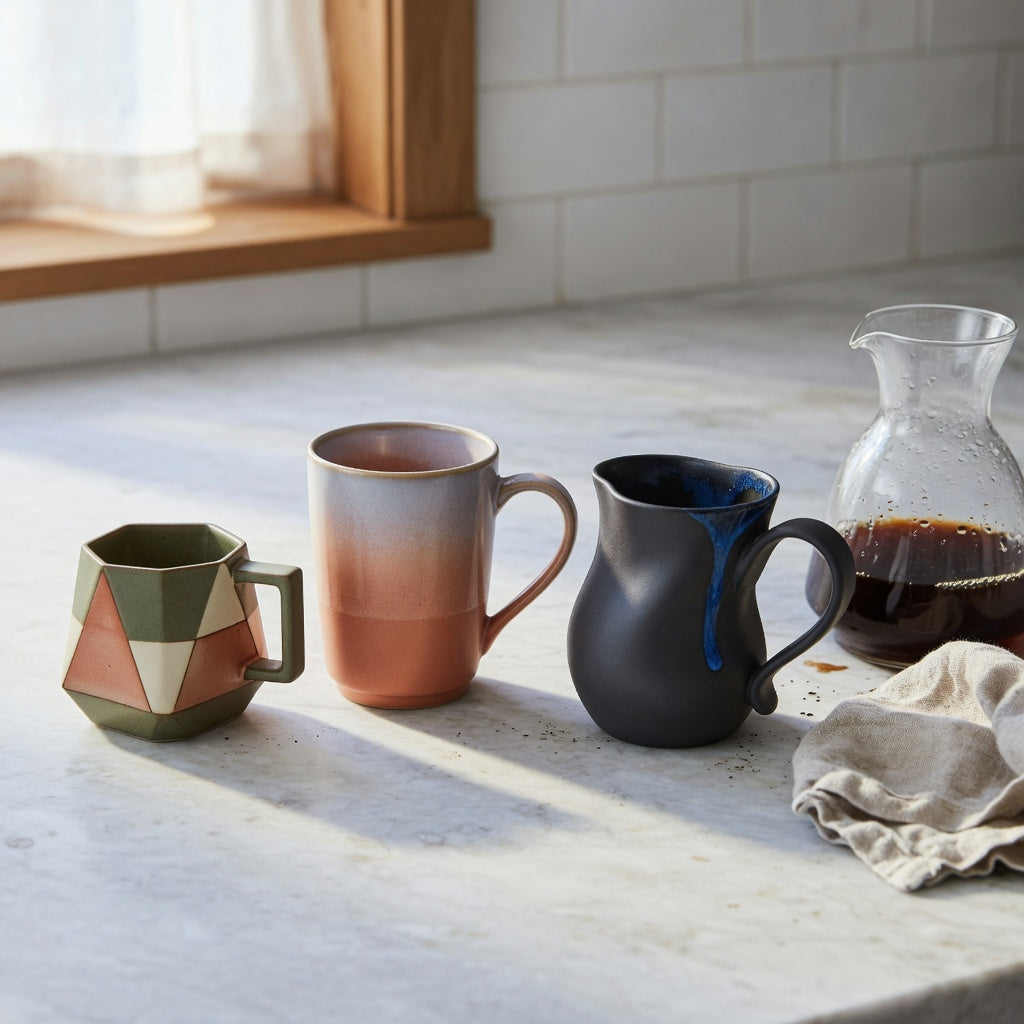
Abstract Geometric Ceramic Mug: Form, Fill, and Care
Shoppers searching for an abstract geometric ceramic mug often land on two different objects: a printed pattern on a straight cup, or a body whose shape or color shift carries the design. Compare 2...
Read more
Ceramic Birthday Mug Gift Ideas: What to Compare
Ceramic birthday mug gift ideas work when the cup matches a real drink, not just the line printed on it. Compare capacity, print limits, dishwasher and microwave labels, metallic trim, and food-saf...
Read more
Leave a comment
This site is protected by hCaptcha and the hCaptcha Privacy Policy and Terms of Service apply.