



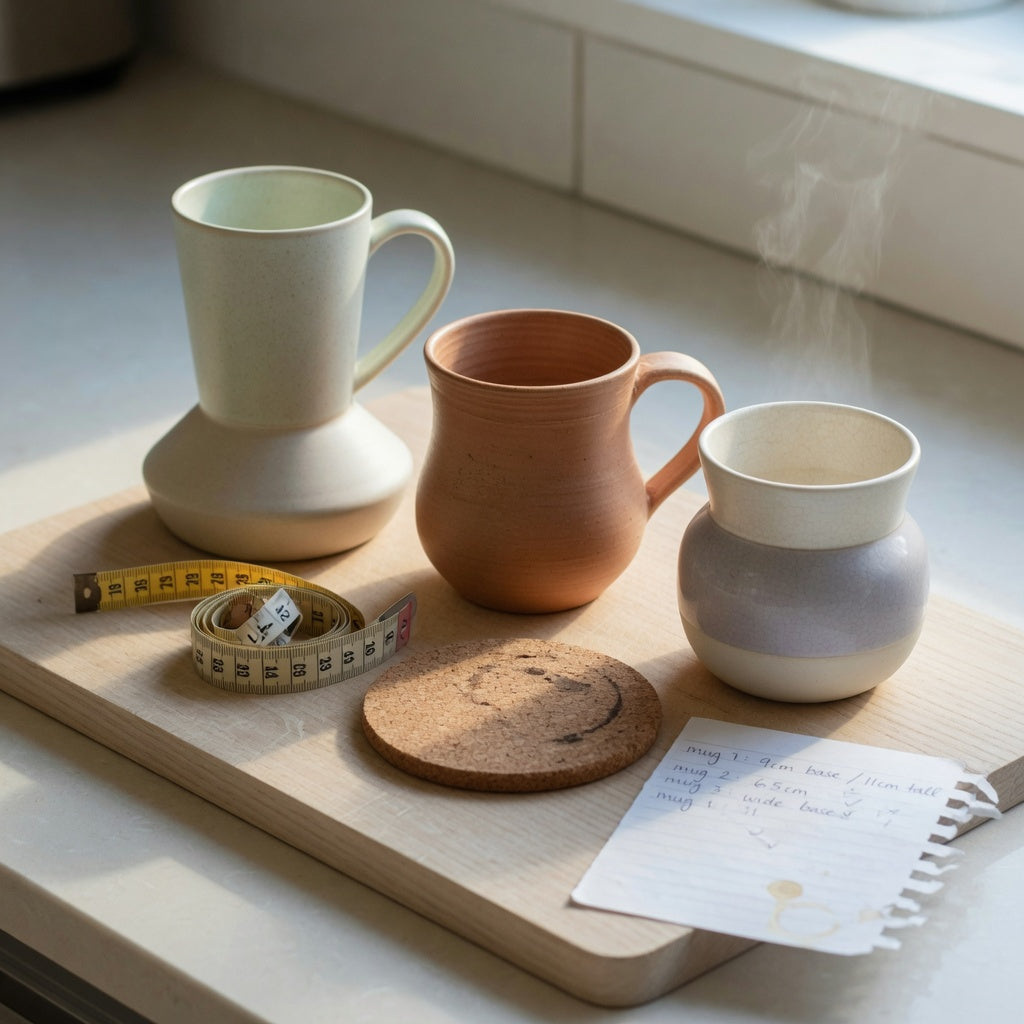
Wide Based Coffee Mugs Shared Household Product Shortlist Guide
Reading time: about 10 minutes
Four mugs came out of the dishwasher this morning and three are still sitting on the counter, because nobody quite trusts them next to a laptop. In a shared house the mug that actually gets used is rarely the best-looking one. It is the one that stays put when somebody sets it down one-handed while answering a text. That is the filter behind this wide based coffee mugs shared household product shortlist guide: match the mug to the routine first, then check the two numbers that decide whether it fits your life.
We sell these mugs and we handle the follow-up questions, so we hear the same correction repeatedly. A broad foot does help stability. It does not make a mug tip-proof, and it tells you nothing about whether the mug clears a cabinet shelf, a tapered cup holder, or the spout of your coffee maker.
Why a wide foot tips later — and where the promise stops
A mug goes over when its center of gravity swings past the outer edge of its base, which is the base of support. Widen the foot and that edge moves outward, so the mug has to lean further before gravity wins. Keep the mass low and it goes later still. That is why a squat mug feels calmer on a desk than a tall one holding the same volume.
Base width alone does not make anything tip-proof. Several other things ride along with it:
- Height and fill level. A full mug carries its mass higher than an empty one, and a tall body lifts the center of gravity even when the foot is broad.
- Where the handle sits. A handle set low on the wall pulls mass down. One set high does not.
- A foot that sits flat. A base that rocks on a tile grout line or a warped desk cancels out its own width, and dried grit under the foot does the same thing in miniature.
- The surface underneath. Polished granite, a rubberized desk mat, and a boat console treat the same mug very differently.
One more caveat before you read any label. We could not find a public benchmark that measures tip angle against base diameter for commercial mugs, and “wide base” has no agreed minimum diameter. Two mugs described the same way can look nothing alike side by side. Treat “tough to tip” as marketing language rather than a specification.
Wide foot, wide mouth, tall body — which shape is your kitchen short on?
Buyers mix up three shapes that solve three different problems. Most shared houses are short on one of them and overstocked on another.
| Shape | Best fit | Where it falls short |
|---|---|---|
| Wide foot, modest body | Desks, dashboards, boat consoles, uneven patio tables | Eats coaster and cabinet space; often too wide for a tapered cup holder |
| Wide mouth, narrower foot | Sipping, aroma, latte art, catching a pour-over stream | More exposed surface, cools faster, and top-heavy when full |
| Tall body, standard foot | Pure capacity and commuting | Highest center of gravity when full, and frequently too tall for drip-machine headroom |
If the spills in your house come from someone nudging a mug on a desk, the wide-foot shape is the fix. If the complaint is coffee going cold by 10 a.m., a lid and wall thickness matter more than the foot. Different problems, different answers.
Wide based coffee mugs shared household product shortlist guide: 250 ml, 400 ml, 480 ml
Three shapes from our own catalog, mapped to three routines. The capacities below come from our current product pages — 250 ml, 400 ml, and 480 ml. What those numbers do not tell you is base diameter, empty weight, or handle clearance, so confirm those on the live listing before you order. Each mug is sold on its own; there is no bundle here, which is the point. You can see the whole range in our unique coffee mugs collection.
1. The small-cup drinker who sets a mug down mid-sentence: Ball Handle 250 ml
The situation: someone in the house drinks espresso-length coffee or tops up tea 80 ml at a time, then leaves the cup on a couch arm, a windowsill, a nightstand. The Ball Handle coffee and tea mug is listed at 250 ml, the smallest of the three we stock. The name points to the handle shape, so check the photos for the handle-to-body gap if finger clearance matters to anyone in the house.
Choose it if the cup sees mostly short pours and a small volume is a feature rather than a compromise: less liquid to clean up when it does go over, and less coffee wasted when someone forgets a cup for an hour.
Skip it if anyone drinks a full 350 ml mug in one sitting. At 250 ml they will refill twice as often and the mug will feel permanently half empty. Two small mugs suit a tea drinker; one small mug for a big-coffee person is a daily irritation.
Verify on the listing: base diameter, empty weight, and whether the foot is flat or recessed.
2. The desk refiller who wants one mug for the whole morning: The Flow 400 ml
The situation: one household shape has to work for both tea and coffee drinkers, and the mug lives on the same desk for hours. The Flow coffee and tea mug is listed at 400 ml — enough for a full pour-over, small enough that a slow sipper is not tipping out half a mug at lunchtime.
Choose it if you want one shape you can order in multiples and stop thinking about. Middle capacities are usually the least objectionable thing on a shared shelf.
Skip it if the routine depends on a specific volume. Someone brewing 500 ml at a time will find it short; someone drinking 150 ml at a time will find it wasteful. A mid-size mug is a compromise, and compromises never fit everyone equally.
Verify on the listing: mouth width against your dripper or AeroPress, and whether it clears the shelf above when stacked.
3. The one-brew commuter or iced-coffee drinker: The Rock 480 ml
The situation: one large brew should last a whole work session, or iced coffee needs room for cubes and still a decent pour. The Rock coffee and tea mug is listed at 480 ml, the largest of the three.
Choose it if the mug mostly lives in one spot and the priority is fewer refills.
Skip it if empty weight or cup-holder fit matters most. A larger listed capacity usually comes with a bigger footprint and more mass when full, which cuts both ways: more planted on a desk, heavier to lift, and easier to knock with an elbow. It is also the wrong pick under a drip machine with tight headroom — measure before you commit.
Verify on the listing: actual base diameter, and whether it clears your cup holder at its narrowest point.
Coaster, cabinet, cup holder, brewer: four measurements to take before checkout
- The cup holder at its narrowest point. Vehicle holders taper, so a mug can drop in halfway and wedge. Many wide-footed mugs are simply not cupholder compatible; if the listing does not confirm fit, plan on it not fitting.
- The coaster and the shelf gap. A 480 ml mug can be perfect on a desk and still not clear the shelf above it. Wide bodies also stack badly unless the shape was designed for it, so measure the tallest single-mug gap in the cupboard.
- Brewer clearance. Drip-machine headroom, capsule spout height, AeroPress width, pour-over cone seat, and the platform of your kitchen scale. A wide mouth can overhang a cone; a wide foot can overhang a scale.
- The handle gap, not the handle style. Three fingers is standard, four is generous. The opening between handle and body matters more than the silhouette in the product photo.
Two more items belong on your check rather than mine: care instructions and foot profile. Dishwasher and microwave suitability belong on the listing, not in an assumption, and a concave base can hold water after a cycle and drip onto whatever it sits on next.
Does a wide ceramic base actually keep coffee hotter?
Not by itself. We found no standards-body or manufacturer test that isolates base width from material, wall thickness, lid, and starting temperature, and the retail roundups that credit a wide ceramic base with longer heat retention are not measuring it. What actually decides how long a mug stays warm:
- Opening area. A wide mouth exposes more liquid surface to air and loses heat faster than a narrow one. This is where wide base and wide mouth get confused — a stable foot can sit under a narrow rim.
- Wall thickness and material. Ceramic mass holds heat, then bleeds it into a cold countertop. Double-wall vacuum steel insulates better but changes the drinking experience. Our notes on ceramic versus porcelain in a shared household go into that trade-off.
- A lid. Splash-resistant and leak-resistant are different claims. A splash-resistant lid stops a knock at the desk, not a full tip inside a tote bag.
So if the real complaint at home is cold coffee, buy for a lid and a wall. Buying for a foot solves a different problem.
What fails first in a shared kitchen — handles, feet and recessed bases
In our experience with questions and replacements, the failure modes are boring and predictable:
- A rocking foot from a slightly warped base or a bit of dried grit. It reads as cheap even when the mug is fine on a flat counter.
- Water trapped in a recessed base after the dishwasher, which then leaves a ring on a wooden desk.
- Handles that only take two fingers once the mug is full — the most common regret we hear about large-capacity mugs.
- Rim chips from stacking in an overcrowded cupboard. Wide bodies need vertical space, not optimism.
- Glaze and lead risk on handmade or imported pieces. FDA guidance sets the action level for cups and mugs at 0.5 micrograms of lead per milliliter of leaching solution in any one of six units, using methods that include ASTM C738. FDA also flags handmade, antique, damaged, or brightly orange-, red-, and yellow-decorated ceramics as the higher-concern group, notes that washing or boiling does not remove lead, and says anything labeled not for food use should stay decorative. Ordinary commercial factory tableware is described as much less likely to be a problem.
If your shortlist leans toward handmade, read the maker's food-contact statement before the first pour — our guide to wide bottom mug shape and fit covers what to ask.
Frequently asked questions
How many wide based coffee mugs does a shared household actually need?
Count routines, not people. Two shapes usually beat four of the same thing: a 250 ml cup for tea and espresso-length pours, plus a 400 ml or 480 ml mug for full coffees. A wide based coffee mugs shared household product shortlist guide is only useful if it ends with fewer, better-chosen mugs rather than more.
Will a 480 ml wide-bottom mug fit a car cup holder?
Capacity tells you nothing about fit. Cup holders are not one standard size and many taper toward the bottom, so measure the narrowest point of yours and compare it with the listed base diameter. If the product page does not confirm cupholder compatibility, plan on it not fitting.
Does a wide base mean the mug holds more coffee?
No. Base width and interior volume are separate measurements: a broad foot can sit under a modest interior, and a narrow-footed mug can hold a lot. Trust the listed capacity, then check base diameter separately for stability and surface fit.
Can a wide based ceramic mug go in the dishwasher and microwave?
It depends on the individual piece, so read the care section on the listing instead of applying a general rule. Two practical notes: recessed feet can hold water after a cycle, and metallic trim or decoration you are unsure about is worth confirming with the maker before it goes in the microwave.
Are handmade or antique wide-bottom mugs safe for hot coffee?
Treat them with more caution than factory-made ware. FDA guidance flags improperly fired traditional glazes, antique pieces, and brightly decorated ceramics as higher risk for lead leaching, and household washing or boiling will not remove lead. Pieces marked not for food use should stay on the shelf.
Start with the mug you already reach for most, then match it to one of the three capacities above and check two numbers on the listing before you order: base diameter and listed capacity. If you are still deciding between silhouettes, browse the full collection with a measuring tape and a coaster in hand — that is a five-minute job that prevents most returns.
More from our blog
Ready to pick your mug? Two ways to save on today's order:
Ordering 1–3 mugs? Get an extra 10% off your 1st order with code 10_OFF Apply 10% Off & Shop Wooden-Handle Mugs →
Gifting 4+ mugs? Buy 3, Get the 4th Free applies automatically at checkout (no code needed; offers do not stack) · Free standard shipping (Nov pre-Christmas delivery: 15–20 calendar days US) · Free replacement if chipped in transit.
Popular mug buying guides: Ceramic Tea Cups & Infuser Mugs · Ceramic Mugs with Lids Compared · Wooden-Handle Tea Infuser Mugs Compared · Christmas & Secret Santa Mugs 2026 · Espresso & Cortado Cups Guide · Cup & Saucer Gift Sets · All 25 Mugs Spec Table · Mug Size Guide · Shipping & Promo FAQ
FIRST ORDER 10% OFF (CODE: 10_OFF) · OR BUY 3, GET THE 4TH FREE


Read more
Pottery Tea Cups Shared Household Product Shortlist Guide (3 Picks)
A three-cup shortlist for homes where everyone drinks tea differently: which capacity fits which habit, what to inspect on the glaze, and when to skip a form entirely instead of buying a matched set.
Read more
15 oz Ceramic Coffee Mugs Shared Household Product Shortlist Guide
A shared cabinet rarely needs one perfect mug — it needs three that do different jobs. We map our three ceramic capacities to real pours, hand sizes, and care routines, with an honest reason to ski...
Read more
Leave a comment
This site is protected by hCaptcha and the hCaptcha Privacy Policy and Terms of Service apply.