



Pottery Tea Cups Shared Household Product Shortlist Guide (3 Picks)
Reading time: about 11 minutes
Three people share one kitchen. One steeps loose oolong in a small pot and pours barely 90 ml at a time. One fills a mug before the 7:40 bus. One works from the kitchen table and reheats the same cup twice before noon. Hand them a matching four-piece tea set and at least two of them will quietly stop using it.
We watch this play out in our store constantly. Someone buys a matched service, then comes back a month later for a single cup in a different size, because the first one only ever suited one person in the house. This pottery tea cups shared household product shortlist guide flips the usual order: identify the drinker first, then pick a capacity. Three ceramic cups at 170 ml, 200 ml, and 250 ml cover nearly every tea habit we hear about, and none of them requires buying a matched set.
Why do matched tea sets fail in a shared kitchen?
A set assumes four people want the same volume at the same temperature at the same hour. They don't. The breakdown is mechanical, not aesthetic:
- Volume mismatch. Fill a 250 ml cup for a 90 ml pour and you get a wide, fast-cooling surface. Fill a small cup for a milk-heavy breakfast tea and it is full before the milk goes in.
- Grip mismatch. Handleless cups reward two-handed cupping. Handled cups reward carrying one-handed from kettle to desk. Both people live in the same house.
- Care mismatch. One housemate rinses and air-dries; another stacks everything in the sink overnight. Thin rims and surface decoration lose that argument quickly.
- Ownership drift. Identical cups become communal and chipped. Distinct silhouettes get claimed, and claimed cups get treated better.
That last point is unglamorous but real. When each person's cup looks different, nobody has to work out whose is whose at six in the morning.
Pottery Tea Cups Shared Household Product Shortlist Guide: one cup per drinker
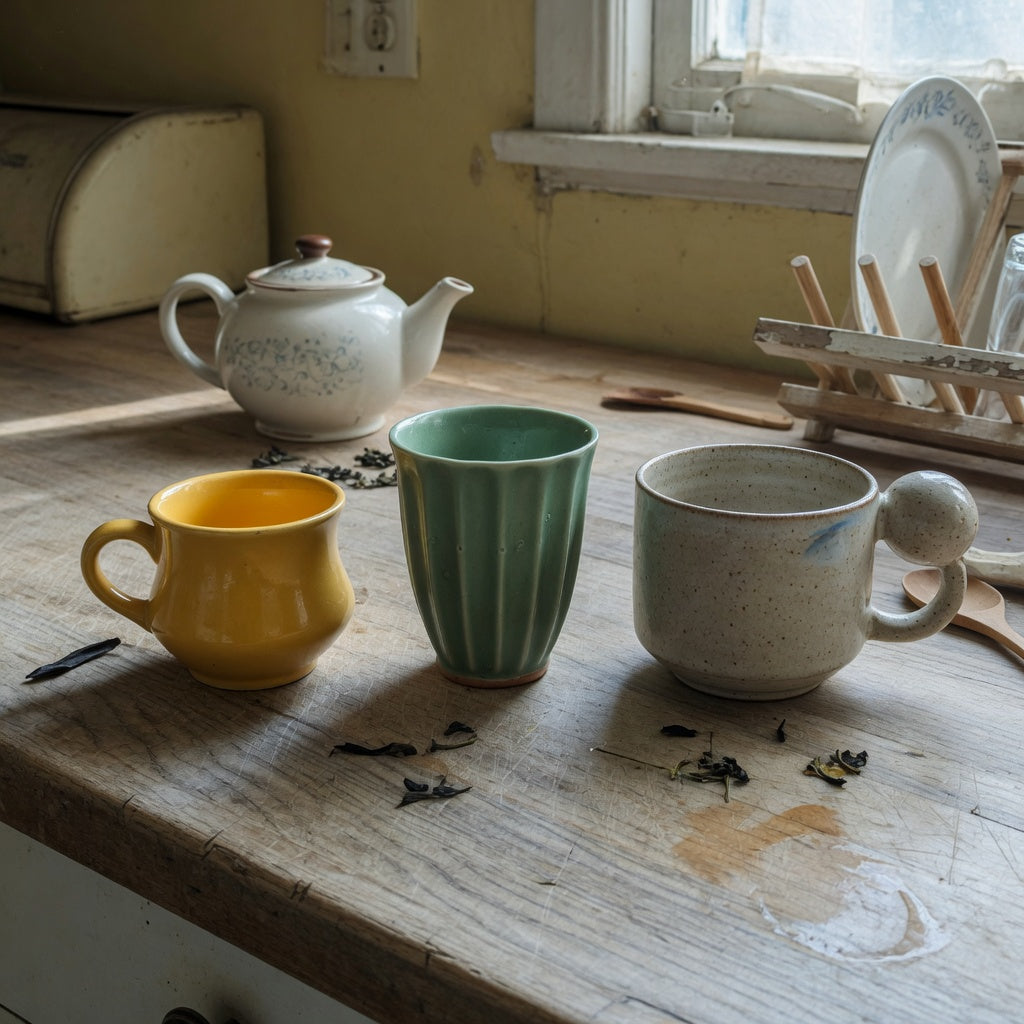
Here are the three ceramic forms we carry and the household job each one actually does. Capacities below are the listed capacities; the rest is body and visible form. These are individual pieces, not a set — buy the one or two that fit the people you live with.
| Cup | Listed capacity | Best household role | Reason to skip it |
|---|---|---|---|
| Retro Coffee & Tea Cup | 170 ml | Small-pot steeps, repeated short pours | Too tight for milk-heavy or travel-sized servings |
| Pleated Coffee & Tea Cup | 200 ml | The everyday default for one-bag or one-pot tea | Ridged exterior takes more attention at the sink |
| Ball Handled Coffee & Tea Mug | 250 ml | Desk sessions, milk tea, carrying between rooms | More footprint on a crowded drying rack |
Retro Coffee & Tea Cup — 170 ml, for the small-pot drinker
The Retro Coffee & Tea Cup is a 170 ml ceramic cup in a retro-styled form. The capacity is the reason to buy it, not the look: 170 ml matches a short pour from a small teapot, so the tea gets finished while it is still hot instead of sitting half-drunk and cooling.
- Choose it if someone in the house brews green tea, white tea, or a light oolong in small repeated infusions — or drinks a small cup several times a day rather than one large one.
- Skip it if the drinker adds milk, uses bags sized for a standard mug, or expects a cup to survive a two-hour desk session. In a 170 ml cup, both the tea and the patience run out. In a coffee-led house with one tea drinker, this is the exception piece, not the anchor.
Pleated Coffee & Tea Cup — 200 ml, the household default
The Pleated Coffee & Tea Cup holds a listed 200 ml and has a vertically pleated exterior. It is the piece we suggest when one cup has to serve several people with different habits, because 200 ml sits between a small-pot pour and a full mug without being wrong for either.
- Choose it if the house needs one shared guest cup that works for afternoon black tea, a standard teabag, or a modest pot pour — and if the ridges are welcome as a grip surface for hands that prefer a textured hold.
- Skip it if you want a completely smooth wall for stacking, or the primary drinker consistently wants more than 200 ml per sitting. The pleats also collect tea film along the ridges faster than a smooth wall, so this one rewards a quick brush rather than a rinse-and-go.
Ball Handled Coffee & Tea Mug — 250 ml, for the long steep
The Ball Handled Coffee & Tea Mug is a 250 ml ceramic mug with a ball-shaped handle. That capacity lines up with what most people mean by a mug — close to the 240 ml benchmark the FDA uses when it describes cups and mugs generally — and the handle gives the drinker a defined place to hold that is not the cup wall.
- Choose it if someone carries tea from the kitchen to a desk, drinks chai or milk tea with a generous splash, or wants one cup that gets refilled rather than re-steeped. The handle is the practical part: it lets a rushed drinker lift a full cup one-handed without gripping the body.
- Skip it if the cabinet is tight, the drying rack is already crowded, or the household prefers traditional small-cup tea. It is also the wrong shape for anyone who wants a cup they can wrap both palms around.
To see all three next to our other sculptural shapes before deciding, browse the unique coffee mugs collection. Comparing silhouettes side by side is faster than reading capacity numbers in isolation.
How much tea does each person actually drink?
Before buying anything, count pours instead of guessing. Ask each person how many times they refill in a day and roughly how much goes in each time.
- Under 150 ml per pour, three or more times a day: small-pot territory. A 170 ml cup is already generous; anything above 200 ml will go cold first.
- Roughly 180 to 220 ml per sitting, once or twice: the 200 ml tier, which is most tea drinkers on most weekdays.
- 240 ml or more, or one cup topped up all morning: the 250 ml tier, especially if milk or honey is going in.
The FDA's description of cups and mugs — small ceramic hollowware for hot drinks, normally holding about 240 ml and made with a handle — is a useful sanity check on that upper tier. Note the phrase normally, but not exclusively. A 170 ml handleless tea cup is still a tea cup; it simply does not match the default that guidance is written around.
What should you check on the glaze before a cup joins the shared shelf?
Safety is where shared households deserve the most caution, because a cup gets used by guests, by a housemate's kid, and by whoever grabs it first. The concern with pottery glaze is leachable lead and cadmium, not the word ceramic.
- Lead. FDA explains that lead can be present in glazes or decorations, and that pottery fired at the proper temperature for the proper time binds essentially all of it into the glaze. Under CPG Sec. 545.450, cups and mugs carry a lead guideline of 0.5 micrograms per mL of leaching solution across six tested units.
- Cadmium. CPG Sec. 545.400 sets a 0.5 microgram per mL guideline for small hollowware under 1.1 liter. Bright orange, red, and yellow decoration is the classic flag, and FDA lists brightly decorated ware among higher-concern categories.
- Labels that mean something. Ware that fails the extraction test should not be labeled Lead Free. Decorative pieces that look like foodware are treated as foodware unless permanently marked with a warning such as “Not for Food Use. May Poison Food.”
- The one thing you cannot fix. Washing, boiling, or scrubbing does not remove lead from pottery. If provenance is unknown — flea market, street vendor, unidentifiable maker, antique — the cup belongs on a shelf, not in the tea rotation.
We keep that boundary deliberately. A product photo cannot certify a cup, and we will not pretend otherwise: check the food-contact and care details published on the current product listing for the exact piece, and ask us directly if something is not stated there. That is a stronger position than assuming a whole category is safe.
Crazing, chips, and the two-minute inspection
Inspect before the first pour and again every few months. Shared cups take more abuse than a single drinker's cup ever will.
- Run a fingernail across the interior. A line you can feel is a crack. Fine lines you can see but not feel are crazing, and crazed glaze on a daily-use cup deserves a maker's opinion before it keeps serving hot tea.
- Look for pinholes and bare patches. Unglazed spots on the drinking surface or rim are exactly where tea sits.
- Check the rim and lip zone. Chips there are both a safety issue and a comfort issue; nobody wants to drink across a rough edge twice.
- Inspect the foot ring. A gritty unglazed base scratches counters and shelves.
Handles, walls, and hot fingers: which form survives a rushed morning?
Heat comfort is the trade-off almost nobody puts in product copy. Thicker ceramic walls buffer temperature and feel cooler on the outside for longer; thinner walls pass heat through faster. We would rather you test than assume — pour warm tap water into a new cup, hold it for thirty seconds, and decide whether it is a two-handed cup or a handled one for your household.
Two care rules apply to any ceramic cup, regardless of what a listing says:
- Never pour boiling water into a cold cup. A cup pulled from a cold pantry or garage shelf can crack from the temperature jump. Pre-warm it first.
- Keep metallic trim out of the microwave. Gold, platinum, and overglaze luster are the usual culprits, and the rule is about the decoration, not the clay.
Dishwasher and microwave status is maker-specific. We will not infer it from the word ceramic, so confirm it on the current product listing for the exact cup you are buying.
Frequently asked questions
Is it worth buying three different pottery tea cups instead of one matching set?
Usually yes, if the household drinks tea differently. A 170 ml cup for small-pot steeps, a 200 ml cup as the everyday default, and a 250 ml handled mug for desk sessions cover the three habits we hear about most. Use this pottery tea cups shared household product shortlist guide as a starting point, then drop whichever tier nobody in the house actually drinks from.
Which size should I pick for green tea versus milk tea?
Green tea and light oolongs poured in small repeated infusions suit the 170 ml cup. Milk tea, chai, and anything carried between rooms suit the 250 ml mug, mainly because you need headroom for the milk. The 200 ml cup is the compromise that handles a standard teabag or a modest pot pour.
Are these cups dishwasher safe and microwave safe?
That depends on the individual piece, not the category. Check the current product listing for the exact cup, and do not assume a smooth glaze implies appliance-safe. Metal decoration in particular should stay out of the microwave regardless.
Is crazing on a pottery tea cup safe to keep drinking from?
Crazing is a network of fine lines in the glaze; a crack is a line you can feel with a fingernail. Retire any cup with a crack, a rim chip, a bare unglazed patch on the drinking surface, or a permanent not-for-food-use warning. For crazing on a daily-use cup, ask the maker before you keep pouring hot tea into it.
Should I pre-warm a ceramic cup before pouring boiling water?
Yes, especially in winter or if the cup is stored somewhere cold. A quick fill with warm tap water, swirled and emptied, reduces the thermal shock that cracks thin-walled pottery. It also keeps the first pour hotter for longer.
What does a working shared tea shelf look like a month in?
Not tidy, and not matched. The cups that survive are the ones somebody reaches for without thinking — the small cup next to the teapot, the 200 ml cup that handles the afternoon pot, the 250 ml mug that ends up at the desk. What fails is the showpiece nobody wants to risk.
Here is the shortlist process we would actually run:
- Count the drinkers and ask each one how much they pour per sitting.
- Assign one capacity per drinker: 170 ml, 200 ml, or 250 ml.
- Inspect every candidate for an intact interior glaze, a clean rim, and a foot ring that will not scratch.
- Confirm food-contact and care details on the exact listing before the cup enters the rotation.
- Retire anything with a felt crack, a rim chip, or unknown provenance.
If you only want to buy one piece today and let the household vote, start with the 200 ml Pleated Coffee & Tea Cup. Then add the 170 ml Retro Coffee & Tea Cup or the 250 ml Ball Handled Coffee & Tea Mug once you know which habit is going unserved.
More from our blog
Ready to pick your mug? Two ways to save on today's order:
Ordering 1–3 mugs? Get an extra 10% off your 1st order with code 10_OFF Apply 10% Off & Shop Wooden-Handle Mugs →
Gifting 4+ mugs? Buy 3, Get the 4th Free applies automatically at checkout (no code needed; offers do not stack) · Free standard shipping (Nov pre-Christmas delivery: 15–20 calendar days US) · Free replacement if chipped in transit.
Popular mug buying guides: Ceramic Tea Cups & Infuser Mugs · Ceramic Mugs with Lids Compared · Wooden-Handle Tea Infuser Mugs Compared · Christmas & Secret Santa Mugs 2026 · Espresso & Cortado Cups Guide · Cup & Saucer Gift Sets · All 25 Mugs Spec Table · Mug Size Guide · Shipping & Promo FAQ
FIRST ORDER 10% OFF (CODE: 10_OFF) · OR BUY 3, GET THE 4TH FREE


Read more
Coffee Mug Gifts Ideas Shared Household Product Shortlist Guide
This coffee mug gifts ideas shared household product shortlist guide matches 200 ml, 400 ml and 440 ml ceramic mugs to real drink routines in two-person kitchens, with a reason to choose or skip ea...
Read more
Wide Based Coffee Mugs Shared Household Product Shortlist Guide
A scenario-based shortlist for shared kitchens: how base shape really affects tipping, what 250 ml versus 480 ml changes in daily use, and which of our three mugs suits which routine.
Read more
Leave a comment
This site is protected by hCaptcha and the hCaptcha Privacy Policy and Terms of Service apply.