




15 oz Ceramic Coffee Mugs Shared Household Product Shortlist Guide
Reading time: about 11 minutes
Three people, one cabinet, and a mug shelf that gets rearranged every week. The drip drinker quietly claims the biggest mug in the house, the tea drinker keeps reaching past it for something lighter, and the guest mug — the one nobody defends — is always the one whose handle pinches. Building a 15 oz ceramic coffee mugs shared household product shortlist guide is really about settling those claims before you order, because a shared cabinet rarely needs one perfect mug. It needs three that do different jobs.
What 15 fl oz actually means once you add cream, foam, or a tea bag
A 15 fl oz label is a volume, not a promise. Fifteen US fluid ounces converts to roughly 444 ml, and that is close to all the label tells you: 15 oz is a retail size, not a regulated category. The FDA's own reference point when it describes a cup or mug — small ceramic hollowware used for hot drinks — is about 240 ml, or 8 fl oz. No standards document defines a "15 oz mug," which is why two mugs with the same number on the box can pour very differently.
The volume you actually drink is always smaller than the volume you buy. Every mug loses capacity to headroom: the gap you leave so coffee does not slosh over the rim when you walk, add cream, or drop in a tea bag. How much you lose depends on the shape of the mug and how close to the edge you dare to fill it. A wide, shallow mug loses more usable volume than a taller one at the same capacity, because the same headroom depth costs more millilitres across a wider surface.
So measure your own pour instead of trusting the number. Tare the mug on a kitchen scale, fill it with water to the exact level you normally fill it with coffee, and read the grams. Water is close enough to 1 g per millilitre that the number doubles as millilitres. Do that once and your "15 oz" habit becomes a real figure you can shop against — usually somewhere in the 350 to 420 ml range.
The 15 oz ceramic coffee mugs shared household product shortlist: three capacities, three roles
We list exact metric capacity for every mug rather than rounding to a friendlier-sounding ounce figure, because rounding is where shortlists go wrong. Each mug is its own product page — we do not package them as matched sets — so a household can hand a different size to each person without buying a bundle. If you want to see the whole range in one place, the unique coffee mugs collection lays them out together.
| Mug | Stated capacity | Household role | Skip it if |
|---|---|---|---|
| The Flow | 400 ml (~13.5 fl oz) | Moderate drip pours, tea with room to steep, the mug that stays easy to lift when full | A full 15 oz black coffee is a hard requirement |
| Morning and Night | 440 ml (~14.9 fl oz) | The closest match to a 15 oz ask, and the natural replacement for a chipped old favourite | The drink routinely gets a tall foam cap or a heavy creamer pour |
| The Rock | 480 ml (~16.2 fl oz) | Milk drinks, mix-ins, long desk mornings that need stirring room | The smallest hand in the house is the main user, or shelf height is tight |
Which size goes to which person in the house?
The moderate drip or tea drinker: The Flow, 400 ml (~13.5 fl oz)
Picture the person who pours a normal drip coffee, adds a splash of milk, and stops there — or the tea drinker who wants the bag to move around without the water line sitting at the rim. The Flow is listed at 400 ml (~13.5 fl oz), about 44 ml under a true 15 fl oz pour, and that gap is the whole point: a full mug stays light enough to lift from a low shelf or carry one-handed, and a tea bag has room to steep.
Choose it when the mug gets lifted while full, when the drinker has smaller hands or a weaker grip, or when the household already owns one oversized mug and needs a lighter partner for it. Skip The Flow if 15 oz is a hard floor — someone who genuinely drinks a full 15 oz black coffee will top this up, overfill it, and blame the mug. Skip it too if the drink is mostly milk, because 400 ml disappears quickly once foam is involved.
The near-15 oz coffee drinker: Morning and Night, 440 ml (~14.9 fl oz)
This is the closest thing in our line to the mug people are actually searching for. Morning and Night is listed at 440 ml (~14.9 fl oz), roughly 4 ml short of 15 fl oz — close enough that most drinkers will never notice the difference, and the sensible upgrade path when an old 15 oz mug finally chips.
Choose it when one person drinks a big black coffee or a large tea and everyone else still wants something they can lift comfortably, which makes it the best single-mug compromise for a two-person kitchen. Skip it if the drink routinely gets a tall foam cap or a generous creamer pour, because at 440 ml there is not much spare headroom above a full pour. Do check the current product page for handle and care details — those vary by design rather than by capacity, and we would rather you read the listing than assume.
The latte, creamer, or long-desk-morning drinker: The Rock, 480 ml (~16.2 fl oz)
If the mug's job is a milk drink, a brew with a heavy pour of creamer, or a desk refill that has to survive a meeting, The Rock at 480 ml (~16.2 fl oz) is the one to shortlist. The extra volume over 15 oz is working room: you can stir, add foam, or walk a full mug back to a desk without the liquid sitting level with the rim.
Skip The Rock if the smallest hand in the house is also the main user. A full 480 ml mug carries noticeably more mass than a full 400 ml one, and the difference shows up on the second cup rather than the first. Skip it for a tight upper shelf too — measure the gap before assuming a taller mug will slide in. And skip it if heat retention is the entire goal; ceramic is about feel and ritual, not a tested hold time.
Handles, full weight, and shelf clearance: the three things no listing photo shows
In our experience, these details decide whether a mug survives a shared kitchen, and none of them are visible in a product photo taken at a flattering angle.
- Handle opening. Measure the inside clearance across the widest point of a mug you already like, then compare it to the listing's stated dimensions. Three or four fingers passing without knuckle pressure is the comfort test; a two-finger handle becomes a daily irritation, and it is the first thing an older or arthritic hand complains about.
- Full weight, not empty weight. Empty weight is only half the story. 400 ml of coffee adds roughly 400 g to whatever the mug weighs, so a 300 ml pour and a 480 ml pour are two different lifting tasks. Ask whether the person lifts it seated, standing, or on stairs.
- Shelf and cabinet clearance. Taller mugs fail at the top shelf far more often than at the door. Measure the vertical gap, then add the height of a full mug's handle swing if you store them hanging.
- Care markings. One person runs a hot dishwasher cycle, another hand-washes. If a glaze or print is finish-specific, that mug is not shared-friendly for that household no matter how well it pours.
One more practical note from handling these daily: sudden temperature swings are hard on glazed ceramic. We pre-warm a thick-walled mug with hot tap water before pouring boiling water into it, especially in winter when it has been sitting in a cold cabinet. It costs ten seconds and removes a known cause of fine hairline cracks.
Glaze, lead, and dishwasher questions worth settling before the mug joins the cabinet
A microwave-safe label is not a lead test. Under FDA CPG Sec. 545.450, the lead guideline for cups and mugs is 0.5 micrograms per mL of leaching solution in any one of six units, tested by methods that include ASTM C738 and AOAC 973.32 and 973.82. Cadmium guidance in CPG Sec. 545.400 sets 0.5 micrograms per mL for small hollowware under 1.1 liters and 0.25 micrograms per mL for large hollowware. Those are the numbers a finished-mug test is measured against — not something a category description can substitute for.
The California Department of Public Health adds the part that matters most for coffee drinkers: lead cannot be seen in a glaze or a painted design, and coffee and tea are acidic drinks that pull lead out of a contaminated dish faster than non-acidic drinks do. The same guidance notes that microwaving speeds leaching and that repeated dishwashing can damage a glaze and make later leaching more likely. It also notes lead is rarely found in plain white dishes — useful context if you are buying plain rather than heavily decorated.
What that means at checkout is simpler than it sounds. FDA has reported imported pottery labelled "lead free" that still contained extractable lead, so treat the phrase as a marketing claim until the listing backs it with test detail. Decorative ceramicware that looks like tableware must carry specific warnings under 21 CFR 109.16 — including "Not for Food Use. May Poison Food" — and if you ever see that, believe it and keep it off the breakfast table. For everyday drinking, read the care and food-contact markings on the individual product page rather than assuming all ceramic behaves the same. Our ceramic vs porcelain capacity guide goes deeper on why the material name alone settles nothing.
Who should skip a 15 oz mug entirely?
- Skip it if the house already runs on 8 to 12 oz cups. A 440 ml mug that is never filled past halfway is just extra weight on the shelf. Our breakdown of how many ounces a mug of coffee really holds helps size that against a standard brew.
- Skip ceramic if heat retention is the deciding feature. An insulated travel mug will outhold any ceramic mug, and we would rather say so than sell you the wrong thing.
- Skip the one-size-for-everyone approach. Identical mugs look tidy and get resented. Assign by pour size and hand size instead.
- Skip heavily decorated finishes for the household dishwasher. Metallic rims, delicate prints, and hand-wash-only glazes are a poor fit for a cabinet four people raid daily.
Before you order: a five-line check for the shared cabinet
- Weigh your real pour with a scale, filled to the level you actually drink.
- Compare the handle opening to a mug that already fits your hand well.
- Add the liquid weight to the empty weight and decide who lifts that mug.
- Measure the shelf gap, including handle swing.
- Read the care markings and any food-contact test information on the specific product page.
Frequently asked questions
Does a 15 oz ceramic mug actually hold 15 oz of coffee?
Only if you fill it to the brim, which almost nobody does. The listed figure is a maximum, and headroom for cream, foam, stirring, or a tea bag comes out of it. Treat 15 oz as a ceiling and weigh your own pour if the exact volume matters.
Which CoffeifyMug mug is closest to 15 oz?
Morning and Night, at 440 ml (~14.9 fl oz), is the closest match in our catalog. The Rock at 480 ml (~16.2 fl oz) gives you extra room for milk drinks, and The Flow at 400 ml (~13.5 fl oz) suits smaller pours and a lighter full mug.
Why build a 15 oz ceramic coffee mugs shared household product shortlist instead of buying identical mugs?
Because pours differ more than people admit. A household where one person drinks a large black coffee and another drinks tea from a half-full mug will use both sizes every day. Assigning sizes by habit works better than forcing one compromise on everyone.
Are 15 oz ceramic coffee mugs microwave and dishwasher safe?
Not as a category — care depends on the specific glaze, decoration, and finish. Metallic trim and some prints are hand-wash only, and a microwave-safe label does not mean the glaze was tested for lead. Check the markings on the individual product page.
Will a heavy ceramic mug keep my coffee hot longer?
A ceramic mug is not a vacuum vessel, and we do not publish heat-retention minutes because the sources we reviewed offer no lab comparison at this size. If a specific hold time matters, buy an insulated mug. For coffee drunk within a normal break, ceramic is about feel.
Start by weighing one pour at your own counter, then match that number to a size — 400 ml for smaller cups and lighter lifting, 440 ml for the closest 15 oz fit, 480 ml for milk drinks and stirring room. Each mug is listed and sold on its own, so you can mix capacities without buying a bundle: open the full CoffeifyMug collection, confirm handle and care details on the page for each size, and buy the mug each person will actually lift when it is full.
More from our blog
Ready to pick your mug? Two ways to save on today's order:
Ordering 1–3 mugs? Get an extra 10% off your 1st order with code 10_OFF Apply 10% Off & Shop Wooden-Handle Mugs →
Gifting 4+ mugs? Buy 3, Get the 4th Free applies automatically at checkout (no code needed; offers do not stack) · Free standard shipping (Nov pre-Christmas delivery: 15–20 calendar days US) · Free replacement if chipped in transit.
Popular mug buying guides: Ceramic Tea Cups & Infuser Mugs · Ceramic Mugs with Lids Compared · Wooden-Handle Tea Infuser Mugs Compared · Christmas & Secret Santa Mugs 2026 · Espresso & Cortado Cups Guide · Cup & Saucer Gift Sets · All 25 Mugs Spec Table · Mug Size Guide · Shipping & Promo FAQ
FIRST ORDER 10% OFF (CODE: 10_OFF) · OR BUY 3, GET THE 4TH FREE


Read more
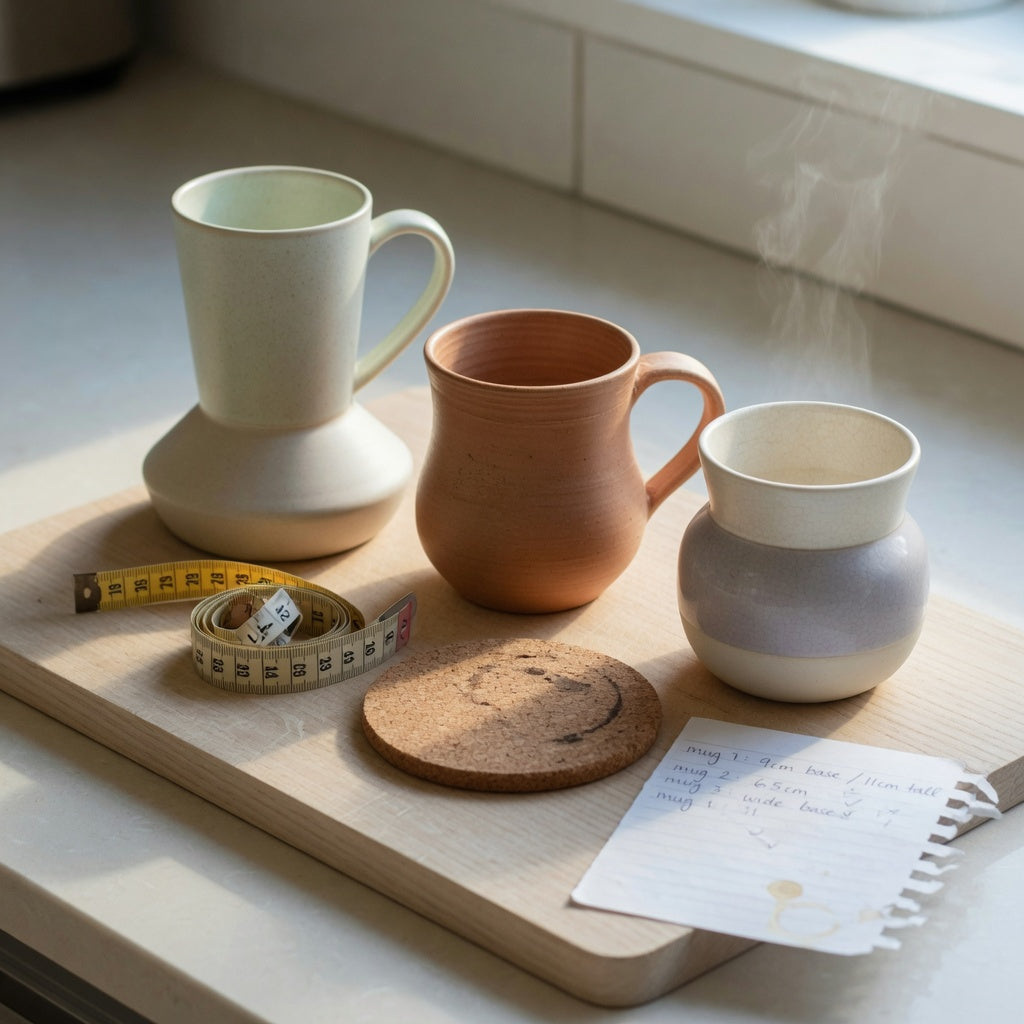
Wide Based Coffee Mugs Shared Household Product Shortlist Guide
A scenario-based shortlist for shared kitchens: how base shape really affects tipping, what 250 ml versus 480 ml changes in daily use, and which of our three mugs suits which routine.
Read more
Coffee Mugs With Big Handles Weekend Coffee Practical Purchase Checklist
A decision-ready checklist for mugs with genuinely roomy handles on slow weekend mornings: finger clearance, filled weight, brewer and dishwasher-rack fit, care wording, and the listing details wor...
Read more
Leave a comment
This site is protected by hCaptcha and the hCaptcha Privacy Policy and Terms of Service apply.