



Unique Espresso Cups Weekend Coffee Product Shortlist Guide
Reading time: about 9 minutes
Sunday pours don't run on a clock — and the cup shouldn't pretend they do
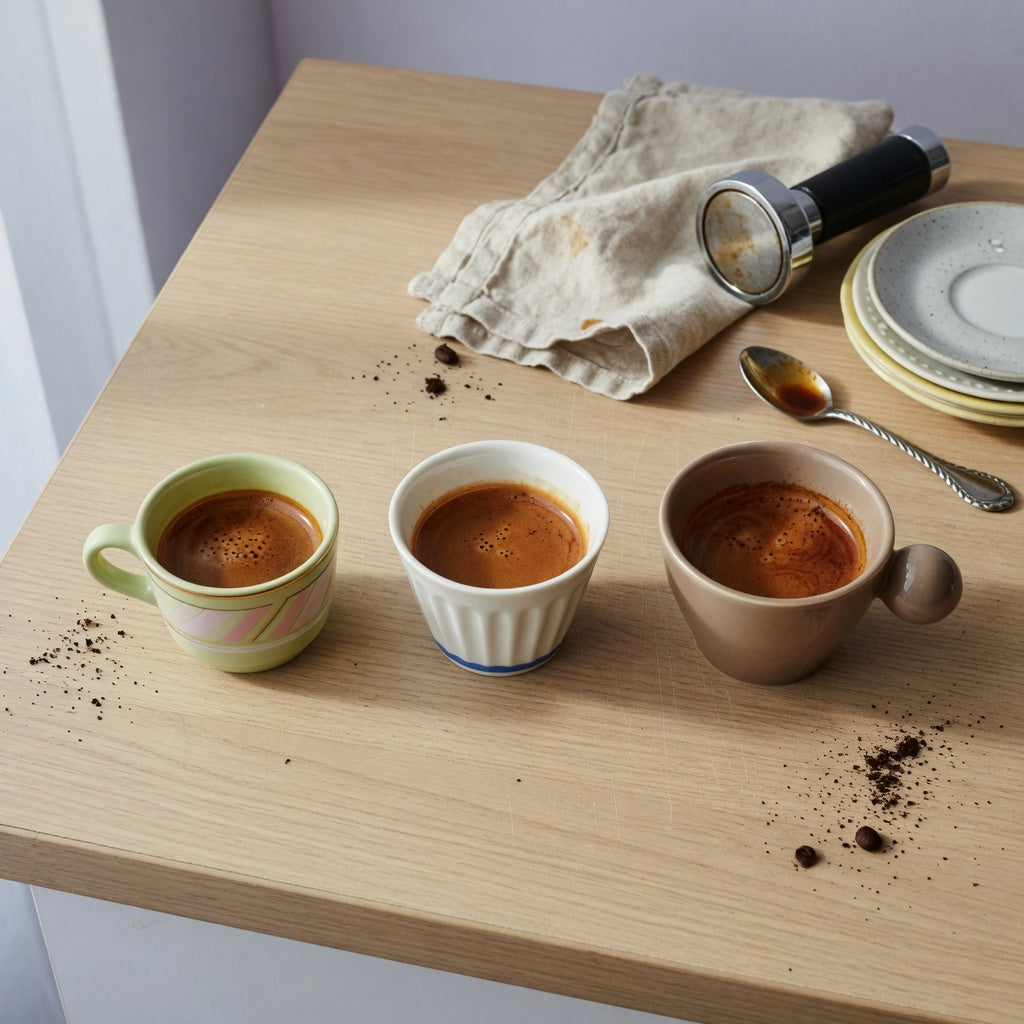
Sunday morning in our shop looks nothing like Tuesday. On a weekday the espresso machine is a queue: pull, rinse, stack, next. On a weekend it turns back into a hobby. Someone pulls a double, carries it to the window, comes back for a second before the first cup has even been rinsed, then leaves both on the counter while they read something. That slower rhythm changes what you want in your hand, which is why this unique espresso cups weekend coffee product shortlist guide is built around three real weekend routines rather than a ranked list of everything we stock.
We handle these cups constantly — stacking them, boxing them, washing them, and hearing back when one disappoints. The shortlist logic below is the same one we use when a shopper messages us on a Friday with some version of: I want something with character, but I'll actually drink from it every weekend.
One scope note before we start. Every cup here is a compact ceramic vessel — 170 ml, 200 ml and 250 ml. None of them is an ornament, and none is an oversized mug. If you want a 350 ml morning tank, work backwards from size in the full unique coffee mugs collection instead of forcing one of these to do the job.
Capacity is not the drink: what 170, 200 and 250 ml actually hold
The number on a listing tells you what the cup can hold, not what you'll pour into it. A certified Italian espresso in the cup is roughly 25 ml; the older specialty definition runs about 25–35 ml; general buying advice puts a useful espresso cup around 50–100 ml, with a common demitasse near 60 ml. So a 170 ml cup isn't strictly an espresso cup. It's a small coffee cup that takes a double shot with headspace, or a cortado with room to move.
That gap matters more on a weekend than on a Tuesday. A 30 ml shot dropped into a 170 ml vessel sits shallow: the crema spreads wide instead of stacking, and the cup reads bigger than the drink inside it. That's geometry rather than a defect — and it's the trade you accept when you choose a characterful small cup over a strict demitasse.
- 170 ml (Retro) — a double shot with headroom, or a short milk drink. Pick it when the cup itself is part of the ritual.
- 200 ml (Pleated) — the useful middle. A longer black coffee or a generous cortado without the half-empty look.
- 250 ml (Ball Handle) — cortado through small-latte territory, or a tea cup that happens to live beside the espresso machine.
Three weekend routines behind this unique espresso cups weekend coffee product shortlist guide
Find your Saturday in the table, then read the paragraph underneath for the candid reason to skip that cup.
| Cup | Listed capacity | Weekend routine it suits | Skip it if |
|---|---|---|---|
| Retro | 170 ml | One person, one double, nothing scheduled | You want a 25–30 ml single to reach the rim |
| Pleated | 200 ml | Two cups on the table with a second round coming | You only ever pull one small shot |
| Ball Handle | 250 ml | Cortado weekends, milk in the cup, tea afterwards | You want a strict 60 ml demitasse |
One person, one double, nothing scheduled: Retro at 170 ml
The Retro coffee and tea cup is listed at 170 ml in ceramic, and it's the pick when the look of the ritual matters as much as the shot. The finish is designed to be seen — it reads as intentional sitting on an open shelf rather than hidden behind a cabinet door. In our experience the shoppers who love it treat the second shot as the real event and the first as calibration.
Skip it if you pull 25–30 ml singles and want the liquid near the rim; a 60 ml demitasse serves that better. One thing worth confirming on the current listing is whether the cup ships on its own or with a saucer — we'd rather you check than plan a table setting around a photograph.
Two cups on the table and a second round coming: Pleated at 200 ml
The Pleated coffee and tea cup at 200 ml is the middle option, and middles win more often than shoppers expect. It's what we reach for when two people are drinking and the counter has to hold both without feeling crowded. A longer black coffee or a generous cortado lands in it without the half-empty look small cups get at brunch. The pleated surface the cup is named for catches light differently than a plain cylinder — it's the reason people pick it off a shelf, and the reason it asks for a minute of care after washing. Textured walls give water more places to sit, so dry it upside down on a rack rather than face-up on a towel.
Skip it if your routine is one small shot and nothing else. 200 ml is more vessel than a 30 ml pour needs.
Milk in the cup and tea in the afternoon: the Ball Handle at 250 ml
The Ball Handle coffee and tea mug is the 250 ml option, and it's the point where the cup stops being purely an espresso vessel. At that capacity it covers the cortado-to-small-latte range without strain, and it doubles as a tea mug on the afternoons you skip coffee altogether. The round handle the mug is named for sits in the hand differently than a flat loop — that's the one detail worth testing in person, or inspecting closely in the listing photos if you're ordering online.
Skip it if you drink strictly 30 ml shots; a double will look like a puddle in 250 ml. Measure your machine as well. Clearance from the drip tray to the group spout is the number that decides whether a taller cup actually gets used, and we can't confirm fit for your specific machine from here.
Week two is where a cup proves itself: rim feel, foot ring, group clearance
Most buyers judge a cup in thirty seconds. The problems show up later. These are the checks we run before recommending anything, and the ones worth running against any product page before you order:
- Group-head clearance. Measure your machine, not the photo. Height plus handle protrusion is the number that matters.
- Rim feel. A thin flared rim delivers liquid differently than a thick rolled edge. Neither is wrong; they feel different on the lip by the third cup.
- Interior colour. A white or clear interior lets you read crema colour and texture. Dark or metallic interiors look striking and hide both.
- Foot ring. A recessed foot traps water in the dishwasher and on the drying rack. Check whether the base is flat or cupped.
- Stackability. Pleated and irregular shapes usually don't nest. If your cabinet is tight, that's a real constraint rather than a detail.
- Care line. Metallic rims and hand-applied finishes are the usual exceptions to dishwasher and microwave use. Confirm it per listing rather than assuming.
Preheating solves most small-cup complaints and costs five seconds: fill the cup with hot water while the shot pulls, tip it out, then pour. Baristas commonly leave cups parked on the machine all shift for exactly this reason, and it makes the third sip taste like the first.
Are brightly glazed or handmade cups safe for hot coffee?
This part of the shortlist has nothing to do with looks. Ceramic glazes and decorative decals can contain lead, and the FDA is explicit that improperly fired pottery can leach it into food or drink — and that washing or boiling will not remove it. The agency also notes that some traditional pottery labelled lead free has still shown extractable lead at or above FDA action levels.
For ceramicware cups and mugs, the FDA's action level is 0.5 µg/ml of leaching solution under CPG 545.450, and 21 CFR 109.16 requires ornamental ware that could be mistaken for food-use ware to carry a conspicuous "Not for Food Use" statement or a hole through the food-contact surface. The agency's own higher-risk list is worth remembering while you shop: handmade pieces with a crude or irregular look, antiques, damaged or worn ware, flea-market and unknown-maker pieces, and ware brightly decorated in orange, red or yellow.
We aren't publishing a glaze test result here, and you shouldn't treat any article as one. What you can do is ask. Before buying an artisan or imported cup, request the glaze and decoration test result against that 0.5 µg/ml cups-and-mugs level. A seller who answers clearly is worth your money; one who changes the subject has told you something too.
Where these three cups are the wrong buy
We would rather you skip a cup than return one. All three sit in a narrow band of compact ceramic, and that rules things out:
- You drink 350 ml or more in one sitting. Every cup here will feel like a tasting pour.
- You want a true demitasse. If a 25–35 ml shot is the whole order, shop 60 ml cups; nothing here fills properly at that volume.
- You want to watch the shot through the wall. That's double-wall glass territory, and ceramic doesn't substitute for it.
- You need dishwasher and microwave confirmation today. Verify it on the individual listing before ordering, and hand wash when you're unsure — it costs a minute and protects the finish.
- You stack hard in a tight cabinet. Pleated and irregular shapes want open shelf space, not a piled saucer stack.
Choose by the volume you actually pour on a Saturday, not the volume you imagine pouring. Then choose the finish you'll still like in March.
Frequently asked questions
Why does this unique espresso cups weekend coffee product shortlist guide only cover three cups?
Because a shortlist is only useful if it ends. We matched three listed capacities — 170 ml, 200 ml and 250 ml — to three weekend routines and gave a clear reason to skip each one. If you already know roughly what you want, that gets you to a decision faster than a roundup of every cup on the market.
Will a 170 ml cup make my double shot look lost?
Somewhat, yes. A 30 ml shot in a 170 ml vessel spreads wider than it would in a 60 ml demitasse, so the crema reads flatter and the cup looks under-filled. If that bothers you, pour a cortado instead or step down to a smaller cup. If it doesn't, the cup earns its place on looks and feel.
Do I need to preheat a thick ceramic cup before a weekend shot?
It's the cheapest improvement available. Fill the cup with hot water while the shot pulls, tip it out, then pour. It costs seconds and makes the second and third sip noticeably closer to the first.
Are these cups dishwasher and microwave safe?
We can't state that for a specific cup here without listing evidence, so confirm it on the current product page. Decorative rims, hand-applied finishes and metallic details are the usual exceptions. When a listing doesn't say, hand wash and skip the microwave.
Can I build a two-cup weekend gift set?
Start from the unique coffee mugs collection and match by finish rather than capacity — two identical finishes in different sizes photograph well and get used more than a mismatched pair. Check each listing for what's actually included before you wrap it.
More from our blog
Ready to pick your mug? Two ways to save on today's order:
Ordering 1–3 mugs? Get an extra 10% off your 1st order with code 10_OFF Apply 10% Off & Shop Wooden-Handle Mugs →
Gifting 4+ mugs? Buy 3, Get the 4th Free applies automatically at checkout (no code needed; offers do not stack) · Free standard shipping (Nov pre-Christmas delivery: 15–20 calendar days US) · Free replacement if chipped in transit.
Popular mug buying guides: Ceramic Tea Cups & Infuser Mugs · Ceramic Mugs with Lids Compared · Wooden-Handle Tea Infuser Mugs Compared · Christmas & Secret Santa Mugs 2026 · Espresso & Cortado Cups Guide · Cup & Saucer Gift Sets · All 25 Mugs Spec Table · Mug Size Guide · Shipping & Promo FAQ
FIRST ORDER 10% OFF (CODE: 10_OFF) · OR BUY 3, GET THE 4TH FREE


Read more
Big Latte Mug First Time Buyer Product Shortlist Guide: 400 vs 480 ml
A first-time buyer's shortlist built on the details listings bury: brim capacity versus real pour, ounce-to-millilitre rounding, handle opening, and clearance under the machine. Includes which of o...
Read more
14 oz Ceramic Coffee Mugs First Time Buyer Practical Purchase Checklist
A first-time buyer checklist for 14 oz ceramic coffee mugs: confirm usable capacity versus brim ounces, check handle clearance and machine fit, and read lead, cadmium, and care claims carefully bef...
Read more
Leave a comment
This site is protected by hCaptcha and the hCaptcha Privacy Policy and Terms of Service apply.