



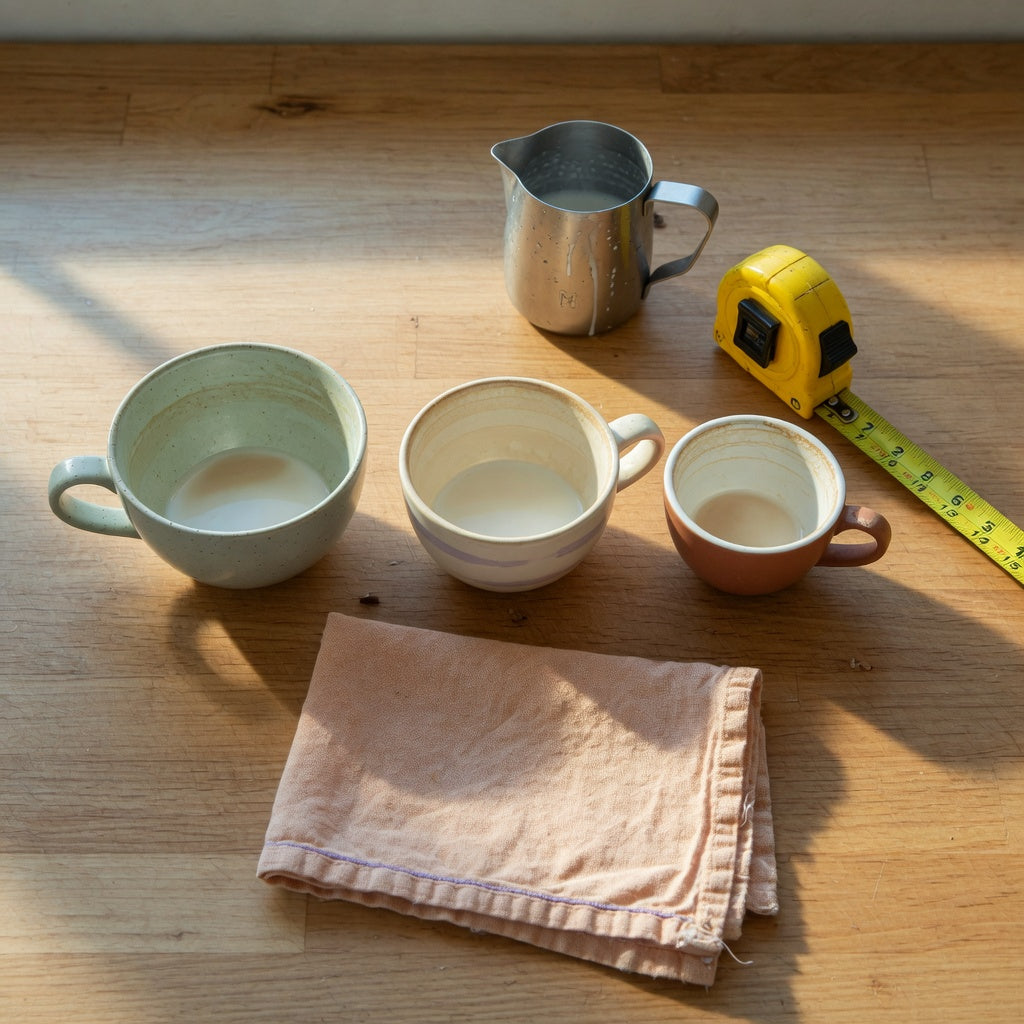
Ceramic Latte Cups Weekend Coffee Product Shortlist Guide (250-440 ml)
Reading time: about 9 minutes
Someone orders a latte cup from a photo, waits a week for delivery, pours a Saturday latte into it, and watches the foam flatten into a ring before they reach the sofa. That is rarely a milk problem. It is a capacity and shape problem, and it is the most common reason a ceramic cup comes back to us.
So rather than another sweeping buyer's guide, this ceramic latte cups weekend coffee product shortlist guide does one narrow job: it takes the three listed capacities we stock — 250 ml, 400 ml, and 440 ml — and gives you a plain reason to pick or skip each one. Weekend coffee is slower than weekday coffee. You have time to steam properly, you choose where the cup lands, and you notice the handle. That is the lens we use below.
The ceramic latte cups weekend coffee product shortlist, at a glance
| Cup | Listed capacity | Weekend routine it suits | Skip it if |
|---|---|---|---|
| Ball Handle Coffee & Tea Mug | 250 ml | One short, concentrated pour; narrow counter or side table; guests who take less | You steam a full pitcher every Saturday |
| The Flow Coffee & Tea Mug | 400 ml | A standard latte with foam headspace; mixed coffee-and-tea weekends | You want the smallest possible footprint |
| Morning & Night Coffee & Tea Mug | 440 ml | A long first cup; a real table rather than a side shelf | You mostly pour small lattes and dislike leftover drink |
Those three capacities are the entire shortlist. If you would rather see the full range of shapes we carry before narrowing down, the unique coffee mugs collection is the fastest way to compare them side by side.
Why the number on a listing rarely matches what you pour
The FDA describes ceramic cups and mugs as small hollowware used for hot drinks such as coffee or tea, normally — but not exclusively — holding about 240 ml (8 fl oz), and made with a handle. That is a useful category reference point. It is not a rule for your kitchen, and it is not a specification for any cup we sell.
What matters more is what the number on a listing actually measures. Brim-full capacity and comfortable-fill capacity are two different quantities. Foam takes up volume. So does the headspace you leave so the drink does not slosh on the walk from counter to table. That gap is the reason buyers keep reporting that a cup rated at 10 oz only holds about 8 oz of finished drink.
- One short latte, drunk standing at the counter: 250 ml is plenty.
- A standard weekend latte with a defined foam cap: roughly 350–400 ml is the forgiving zone.
- A long first cup, seconds, or a vessel that doubles as a tea cup later: 400 ml and up.
If your target lands near 355 ml, the sizing logic in our 12 oz ceramic coffee mugs weekend shortlist overlaps with the middle of this one.
Ball Handle 250 ml: right for one short pour, wrong for a full pitcher
We point people here when their weekend latte is genuinely a single concentrated pour rather than a jug of milk. At 250 ml there is less dead space between the drink surface and the rim, which suits a shorter serve and a smaller table. It is a poor match if you routinely steam a full pitcher — you will finish the pour with milk still in the jug, and you will feel that every Saturday.
One caution about the name: Ball Handle describes a handle treatment, not a set of dimensions. Bore width, base diameter, and wall thickness all have to come from the current Ball Handle product listing, not from the product name or a photograph of it.
The Flow 400 ml: the capacity most weekend routines settle on
If you are unsure, this is where most people land, and it is the recommendation we make most often. Four hundred millilitres leaves room for a foam cap and a little headspace without the cup reading as a bowl. It is also the size that transitions cleanly into an afternoon tea session, which matters if you want one vessel doing two jobs across a weekend.
The detail worth confirming is base diameter rather than capacity. A 400 ml body can be tall and narrow or short and wide, and those two shapes sit very differently beside a laptop or on a crowded counter. Check the measurement on the Flow mug listing.
Morning & Night 440 ml: a table cup, not a side-table cup
The largest of the three. It suits the routine where the first cup is poured slowly and finished slowly, and where the cup lives on a table with clear room around it. Be honest about your habits: if you usually pour 250–300 ml of finished drink, the extra volume becomes empty headspace rather than more coffee, and the cup will feel like the wrong purchase even though there is nothing wrong with it.
Base diameter is the deciding number here too. Confirm it on the Morning & Night listing, then measure the actual spot where the cup will sit — the real spot, not the shelf you think it will live on.
Handle bore, rim width, and the weight of a full cup
Handle bore — the open gap between the handle and the body — matters more than handle length. In our experience, a narrow bore fits two fingers and a wider one fits three or four, and on a full 440 ml cup that difference is the whole experience. If handle shape is your deciding variable, our walkthrough on ceramic coffee mugs with handles goes deeper into finger room and balance.
On interior shape: buyers shopping for latte-art practice are usually told to look for a rounded or bowl-like floor rather than straight cylindrical sides, on the theory that a curved base helps the foam fold outward as you pour. We treat that as a widely repeated preference, not something you can verify from a spec sheet. What you can check is rim width and whether the interior narrows toward the base — both are visible in listing photos and both affect how the pour behaves.
And if your weekend drink is usually a flat white or filter coffee, a straight-sided cup is not a compromise. It is a different tool doing a different job.
What we check on a listing before we recommend a cup
Glaze safety is the question buyers raise with us most, and the words on a listing are worth reading precisely.
- Lead: the FDA's action level for leachable lead in ceramic cups and mugs is 0.5 micrograms per millilitre of leaching solution, applied to any one of six units tested.
- Cadmium: action levels are 0.5 micrograms per millilitre for small hollowware and 0.25 for large hollowware.
- Lead free is not self-enforcing. The FDA has reported traditional pottery labelled lead free that still contained extractable lead at or above its action levels, and notes that washing or boiling cannot remove lead from a piece.
- Higher-risk pieces: the FDA flags handmade, antique, damaged, flea-market, and brightly orange-, red-, or yellow-decorated ceramics as categories to treat with more caution. Everyday commercial factory pottery is described as much less likely to have a problem.
- Decorative ware: under 21 CFR 109.16, a ceramic piece that appears suitable for food use is treated as food use unless it carries both a conspicuous and a permanent Not for Food Use warning, or has a hole bored through the food-contact surface.
- Testing method: the FDA cites ASTM C738, an acetic-acid extraction, and describes it as a severe test unlikely to be matched in ordinary use. Most product pages do not publish batch results, so treat a glaze claim as something to confirm with the seller rather than assume.
- Microwave: the FDA explains that microwaves are reflected by metal and pass through ceramic. That is why metallic trim or luster is a real reason to keep a cup out of the microwave, and why a blanket ceramic-is-microwave-safe statement does not cover every piece.
- Cracks and crazing: retire a cup with a cracked or crazed glaze. That is a defect mode, not a cosmetic quirk.
- Saucers: do not assume one is included. Check the individual product page, because a saucer changes both the footprint on the table and how the cup presents to guests.
If you are weighing glazed finishes specifically, our guide to ceramic glazed coffee mugs covers finish and care in more depth.
Where all three of these cups are the wrong choice
- You want a travel cup. None of these is a sealed tumbler. Ceramic at 400 ml plus a separate lid you have to carry is not a commute solution.
- You pour 500 ml or more in one sitting. All three will need a refill. A larger single vessel beats topping up a 250 ml cup twice.
- You want a wide canvas for serious latte-art practice. A 250 ml rim gives you very little surface, and interior taper is the variable that actually shapes the pour — verify it on the listing before buying for that purpose.
- You need something that survives a bag or a bike ride. These are counter and table vessels. That is a limitation, not a flaw.
Frequently asked questions
Why does my 10 oz cup overflow when I pour an 8 oz latte?
Because listed capacity is usually measured to the brim, while a drinkable fill leaves room for foam and headspace. An 8 oz finished latte in a cup rated at 10 oz can still crest the rim once the foam settles. Size up a step if you steam a full pitcher.
Is 400 ml too big for a single latte?
Not for most home setups. Four hundred millilitres holds a standard latte plus a foam cap comfortably, and it is the capacity we see returned least often for being the wrong size. It is too big only if you consistently pour under 300 ml of finished drink.
Can I microwave a ceramic latte cup with a metallic handle or trim?
Treat metal trim as a stop sign. The FDA explains that microwaves are reflected by metal, which is why metal pans and foil are not used in microwave ovens. Check the care instructions on the exact listing, and if a piece has a metallic luster or trim and the listing does not explicitly permit microwave use, keep it out.
Do these cups come with saucers?
Do not assume so. Confirm on the individual product page whether a saucer is part of the listing, since it changes both the footprint on your table and how the cup presents when you serve guests.
Which capacity should I buy first if I only make one latte a weekend?
Start with the 400 ml Flow mug unless your side table is genuinely narrow. It covers the widest range of pour sizes and it is the safest single purchase while you work out whether you prefer a short serve or a long one. Of the three lines in this ceramic latte cups weekend coffee product shortlist guide, it is the one we recommend most often.
Before you commit, run four checks: measure the spot where the cup will actually sit, compare the listed capacity against how much finished drink you really pour, confirm from the listing whether a saucer is included and whether the care line permits microwave use, and decide whether you need one cup or a matching pair. Then choose from the unique coffee mugs collection with those answers in hand. Two minutes with a tape measure beats a return.
Ready to pick your mug? Two ways to save on today's order:
Ordering 1–3 mugs? Get an extra 10% off your 1st order with code 10_OFF Apply 10% Off & Shop Wooden-Handle Mugs →
Gifting 4+ mugs? Buy 3, Get the 4th Free applies automatically at checkout (no code needed; offers do not stack) · Free standard shipping (Nov pre-Christmas delivery: 15–20 calendar days US) · Free replacement if chipped in transit.
Popular mug buying guides: Ceramic Mugs with Lids Compared · Wooden-Handle Tea Infuser Mugs Compared · Christmas & Secret Santa Mugs 2026 · Espresso & Cortado Cups Guide · Cup & Saucer Gift Sets · All 25 Mugs Spec Table · Mug Size Guide · Shipping & Promo FAQ
FIRST ORDER 10% OFF (CODE: 10_OFF) · OR BUY 3, GET THE 4TH FREE


Read more
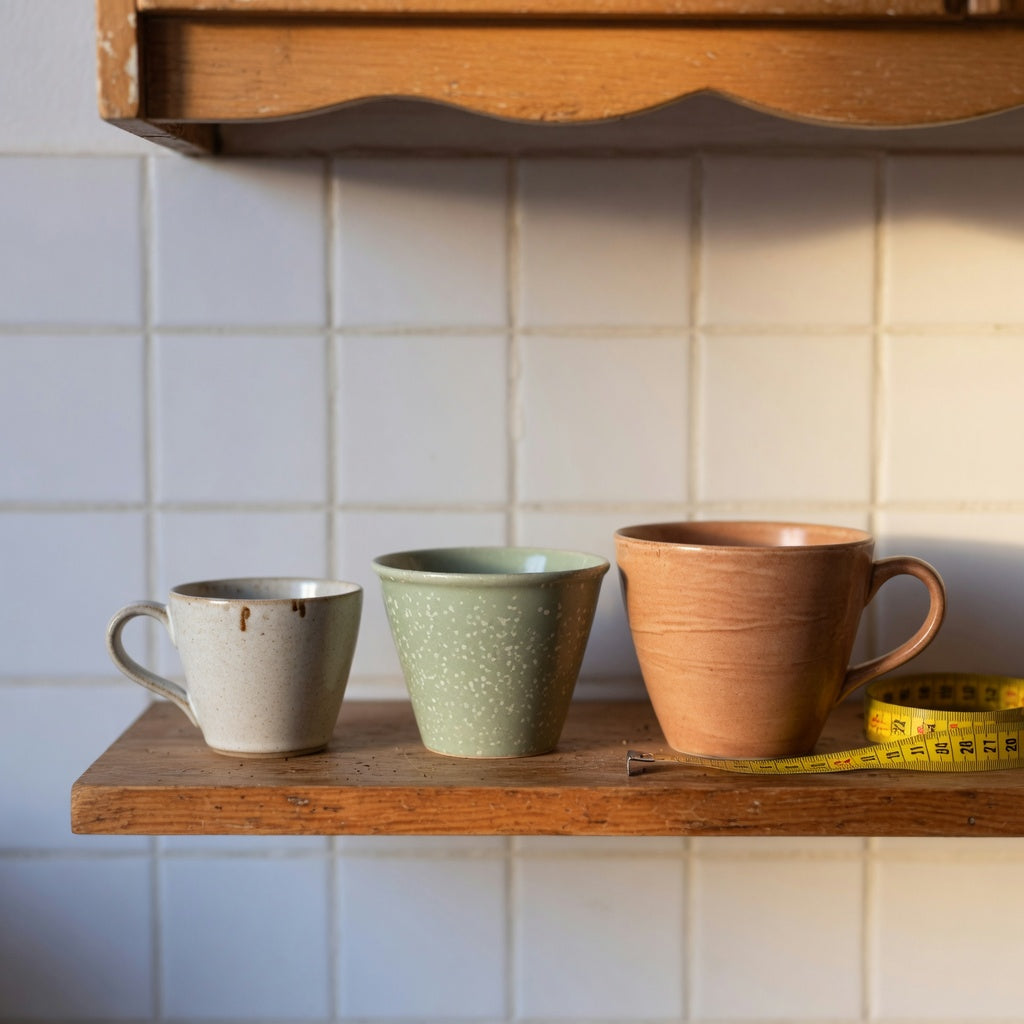
Ceramic Latte Cups Compact Kitchen Product Shortlist Guide (250–440 ml)
A scenario-based shortlist of ceramic latte cups for small kitchens: the 250 ml Ball Handle, 400 ml The Flow, and 440 ml Morning and Night, with shelf, footprint, handle, and glaze trade-offs spell...
Read more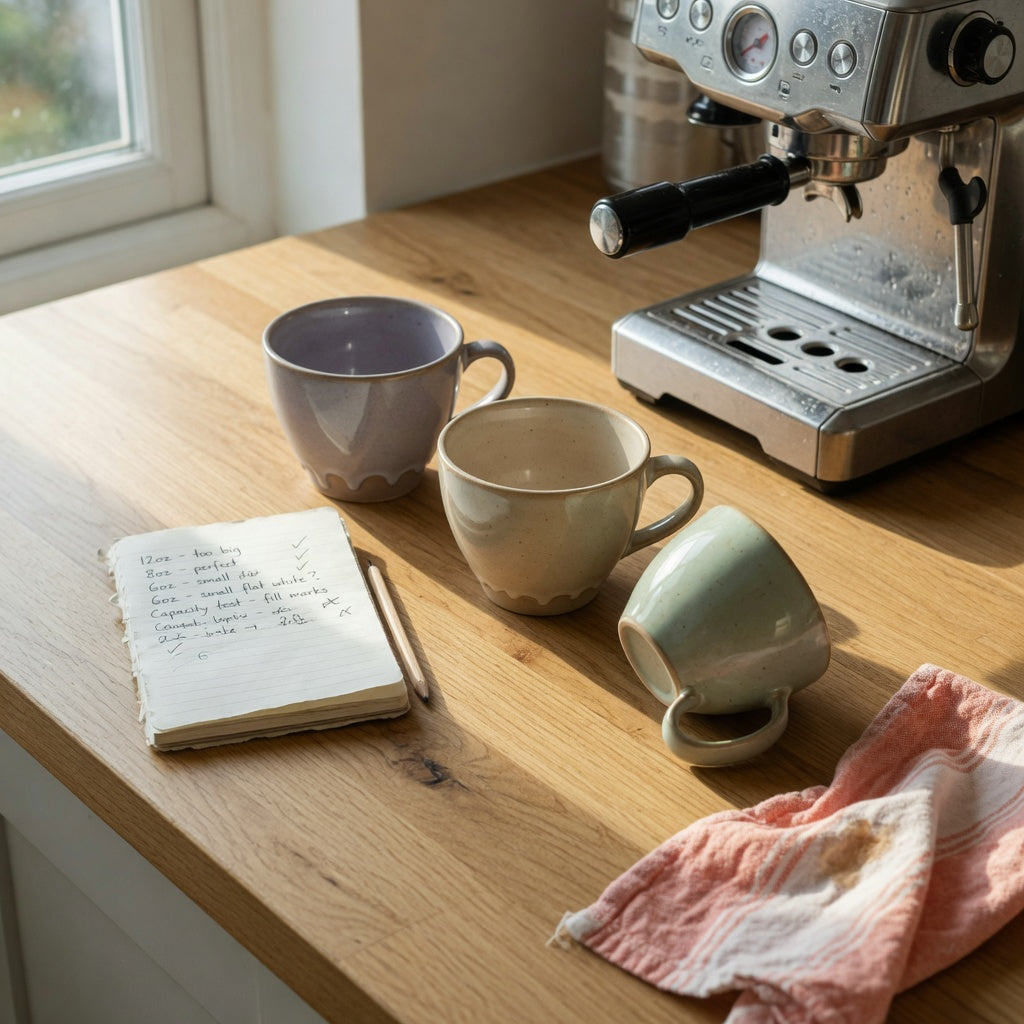
Ceramic Latte Cups Shared Household Product Shortlist Guide: 3 Sizes
A scenario-based shortlist for shared households: Ball Handle 250 ml for small milk drinks, The Flow 400 ml for daily lattes and latte-art practice, Morning and Night 440 ml for long coffee-and-tea...
Read more
Leave a comment
This site is protected by hCaptcha and the hCaptcha Privacy Policy and Terms of Service apply.