



Cute Espresso Cups Weekend Coffee Product Shortlist Guide: 3 Picks
Reading time: about 10 minutes
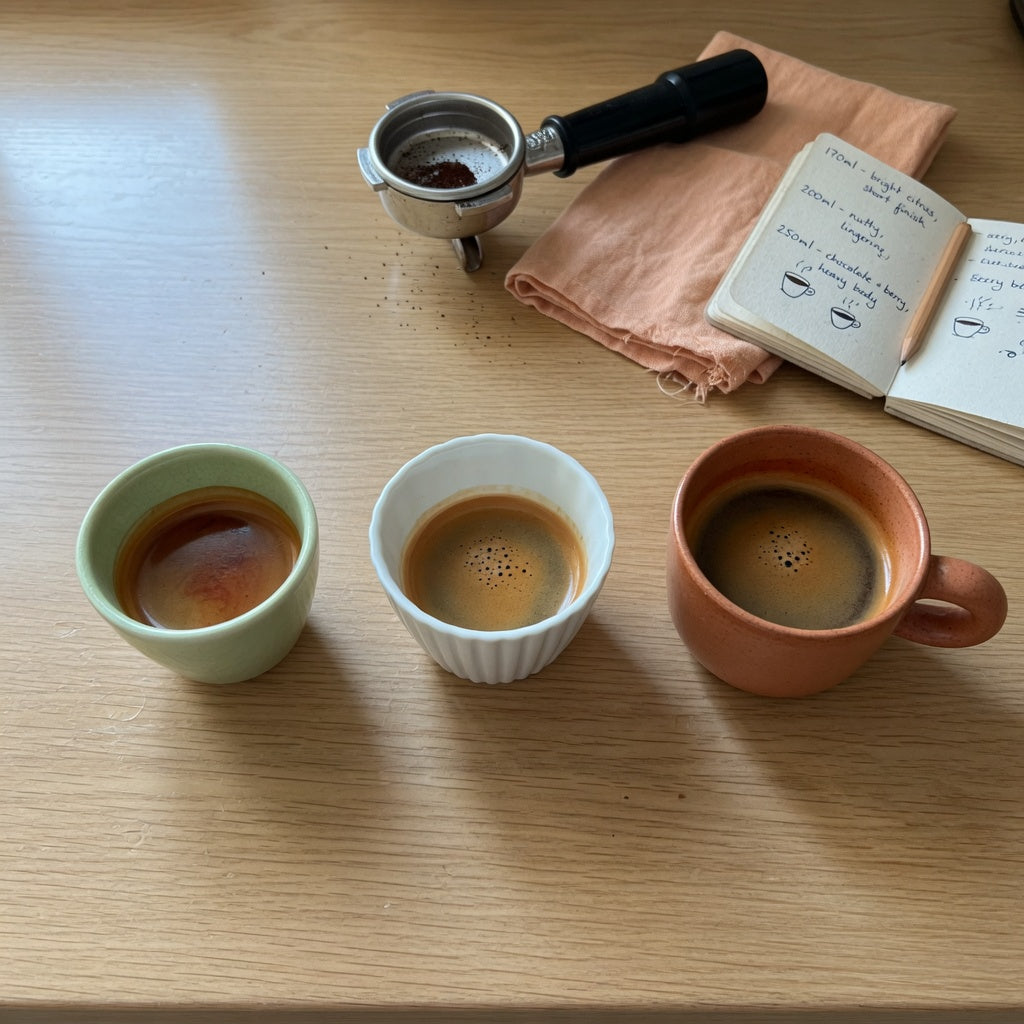
Sunday, 9:10 a.m. The grinder has been dialed twice, the kettle is warm from a second boil, and nobody is standing at the counter waiting for a travel lid. It is the one pour of the week where the cup matters as much as the shot — and the one where a decorative cup quietly gives itself away. Too tall for the rim to catch both streams from a bottomless portafilter. A loop you can only hook one finger through. A body that looks generous when it is empty and crowds the rim at the first double.
We handle this category daily at the counter, and the returns tell a consistent story. Buyers rarely regret the color or the pattern. They regret the size. So instead of another broad overview, this cute espresso cups weekend coffee product shortlist guide narrows the field to three compact ceramic cups we stock, names the weekend drinker each one actually fits, and says plainly when to skip all three.
What 170 ml, 200 ml and 250 ml actually mean on a slow weekend pour
Capacity is the number people misread most often, and they misread it in both directions. Traditional Italian espresso service treats the drink as a small pour — roughly 25 ml — while cup capacity is a separate measurement altogether. You pour to a working line, not to the rim, because a cup filled to the edge sloshes on the walk from the machine to the table.
That gap explains why a 170 ml cup can serve a single shot beautifully and still frustrate someone who wants crema sitting just under the rim. It also explains why none of the three cups below is a strict demitasse. All three are compact ceramic vessels, and all three are larger than a traditional single-shot cup. Nothing on this page changes that arithmetic, and no listing should pretend otherwise.
- 170 ml listed capacity — a single shot with real headroom, or a shot plus a small splash of milk.
- 200 ml listed capacity — the middle ground: a modern double, or a macchiato with a defined milk layer.
- 250 ml listed capacity — the most forgiving of the three, built for a longer drink and a slower pace.
- Not on this shortlist — a true 50 ml china cup with crema reaching the rim. If that look is what you want, buy a demitasse and accept the smaller pour.
One geometric detail most listings skip: rim width does as much work as volume. A bottomless portafilter splits the flow into two streams, and a wide opening catches both. A tall, narrow cup tends to catch one and stripe the drip tray with the other.
The cute espresso cups weekend coffee product shortlist guide: three ceramic cups compared
These three are not ranked against each other. They solve three different weekend problems, so the fastest way to use this list is to rule two of them out on the first read.
Retro 170 ml — the single-shot Saturday cup
Listed capacity is 170 ml, the body is ceramic, and the visible form is retro: a small cup with a vintage silhouette rather than a miniature one. In the hand it reads as a proper cup, which is the point of choosing a compact shape over a demitasse. Choose it if your weekend default is one careful shot, you like a cup that looks proportional on a small saucer, and you want the shortest possible route from grinder to table. Skip it if your default involves milk or a second drink — at 170 ml you will be refilling rather than settling in. See the Retro 170 ml cup listing.
Pleated 200 ml — the double-shot and macchiato cup
200 ml listed capacity, ceramic body, and a pleated exterior that gives the eye a shape to follow without relying on printed decoration. Thirty millilitres more than the Retro does not sound like much on paper, but it changes the pour: a double shot with a small milk addition fits without crowding the rim, so more of the surface stays visible. Choose it if you alternate between straight espresso and a macchiato, or you want one cup that still works when a guest asks for something slightly bigger. Skip it if you specifically want tiny, jewel-like proportions — at 200 ml this is compact, not miniature. Check the Pleated 200 ml cup.
Ball Handle 250 ml — the cup that leaves the kitchen
The largest of the three at 250 ml listed capacity, ceramic, with a ball-shaped handle that is the cup's defining visible feature rather than a finishing detail. That shape is exactly why we pull this one off the shelf for shoppers who carry a full cup to the sofa without a saucer underneath — and why we tell the rest to look at the other two. Choose it if your weekend coffee is a longer drink, you serve it away from the machine, or thin loops feel fiddly in a warm hand. Skip it if you want a classic espresso silhouette or your counter space is tight; at 250 ml it takes up noticeably more room than the Retro or the Pleated. View the Ball Handle 250 ml mug.
| Cup | Listed capacity | Body | Best weekend job | Reason to skip |
|---|---|---|---|---|
| Retro | 170 ml | Ceramic | Single shot, neat service | Little room for a milky double |
| Pleated | 200 ml | Ceramic | Double shot or macchiato | Not the tiny decorative look |
| Ball Handle | 250 ml | Ceramic | Longer drink carried away from the machine | Bigger footprint, less classic shape |
Will it fit under the spout, and can you get a finger through the handle?
Two measurements cause more returns in this category than any complaint about pattern. There is no published standard for spout-to-tray clearance, so fit is always a product-by-product number you have to check against your own machine. Before ordering, run these four checks:
- Height under the spout. Measure from the drip tray to the lowest part of the group head, then compare that number with the cup height printed on the listing. A cup that only fits with the tray removed will irritate you by the third weekend.
- Rim width. Wider openings cope better with a split flow than tall narrow ones. If you pull with a bottomless basket, this matters more than capacity.
- Handle clearance. Many pretty cups use fingertip loops. Look at the handle photo and ask whether two fingers will pass through comfortably when the cup is full. If not, you will end up gripping the body — hot ceramic against bare fingers.
- Saucer footprint. A saucer adds roughly its own diameter to the space the cup occupies. On a narrow shelf or a two-foot rental counter, that number decides whether cups stay out or go back in the cabinet.
None of those four checks is about looks. All four are the difference between a cup you reach for every weekend and a cup you photograph once.
Where a compact ceramic cup stops being the right choice
Honesty is more useful at the counter than enthusiasm, so here is where we steer shoppers away from this whole category.
- Dialing in a new bean. A plain white interior shows crema color and texture most clearly; patterned or dark interiors hide it. If you are learning to read a shot, buy one white cup for evaluation and keep the pretty one for serving guests.
- Long blacks, americanos and lattes. Even the 250 ml cup here is a small vessel. If those are your weekend drinks, a standard mug is the better tool — start with our unique coffee mugs collection and compare capacities from there.
- Dessert pours. An affogato depends on cup geometry more than pattern, which is a separate decision we cover in our affogato cup size comparison.
- Anything sold purely as decoration. Ornamental ware is not drinkware and must be labelled that way. Do not assume a display piece is safe for food just because it looks like a cup.
Glaze, care and gifting details we settle before recommending
The FDA notes that lead in ceramic glaze is bound when pottery is fired correctly, but that improperly fired glaze may not fuse and can contaminate food; the agency also warns that some traditional pottery labelled lead free has still shown extractable lead, and that ceramicware intended only as decoration must be identified so it is not used with food. That is why we ask hand-painted and imported cup makers to speak plainly about food-contact status instead of leaving shoppers to guess from a photo.
Two more practical points come up in almost every weekend-coffee conversation:
- Rim finish. Painted rims and metallic accents are usually the first details to degrade in a dishwasher. If a listing does not state dishwasher suitability, treat hand washing as the safe default — that is a care habit, not a claim about any specific cup on this page.
- Saucers versus stacking. A set with saucers photographs better and feels more like a gift; a stackable set stores better in a small kitchen. Handmade and speckled glazes also vary cup to cup, which is charming in a present and irritating if you expected four identical pieces.
Three questions that eliminate two of these cups in a minute
- What is your default weekend pour? Single shot, double, or double with milk. That answer alone removes two of the three cups above.
- Where does the cup live? Beside the machine, at the table, or on a shelf between uses. Shelf-first buyers should weight visible form; machine-first buyers should weight rim width and height clearance.
- Who else uses it? A household mixing straight-espresso drinkers with milk-drink drinkers usually lands on 200 ml as the shared compromise.
Then confirm the boring details before you commit: listed capacity, ceramic body, handle clearance, and the care instructions on the listing.
Frequently asked questions
Is 170 ml too big for a single espresso?
By strict demitasse standards, yes — a traditional single-shot cup is far smaller. At 170 ml a single shot sits with room to spare, with space left over if you add a splash of milk. If you want crema reaching the rim, buy a dedicated demitasse instead.
Can I pull a double shot into these cups?
The 200 ml and 250 ml cups handle a modern double comfortably, including a small milk addition. The 170 ml cup takes a double but leaves almost no headroom once milk enters the picture.
Will these cups fit under my espresso machine?
That depends on your machine, not the cup. Measure tray-to-spout height and compare it with the dimensions on the listing. There is no industry standard for clearance, so this stays a per-machine check rather than a yes-or-no answer.
Are these cups dishwasher safe?
Check the current listing for each cup — care instructions vary by glaze and finish, and we will not guess on your behalf. Where a listing is silent, hand washing keeps painted rims and glazes looking better for longer.
How are these different from a demitasse?
Capacity and proportion. These are compact ceramic cups at 170–250 ml; a demitasse is much smaller and built for one short shot. If you only need one answer from this cute espresso cups weekend coffee product shortlist guide, it is this: start with the pour you actually make, not the pattern you like most.
Pour first, then pick. Singles point to the Retro 170 ml, doubles and macchiatos point to the Pleated 200 ml, and long weekend drinks you carry away from the machine point to the Ball Handle 250 ml. Keep the four fit checks above next to you while you compare, and if you want to see the wider range of shapes and finishes first, browse the full collection of unique coffee mugs.
More from our blog
Ready to pick your mug? Two ways to save on today's order:
Ordering 1–3 mugs? Get an extra 10% off your 1st order with code 10_OFF Apply 10% Off & Shop Wooden-Handle Mugs →
Gifting 4+ mugs? Buy 3, Get the 4th Free applies automatically at checkout (no code needed; offers do not stack) · Free standard shipping (Nov pre-Christmas delivery: 15–20 calendar days US) · Free replacement if chipped in transit.
Popular mug buying guides: Ceramic Mugs with Lids Compared · Wooden-Handle Tea Infuser Mugs Compared · Christmas & Secret Santa Mugs 2026 · Espresso & Cortado Cups Guide · Cup & Saucer Gift Sets · All 25 Mugs Spec Table · Mug Size Guide · Shipping & Promo FAQ
FIRST ORDER 10% OFF (CODE: 10_OFF) · OR BUY 3, GET THE 4TH FREE


Read more
Ceramic Latte Cups Shared Household Practical Purchase Checklist
A shelf-side checklist for buying ceramic latte cups in a shared household: verify real pour volume, map capacity to each drinker, judge handle clearance at full weight, and read glaze claims again...
Read more
Ceramic Latte Cups Compact Kitchen Product Shortlist Guide (250–440 ml)
A scenario-based shortlist of ceramic latte cups for small kitchens: the 250 ml Ball Handle, 400 ml The Flow, and 440 ml Morning and Night, with shelf, footprint, handle, and glaze trade-offs spell...
Read more
Leave a comment
This site is protected by hCaptcha and the hCaptcha Privacy Policy and Terms of Service apply.