



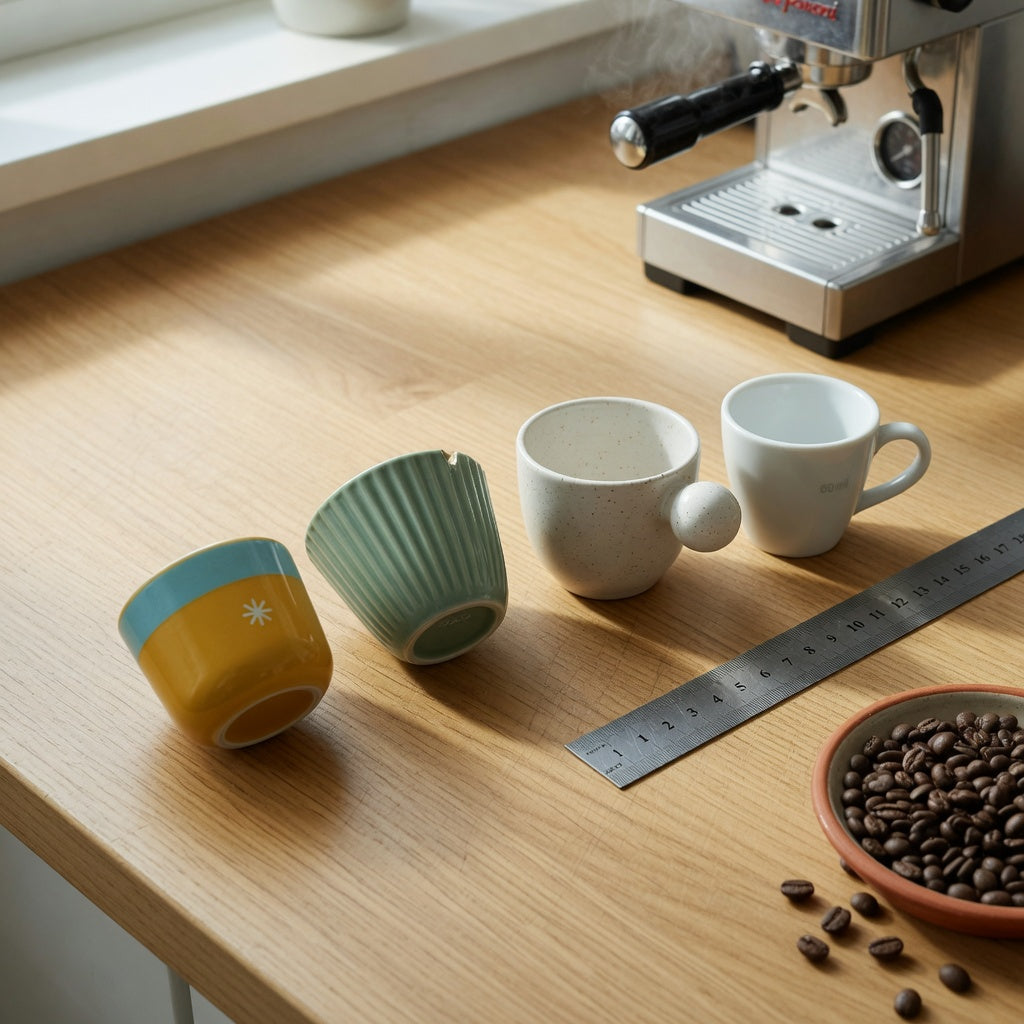
Unique Espresso Cups Shared Household Practical Purchase Checklist
Reading time: about 12 minutes
A customer emailed us photos of her cupboard last month: eleven espresso cups, four people, one machine, and a standing argument over which cup is “the good one.” Her partner pulls a double at 6 a.m. and drinks it standing at the counter. Her daughter makes cortados. Her mother-in-law will not touch a cup without a handle. And the two handmade ceramic espresso cups she bought for their glaze sit at the back of the shelf, too tall to slide under the group head.
That cupboard is why we built this unique espresso cups shared household practical purchase checklist. “Unique” is an aesthetic decision — a reactive glaze, a pleated body, a shape you notice from across the kitchen. Drinking out of it is a mechanical one: a small, very hot pour, handled by several people, every morning, usually before anyone is fully awake. We sell this category and we hear the same handful of complaints come back, so here is the order our team would work through before spending money.
Why does single-drinker cup advice collapse in a shared kitchen?
Most espresso cup guidance is written for one drinker with one routine. A household has three or four routines sharing one machine and one shelf, and the advice stops being useful the moment two people disagree about what the cup is for.
What “unique” looks like in practice: reactive or speckled glazes, pleated or faceted bodies, painted patterns, unusual handles, coloured interiors, glass. What it does not change is the physics. The drink is still roughly 25–60 ml of very hot coffee, and it sheds heat fast in a wide, thin vessel.
Two rules follow from that. Buy per person, not per household — a four-cup matching set photographs beautifully and usually ends up with two cups in permanent rotation and two at the back of the cupboard. And treat the shelf as a rotation rather than a uniform. Each of our three cups has its own product page, so nobody has to accept a bundle they did not choose. To see the finishes side by side before you commit, browse the unique coffee mugs collection first.
Does a 170 ml cup hold a single shot, or a double?
Listings blur two different numbers, and that blur is what costs people money.
- The drink. Reference points used in specialty coffee put a single shot at roughly 25–35 ml, with the certified Italian espresso sitting around 25 ml.
- The cup. A demitasse is generally described as 50–100 ml, with about 60 ml as the classic size. The gap is crema, aroma headspace, and a wall thick enough that your fingers survive.
So a “3 oz” listing — roughly 90 ml — is not a triple shot. It is a cup built for one shot with room to breathe. And 170 ml is not oversized; it is a double-shot or espresso-forward cortado vessel. Misread that once and you end up with a cabinet of cups that are technically espresso cups but practically the wrong size for everyone in the house.
A cortado glass and a 170 ml ceramic cup can hold similar volumes. The glass lets you watch the layers form; a ceramic body holds warmth longer and feels steadier in the hand. Neither is better — they serve different drinkers, and in a shared house you can own both without waste.
The second half of the problem is physical. A cup can hold the right volume and still fail: too tall for the group head, base too wide for the drip tray recess, handle catching the machine’s side panel. Capacity narrows the field. Measurements close it.
| Who is drinking | What lands in the cup | Capacity that works | Where we would start |
|---|---|---|---|
| The straight-shot drinker | 25–35 ml, finished in two sips | 50–100 ml, light interior | Not our range — a classic 60 ml china demitasse |
| The double-shot sipper | 50–60 ml, taken slowly | 120–170 ml | Retro Coffee & Tea Cup (170 ml) |
| The cortado drinker | Espresso plus a roughly equal pour of steamed milk | 170–200 ml | Pleated Coffee & Tea Cup (200 ml) |
| The milky-coffee or tea drinker | 200 ml and up | 200–250 ml | Ball Handled Coffee & Tea Mug (250 ml) |
Which of our three ceramic cups suits which drinker?
We keep three compact ceramic vessels in the range, and they sit in a deliberately tight cluster: 170, 200 and 250 ml. They are built for double-shot and cortado routines rather than strict 25 ml singles. What we can state with confidence is the listed capacity and the ceramic finish you can see in the photos. Anything about glaze chemistry, dishwasher ratings or exact outer dimensions has to be checked on the current listing for that specific cup — we will not guess at it here, and you should be wary of any seller who fills those gaps from a product photo.
- Retro Coffee & Tea Cup — 170 ml. The compact one, and the cup we would hand to the 6 a.m. double-shot drinker who wants crema headroom without a thimble of liquid. Also the safest first purchase if you are unsure: it is the smallest, so it is the least likely to crowd the machine or the shelf.
- Pleated Coffee & Tea Cup — 200 ml. The pleated body gives the eye something to hold that a plain cylinder does not, and 200 ml is a useful zone for cortados and small flat whites. This is the one to buy for the household member who adds milk and still wants to taste the coffee.
- Ball Handled Coffee & Tea Mug — 250 ml. The largest, and the obvious pick for whoever insists on a handle and a longer drink — the afternoon tea person as much as the coffee drinker. It is also the one to measure first: 250 ml of ceramic plus a saucer gets close to the group head on compact machines.
The trade-off, said plainly because it saves a return: none of these three is a true demitasse. If someone in your house pulls a single shot and finishes it in two mouthfuls, buy them a 60 ml china cup and let them keep it separate. Our cups earn their place with the people who want more liquid, more colour, or more presence on the shelf — not with the two-sip purist.
Will a decorative cup still let you read the crema and drink comfortably?
Yes, but the interior colour decides how much you can read, and the rim decides how much you enjoy reading it.
A white or clear interior gives you something to judge: pale blond versus deep hazelnut versus a dark ring at the edge, which is often the first sign a shot ran long. Dark interiors, heavy reactive glazes and metallic lustre hide all of that. Not a dealbreaker — plenty of drinkers care about the look, not the diagnosis — but in a mixed household, give the light interior to whoever notices a sour shot and the dramatic glaze to someone else.
Three details that only surface after a week of daily use:
- Rim feel. A thin, slightly flared rim reads precise. A thick rolled rim reads soft and forgiving. Irregular, hand-thrown rims are the whole appeal for one drinker and quietly irritating for another — worth a conversation before you buy two.
- Shape. A narrower base with a wider mouth pushes aroma toward your nose. Square, sculptural and novelty shapes tend to look better on a shelf than they drink from, because crema breaks differently across a non-circular surface.
- Handle or handleless. Handleless espresso cups pack tighter and stack better, but a thick ceramic wall with nothing to grip puts heat straight into your fingertips. Keep one handled option in the rotation and the daily argument usually ends.
One habit worth adopting with any thick-walled cup: preheat it. Fill with hot water while the machine comes up to temperature, tip it out, then pull the shot. Ten seconds, and it is the difference between a warm espresso and a lukewarm one.
Will it fit under the group head and survive the shelf?
This is the question that never appears on a product page, and it is the one that turns a good cup into a decorative object. Measure four things before you buy:
- Clearance. From the drip tray up to the underside of the portafilter spout. That is your maximum cup-plus-saucer height — and if you weigh shots, subtract the scale now rather than later.
- Base diameter. The foot has to sit inside the drip tray recess without wobbling. A wide base on a narrow tray is a small daily annoyance that never goes away.
- Handle swing. A generous handle can foul the machine’s side panel or tip the cup off-centre under the spout.
- Shelf and stack. One-off pottery and double-wall espresso glasses usually will not stack, and cup-and-saucer pairs eat vertical space fast. Decide up front whether saucers are welcome in your cupboard at all.
Write those four numbers down, then browse. Doing it in that order turns a forty-minute scroll into a five-minute decision — and it is the single biggest reason buyers tell us a cup “didn’t work out.”
Are brightly glazed and handmade ceramic cups safe for hot coffee?
Unusual cups are often handmade, imported, or brightly decorated, which is exactly the category where food-contact questions deserve a straight answer rather than a vibe.
FDA guidance notes that lead in ceramic glazes or decorations can leach into food and drink if the pottery is not properly fired, that some traditional pottery labelled lead free has still shown extractable lead at or above FDA action levels, and that washing or boiling will not remove lead from pottery. For cups and mugs specifically, the FDA’s chemical-contaminants listing sets an action level of 0.5 µg/ml of leaching solution. Separately, 21 CFR 109.16 covers ornamental ceramicware: pieces with lead in glazes or decals that otherwise look usable must carry conspicuous “Not for Food Use” labelling or a hole through the food-contact surface.
FDA also flags the higher-risk categories worth extra caution — handmade pieces with a crude or irregular look, antiques, damaged or worn ware, items from flea markets or unknown makers, and pottery brightly decorated in orange, red or yellow. A bright reactive glaze is not proof of a problem, but it is a fair reason to ask a seller for lead and cadmium test results before you drink hot coffee out of it every morning. If a cup arrives marked for decorative use only, believe the label and put it on a shelf.
What fails first in a busy kitchen, and who washes what?
Shared households are hard on ceramics. Cups get stacked wet, loaded badly, and reheated by whoever reaches the microwave first.
- Metallic rims and lustre decoration belong in the hand-wash pile, and never in the microwave.
- Hand-painted patterns can dull under abrasive detergent over months, not days — which is why the damage is easy to miss until the pattern looks tired.
- Glass scratches and clouds, and a dropped double-wall glass can lose its vacuum seal while still looking intact.
- Rims chip where you drink. Run a thumb around each cup as you unload it; that is the most common failure we hear about.
- Unglazed feet trap water and leave rings on painted shelves. A quick towel-dry before stacking solves it.
If a listing does not explicitly say dishwasher-safe, assume hand-wash and treat a machine cycle as a bonus rather than a right. For our three cups, read the care wording on the current product page for the exact piece you are buying — finishes differ, and in our experience it is better to verify than to trust a blanket claim.
The unique espresso cups shared household practical purchase checklist
Work through this in order and the decision usually makes itself:
- List each person in the house and what they actually drink most mornings — not what they might drink.
- Convert every drink to millilitres: single roughly 25–35 ml, double roughly 50–60 ml, then add milk.
- Pick a cup roughly 60–120 ml above the drink volume, to leave room for crema and headspace.
- Decide who needs a light interior to read the shot, and who only cares about the finish they love.
- Choose handle or handleless per person, not per household.
- Measure group-head clearance, the drip tray recess, and side clearance for the handle.
- Confirm whether saucers fit your shelf and whether anything in the rotation will stack.
- For any handmade-looking or brightly glazed cup, ask for food-contact test results and check the base for a “Not for Food Use” mark.
- Read the care statement for dishwasher, microwave and metallic decoration rules.
- Buy one cup first, live with it for a week, then add the second — mixed households rarely need four identical cups.
Most households land close to this: the 170 ml Retro for whoever drinks the smallest, hottest pour; the 200 ml Pleated for the cortado person; the 250 ml Ball Handle for the one who wants a handle and a longer drink. Start with a single cup for your most particular drinker and add the rest only as your routines justify them. You can compare all three finishes in the CoffeifyMug unique coffee mugs collection — go in with your measurements rather than your assumptions.
Frequently asked questions
Do I need different cups for a single shot and a double shot?
In a shared house, usually yes. A strict 25–35 ml single disappears into a 170 ml cup and cools faster than it should, so a small 50–100 ml demitasse serves that drinker better. Save the larger ceramic cups for doubles and cortados, where the liquid actually fills the vessel.
Does this unique espresso cups shared household practical purchase checklist change for tea drinkers?
Very little, which is why these cups work in a mixed house. A 200–250 ml ceramic cup handles a tea bag or a short steep comfortably, so the same vessel can serve the person who drinks tea at 4 p.m. and coffee at 8 a.m. Just keep the strongest-flavoured teas away from a pale interior if that cup also does espresso duty.
How do I check whether a handmade-looking cup is safe for hot coffee?
Ask the seller for lead and cadmium leaching test results, and look for a “Not for Food Use” mark on the base — if it is there, the piece is decorative. The FDA sets an action level of 0.5 µg/ml for lead leaching from ceramic cups and mugs, and notes that washing or boiling cannot remove lead from pottery.
Do these cups come with saucers, and can they go in the dishwasher?
Check the current product listing for the specific cup rather than assuming either way; finishes and included accessories vary, and we would rather you read the exact page than rely on a general answer. As a rule, anything with metallic decoration or an unstated care rating should be hand-washed.
Should everyone in the house get the same cup?
Usually not. Matching sets look tidy in photos, but four people with four routines tend to reach for different cups. Buying one at a time and letting the rotation settle costs about the same and produces far fewer unused cups at the back of the shelf.
More from our blog
Ready to pick your mug? Two ways to save on today's order:
Ordering 1–3 mugs? Get an extra 10% off your 1st order with code 10_OFF Apply 10% Off & Shop Wooden-Handle Mugs →
Gifting 4+ mugs? Buy 3, Get the 4th Free applies automatically at checkout (no code needed; offers do not stack) · Free standard shipping (Nov pre-Christmas delivery: 15–20 calendar days US) · Free replacement if chipped in transit.
Popular mug buying guides: Ceramic Tea Cups & Infuser Mugs · Ceramic Mugs with Lids Compared · Wooden-Handle Tea Infuser Mugs Compared · Christmas & Secret Santa Mugs 2026 · Espresso & Cortado Cups Guide · Cup & Saucer Gift Sets · All 25 Mugs Spec Table · Mug Size Guide · Shipping & Promo FAQ
FIRST ORDER 10% OFF (CODE: 10_OFF) · OR BUY 3, GET THE 4TH FREE


Read more
14 oz Ceramic Coffee Mugs Compact Kitchen Practical Purchase Checklist
A 14 oz mug can fit a compact shelf or fight it. This 14 oz ceramic coffee mugs compact kitchen practical purchase checklist compares our 400 ml, 440 ml, and 480 ml mugs against fill line, handle c...
Read more
Big Latte Mug Weekend Coffee Practical Purchase Checklist (400–480 ml)
A weekend latte has time on its side, so the mug matters more than it does on a rushed weekday. This checklist matches capacity, handle room, shape, fit, and care questions to the 400, 440, and 480...
Read more
Leave a comment
This site is protected by hCaptcha and the hCaptcha Privacy Policy and Terms of Service apply.