



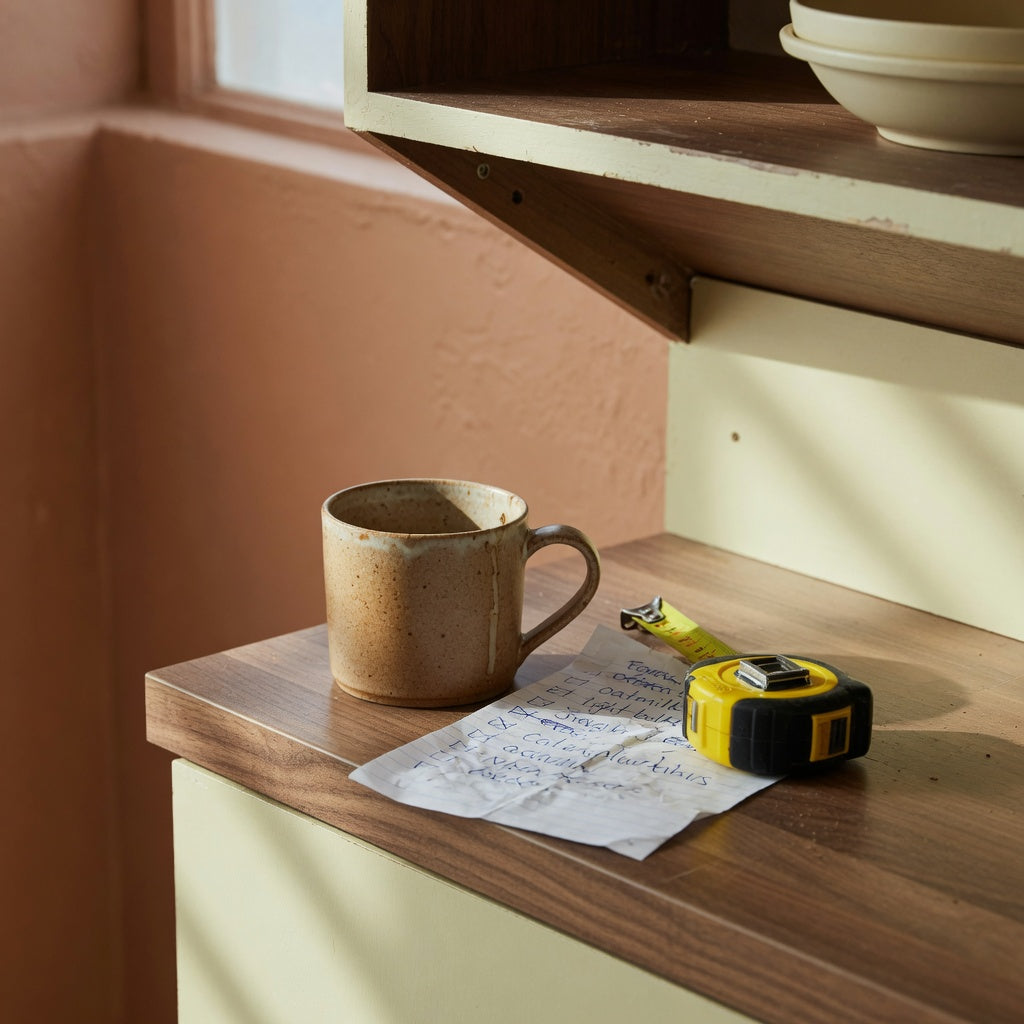
14 oz Ceramic Coffee Mugs Compact Kitchen Practical Purchase Checklist
Reading time: about 9 minutes
A 14 oz mug sounds like the safe middle - until you close the cabinet door and hear the handle hit the frame. In a compact kitchen, capacity is only one line on the spec sheet. This 14 oz ceramic coffee mugs compact kitchen practical purchase checklist is built around the constraints we hear about in our store: shelf height, brewer clearance, handle knuckles, full-mug weight, and care labels that change between glazes. We list capacity in milliliters for a reason. A mug at 14.9 fl oz and one at 13.5 fl oz can both sit near a 14 oz search result, but they pour differently.
What does 14 oz mean once the mug is full?
A U.S. 14 fl oz pour is about 414 mL. FDA guidance for ceramicware describes cups and mugs as small hollowware normally around 240 mL (8 fl oz), so a 14 oz mug is clearly in the larger everyday-cup range. Listings often quote brim capacity, though, not the amount you comfortably drink after leaving room for milk or a lid.
Ask two questions before comparing shapes: is the listed number brim-full or a working fill, and does a lid sit inside the rim? If the listing does not say, treat the number as a starting point. In our catalog, the spread is easy to see:
| Mug and listed capacity | Approx. U.S. fl oz | Reader situation | Verify before ordering |
|---|---|---|---|
| The Flow coffee and tea mug - 400 ml | ~13.5 fl oz | You usually pour 10-12 oz of drip coffee or tea and want modest headroom. | Exterior height, handle projection, and whether 400 ml is brim-full or a working fill. |
| Morning and Night coffee and tea mug - 440 ml | ~14.9 fl oz | You want the closest listed capacity to a 14 oz target and often add a splash of milk. | The same dimensions, plus whether the extra 40 ml changes cabinet or brewer clearance. |
| The Rock coffee and tea mug - 480 ml | ~16.2 fl oz | You make a 16 oz drip or latte and have measured shelf height for a larger mug. | Full-mug weight, base diameter, and handle width before you commit shelf space. |
That 80 ml spread is why two mugs sold as 14 oz can feel different in hand. The Rock is the largest listed option here at 480 ml. It is not the best first mug for a narrow shelf or for someone who drinks 8 oz; it will feel heavier and can let a small pour cool before you finish. If you mostly drink 8 to 10 oz, the 400 ml Flow is the closer starting point. If you add milk or make a 12 to 14 oz pour, the 440 ml Morning and Night is the closer match. If you routinely make 16 oz and have measured the shelf, The Rock is the larger option.
What belongs on your 14 oz ceramic coffee mugs compact kitchen practical purchase checklist?
Measure your kitchen before you fall for a glaze. The checklist below is the one we would run through with a mug in hand, not just a product photo.
- Measure shelf height with the door closed. Use the mug's exterior height; capacity tells you nothing about vertical clearance.
- Measure handle projection at the widest point. Check it against the cabinet door, wall, and the space above a single-serve brewer.
- Check base diameter for cup holders and narrow shelves. A handled mug is not automatically a travel mug.
- Ask for empty and full weight. Full weight decides whether you can lift it one-handed without tipping.
- Confirm the fill line. A 400 ml, 440 ml, or 480 ml number should be labeled brim-full or comfortable pour.
- Check stackability if mugs share a shelf. Handle shape and rim design decide whether they nest or wobble. If you are buying a set as a gift, check this before you wrap it.
- Read care claims by exact SKU: microwave, dishwasher, oven, broiler, and freezer.
- Look for a lead and cadmium test statement, not just a food-safe or lead-free badge.
If you are still comparing shapes, start with our unique coffee mugs collection, then measure the finalists. If 440 ml already sounds generous for your shelf, a smaller-capacity mug may be the better fit; do not size up just because the listing says 14 oz.
Will the handle clear the cabinet door and your knuckles?
Handle clearance is the most common compact-kitchen miss. A mug can hold exactly what you want and still be annoying if the opening pinches your fingers against a hot wall or if the handle projects past the shelf edge. A wide opening is not automatically better; it also increases the mug's overall width.
Check the opening height and width, then imagine lifting a full mug. If your knuckles touch the body, you will feel it every morning. If the mug lives on an office desk, base diameter and handle projection matter more than stackability; on a kitchen shelf, all three matter.
If shelf depth is the limiting factor, a smaller-capacity mug with a tucked handle may beat a 14 oz mug with a dramatic loop. That is a trade-off worth making before you buy, not after.
Does porcelain, stoneware, or double-wall ceramic change the fit?
Material changes three things in a compact kitchen: weight, chip risk, and how much exterior bulk you get for a given capacity. The material name tells you what to ask about, not what you get. Confirm wall thickness and weight on the listing.
- Porcelain: often thinner and lighter, which can help with full-mug weight, but it is not automatically more chip-resistant.
- Stoneware: often thicker and heavier, which can feel sturdy but may crowd a narrow shelf.
- Double-wall ceramic: adds an air gap, which can change exterior dimensions and weight; it is not automatically better for every pour.
- Ceramic-lined steel: a different product from solid ceramic. Useful if weight and impact resistance matter more than the all-ceramic feel, but the drinking surface is a lining, not the whole body.
We do not assume a material from a product photo. If the listing does not say, ask. If you want the all-ceramic feel, do not buy a ceramic-lined steel mug and hope it feels the same.
Which care label can disqualify an otherwise perfect mug?
A dishwasher-safe collection banner is not a care label for every mug in the collection. If a mug has metal trim or metallic decals, confirm microwave instructions for that exact SKU; do not assume a collection-level claim covers it. The same goes for oven and broiler claims: a mug rated for hot coffee is not automatically oven-safe.
In our store, we read care labels by SKU, not by collection banner. Look for four separate statements: microwave, dishwasher, oven or broiler, and freezer. If any are missing, assume the safe answer is no until confirmed.
For ware that contains or might contain lead, California's health department warns that microwaving and dishwashing can damage the glaze and increase the chance of leaching. That is not a reason to fear every ceramic mug. It is a reason to treat unknown glaze safety as a real question, especially if you heat coffee directly in the mug or run it through a hot dishwasher cycle every day. Decoration at the lip deserves its own look, separate from the interior glaze, because that is the area your mouth touches.
How should you read lead-free, lead-safe, and food-safe?
These terms are not interchangeable. FDA's action level for lead in cups and mugs is 0.5 micrograms per milliliter of leaching solution, judged on any one of six units, using methods that include ASTM C738. For cadmium, the action level is 0.5 micrograms per milliliter for small hollowware and 0.25 micrograms per milliliter for large hollowware. A 14 fl oz mug is about 414 mL, well below the 1.1 L threshold FDA uses for large hollowware, so cup-and-mug guidance is the relevant frame.
California's Department of Public Health draws a clearer line for shoppers: lead-free tableware contains no lead, while lead-safe tableware may contain some lead but does not leach above Proposition 65 standards. A lead-free label is not a test report. FDA has found imported traditional pottery labeled lead-free that still contained extractable lead above action levels.
Check for a test statement, not just a word. Decorative ceramicware that looks like a mug is also a separate category: under 21 CFR 109.16, ornamental ware that appears suitable for food is treated as food-use unless it carries the required Not for Food Use warning or is physically disabled for food contact. If a mug is sold as a display piece, do not use it for coffee.
CDPH also says you cannot tell whether a dish contains lead just by looking; higher concern includes damaged or chalky glaze, decoration on top of the glaze, and bright color on the food-contact surface. Coffee is acidic, which is why glaze safety gets more attention here than with a dry snack plate. That does not mean every glazed mug leaches. It means food-safe deserves a specific answer.
Frequently asked questions
Is 14 oz a good size for daily drip coffee?
For many drip drinkers, yes - if the listed capacity is a comfortable fill, not just brim-full. A 14 U.S. fl oz mug is about 414 mL, which is larger than FDA's roughly 8 fl oz cup-and-mug example. Our The Flow is 400 ml (~13.5 fl oz), Morning and Night is 440 ml (~14.9 fl oz), and The Rock is 480 ml (~16.2 fl oz), so you can match the pour rather than the label.
Can I tell from a photo whether a 14 oz ceramic mug will fit my cabinet?
No. Photos hide the two dimensions that decide fit: exterior height and handle projection. Measure shelf clearance, door clearance, and the mug's widest point. Do not judge capacity from the photo either; a wide-angle shot can make a 400 ml mug look as large as a 480 ml one.
Does a 14 oz ceramic coffee mug fit a car cup holder?
Not reliably. Handled mugs are often too wide at the base or handle for a cup holder, and there is no universal cup-holder standard. Check base diameter and handle clearance against your vehicle before treating it as a travel mug.
Where does lead testing fit in a 14 oz ceramic coffee mugs compact kitchen practical purchase checklist?
Put it beside capacity and care, not after them. Ask for a lead and cadmium test statement, and treat lead-free and lead-safe as different claims. FDA has found pottery labeled lead-free that still contained extractable lead above action levels, so the label alone is not enough.
Are metallic handles or decals microwave-safe?
Do not assume they are. Metal trim and some overglaze decals can make an otherwise microwave-safe mug unsafe to microwave. Follow the exact SKU's care instructions; if the listing is silent, heat water separately and pour it in.
Before you order, put a tape measure against the shelf, check the handle opening with your hand, and confirm the fill line in milliliters. Start with the mug that matches your usual pour, then compare the 400 ml, 440 ml, and 480 ml options in our unique coffee mugs collection. That is a more reliable next step than guessing from a product photo.
More from our blog
Ready to pick your mug? Two ways to save on today's order:
Ordering 1–3 mugs? Get an extra 10% off your 1st order with code 10_OFF Apply 10% Off & Shop Wooden-Handle Mugs →
Gifting 4+ mugs? Buy 3, Get the 4th Free applies automatically at checkout (no code needed; offers do not stack) · Free standard shipping (Nov pre-Christmas delivery: 15–20 calendar days US) · Free replacement if chipped in transit.
Popular mug buying guides: Ceramic Tea Cups & Infuser Mugs · Ceramic Mugs with Lids Compared · Wooden-Handle Tea Infuser Mugs Compared · Christmas & Secret Santa Mugs 2026 · Espresso & Cortado Cups Guide · Cup & Saucer Gift Sets · All 25 Mugs Spec Table · Mug Size Guide · Shipping & Promo FAQ
FIRST ORDER 10% OFF (CODE: 10_OFF) · OR BUY 3, GET THE 4TH FREE


Read more
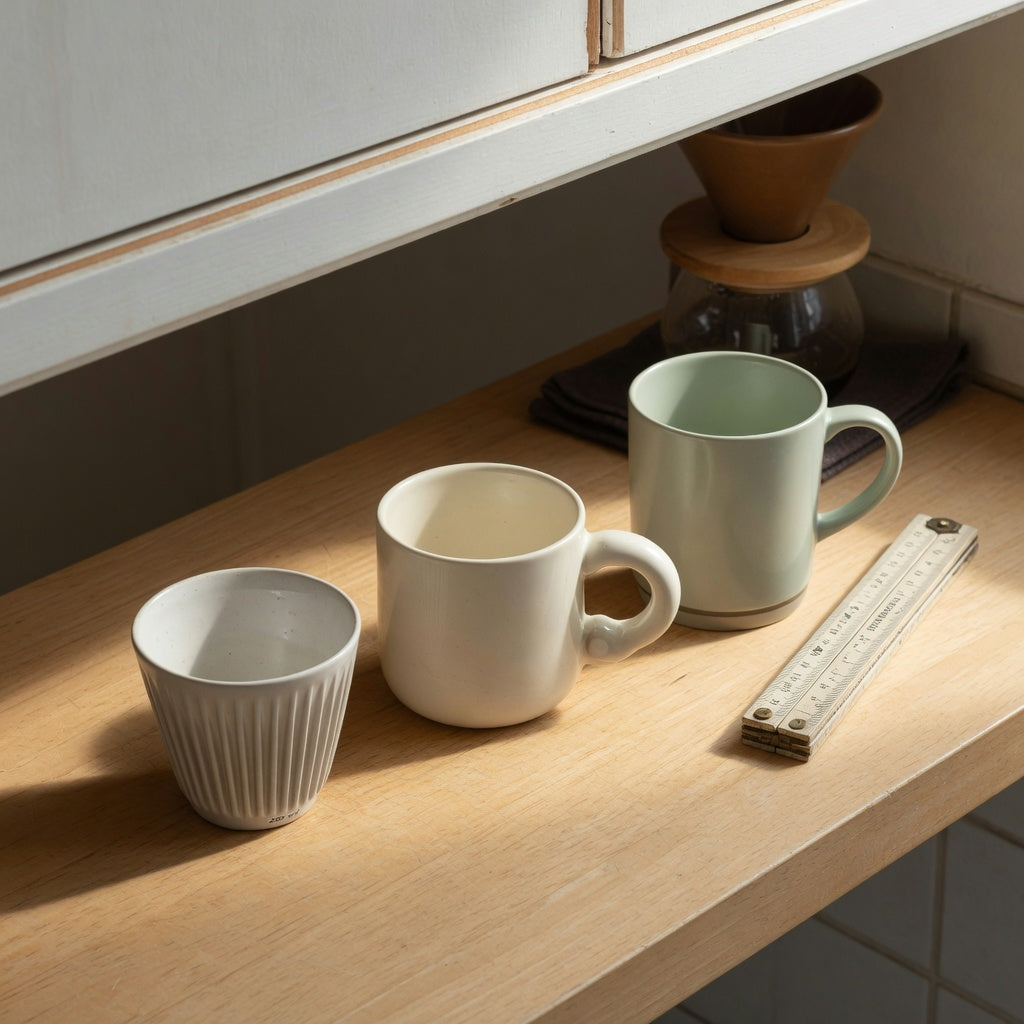
Ceramic Mug Shapes Compact Kitchen Product Shortlist Guide
Three ceramic mug shapes from our own shelves, sized against real compact-kitchen limits: a 200 ml pleated cup, a 250 ml ball-handle mug and a 400 ml Flow mug. Each gets a reason to buy, a reason t...
Read more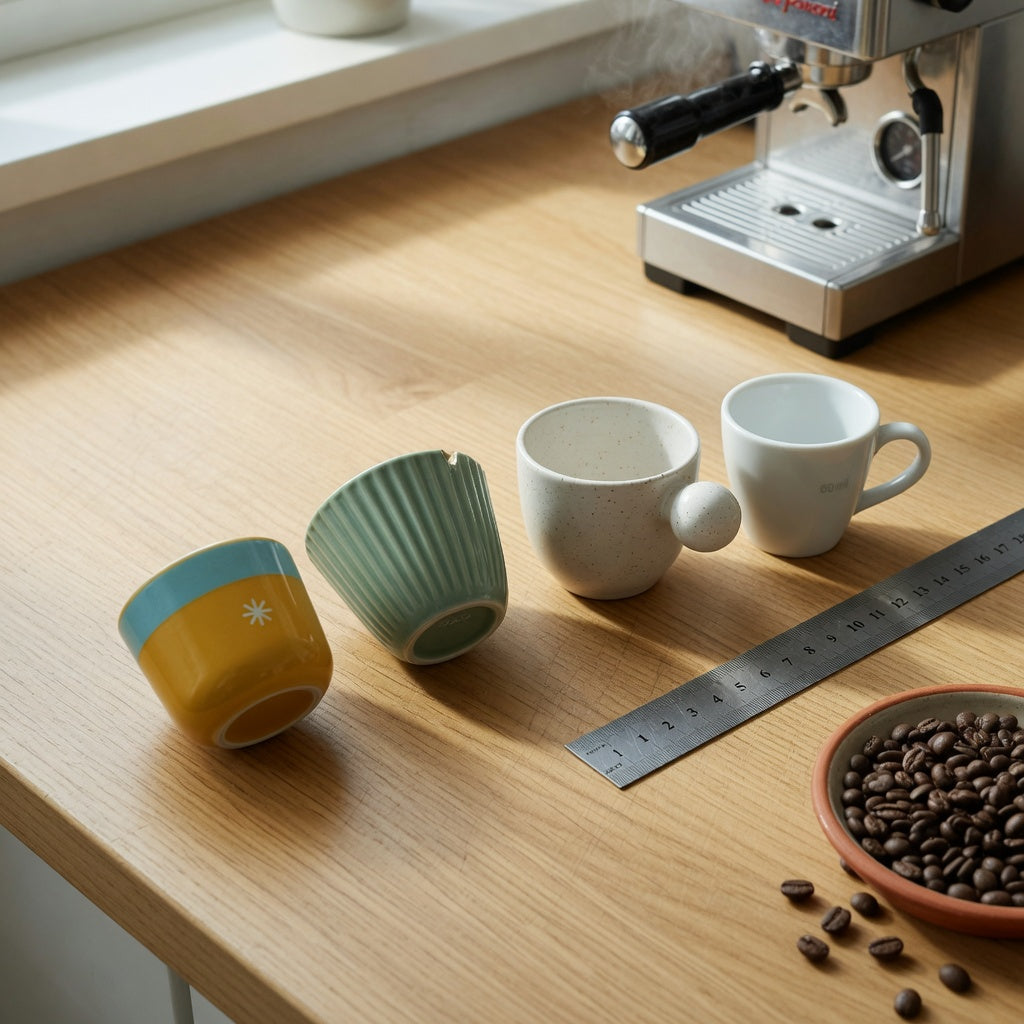
Unique Espresso Cups Shared Household Practical Purchase Checklist
Four people, one machine, and a shelf of cups nobody agrees on. A capacity-first checklist for choosing distinctive espresso cups each person will actually reach for — plus the fit, glaze-safety, a...
Read more
Leave a comment
This site is protected by hCaptcha and the hCaptcha Privacy Policy and Terms of Service apply.