
Unique Espresso Cups Capacity Guide: 170 vs 200 vs 250 ml
Reading time: about 10 minutes
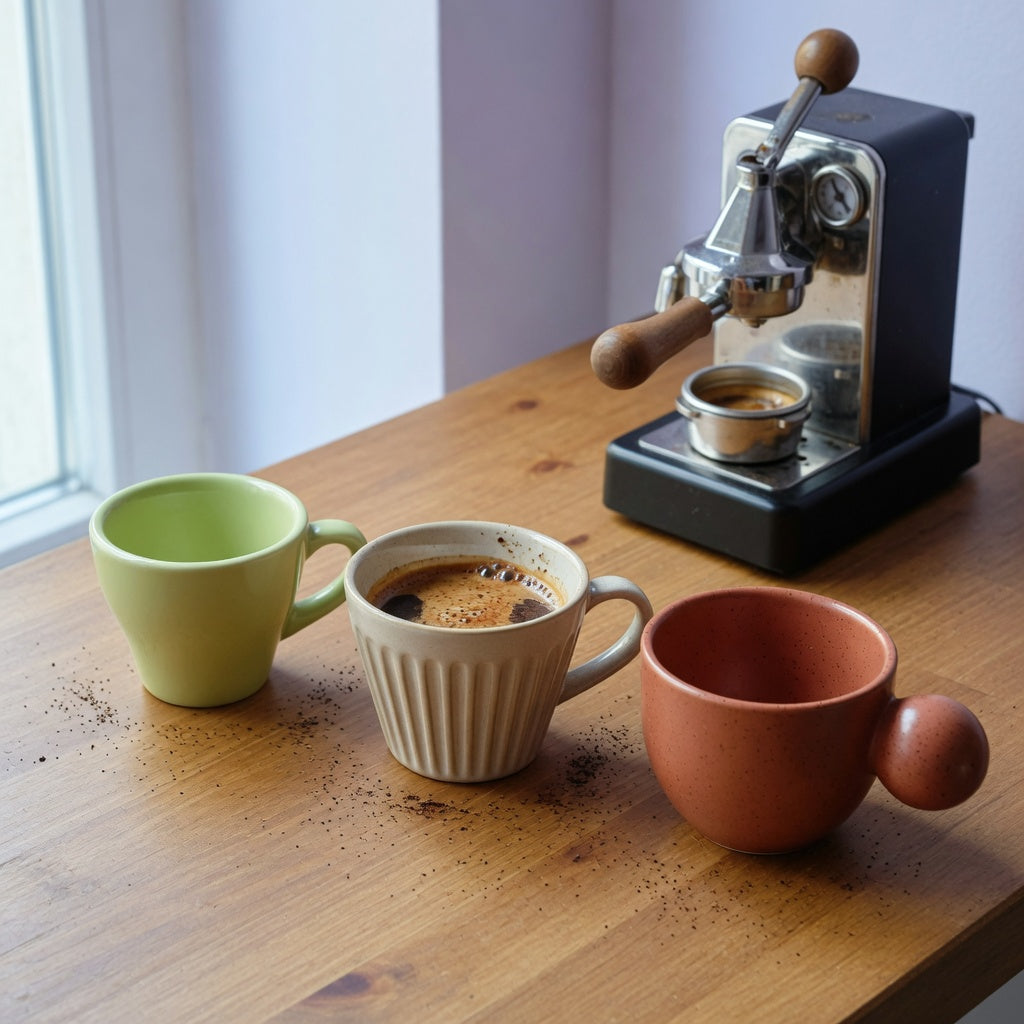
Three cups sit on our packing table most weeks, and side by side they look like a family: the Retro Coffee Tea Cup at 170 ml, the Pleated Coffee Tea Cup at 200 ml, and the Ball Handled Coffee Tea Mug at 250 ml. Fill them once and the resemblance ends. That 80 ml spread decides whether a double shot looks stranded at the bottom, whether a cortado fits in a single pour, and whether the cup you bought for its glaze ends up at the back of the cupboard.
This is the unique espresso cups capacity guide we walk shoppers through in our store when they message asking which of the three to take home. It is deliberately narrow: only the capacities we stock, the pour each one handles comfortably, and the refill habit behind it. No broad buying advice, no invented specs.
Unique espresso cups capacity guide: what 170, 200 and 250 ml actually hold
Listed capacity is measured to the rim, not to the drink you should pour. A cup filled to the top is a cup you cannot carry across a kitchen. Subtract roughly 20 to 30 ml for crema, foam and the simple physics of liquid moving, and you get the pour that actually works.
| Cup | Listed capacity | Comfortable pour | Routine it suits |
|---|---|---|---|
| Retro Coffee Tea Cup | 170 ml | One double shot with room to swirl; a small milk-cut drink | Espresso-first drinkers, one cup one pour |
| Pleated Coffee Tea Cup | 200 ml | Double shot plus a modest milk addition; a cortado with headroom | Cortado and macchiato drinkers, two-shot mornings |
| Ball Handled Coffee Tea Mug | 250 ml | Cortado with generous room; a longer black coffee | Slow sippers, desk use, milk-leaning drinkers |
All three are compact ceramic vessels rather than glass, which matters twice over: how long the drink stays hot, and how the rim feels against your lip on the first sip. Wall thickness varies by shape and finish, and we do not print a thickness figure on every listing — the rim cross-section in the product photos is the honest indicator if that detail decides it for you.
Why a 170 ml cup is not a 170 ml espresso
Espresso is a small drink poured into a cup that is intentionally larger than the liquid. Published references put a certified Italian espresso at roughly 25 ml, and the older specialty-coffee definition sits in the 25–35 ml band. Demitasse listings commonly land between 50 and 100 ml. The cup is bigger than the shot on purpose: headspace for crema, a wall that holds warmth, a rim wide enough to smell the coffee before you taste it.
- Single shot (about 25–35 ml): fits any of the three, but all of them are oversized for it.
- Double shot (about 50–60 ml): the natural home of the 170 ml Retro cup.
- Cortado (espresso plus roughly equal steamed milk, about 120 ml): comfortable in the 200 ml Pleated, snug but workable in the 170 ml.
- Flat white or small cappuccino (roughly 150–180 ml): possible in the 250 ml Ball Handle, tight in the two smaller cups.
Pour 30 ml into a 170 ml cup and roughly five times the volume sits empty. That still drinks well — the crema spreads, the aroma collects — but the proportions are built around a double, not a single. If you only ever pull singles, be honest about that before you buy.
Which capacity fits your morning refill pattern?
Capacity only means something in context. Three patterns cover most of the espresso cup orders we pack, and in our experience buyers rarely switch patterns after purchase — they buy for the drink they make on a Tuesday, not the one they make for guests.
One double shot, then you switch to water
Take the 170 ml Retro cup. A 50–60 ml double lands with crema intact and still leaves room to swirl without sloshing over the rim. Small pours also lose heat faster, which is the right outcome for a shot you plan to finish in three minutes and the wrong one for a 200 ml milk drink.
Two shots, or a shot with a splash of milk
The 200 ml Pleated cup is the cortado-adjacent option. A double plus an equal-ish pour of steamed milk lands around 120 ml, so the cup takes it with visible headroom instead of a meniscus you have to nurse to the table. It is the middle size for a reason — the one that flatters both a straight double and a small milk drink without pretending to be a latte vessel.
You sip slowly and the cup lives on a desk
Go to the 250 ml Ball Handled mug. More liquid, more time, and a handle that lets you carry it one-handed from kitchen to desk while the other hand holds a phone. It suits a long black, an Americano, or a cortado you plan to drink across twenty minutes of email. What it is not: a travel mug, or anything you would put in a bag.
Where the 250 ml Ball Handle stops being the right cup
250 ml sounds roomy until you pour a latte. Most café lattes land somewhere past 250 ml, and a home latte built in a wide mug usually exceeds 300 ml. The Ball Handle will hold a small latte and look good doing it, but the proportions work against you — milk-heavy drinks want a wider, taller vessel so the foam has somewhere to stack instead of sitting in a disc on top.
If milk drinks are your default rather than your exception, this is the honest answer: go up a size class. The full unique coffee mugs collection includes the larger shapes, and 250 ml is the ceiling of this particular group. Buying a 250 ml cup for a daily 320 ml latte means you will fill it to the point where carrying it becomes a two-handed job.
Does a 30 ml pour really need a preheated cup?
Yes, and more than a 250 ml drink does. A 25–35 ml shot has almost no thermal mass; a cold ceramic wall pulls heat out of it within seconds, and by the time you sit down the crema has cooled and tightened. Thick ceramic holds heat beautifully once it is warm. It does not warm itself.
- Fill the cup with hot water while the machine comes up to temperature.
- Tip it out into the sink just before you start the shot — not after.
- Leave the inside damp. A wet wall helps crema settle and will not meaningfully dilute a 30 ml pour.
This is the single step most home setups skip, and it costs thirty seconds. It is also the reason two people can pull identical shots from the same machine and disagree about which cup is better.
Rim, interior colour and reading crema in a decorative cup
- Rim shape. A thin, slightly flared rim pushes liquid forward on the tongue; a thicker rolled rim feels softer but mutes the first impression of acidity. The Retro and Pleated profiles read differently here, which is why cup preference is personal rather than objective.
- Interior colour. A light or clear interior makes crema easy to judge — you can see the tiger-striping and how fast it fades. Dark or metallic interiors look striking and hide all of it.
- Handle clearance. A handle can strike the drip tray even when the cup body clears the group head. Measure the gap, not just the cup.
Our listings photograph exterior finish closely. Interior colour is visible in those shots on most products but is not written as a spec line on every one, so if crema-reading is the reason you are buying, confirm it with us before ordering rather than assuming from a thumbnail.
Are brightly glazed unique cups safe for hot coffee every day?
Fair question, and the answer is not automatic. The FDA notes that lead in ceramic glazes or decorative decals can leach into food and drink when ware is not properly fired, that washing or boiling cannot remove lead once it is present, and that some pottery labelled lead free has still shown extractable lead at or above agency action levels. For cups and mugs, the action level is 0.5 µg/ml of leaching solution. Ornamental pieces that look usable but are not intended for food must be conspicuously labelled as not for food use, or have a hole through the food-contact surface, under 21 CFR 109.16.
The FDA flags higher-risk ceramicware as handmade pieces with a crude or irregular look, antiques, damaged or worn ware, items from unknown makers, and ware brightly decorated in orange, red or yellow. That does not condemn every colourful cup — it means glaze chemistry and firing control matter, and a maker claiming lead-free should be able to produce test documentation on request. We keep our own product claims inside what we can actually verify: the listed capacity and the visible ceramic finish. If a listing is silent on food-contact testing, treat that as an open question rather than a green light.
Chips, stacking and dishwasher reality in a small-cup rotation
- Chips come from rims, not bodies. Stacking one cup inside another puts the foot of the top cup against the rim of the bottom one — the weakest point on the piece.
- Hand-painted detail and metallic rims are usually the first things to dull in a dishwasher, and it happens gradually rather than as a dramatic failure. If the decoration is why you bought the cup, wash it by hand.
- Hot water and a soft brush lift coffee oils. Abrasive powders dull glazes over months of daily use.
- Do not move a just-rinsed cup onto a cold stone counter. Thermal shock is real for ceramic, and the crack often shows up days later.
We do not print dishwasher or microwave ratings on every listing, so check the current product page or ask us before committing a favourite cup to the machine. The safe default — hot water, a soft brush, air dry — never damages a glaze.
Frequently asked questions
What does this unique espresso cups capacity guide actually compare?
Three current capacities: 170 ml (Retro), 200 ml (Pleated) and 250 ml (Ball Handle). The comparison covers listed capacity, comfortable pour volume and how often you refill — not which cup is objectively best.
Is a 170 ml cup too big for a single espresso?
Strictly, yes. A certified Italian espresso is roughly 25 ml and the older specialty definition is 25–35 ml, so 170 ml is well oversized for one shot. It is sized for a double, or a shot with a small milk addition.
Can the 250 ml Ball Handle be used for a cortado?
Comfortably. A cortado of roughly 120 ml leaves plenty of headroom and the crema has space to settle. It is the milk-heavy drinks that outgrow it — a 300 ml latte fills it past the point where you can carry it safely.
Will these cups fit under my espresso machine?
The gap between the drip tray and the group head is the number that decides it, and a handle can hit the tray even when the cup body fits. Compare that gap with the height on the product page; if height is not listed, ask before ordering.
Are the cups dishwasher and microwave safe?
Treat that as unconfirmed unless the current listing states it. Decorative and hand-finished ceramics vary widely, and a rating given for one finish does not carry over to another. Hand washing in hot water is always the safe default.
Pick the capacity you will actually refill tomorrow
Run this filter before you order:
- Single shot only — the 170 ml Retro is the closest fit, though all three are oversized.
- Double shot — 170 ml Retro.
- Double plus milk — 200 ml Pleated.
- Long black, cortado or desk sipping — 250 ml Ball Handle.
- Latte or cappuccino as your daily drink — go up a size class; 250 ml is the ceiling here.
Buy for the drink you make most mornings, not the one you make on weekends. If you are still torn between two, start with the 200 ml Pleated — it is the middle size that handles a straight double and a small milk drink without looking wrong for either. And if you want to see the whole range side by side, the current collection is the place to compare shapes and finishes in one scroll.
More from our blog
Read more
Ceramic Mug Shapes Capacity Guide: 200, 250 or 400 ml
Three current ceramic bodies, three capacities, three different morning routines. We compare the 200 ml pleated cup, the 250 ml ball-handle mug and the 400 ml The Flow by silhouette, handle geometr...
Read more
Unique Espresso Cups Comparison: Which Current Option Fits Your Routine?
A shelf-by-shelf comparison of our 170 ml Retro, 200 ml Pleated and 250 ml Ball Handle ceramic cups — which one suits a strict double shot, a cortado, or a slow-sipping desk mug, plus the fit and g...
Read more
Leave a comment
This site is protected by hCaptcha and the hCaptcha Privacy Policy and Terms of Service apply.