

Unique Espresso Cups Comparison: Which Current Option Fits Your Routine?
Reading time: about 11 minutes
Pull a double shot into a wide 350 ml mug and watch what happens. The crema spreads into a thin tan ring against the walls, the coffee drops below drinking temperature before you reach the sofa, and a shot you timed carefully tastes like an afterthought. We get some version of that email most months — someone bought a beautiful oversized mug for espresso and cannot work out why the coffee went flat. The machine did nothing wrong. The cup was the only variable that changed.
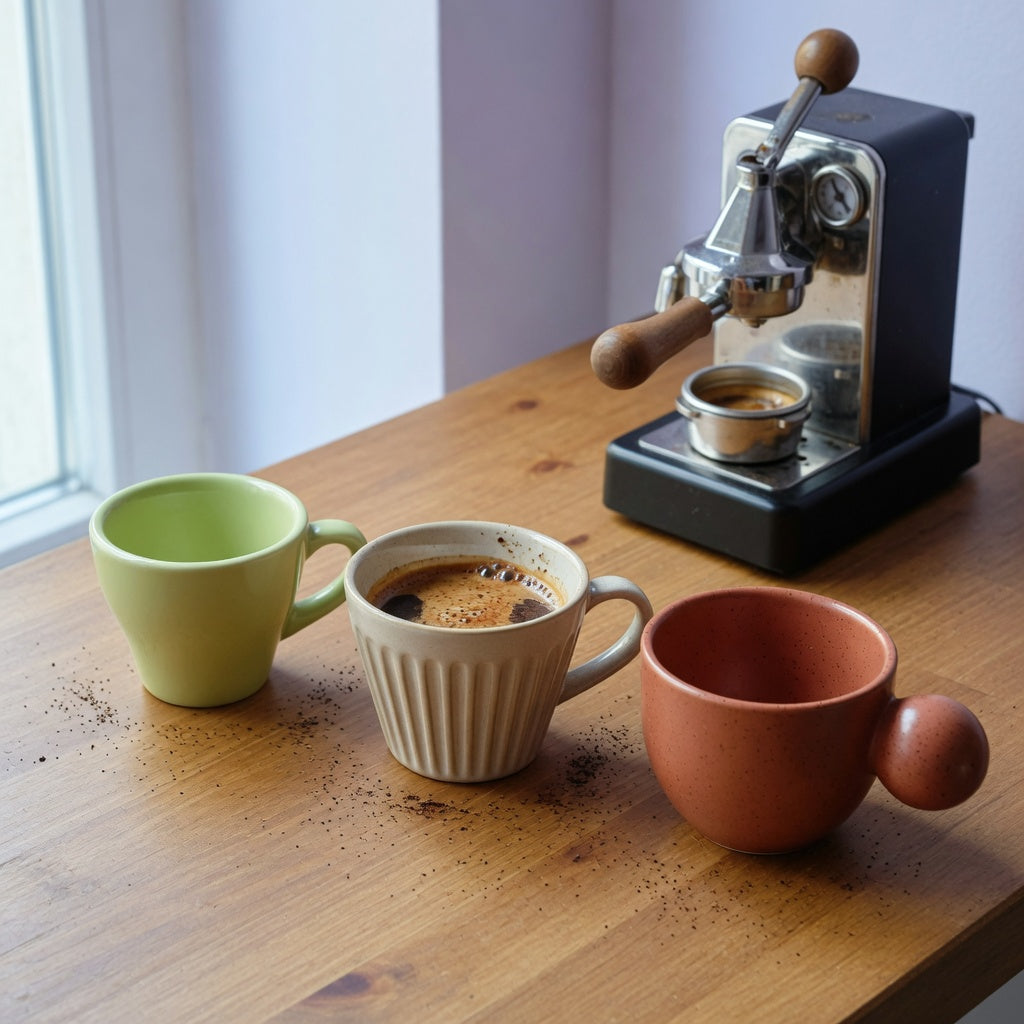
So this is a unique espresso cups comparison built from our own current shelf rather than another broad buying guide. Three compact ceramic vessels with a visible ceramic finish, three listed capacities, three genuinely different weekday routines. Our team pulls shots into all three during packing-table checks, and we field the same handful of fit, glaze and care questions before checkout. Here is what we actually tell people.
Two numbers that trip people up: shot volume and cup capacity
A certified Italian espresso is defined at roughly 25 ml. The older specialty definition runs 25–35 ml. The cup that serves it almost always holds more, because crema and headspace need somewhere to sit. Those two facts explain why a 170 ml ceramic cup can honestly be sold as an espresso cup, and why shoppers comparing '2 oz', '3 oz', '80 ml' and '120 ml' listings end up guessing.
- Shot volume: about 25 ml for a certified Italian espresso; 25–35 ml in the older specialty definition.
- Working demitasse capacity: commonly quoted between 50 and 100 ml, with many everyday cups near 60 ml.
- A double shot: roughly 50–60 ml of liquid before any milk — the routine most home setups actually pull.
- A cortado: usually a roughly equal mix of espresso and warm milk, so 60–90 ml in total.
Read listed capacity as room to work in, not as the size of the drink. A 25 ml ristretto in a 250 ml mug is a lonely thing. A 60 ml double in a 170 ml cup looks correct on the saucer.
Unique espresso cups comparison: our three current cups side by side
All three are the same idea in different proportions: compact ceramic, a finish you can see and feel, and a capacity printed on the product page. Those capacities are the only numbers we will commit to here — height, base diameter and handle swing vary by batch and are not published on every listing, which we come back to below.
| Cup | Listed capacity | Routine it suits | Trade-off to accept |
|---|---|---|---|
| Retro Coffee & Tea Cup | 170 ml | A single or double shot, short black, or a small tea | Least headroom for milk; a 25 ml shot will look lost in it |
| Pleated Coffee & Tea Cup | 200 ml | A double with a splash, a small cortado, or tea | Middle sizing — neither the purest demitasse nor the most forgiving |
| Ball Handled Coffee & Tea Mug | 250 ml | Cortado, longer blacks, tea, slow sipping | Handle and wider body need measuring before you commit |
Two cups at 170 ml and 200 ml are close enough that most buyers should not agonise between them; the decision that actually changes your morning is 170 ml versus 250 ml.
Which cup matches the drink you actually make on a Tuesday?
- You pull 25–40 ml and drink it standing up. The 170 ml Retro cup is the closest fit of the three. The liquid stays visibly present against the wall and the rim is comfortable without much tipping. It is the wrong choice if you routinely add milk — 60 ml of cortado in a 170 ml cup leaves a lot of empty ceramic.
- You pull a double and finish it with a splash of warm milk. The 200 ml Pleated cup takes that splash plus the crema layer without looking half-empty. It is the safest single-cup purchase for a household where two people drink differently.
- One cup has to cover cortado, long black and tea. The 250 ml Ball Handle mug is the generalist. It is also the one a non-espresso-drinker in the house will reach for, which matters when you are buying for a shared kitchen rather than a solo setup.
- You are buying blind for someone else. Browse the unique coffee mugs collection and compare finishes first, then narrow by capacity. Finish is what people notice on the shelf; capacity is what they notice on day two.
Handle or no handle: what the Ball Handle changes under a group head
The Ball Handle mug is the handle-forward option here — the name says as much. A handle changes two things at once. It changes how your fingers sit when the ceramic is hot, and it changes how much floor space the cup needs beneath the group head. On compact machines with a shallow drip tray, a handle can foul the machine body or stop the cup sitting square on the grate, which produces a tilted shot and a mess.
Handleless cups trade the opposite way: they demand a warm cup and a confident grip, but they sit tighter on crowded shelving and slide under almost anything. If you drink standing at the counter, that trade is usually fine. If you carry coffee to a desk, a handle earns its keep.
We can quote the listed capacity of any cup on this page instantly. We will not guess at handle swing or exact height for you — if your clearance is tight, message us and we will measure the current batch before you order rather than letting you assume.
Crema is easier to read in some cups than others
Crema tells you things: colour, persistence, how fast the tan ring retreats from the edge. You can only read that against a pale interior. A white or light interior makes blonding visible in the last seconds of a shot; a dark, metallic or heavily patterned interior hides exactly the signal you are watching for. If you pull by eye instead of by scale, interior colour matters more than the decoration on the outside of the cup.
Rim shape is the other tactile variable. A thinner, slightly flared rim delivers coffee forward on the tongue with less tipping; a thick rounded rim feels softer but pushes liquid wider across the palate. Irregular rims are part of the charm of handmade-looking ceramics — and part of the risk, because lip feel varies from piece to piece. Our advice: check the listing photos for the interior colour, and if you cannot tell from the images, ask before you buy.
The 30-second preheat, and why thick ceramic needs it
Ceramic holds heat well once it is warm, but it takes heat from the coffee to get there. A cold, thick-walled cup can pull noticeable heat out of a 30 ml shot in the time it takes to walk to the table. The fix costs half a minute: fill the cup with hot water while you grind and tamp, tip it out, then pull the shot into a warm vessel.
Baristas push this further and keep demitasses parked on the machine's warm top so they are never cold. At home, hot tap water and a 20–30 second sit is enough at these capacities. Two habits to avoid: do not pour boiling water into a cup straight off a cold shelf and then add ice, and never move a hot cup onto a cold stone counter. Thermal shock is a genuine way to lose a favourite piece.
Two measurements to take before you order
- Clearance under the group head. Measure from the drip-tray grate to the underside of the portafilter with your basket loaded, then leave a few millimetres so the cup sits level. Handles add width as well as height — check the swing, not just the height.
- Outer base diameter against the grate. A base narrower than the grate slots will wobble; a base wider than the grate can overhang and tip. This is the number listings almost never publish.
Then think about storage. Three 170 ml cups nest more easily than three 250 ml mugs with handles, and open shelving punishes a wide footprint. If your cupboard is already tight, the smaller capacity is the practical pick regardless of which finish you prefer.
Glaze, lead and the food-safety questions unique ceramics invite
This is the part of the unique espresso cups comparison most shoppers skip and later worry about. Decorative ceramics are not automatically food-safe, and 'handmade' is not a safety certification.
- The FDA sets an action level of 0.5 µg/ml of lead in the leaching solution for ceramicware cups and mugs (CPG 545.450).
- FDA guidance flags handmade pieces with a crude or irregular look, antiques, damaged or worn ware, items from flea markets or unknown makers, and ware brightly decorated in orange, red or yellow as higher-risk. It also notes that some pottery labelled 'lead free' has still shown extractable lead at or above action levels.
- Washing or boiling cannot remove lead from pottery. Once it is in the glaze, it stays there.
- Under 21 CFR 109.16, ornamental ceramicware that looks usable must carry a conspicuous 'Not for Food Use' statement or a hole through the food-contact surface. If a piece is sold as decoration, treat it as decoration.
The practical version: buy drinkware from sellers who can tell you what the glaze is and where the piece was fired, and never repurpose a decorative-only import as a coffee cup. If you need glaze documentation for a specific cup on this page, ask us before ordering — we would rather answer the question than have you guess at it.
Dishwasher, chips and gifting: what actually shortens a cup's life
Three things end a decorative cup early: thermal shock, stacking, and the dishwasher. Detergent and high heat gradually dull glazes and can wear hand-applied or metallic decoration. A cup stacked rim-down against another rim will chip eventually, usually on the rim you drink from.
We do not attach a dishwasher or microwave rating to these cups unless the current listing states one, so check the product page or ask. Gold rims, lustre finishes and hand-applied decoration routinely fail both tests, and a dishwasher claim applies to the glaze — not to the decoration sitting on top of it. Daily cups are better washed by hand and dried upside down on a rack with airflow, especially feet that trap water.
For gifting, capacity is the safer variable. A 200 ml cup fits more routines than a 170 ml one, while the 250 ml Ball Handle reads as a coffee mug and suits a recipient who may not own an espresso machine at all. If the recipient is a committed single-shot drinker, though, a 250 ml mug will feel like a bucket and they will say so politely.
A 60-second decision checklist
- Strict 25–40 ml drinker, no milk? Take the 170 ml Retro cup.
- Double shot plus a splash, or a small cortado? The 200 ml Pleated cup has the headroom.
- Cortado, long black and tea in one cup? The 250 ml Ball Handle mug.
- Buying for someone else, or unsure of the finish? Start in the full unique coffee mugs collection and compare glazes before capacities.
- Tight machine clearance? Measure height under the group head, base diameter against the grate, and handle swing before you commit.
- Want a pale interior for reading crema? Confirm it in the listing photos or ask us — do not assume from the outer glaze.
Frequently asked questions
Is a 170 ml cup too big for a single espresso?
For a 25 ml shot, yes — the liquid will look lost against the wall. For a 50–60 ml double, 170 ml is a sensible working size because it leaves room for crema and headspace without letting the coffee go cold in two minutes. If you only ever pull singles, look for a smaller demitasse than anything in this comparison.
Which pick from this unique espresso cups comparison works best for a cortado?
A cortado is usually a roughly equal mix of espresso and warm milk, so 60–90 ml in total. The 200 ml Pleated cup handles that comfortably, and the 250 ml Ball Handle gives extra room if you lean milk-heavy or want one cup for longer drinks too. The 170 ml Retro is the tightest fit for that routine.
Do I need to preheat these ceramic cups?
It is worth the 30 seconds. Thick ceramic pulls heat out of a small shot quickly, so fill the cup with hot water while you grind and tamp, then tip it out before pulling. Twenty to thirty seconds is enough at these capacities, and it changes the drink more than most accessory purchases do.
Are brightly glazed or handmade espresso cups safe for hot coffee?
Not automatically. The FDA sets an action level of 0.5 µg/ml of lead in the leaching solution for ceramic cups and mugs, and flags irregular handmade-looking ware and pieces brightly decorated in orange, red or yellow as higher-risk categories. Ask the seller for glaze and firing details, and never drink from a piece marked 'Not for Food Use'.
Can these cups go in the dishwasher or microwave?
Only if the current product listing says so. We do not apply a dishwasher or microwave rating to a cup that has not been tested for it, and decoration — especially metallic or hand-applied — is usually the first thing to fail. Hand washing and air drying keeps the glaze and the finish intact far longer.
Capacity is the one decision you cannot undo later. Match the cup to the drink you make on a weekday morning, not the one you plan to make at weekends, then settle the finish. If you are still weighing the 170 ml and 200 ml options, the 200 ml cup is the safer start — and if handle clearance is your worry, message us for current-batch measurements before you check out.
More from our blog
Read more
Unique Espresso Cups Capacity Guide: 170 vs 200 vs 250 ml
A practical comparison of the three capacities we currently stock — 170 ml, 200 ml and 250 ml — matched to real refill patterns, with the drinks each one is genuinely not built for.
Read more
Big Latte Mug Comparison: 400 ml, 440 ml or 480 ml?
Three mugs, three capacities, three different mornings. This big latte mug comparison separates brim capacity from the pour you actually get, then shows which of our current 400 ml, 440 ml and 480 ...
Read more
Leave a comment
This site is protected by hCaptcha and the hCaptcha Privacy Policy and Terms of Service apply.