
Ceramic Mug Shapes Capacity Guide: 200, 250 or 400 ml
Reading time: about 10 minutes
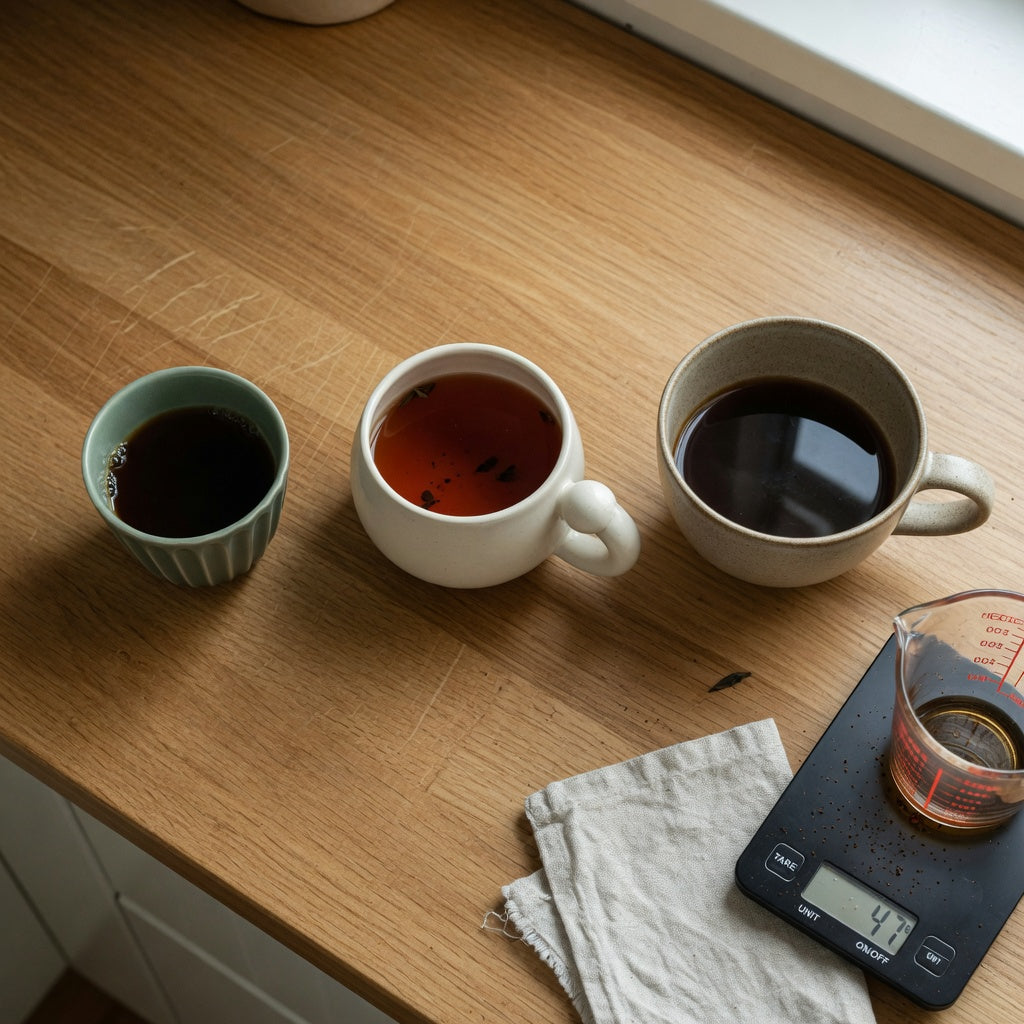
Three mugs sit on our packing bench most weeks: a 200 ml pleated cup, a 250 ml ball-handle mug and a 400 ml The Flow. Same broad material family, three completely different pours. The question that keeps arriving in our inbox is some version of 'which one is the normal size?' There isn't one. There's the pour you actually repeat most mornings, and a body that either makes it easy or makes it mildly irritating. This ceramic mug shapes capacity guide sticks to the three capacities we currently list, the refill pattern each one implies, and the silhouette and handle checks that decide whether a mug earns its counter space.
What the millilitre figure on a mug actually measures
Listed capacity is brim-full volume, not the amount you end up drinking. Nobody fills a mug to the lip — you leave headroom so the coffee doesn't slosh onto your sleeve on the walk back to the desk, and so a tea bag or a spoon has somewhere to sit. Our working rule is to plan on roughly 10 percent less than the listed number.
Convert before you compare, because listings mix units freely. Using the NIST approximate conversion of 1 fluid ounce = 29.57 millilitres, our three current sizes land at about 6.8, 8.5 and 13.5 fl oz. It also helps to know where the middle one sits: U.S. FDA guidance describes ceramic mugs as small hollowware that normally, though not exclusively, holds about 240 ml (8 fl oz) and has a handle. In that same guidance, a cup is described as having a base and curved sides while a mug has cylindrical sides. That's a regulatory distinction rather than a comfort rule, but it explains why the 250 ml ball-handle mug reads as the familiar default.
- 200 ml (6.8 fl oz) — a small cup, not a small mug. Plan on two, or on a top-up.
- 250 ml (8.5 fl oz) — roughly the reference size, with headroom left over.
- 400 ml (13.5 fl oz) — a genuine large. One fill replaces two small ones.
200 ml pleated cup: short pours, tea top-ups and small milk drinks
At 200 ml, the pleated coffee and tea cup lands in the band many cafés use for milk-forward small drinks — cappuccino, cortado and flat white territory, commonly quoted somewhere between 150 and 240 ml. It's also the size that suits a tea drinker who tops up every ten minutes rather than steeping one giant mug and watching it go stewy.
Who it fits: someone who makes a 6 oz coffee, a slow sipper who likes a warm refill, a host pouring small amounts for guests, or a tasting setup where three small cups beat one big one.
Who it doesn't fit: the 12 oz drip habit, anyone who carries a mug between rooms for an hour, or a latte drinker who wants a wide surface to pour milk into. A small drink in a big body cools fast and looks lost; a large drink in this cup simply doesn't fit.
Two things worth checking on the current listing before you commit, because we won't guess on your behalf: whether the pleating is external only or runs into the interior — interior creases collect tea tannin and coffee oils and want a soft brush rather than a sponge — and how thick the rim reads. A fine rim feels delicate against your lip; a rolled rim insulates better but drinks more like a hotel cup.
250 ml ball-handle mug: the one-pour desk routine
The ball-handled coffee and tea mug is the middle child, and for most shoppers it's the one that matches reality: an 8 oz brew plus headroom, no refill, no half-empty cup going cold while you answer email.
The handle geometry is the interesting part. A ball or knob-style grip changes where your fingers sit compared with a plain loop — you tend to pinch rather than slide a full circle of fingers through. In our experience that's a plus for smaller hands and a minus for anyone who likes to hook two fingers in and carry the mug by the handle alone. Look at the listing photos and ask the question buyers ask us: can you lift it comfortably with three fingers while it's full? If the answer looks like no, size up rather than down.
Weight is manageable here. Filled to a sensible level, the liquid alone is around 230 g, so the whole thing stays light enough to lift one-handed without thinking about it. It's also the least fussy footprint on a desk — it won't crowd a coaster, and a mid-morning reheat takes two minutes.
What it is not good for: a 16 oz cold brew, an iced latte where ice eats a third of the volume, or a drinker who makes one mug and expects it to survive a two-hour meeting.
400 ml The Flow: long sessions, 12 oz pours and big teas
The 400 ml The Flow coffee and tea mug is the large of the three at roughly 13.5 fl oz. That's a 12 oz drip with room, a big morning tea, or a latte where milk is most of the drink. If you make one hot drink and take it into a meeting, this is the capacity that stops you standing up in the middle of it.
The trade-off is weight. A full 400 ml holds about 370 g of liquid before you add the ceramic, which puts a full mug somewhere near half a kilo — noticeably heavier in one hand than the 250 ml. Handle clearance matters more here than it does on the small cup, because you'll feel a narrow grip by the end of the drink.
Heat loss is the other trade-off, and it's physics rather than a design flaw. A larger exposed surface at the top means more heat leaves between sips. Our fix is boring and effective: stand the mug under the hot tap for a minute while the kettle boils, tip it out, then pour. Twenty seconds of prep slows the cool-down on a big mug more than hunting for a special silhouette ever will.
Where it doesn't suit: espresso, a 6 oz pour, or a slow small-coffee drinker. Fixing that mismatch is a capacity decision, not a shape one. For a wider look at how volume changes the experience across the range, our comparison of ceramic mugs for coffee and tea drinkers covers the drink-type side in more depth.
Ceramic mug shapes capacity guide: which listed size fits which serving routine
Here's the practical mapping. Pick the row that sounds like your actual week, not the row you'd like your week to sound like.
| Serving routine | Usable pour | Fits from our current range |
|---|---|---|
| Espresso, cortado, small tea top-ups | 100–150 ml | Pleated cup, 200 ml |
| One standard coffee at a desk, occasional reheat | 200–230 ml | Ball-handle mug, 250 ml |
| 12 oz drip, large tea, latte, long meetings | 320–370 ml | The Flow, 400 ml |
| Wide bowl for milk pouring and latte art | 150–240 ml | Browse the wider silhouettes in our unique coffee mugs collection |
One honest caveat: if you drink exactly 300 ml each morning, none of the three is a perfect fit. The 250 leaves you short and the 400 leaves you with a third of a mug going tepid. That's the situation where you either accept the leftover or look at other shapes in the collection.
Why a wider, shallower body doesn't automatically keep coffee hotter
Plenty of mug copy oversells this. Silhouette alone doesn't decide heat retention — exposed surface area, wall thickness and whether the top is open do. Three consequences worth carrying into any purchase:
- An open top dominates. Evaporation and rising warm air remove a lot of heat. A lid or a saucer does more than any belly profile.
- Thin walls pass heat through faster. A thicker wall holds more heat in the body itself, which is why heavy diner-style mugs feel warm for longer — and also why they feel like a brick when full.
- Surface area scales with width. Two mugs of identical volume, one tall and narrow and one short and wide, will not cool identically.
We won't rank named shapes as scientifically hotter, because the evidence for those claims isn't there. Preheating beats geometry every time on our bench.
Rim feel, handle clearance and interior corners: the checks millilitres miss
Retailers use 'belly', 'barrel', 'tapered' and 'diner' loosely, and the same word can describe two quite different profiles. Trust the photo and the stated measurements over the product name. Run this list before buying any ceramic mug, ours included:
- Rim: thin, medium or rolled? A slightly rounded lip is the most forgiving to drink from. A very fine rim with a shallow pour lip is where dribbles down the outside start.
- Handle: how many fingers clear the opening, and does your thumb scrape a knuckle when you lift it?
- Balance: is the handle attached high or low? A high-set handle tips a full mug forward in the hand.
- Interior: rounded corners rinse clean. Faceted or footed interiors trap residue and need a brush, which matters if you drink milky coffee daily.
- Footprint and spout clearance: base diameter against your coaster, and overall height against your coffee machine's spout. Measure once with a ruler rather than assuming.
- Stacking: a tall handle or a flared rim can stop two mugs nesting on a shelf. If cabinet space is tight, check the height and handle profile first.
- Wash routine: if dishwasher safety is a deciding factor, confirm it on the current product page. We'd rather you check than assume.
Glaze and firing matter more than silhouette for food contact
None of the above counts if the glaze isn't right. FDA's compliance guide for ceramic cups and mugs sets a lead guideline of 0.5 micrograms per millilitre of leaching solution in any one of six tested units, and cites the ASTM C738 acetic-acid extraction method — a deliberately severe test, harsher than ordinary use. Lead in a glaze that hasn't been properly fired into the ware can leach into a drink, and the FDA states there is no known safe level of lead exposure, with fetuses, infants and children the most vulnerable.
The relevant point for shoppers: leaching is about glaze chemistry and firing, not about whether a body is pleated, curved or cylindrical. Buy food-use ware rather than decorative-only pieces, and if a listing doesn't say a mug is intended for food contact, treat it as decorative. When we can't confirm a detail on a page, we say so — and you should hold any seller to that standard, including us.
Frequently asked questions
Do the capacities in this ceramic mug shapes capacity guide include headroom?
No. The 200, 250 and 400 ml figures are brim-full volumes. Plan on pouring roughly 10 percent less so you have room to carry the mug without spilling, and so a spoon or tea bag fits.
Is 250 ml enough for a regular cup of coffee?
For most drip and pour-over drinkers, yes. It sits close to the 240 ml reference size the FDA cites for ceramic mugs and gives you roughly 210–230 ml of usable pour. If you routinely drink 12 oz or more in one sitting, or load a mug with ice, go to the 400 ml instead.
Will a pleated or textured body be harder to clean?
Only if the texture runs into the interior. External pleating wipes clean like any glazed surface, but internal creases collect tea tannin and coffee oils and want a soft brush rather than a sponge. Check the listing photos or ask before buying if that matters to you.
Can I make a latte in the 400 ml mug?
Yes for drinking, with a caveat for pouring. A 400 ml body comfortably holds a latte's milk volume, but wide shallow bowls are easier for latte art because the milk has more surface to spread across. If art matters, look at wider silhouettes in the collection; if you just want to drink it, the 400 ml is the practical pick.
Does a thicker-walled mug keep coffee hot longer?
It helps, because the ceramic body itself holds more heat, but an open top is a bigger factor than wall thickness. Preheating with hot water before you pour does more for temperature than any single shape.
Start with the pour, not the shelf appeal: measure what you actually drink in millilitres once, then choose between the 200 ml pleated cup, the 250 ml ball-handle mug and the 400 ml The Flow mug. If none of the three matches your routine, the full collection has the shapes we didn't cover here.
More from our blog
Read more

Ceramic Mug Shapes Comparison: 200 ml, 250 ml, or 400 ml?
A current ceramic mug shapes comparison of our 200 ml Pleated cup, 250 ml Ball-Handled mug, and 400 ml The Flow mug — with the capacity, handle, and rim trade-offs that actually change how you drink.
Read more
Unique Espresso Cups Capacity Guide: 170 vs 200 vs 250 ml
A practical comparison of the three capacities we currently stock — 170 ml, 200 ml and 250 ml — matched to real refill patterns, with the drinks each one is genuinely not built for.
Read more
Leave a comment
This site is protected by hCaptcha and the hCaptcha Privacy Policy and Terms of Service apply.