
Ceramic Latte Cups Capacity Guide: 250, 400 or 440 ml?
Reading time: about 11 minutes
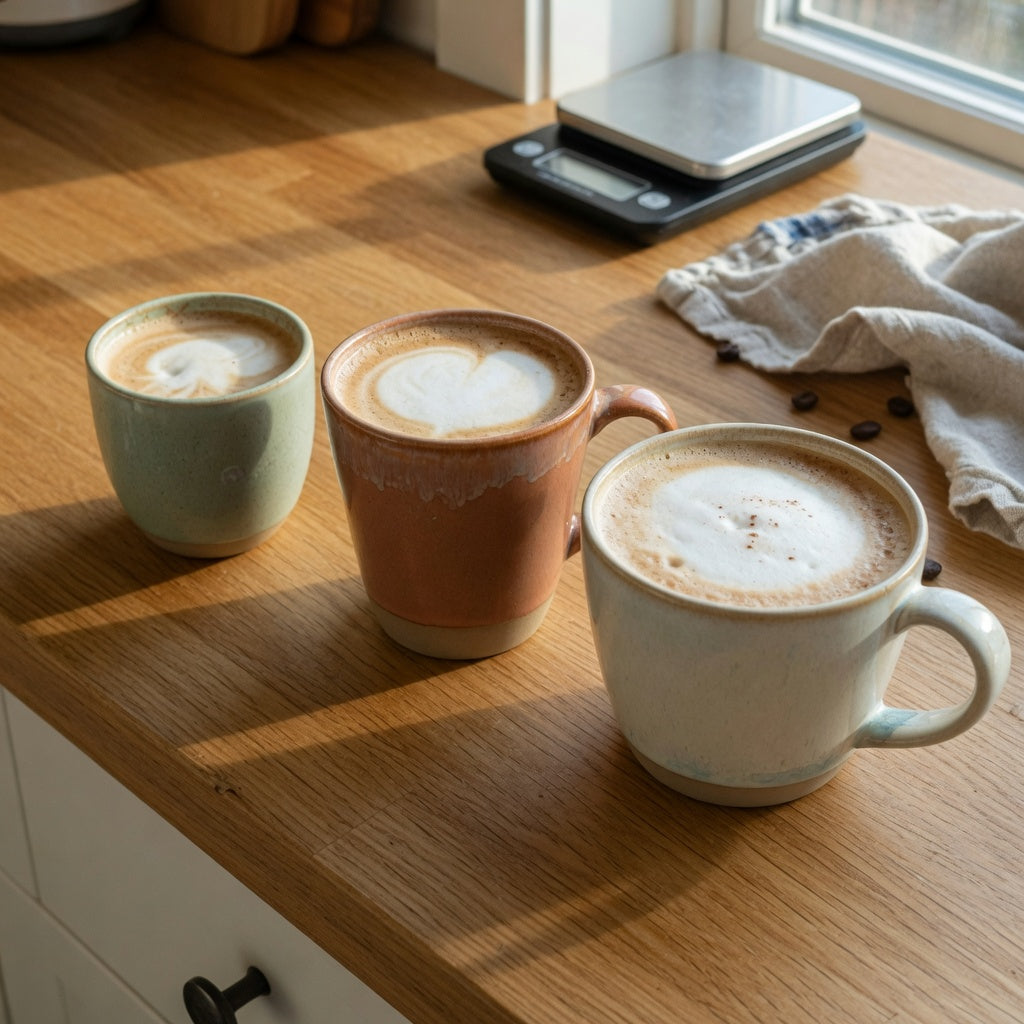
Two cups sit side by side on our packing bench: a 250 ml cup and a 440 ml cup from the same shelf. Fill both with the same double-shot latte and the smaller one looks full to a sensible line while the larger one looks half-empty. That 190 ml gap is not a defect. It is the whole buying decision. This ceramic latte cups capacity guide compares the three sizes we currently list, 250 ml, 400 ml and 440 ml, by what they actually pour, how often you will refill, and how much counter or desk space each one takes up.
Why the listed capacity isn't the pour you get
Capacity is measured to the rim, with nothing in the cup. A latte never gets filled to the rim. You need headspace for the foam cap, and you need the drink low enough that it does not slosh when you carry it back to your desk.
For context, the FDA describes ceramic cups and mugs as small hollowware that normally holds about 240 ml, or 8 fl oz, and is made with a handle. The same description separates a cup, which normally has a base and curved sides, from a mug, which has cylindrical sides. That is a useful reminder that latte cup is a retail phrase, not a regulated shape. We have not found a standards-body definition of the ideal latte volume, and cafe practice ranges widely.
Run the arithmetic before you buy:
- A typical double shot often lands around 50 to 60 ml depending on your basket and ratio.
- Leave roughly 10 to 15 ml of clearance under the rim for foam.
- On a 250 ml cup, that leaves about 175 to 190 ml of milk, which suits a flat white or a modest latte.
- On a 400 ml cup, the same shot gives you closer to 330 ml of milk, the size most cafes serve as a standard latte.
- On a 440 ml cup, you are pushing toward 370 ml of milk, which is a long drink or a cup that doubles as a tea mug.
This is also why a 12 oz mug and a 400 ml cup feel nearer to each other than the numbers imply: the gap is under two tablespoons. The number on the box is a starting point, not a promise.
Ceramic latte cups capacity guide: the three sizes we currently list
These are the only capacities confirmed in our current catalog. Treat them as listed numbers, not a promise that every cup shares the same interior profile. All three sit in our unique coffee mugs collection, and each listing carries its own capacity line.
| Cup | Listed capacity | Drink it fits | What to check before buying |
|---|---|---|---|
| Ball Handle | 250 ml | Flat white, single-shot latte, cortado or macchiato-sized pours | Check the handle span on the Ball Handle listing. A smaller body is held closer to your hand when full, so grip matters more than it looks in a photo. |
| The Flow | 400 ml | A 12 to 13 oz latte, latte-art practice, one long morning drink | Check rim diameter on the Flow listing if you pour art. A wider opening gives the pitcher more room, but the listing is the source, not this table. |
| Morning and Night | 440 ml | Large lattes, iced drinks where ice eats volume, tea | Check base width on the Morning and Night listing against your coaster, cabinet shelf and car cup holder. |
If a figure is not stated on the page, treat it as unknown rather than assuming it matches a sibling cup.
250 ml, 400 ml or 440 ml: how each size plays out across a day of refills
Our team handles customer questions and returns, so we hear how cups fail in real routines. The failure is rarely the glaze. It is the refill rhythm.
250 ml is a one-drink cup. You pull a shot, steam a small pitcher, and drink it while it is at its best. If you want a second coffee, you re-dose and re-steam. Two 250 ml lattes add up to 500 ml of total drink, more than a single 440 ml, but split into two fresher pours. In our experience, buyers who like this size drink one really good coffee rather than a long, slowly cooling one.
400 ml is the desk cup. One fill often survives a meeting and a half. Refill it once and you have had 800 ml of milk-based coffee before lunch, which is more than many people intend. This is the size we see gifted most often, because it matches what a cafe serves and therefore feels familiar on the first pour.
440 ml is the largest and the least forgiving of mismatch. The step up from 400 ml is just 40 ml, roughly two and a half tablespoons. That is enough for a splash more milk or a taller foam cap, but not a different drink. Choose it when the cup doubles as a tea mug or when you routinely add ice, not because you expect a dramatically bigger coffee. And be honest about the top end: if you want a true 16 oz drink, none of these three is it.
Handle geometry and desk footprint: what changes when the cup is full
A full 440 ml cup carries roughly 440 g of liquid before you count the ceramic. A full 250 ml cup carries roughly 250 g. That is about a 75 percent jump in load on the same basic grip, which is why handle design matters far more at the larger size than the smaller one. A handle that feels generous on an empty cup can feel pinched once the cup is full and you are carrying it one-handed across a kitchen.
Footprint is the other quiet variable. Extra volume can come from a wider body or a taller one, and those two choices solve different problems. A wider base is steadier on a wobbly cafe table but may not fit a cup holder, while a taller body clears less cabinet shelf height. We deliberately do not publish guesswork dimensions here. Open the product page for the cup you are considering and read the listed measurements against the space you actually have.
If grip is your main deciding factor, start with the Ball Handle 250 ml cup for the smaller body, or the Flow 400 ml cup for the middle. Just verify handle span and weight on the listing rather than inferring them from capacity.
Where the 250 ml cup stops working, and where the 440 ml starts
The Ball Handle 250 ml cup is a poor choice for three situations: iced lattes, where ice cubes occupy a serious share of the volume and leave you with very little actual drink; anyone who drinks two coffees back to back without wanting to re-pull a shot; and milk-heavy drinks where the espresso-to-milk ratio would end up too thin for the cup to taste like much. It is not a travel mug and will not replace one.
At the other end, the Morning and Night 440 ml cup is the wrong pick for a cortado, a macchiato or a single espresso. The drink will look lost in the bottom and the crema will spread thin. If your routine is a small, intense coffee, a smaller dedicated cortado-style cup is a better starting point than any of the three lattes here.
The Flow 400 ml cup sits in the middle for a reason: it is the least risky choice when you are buying for someone else and do not know their exact coffee habit. It is not the best fit for a committed cortado drinker or someone who wants a pint-sized iced coffee.
Glaze safety, lead, and what a lead free label can and cannot tell you
Glazed ceramic is a food-contact material, so it deserves a straight answer rather than a reassuring badge. The FDA sets an action level of 0.5 micrograms per milliliter for leachable lead in ceramic cups and mugs, applied to any one of six units tested. Cadmium action levels are 0.5 micrograms per milliliter for small hollowware and 0.25 micrograms per milliliter for large hollowware. Testing typically uses an acetic-acid extraction method, ASTM C738, described as a deliberately severe test that ordinary use is unlikely to match. A pass is a safety margin, not proof of zero.
The phrase lead free is weaker than it sounds. The FDA has found traditional pottery labeled lead free that still released extractable lead at or above its action levels, and it treats that labeling as false or misleading. Washing, boiling or scrubbing will not remove lead from a piece that has it. The agency flags handmade, antique, damaged, flea-market and brightly orange, red or yellow decorated ware as higher concern, while describing everyday commercial factory pottery as much less likely to be a problem. One more FDA rule worth knowing: decorative ceramicware that looks suitable for food use is treated as food use unless it carries both a conspicuous and permanent Not for Food Use warning or has a hole bored through the potential food-contact surface.
Our position is simple: ask for leachable lead and cadmium results for the specific glaze on the specific cup. If a listing cannot answer, treat the claim as unverified, including ours. We would rather you ask than assume.
Microwave, dishwasher and crazing: care rules that are piece-specific
The FDA explains that microwaves pass through ceramic and reflect off metal. That is why plain glazed ceramic generally reheats fine, and why metallic trim, lustre bands and gold handles are the exception. Reflected microwaves can cook unevenly and may damage the oven.
Three practical rules we repeat to customers:
- Read the care line on the exact cup, not on a similar one. We do not treat a collection as automatically microwave or dishwasher safe; suitability is decided piece by piece, often by the glaze and any applied decoration.
- Retire crazed or chipped cups. Fine glaze cracks and chips are a sign the surface is no longer intact, and the FDA lists damaged pieces among the higher-concern categories for lead exposure.
- Skip harsh cycles on hand-finished glaze. If a glossy surface starts to dull, detergent and heat stress are the usual suspects; a gentler cycle is the safer habit.
The 60-second fit check before you add to cart
- Write down the drink you make most often, in milliliters if you can. A 150 ml flat white and a 350 ml latte need different cups.
- Add 15 ml for foam headspace, then pick the nearest listed capacity: 250 ml, 400 ml or 440 ml.
- Check the base width against your coaster or cup holder, and the height against your cabinet shelf. Use listed measurements, not product photos.
- Decide whether the cup has to survive a microwave or dishwasher, and confirm that on the listing for that exact product.
- If you are buying as a gift and the habit is unknown, default to the 400 ml Flow.
When you are ready, compare the three in our unique coffee mugs collection and open each listing's care and measurement lines before checkout.
Frequently asked questions
Is a 250 ml ceramic latte cup big enough for a normal latte?
It is enough for a flat white or a small latte made with one or two shots and a modest amount of milk. After a double shot and foam headspace, you are working with roughly 175 to 190 ml of milk. If your usual cafe order is a 12 oz latte, this cup will feel small.
Why does my 400 ml cup only hold about 350 ml of coffee?
Because listed capacity is measured to the rim with nothing in the cup. A real pour stops short to leave room for foam and to keep the drink from spilling. That gap is normal across the category, and it is why this ceramic latte cups capacity guide starts with fill lines rather than numbers.
Which of the three is best for practising latte art?
The 400 ml Flow cup is the most practical practice vessel because it gives you a standard latte volume without wasting half a pitcher. Check the rim diameter on the listing before you buy; a wider opening gives the pitcher more room, but we do not publish that dimension here.
Are these ceramic latte cups microwave and dishwasher safe?
That has to be answered per cup, not per collection. Check the care section on the individual product page for the exact model you are buying, and never microwave a piece with metallic trim or a lustre finish.
Should I worry about lead in a glazed latte cup?
It is worth one question. Ask the seller for leachable lead and cadmium results for that glaze, since a lead free label alone can be applied loosely. Everyday commercial factory pottery is far less likely to be a concern than handmade, antique or damaged ware.
Start with the size that matches the drink you make four mornings out of five. If that is a flat white, the 250 ml Ball Handle is the honest fit. If it is a cafe-style latte, start with the 400 ml Flow. If the cup doubles as a tea mug or takes ice, the 440 ml Morning and Night makes more sense. Then browse the unique coffee mugs collection for the second cup.
More from our blog
Read more

Ceramic Latte Cups Morning Routine Product Shortlist Guide
A short, scenario-based shortlist of ceramic latte cups built around your real morning: how many minutes you have, how much you actually pour, and whether you go back for a refill. Each cup gets an...
Read more
Ceramic Latte Cups Home Office Product Shortlist Guide: 3 Desk Picks
A desk-first shortlist of three ceramic latte cups — 250 ml, 400 ml, and 440 ml — with the home-office scenario each fits, the reasons to skip it, and the listing details that matter before checkout.
Read more
Leave a comment
This site is protected by hCaptcha and the hCaptcha Privacy Policy and Terms of Service apply.