

Standard Coffee Cup Size ml: How 170, 250 and 400 ml Mugs Compare
Reading time: about 11 minutes
A shopper sent us a photo last month: her new mug beside a glass measuring jug, both filled to the rim, with a one-line message asking why "one cup" looked like a cup and a half. She wasn't wrong about either vessel. She was holding a recipe's standard coffee cup size ml next to a mug's stated brim capacity, and those two numbers were never measuring the same thing.
That question lands in our inbox most weeks. Here is the version we would give a friend standing in her kitchen: the number on a mug listing is a volume, the number in a recipe is a convention, and the number printed on your coffee maker is a third convention that matches neither. Once you separate those three, picking a capacity gets easy.
Why standard coffee cup size ml figures disagree: 240 ml, 175 ml and 360 ml
No single regulated millilitre size exists for a coffee cup. What exists is a set of overlapping conventions, each built for a different job:
- US nutrition labeling: 21 CFR 101.9 sets a cup at 240 ml, a fluid ounce at 30 ml, a tablespoon at 15 ml and a teaspoon at 5 ml. These are rounded labeling equivalents, not precision physics.
- Exact fluid-ounce conversion: NIST Handbook 130 gives a multiplier of 29.5735 ml per US fluid ounce, which puts 8.0 fl oz at 236.588 ml before rounding.
- Coffee makers: the brew "cup" mark on most machines lands near 6 oz, and the Coffee Association of Canada's brewing guidance uses a 175 ml cup. A 12-cup brewer therefore does not fill 12 mugs.
- A labeling reference amount: 21 CFR 101.12 lists 360 ml prepared as the reference amount for flavored and sweetened coffee or tea, shown on labels as an example 12 fl oz. That is a nutrition-panel serving reference, not a mug standard, and it does not describe black coffee.
None of those numbers is wrong. They answer different questions, which is why the honest reply to "how many ml is a coffee cup" is "which cup do you mean?"
The ounce-to-ml conversion that settles most mug-listing arguments
Most disagreement in reviews and forum threads comes down to rounding. Here are the same cup sizes converted two ways:
| Stated size | Exact (× 29.5735) | Rounded label math (× 30) |
|---|---|---|
| 4 fl oz | 118 ml | 120 ml |
| 6 fl oz | 177 ml | 180 ml |
| 8 fl oz | 236.6 ml | 240 ml |
| 12 fl oz | 354.9 ml | 360 ml |
| 16 fl oz | 473.2 ml | 480 ml |
The gap is small per cup and adds up fast across a morning. It matters even more when you compare a cafe cup quoted in ounces against a mug quoted in millilitres, because a 12 US fl oz cup and a 12 imperial fl oz cup are not the same volume at all — imperial ounces run roughly 4% larger. US fluid ounces are what almost every US retail listing means. A listing given only in millilitres removes the guesswork entirely.
170 ml, 250 ml and 400 ml ceramic mugs: what each capacity is good for
Our own shelf carries three capacities, and we quote the exact listed millilitres rather than a vague "standard" badge, because that is the figure you can check against a jug at home. Here is how the three behave in daily use.
| Capacity | Closest familiar reference | Strong at | Weak at |
|---|---|---|---|
| 170 ml | just under a 6 oz brew cup (177 ml) | cortado, flat white, double espresso, small tea | iced drinks, big lattes, anyone who refills twice |
| 250 ml | slightly above the 240 ml labeling cup | drip coffee, tea, an 8 oz pour-over | 12 oz cravings, foam-heavy drinks |
| 400 ml | about 13.5 fl oz | long lattes, iced coffee, tea all morning, desk days | small milk drinks, tight espresso-machine clearance |
170 ml: the small end, and the size most people under-buy
The Retro Coffee & Tea Cup, listed at 170 ml, is a genuine small-format cup. It suits a cortado, a flat white, a double espresso with a little room, or a modest tea. What it does not suit is a 12 oz habit. Someone used to filling a travel mug will pour, look at it, and pour again — and that second pour is fine, as long as you expected it. If your morning drink is mostly milk and mostly large, 170 ml will read as a sample.
We tell buyers this plainly because it is the return reason we see most on small cups. Before ordering, measure the mug you reach for now: fill it with water, tip it into a jug, note the number. If it lands near 300 ml, this is not your cup.
250 ml: the closest thing to an everyday default
The Ball Handled Coffee & Tea Mug, listed at 250 ml, sits just above the 240 ml labeling cup. That is exactly why it reads as "normal" to most people: a standard drip serving or a teabag plus water fills it to a sensible level with headroom left over. It is a poor match for iced coffee, though, because ice displaces volume before the liquid goes in — a 250 ml mug packed with ice holds far less than 250 ml of actual coffee. Treat it as a hot-drink mug, not an all-dayer.
One thing worth checking on the live listing rather than assuming: dishwasher and microwave guidance varies by glaze and trim, and we would rather you read the care section on the product page than carry over advice from another mug in a similar finish.
400 ml: a desk mug, not a coffee-culture cup
The The Flow Coffee & Tea Mug, listed at 400 ml, works out to roughly 13.5 fl oz — the size that ends up living on a desk rather than beside an espresso machine. It is the right answer for a long latte, an iced drink with room for ice, or someone who drinks tea by the pot. Two honest caveats. First, a small milk drink built in a 400 ml mug tastes thin, because the coffee-to-milk ratio shifts; make the drink in a jug and pour it into a warmed small cup if that is the texture you actually want. Second, filled near the brim it is heavy to hold one-handed, so handle geometry matters more at this size than at 170 ml. Check the handle opening against your own grip if you have larger hands or a weak wrist.
Brim capacity vs usable fill: where 30 to 60 ml quietly disappears
A capacity figure usually describes the vessel, not the pour. Between the two sits headspace — room for milk, foam, a teabag to move, a spoon to stir, and the walk from kitchen to sofa without a spill.
In practice, a mug you carry is rarely filled past roughly 80–85% of its stated capacity. That translates to:
- A 170 ml cup gives you roughly 135–145 ml of drink at a comfortable fill level.
- A 250 ml mug gives you roughly 200–215 ml.
- A 400 ml mug gives you roughly 320–340 ml.
If you are matching a recipe or a cafe drink volume to a mug, add that headroom back in before deciding. A 125 ml cappuccino is comfortable in a 170 ml cup. The same drink in a 250 ml mug looks half-empty and cools faster, because a wider exposed surface loses heat quicker than a narrow one.
Which mug size in ml matches espresso, cappuccino, flat white, filter and iced coffee?
Keep two numbers separate: the volume of the drink and the capacity of the vessel. The espresso world is where confusion runs deepest. The Italian certified espresso profile describes an espresso at roughly 25 ml, while a demitasse is commonly around 60 ml — the cup is more than double the shot. Manufacturer guides such as Nescafé's publish their own approximate cup lists as brand conventions, not standards.
| Drink | Typical drink volume | Sensible vessel capacity |
|---|---|---|
| Espresso | ~25 ml | 60 ml demitasse |
| Cortado | ~50–70 ml | 100–170 ml |
| Cappuccino (25 ml espresso + ~100 ml steamed milk) | ~125 ml | 170 ml |
| Flat white | ~140–160 ml | 170–200 ml |
| Latte | ~200–350 ml | 250–400 ml |
| Filter coffee or tea | ~240–350 ml | 250–400 ml |
Is 200 ml too big for a cappuccino? Not dramatically — but at 200 ml the milk-to-coffee ratio drifts toward latte territory and the foam layer thins out. If you want the classic texture, stay at 170 ml and make the drink to fit the cup.
Cafe sizes, paper cups and coffee maker marks do not speak millilitres
Chain sizing is a house convention, not an industry standard. Starbucks' own customer-service answer lists Trenta at 31 fl oz, and the hot and iced versions of the same named size hold different volumes because ice needs room — plenty of third-party charts still print 30 oz and quietly disagree with the source. Paper cups run on a similar 8/12/16 oz ladder that maps to roughly 237, 355 and 473 ml on the exact conversion.
That is why a "grande" habit does not translate neatly into a millilitre listing. If you drink 16 oz coffees, buy at 400 ml or above. If you drink 8 oz, a 250 ml mug is your match and a 400 ml one will leave you drinking cold coffee by mid-morning.
A six-point checklist before you buy any mug listed in millilitres
- Confirm the unit system. Millilitres only? Good. Ounces only? Assume US fluid ounces unless the seller states otherwise.
- Ask whether the figure is brim or usable. If the listing doesn't say, plan on 80–85% of that number as real drink volume.
- Measure your espresso machine's clearance. Height between drip tray and spout, plus width under the group head, decide whether a wide 400 ml mug fits at all.
- Check the cabinet shelf gap. Tall mugs that won't clear the shelf above end up living on the counter permanently.
- Read the care section on the current listing. Do not carry microwave or dishwasher guidance across from a similar-looking mug — glazes and trims differ, and we would rather you check the product page than guess.
- Think about your second cup. People who refill twice a morning are usually happier with 250 ml than 400 ml, because the second cup is still hot.
That last point is the one buyers argue with us about most, and it is a preference question rather than a fact. If your coffee goes cold half-finished, a smaller cup is not a downgrade — it is a fix.
Still narrowing it down? The full unique coffee mugs collection lists every current capacity side by side, and our ceramic cortado cup capacity guide covering 170 ml, 200 ml and 270 ml goes deeper on the small end.
Frequently asked questions
Is a cup of coffee 6 oz or 8 oz?
Both, depending on context. Coffee makers and brewing guidance commonly use a 6 oz cup (about 175–177 ml), while US nutrition labeling defines a cup as 240 ml, close to 8 oz. A recipe written for a brewer and the mug you fill at the counter are not using the same cup.
How many ml is a 12 oz coffee cup?
About 355 ml using the exact NIST factor of 29.5735 ml per US fluid ounce, or 360 ml if the seller rounded to 30 ml per ounce. That 5 ml gap is why two listings both claiming "12 oz" can quote different millilitre figures.
Is 250 ml the standard coffee cup size ml I should buy?
It is close to a practical default, but not identical to any official figure. A 250 ml mug sits just above the 240 ml US labeling cup and comfortably above a 175 ml brew cup, which is why it feels normal in the hand. Treat it as a sensible middle, not a regulated standard.
Is 200 ml too big for a cappuccino?
It sits at the upper edge. A classic cappuccino is roughly 25 ml of espresso plus about 100 ml of steamed milk, so a 170 ml cup gives you the right ratio plus headspace. At 200 ml you will tend to add more milk, which pushes the drink toward a small latte.
Why does my 12-cup coffee maker not fill 12 mugs?
Because the machine's cup marks are typically around 6 oz, not the 8 oz you probably pour. A 12-cup brewer yields roughly 72 fl oz in total — about 2.1 litres — which fills far fewer large mugs than the name suggests.
Before you commit, fill your current favourite mug with water, pour it into a measuring jug, and shop within about 30 ml of that number. It is the fastest way to stop guessing at capacity — and if you would rather compare all three of ours in one place, start with the collection page, where every listed millilitre figure is stated plainly.
More from our blog
Read more
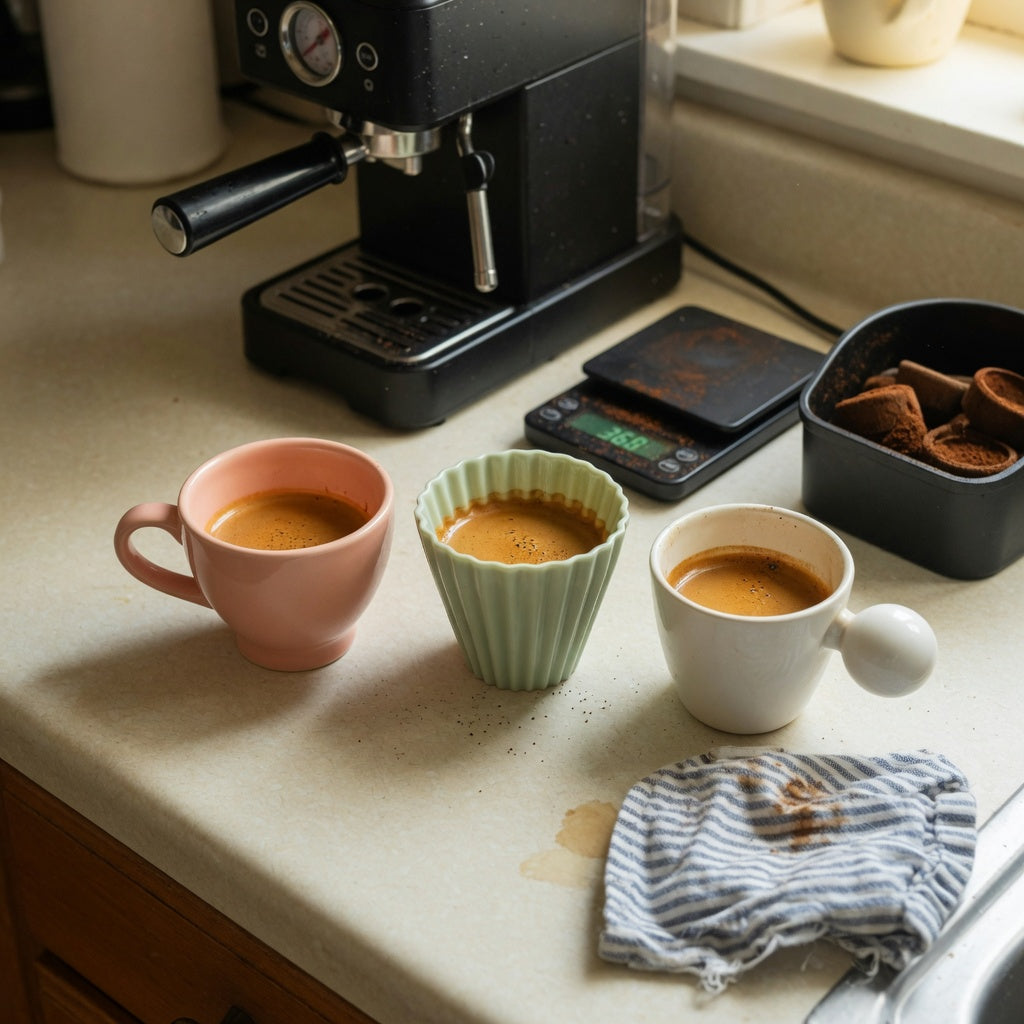
Unique Ceramic Espresso Cups: What to Compare Before Buying
A practical comparison of unique ceramic espresso cups: capacity in milliliters, clay body, glaze and food-contact checks, heat behavior, rim and handle fit, and realistic care. We map our 170 ml, ...
Read more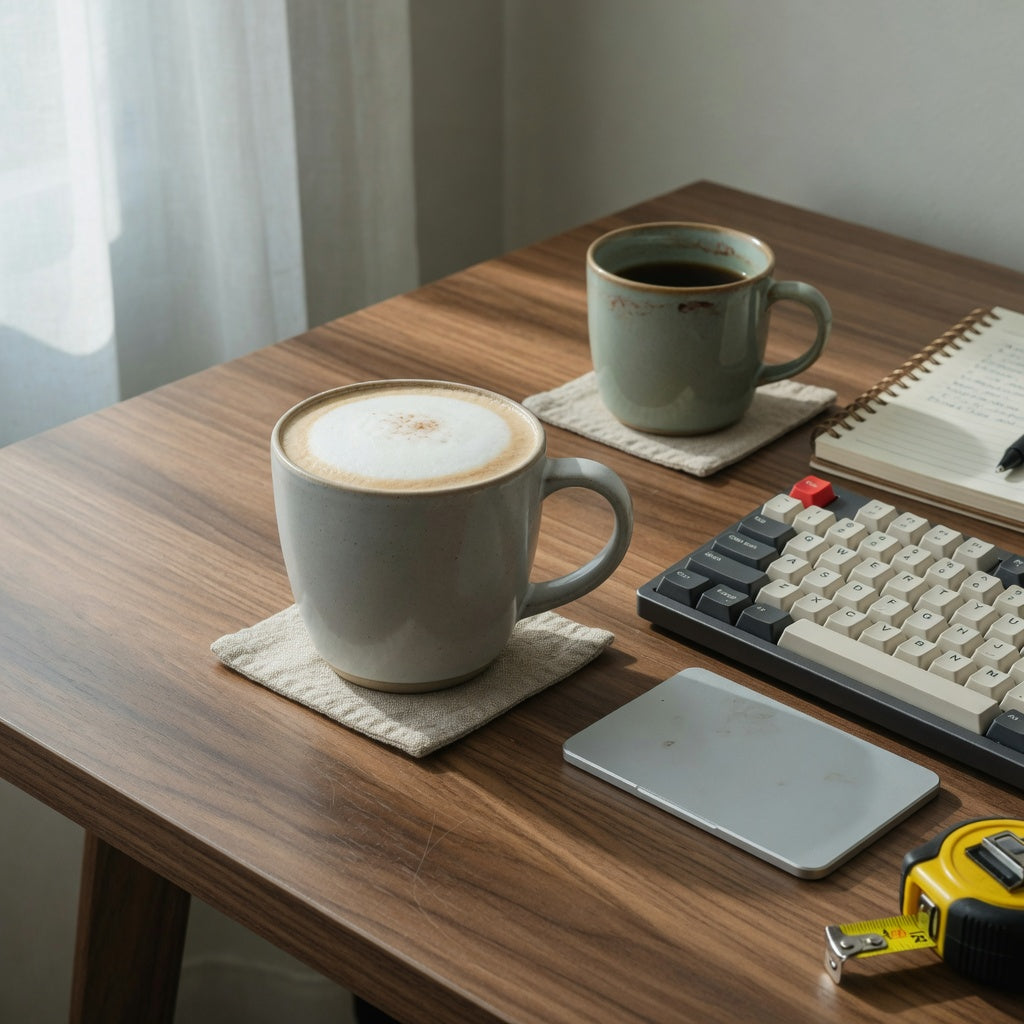
Big Latte Mug for Desk Use: Capacity, Footprint, and Handle Fit
A big latte mug for desk use usually fails on footprint and handle clearance, not volume. We compare our 400 ml, 440 ml, and 480 ml mugs by base size, one-hand carry, and refill math so you can pic...
Read more
Leave a comment
This site is protected by hCaptcha and the hCaptcha Privacy Policy and Terms of Service apply.