
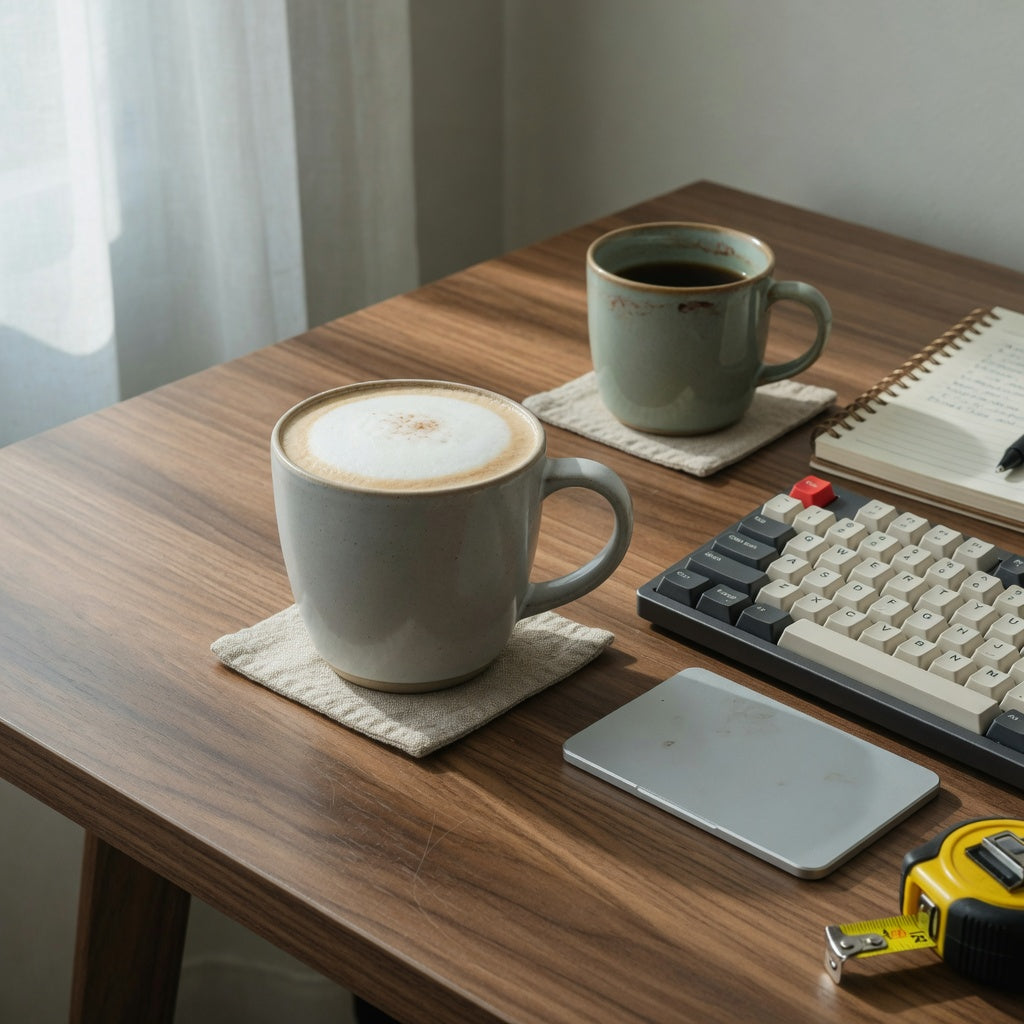
Big Latte Mug for Desk Use: Capacity, Footprint, and Handle Fit
Reading time: about 9 minutes
A big latte mug for desk use rarely fails because of volume. It fails because the handle parks itself exactly where your mouse hand travels, because the base straddles a mousepad and a stack of sticky notes, or because you poured 480 ml, drank 300 of them, and left the rest going cold beside the keyboard. We sell three ceramic mugs in this range — The Flow at 400 ml, Morning and Night at 440 ml, and The Rock at 480 ml — and desk fit is the question we answer most often. Here is how we walk customers through it, including the cases where the smaller mug is genuinely the better buy.
Which measurement actually decides desk fit: capacity, base, or handle?
Three measurements decide whether a mug belongs on a desk, and listed capacity is only one of them:
- Base diameter — how much flat surface the mug claims, and whether it still sits level when part of the base lands on a mousepad, a cable, or a stack of paper.
- Handle geometry — the size of the opening and, more importantly, how far the handle projects past the body. That projection is what collides with your hand, your mouse, or the lip of a keyboard tray.
- Height — whether it clears a monitor riser shelf, a cabinet shelf at home, or the group head of an espresso machine with a scale sitting on the drip tray.
Capacity tells you how much you can pour. It tells you nothing about whether the mug will sit where you want it to sit. In our experience, when a customer says a mug is too big for their desk, they almost never mean the millilitres — they mean the base and the handle.
400 ml, 440 ml, and 480 ml in ounces — and in refills
We list our mugs in millilitres because printed ounce figures are usually rounded, and rounding is where comparisons go wrong. Using the NIST conversion of 29.5735 ml per US fluid ounce, the three sizes land here:
| Mug | Listed capacity | Approx. US fl oz | Desk it tends to suit |
|---|---|---|---|
| The Flow | 400 ml | ~13.5 | Compact desks, keyboard trays, riser shelves with limited height |
| Morning and Night | 440 ml | ~14.9 | A standard desk with a permanent mug zone beside a full keyboard |
| The Rock | 480 ml | ~16.2 | Wide desks and side tables, long unbroken work sessions |
That is also why a listing saying "10 oz" and one saying "300 ml" are not describing the same vessel: 300 ml is about 10.1 fl oz, while 10 fl oz is about 296 ml. At our sizes the gap is small. On larger mugs it widens quickly, which is why we quote the millilitre figure and let you do the conversion with a fixed number. If you want the longer version of that arithmetic, our guide to ounces in a mug of coffee works through it step by step.
Brim capacity is not the pour you get
Every capacity figure describes the vessel, not the drink. Leave a centimetre or two of headroom for a foam cap and for the milk to settle, and a 400 ml mug is realistically a 350 ml latte; the 480 ml mug lands nearer 420 ml. Iced drinks need more headroom still, because ice displaces volume before it even starts melting.
For scale: the FDA's compliance guide for ceramic hollowware (CPG 545.450) describes a typical cup or mug as holding about 240 ml, or 8 fl oz. All three of our mugs sit well above that reference size, which is exactly why footprint — not volume — becomes the deciding factor once the mug moves from the kitchen counter to the desk.
Handle clearance and one-hand carry on a full mug
Two separate questions hide inside the word handle. Does your hand fit through the opening while the mug is heavy? And does the handle sit where your wrist naturally goes?
- Knuckle room. A full mug needs a firmer grip than an empty one. 400 ml of coffee and milk weighs roughly 400 g before you add the ceramic, so an opening that felt generous in the shop can feel tight on the walk from kitchen to desk.
- Handle direction. Set the mug to the right of a keyboard with the handle pointing left and you reach across the body every time. Point it right and it sweeps into your mouse arc. Neither is wrong — you pick the conflict you can live with.
- Projection. Measure the handle's outward reach, not just the body. That is what decides whether the mug fits on a narrow shelf or a crowded coaster.
One test we suggest before ordering: fill a measuring jug to 400 ml, pour it into a mug you already own, and lift it one-handed while your other hand rests on a mouse. It is a more honest check than any spec sheet, and it costs nothing but two minutes.
Desk footprint: what to measure before a big latte mug for desk use lands on it
Run this with a tape measure before you order, not after:
- The clear zone beside your keyboard. Width and depth of the free surface, plus 3–4 cm beyond the mug base for the handle sweep.
- Overhead clearance. Height of any monitor riser shelf or hutch above that zone. A tall mug on a riser shelf fails more often than a wide one.
- Base stability. A mug half on a mousepad tips slightly every time you type. Give it a coaster on a hard, level surface.
- Appliance clearance. If you pull espresso at your desk, measure the gap between drip tray and group head with your scale in place.
- Commute fit. If the mug travels, measure your car cup holder diameter. Plenty of oversized mugs simply do not fit one.
We publish listed capacity on every product page; if a dimension you need is not shown on the current listing, message us before ordering rather than guessing from a photo. Base diameter and handle projection are the two numbers customers most often wish they had checked first.
Does 80 ml actually save you a refill?
The gap between The Flow at 400 ml and The Rock at 480 ml is 80 ml — about 2.7 US fluid ounces, roughly a third of an 8 oz cup. Two lattes a day at your desk and that difference adds up across a week. One latte followed by water and you are carrying a larger, heavier mug for no benefit.
The counter-argument matters too. We do not publish heat-retention figures for these mugs, so do not buy on the assumption that more liquid stays hot longer — a wide surface gives heat somewhere to go, and a mug you abandon half-full leaves cold coffee in the bottom. A 400 ml pour you finish beats a 480 ml pour you walk away from.
Which of the three fits a cramped desk, a standard desk, and a wide desk?
- Cramped desk, keyboard tray, or a riser shelf: The Flow, 400 ml. Smallest listed capacity we carry in this range, which is the point — you trade 80 ml of volume for surface area and one-hand lift comfort.
- Standard office desk with a permanent mug spot: Morning and Night, 440 ml. The middle option, and where most daily latte drinkers land once they have measured their space.
- Wide desk, home office, or a side table you actually work from: The Rock, 480 ml. Largest listed capacity of the three, and the one to skip if your keyboard is already crowded.
Where none of them is the right answer: if your drink is closer to a cappuccino, or you want a wide shallow bowl for pouring latte art, a smaller and wider vessel will serve you better than any of these. The full collection of unique coffee mugs is where you can compare all three side by side, and our oversized ceramic mug capacity guide covers the broader size picture if you are still narrowing down.
Care labels, glaze wear, and what "lead-free" can and cannot tell you
Ceramic is not one material, and glaze chemistry matters for food contact. FDA guidance for ceramic hollowware sets a lead action level of 0.5 micrograms per millilitre of leaching solution, applied to any one of six units tested under CPG 545.450. That is a test threshold, not a slogan — a "lead-free" line in a listing is a claim, and the fair follow-up question is what testing sits behind it.
On dishwasher and microwave use, read the care notes on the specific product page rather than assuming. A label that applies to one ceramic body does not transfer to another, even within the same collection, and a mug pushed through a hot cycle it was not made for tends to show it as a dulled glaze rather than a dramatic failure. We would rather you check the listing than find out at month three.
Before you commit, do the two-minute version of this: measure the clear zone beside your keyboard, pour 400 ml into a mug you already own and lift it one-handed, then decide whether the extra 80 ml is worth the footprint. If you are still torn between two sizes, compare the full range here or send us your desk measurements — we answer that question most days of the week.
Frequently asked questions
Is a 400 ml mug big enough for a latte at a desk?
For most people, yes. With sensible headroom for foam, 400 ml holds roughly 350 ml of drink, comfortably more than a café latte served in a 300–355 ml cup. It only becomes a problem if you routinely pour large, milk-heavy drinks and dislike refilling.
Will a big latte mug for desk use fit under my espresso machine?
That depends on your machine, not the mug. Measure the gap between drip tray and group head with your scale in place, then compare it against the mug height on its current product page. Do not assume clearance just because the capacity is right.
How do I check handle clearance before ordering?
Look for the handle opening and how far the handle projects from the body on the current listing. If either number is missing, ask us before you buy — handle fit is the most common reason a mug that looked fine in a photo feels wrong in daily use.
Is 480 ml too much coffee for one sitting?
It can be. The Rock's 480 ml is about 16.2 US fluid ounces, a long drink for most people and a fair amount to carry one-handed. If you usually stop halfway through a mug, take the 400 ml size and refill instead — you get a hotter second cup.
Are these mugs dishwasher and microwave safe?
Check the care notes on each current product page rather than relying on general ceramic guidance. Ceramic bodies and glazes vary, and a care label that applies to one mug does not automatically apply to another in the same collection.
More from our blog
Read more

Standard Coffee Cup Size ml: How 170, 250 and 400 ml Mugs Compare
A mug listing, a recipe and a coffee maker all say "one cup" and mean three different volumes. Here is how 170 ml, 250 ml and 400 ml ceramic mugs compare once you separate brim capacity from the am...
Read more
Ceramic Mug Shapes Comparison: 200 ml, 250 ml, or 400 ml?
A current ceramic mug shapes comparison of our 200 ml Pleated cup, 250 ml Ball-Handled mug, and 400 ml The Flow mug — with the capacity, handle, and rim trade-offs that actually change how you drink.
Read more
Leave a comment
This site is protected by hCaptcha and the hCaptcha Privacy Policy and Terms of Service apply.