
Unique Ceramic Espresso Cups: What to Compare Before Buying
Reading time: about 11 minutes
A customer once carried back a cup she had bought for its glaze — hand-dipped, slightly irregular at the rim, exactly the silhouette she wanted on her counter. The problem appeared on the second morning. She pulls double shots, and the espresso and crema reached the rim before she could set the portafilter down. Nothing was defective. The cup was simply the wrong capacity for her routine.
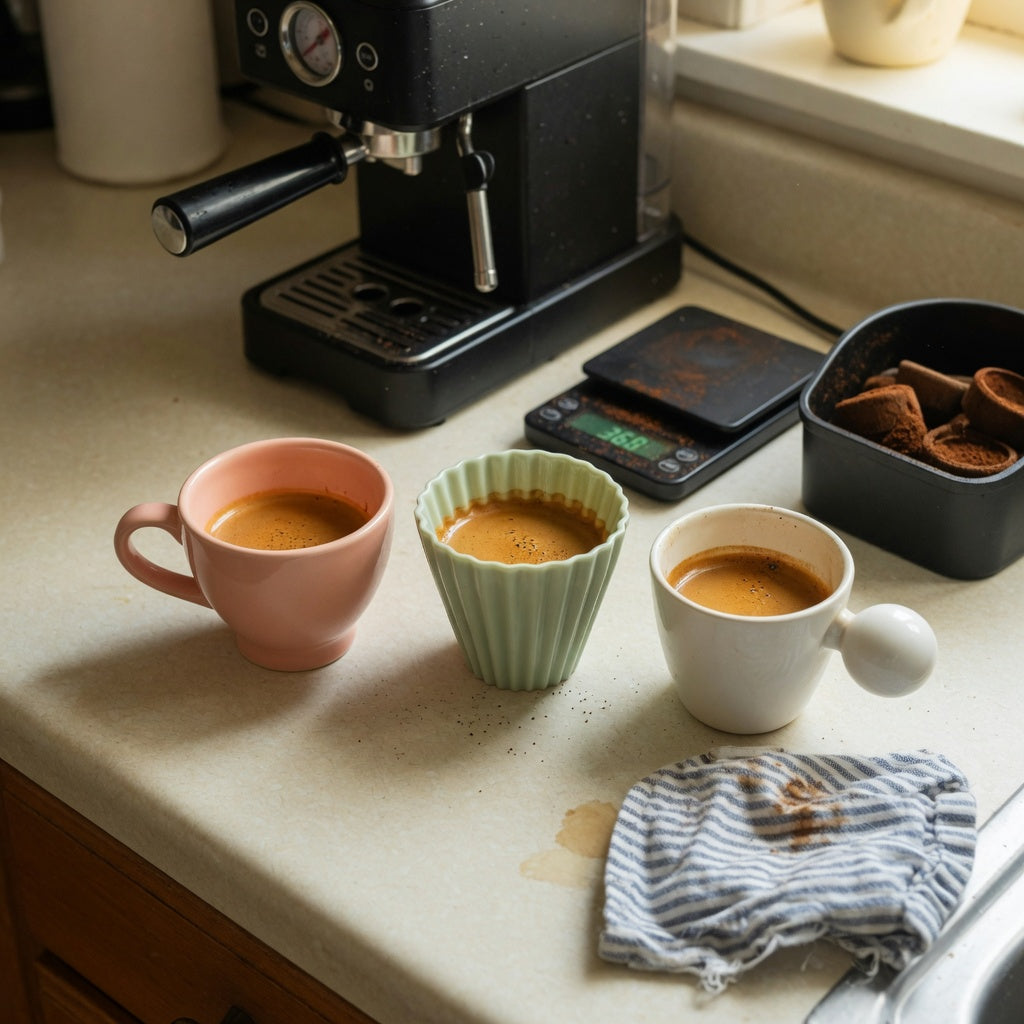
That gap between how a cup photographs and how it pours is what we check before we stock unique ceramic espresso cups. The details that decide whether you reach for it daily are unglamorous: listed capacity in milliliters, the clay body, whether the interior glaze is documented for food contact, rim width and thickness, handle clearance, and how the wall behaves with a hot shot inside. We carry three compact ceramic options — listed at 170 ml, 200 ml, and 250 ml — and we will show which routine each one suits, and where a smaller cup would serve you better.
What does “unique” mean in a cup you will actually use daily?
“Unique” gets used for four different things, and they are not equally practical. A handmade cup with slight shape variation is a different purchase from a factory cup in an unusual silhouette. A reactive or hand-dipped glaze is a different purchase again from a mixed-color set. Decide which kind of uniqueness you are paying for, because each one carries its own risk.
- Shape variation: A one-off profile feels personal, but two cups from the same order may sit differently under a portafilter spout.
- Surface variation: Reactive, speckled, matte, and hand-dipped finishes usually mean no two pieces match exactly. Sometimes that is the point; sometimes it ruins a matched pair gift.
- Color stories: Mixed-color sets make each place setting identifiable at a shared office kitchen, but they will not photograph as a uniform stack.
- Handle as the feature: A ball handle or narrow finger opening is often the visual hook. Whether your finger passes through it comfortably is a separate question from whether it looks good.
- Scale: A 200–250 ml ceramic vessel is closer to a cortado or short coffee than to a traditional demitasse.
In our store, a cup has to survive the counter test: stable base, usable opening, and a capacity that matches the drink you pull most often. Anything else is decoration you will eventually stop using.
How much capacity do a double shot, macchiato, and cortado each need?
Traditional espresso service is small — a classic single is often described in the 25–35 ml range — while plenty of home setups and cafés now pull a noticeably larger double. That spread is why “espresso cup” is not a size. Milliliters are the honest comparison; ounces get rounded differently on almost every listing.
Use this map as a starting point, then adjust for your own basket and dose:
| Listed capacity | Routine it suits | What to verify |
|---|---|---|
| 60–90 ml | Single espresso, ristretto, compact macchiato | Crema headroom and clearance under the spout |
| 90–130 ml | Double with room for crema, larger macchiato | Whether your shot volume plus crema fills past the shoulder |
| 130–200 ml | Generous double, cortado-style serve, short filter coffee | Rim width for pouring milk; whether it reads as a mug to you |
| 200–250 ml | Longer milk drink, tea, slow-sipped coffee at a desk | Handle comfort once the body is full and warm |
One rule we give every shopper: leave a finger-width of headroom above your normal pour. A cup filled to the rim loses the crema you paid for and makes the first sip a balancing act.
Which unique ceramic espresso cups fit a double-shot or cortado routine?
Match the situation first, then the style:
- You pull doubles and want a compact cup with a retro silhouette. The Retro Coffee Tea Cup is listed at 170 ml, which is a sensible landing spot for a double plus crema, or a small milk drink. It is not the cup to assume for a strict single-shot demitasse, and it is not built for a full latte.
- You like visible texture and want more headroom for milk. The Pleated Coffee Tea Cup is listed at 200 ml — the size that tends to suit cortado-style serving or a longer black coffee. The pleated wall is a grip consideration too: more surface, more places for coffee oils to sit.
- You drink at a desk or you are buying a gift with an obvious visual hook. The Ball Handled Coffee Tea Mug is listed at 250 ml. The handle is the feature worth checking before you buy, so look at the current listing for how the opening is dimensioned rather than guessing from the photo.
All three are described as ceramic, and all three are compact vessels rather than oversized mugs — but the clay body, glaze details, and care instructions are things to confirm on the live listing page, not to infer from a similar cup. If none of these capacities match your pour, the wider unique coffee mugs collection is the faster place to compare silhouettes side by side.
Porcelain, stoneware, or earthenware — what changes in the hand?
“Ceramic” covers all three, and they behave differently. Porcelain is a vitrified, low-absorption body when it is properly fired, which is why it often feels smoother and lighter. Stoneware tends to be denser and heavier in the hand. Earthenware is the porous one: the FDA notes that earthenware must be glazed to hold food or liquid, because the glaze fuses a glass-like coating that seals the pores.
- Porcelain: Crisp espresso presentation, often thinner walls, can feel delicate to people used to heavy mugs.
- Stoneware: Grounded and substantial on a counter; thick walls hold more heat mass, which cuts both ways once the cup is full.
- Earthenware: Characterful and often colorful, but only sensible for daily coffee if the interior glaze is intact and intended for food contact.
A rustic look tells you nothing about firing temperature or water absorption. If a listing does not state the body, treat it as an open question and ask before you buy — especially for a gift.
Why a thick wall can feel hot even when the shot stays warm
Wall mass does not automatically keep espresso hotter. A cold ceramic cup pulls heat out of the first pour, which is why preheating matters more than thickness. Fill the cup with hot water while you grind and dose, then empty it right before you pull the shot. Thirty seconds of hot-water rinse changes the first sip more than a millimetre of extra wall.
There is a comfort trade-off nobody mentions in product photos. A thick-walled cup can stay warm longer on the outside, and that same mass becomes uncomfortable against bare fingers. Handleless cups are fine if you lift from the saucer by the base; at a desk or during a long conversation, a real handle earns its keep.
Rim width, rim thickness, and handle clearance: the fit checks a photo hides
A spouted portafilter delivers two streams, and they need somewhere to land. A narrow opening forces you to tilt the cup mid-pour, which is exactly when espresso splashes onto the drip tray. Wider is more forgiving, and it also gives crema more surface and gives you room to spoon in a little steamed milk for a macchiato.
Rim thickness shapes the drinking experience. A thick, uneven, or sharply flared rim can push liquid toward the outside of your lip and send a drip down the cup. A very thin rim feels precise but chips more readily against a dishwasher rack or a metal sink. Check product images from more than one angle, and check the base too — a broad, level foot is far easier to set down next to a grinder, scale, or laptop than a narrow ring.
Stackability is another thing not to assume. Two cups that look alike on a shelf may nest well or may grind against each other in a cabinet. If you are fitting six cups into a small kitchen, ask.
Are reactive and hand-dipped glazes safe to drink from daily?
This is the section worth slowing down for. The FDA explains that lead may be present in the glazes or decorations of some traditional pottery and can leach into food and drink if the pottery is not made properly — and that when pottery is fired at the right temperature for the right time, essentially all the lead is bound into the glaze. The agency flags extra caution for handmade ware with a crude or irregular look, antiques, damaged or heavily worn pieces, unknown makers, flea-market finds, and brightly decorated pieces in orange, red, or yellow.
A “lead free” badge on a product page is not, by itself, proof. FDA guidance has addressed traditional pottery labeled lead free that still showed extractable lead, and states that ceramicware with extractable lead should not carry that label. California’s lead-in-tableware guidance draws a useful distinction too: lead-free ware contains no lead, while lead-safe ware may contain some if the amount that can migrate stays under Proposition 65 limits. Those are different claims, and hobby lead swab tests are a third thing again.
Questions worth asking any seller of one-off or handmade cups:
- Is this piece explicitly intended for food and drink contact?
- Is the interior fully glazed and free of crazing, cracks, or exposed clay?
- Does the maker state the clay body and firing, or at least the glaze system?
- Is the piece marked “not for food use” or “decorative only”? If so, stop there.
- Are gold, luster, or overglaze decorations present, and are separate care instructions supplied?
Also worth knowing: the FDA states no amount of washing, boiling, or other home process removes lead from pottery. You cannot fix an unknown glaze in the sink. For daily espresso, a current food-use product from an identifiable seller beats a beautiful vintage demitasse with undocumented origins.
Care by finish: plain glaze, matte or reactive surfaces, and gold or luster
Care instructions should follow the finish, not the word “ceramic.” A smooth high-fired glaze is easy to live with. A matte or textured surface holds coffee oils in its micro-texture, and overglaze decoration needs gentler handling than an in-glaze surface.
- Right after the shot: rinse within a few minutes so oils do not settle into grooves or under a textured rim.
- For staining: soft sponge and mild dish soap first; skip abrasive scouring pads that dull a finish or scratch decoration.
- Dishwasher: only if the current listing says so. Rack movement and contact with other dishes is the usual cause of chipped rims and handles.
- Microwave: confirm before heating, and never assume metallic decoration is microwave safe. The CDC has noted that lead can leach when a glaze is improperly fired or has broken down from wear, particularly after repeated microwave or dishwasher cycles.
- Damage: retire a chipped or cracked cup from drinking duty until the maker confirms it is still suitable for food contact.
The checklist we would use before adding one to the cart
- Capacity in milliliters, and whether that leaves headroom above your normal pour.
- Clay body and firing, stated by the seller rather than guessed from a photo.
- Food-contact glaze claim, plus interior condition if the piece is handmade or vintage.
- Rim width and thickness — will it catch two streams and drink without dribbling?
- Handle opening, if you need a finger through it, or base width if the cup is handleless.
- Dishwasher and microwave status, written down rather than assumed.
- Expected piece-to-piece variation if you are buying a set or a gift, plus the return terms if the glaze lands differently than shown.
If you want a second opinion on capacity before committing, our comparison of the best ceramic espresso cup for beginners covers the same trade-offs from a first-purchase angle, and the retro profile gets its own breakdown in what to compare in retro ceramic espresso cups.
Frequently asked questions
What size should unique ceramic espresso cups be for a double shot?
Plan on roughly 90–150 ml for a double with crema headroom, depending on your basket and dose, and move up toward 200 ml if you add milk for a cortado. Our 170 ml and 200 ml listings sit in that range; the 250 ml ball-handled cup is better suited to a longer drink.
Are handmade or reactive-glaze espresso cups safe for daily coffee?
They can be, provided the piece is made for food and drink contact and the seller documents the glaze and firing. Avoid unidentified, antique, damaged, or “decorative only” pieces, and remember that a lead-free label is not the same claim as lead-safe testing.
Do thick ceramic walls keep espresso hotter than thin ones?
Not on their own. A cold thick wall absorbs heat just as a thin one does, so preheating does most of the work. Thickness affects how the outside of the cup feels in your hand more than it affects the temperature of the coffee after the first minute.
Can unique ceramic espresso cups go in the dishwasher?
Only if the current product listing says they can. Rack contact chips rims and handles, and metallic or overglaze decoration usually needs hand washing. When instructions are missing, rinse promptly and wash by hand as the safer default.
How much variation should I expect in a handmade or hand-dipped set?
Expect visible differences in glaze depth, color boundary, and sometimes height or rim shape — that is the nature of the finish. If you need a matched set for a gift, confirm the seller’s variation policy and return window before ordering rather than after unboxing.
Start with the pour, not the picture: note your usual shot volume in milliliters, add headroom, then choose between the 170 ml retro cup, the 200 ml pleated cup, and the 250 ml ball-handled mug — and if your routine changes with the season or the guest, browse the full unique coffee mugs collection for a shape that fits more than one drink.
More from our blog
Read more

Wide Based Coffee Mugs: 250 ml, 400 ml, or 480 ml?
Compare the 250 ml Ball Handle, 400 ml Flow, and 480 ml Rock by capacity, visible base geometry, desk footprint, grip, brewer clearance, and ceramic-care questions before choosing.
Read more
Standard Coffee Cup Size ml: How 170, 250 and 400 ml Mugs Compare
A mug listing, a recipe and a coffee maker all say "one cup" and mean three different volumes. Here is how 170 ml, 250 ml and 400 ml ceramic mugs compare once you separate brim capacity from the am...
Read more
Leave a comment
This site is protected by hCaptcha and the hCaptcha Privacy Policy and Terms of Service apply.