



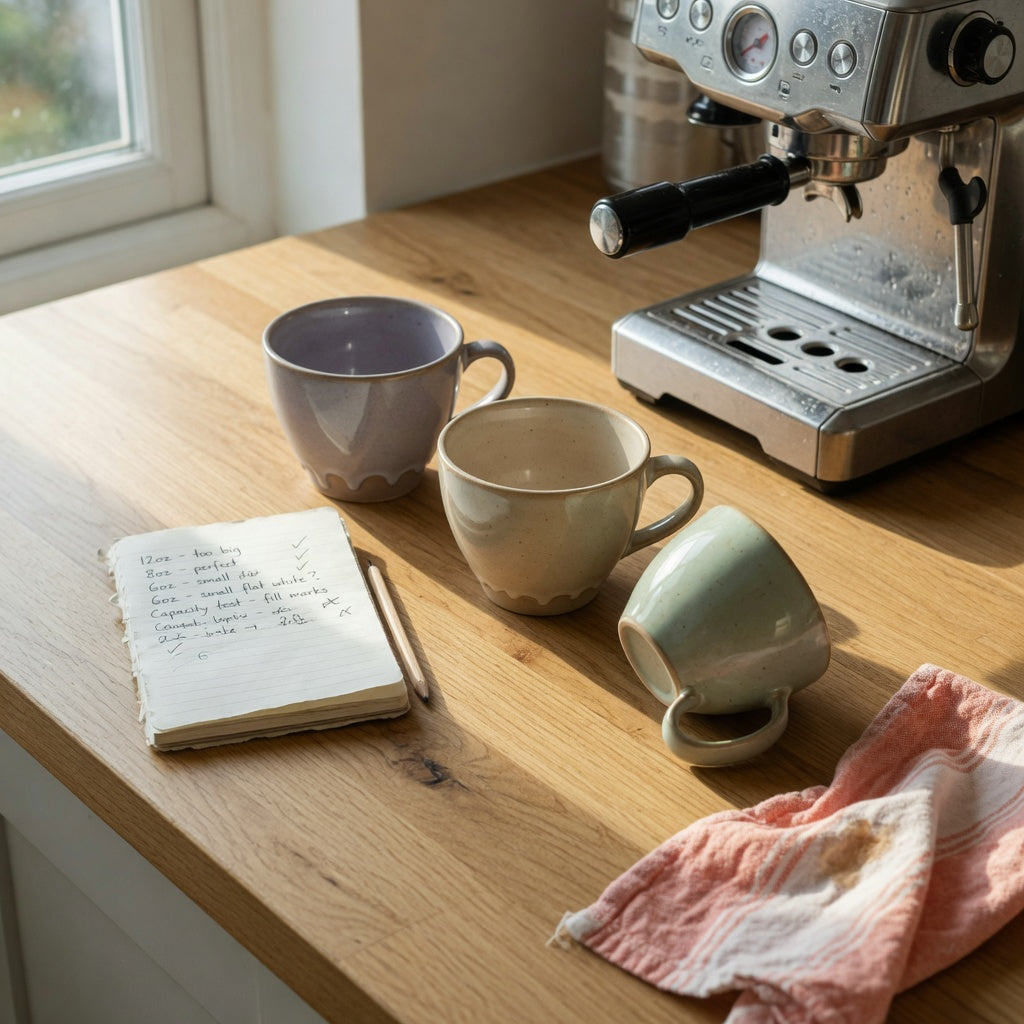
Ceramic Latte Cups Shared Household Product Shortlist Guide: 3 Sizes
Reading time: about 9 minutes
A four-cup shelf where three cups are never touched is usually a capacity problem, not a taste problem. In a shared household, the cup that gets used matches the largest drink someone actually makes, fits the shelf it lives on, and feels secure when it is full. That is the logic behind this ceramic latte cups shared household product shortlist guide: not one 'best' cup, but a short list where each cup has a job and a reason to be skipped.
We stock three listed capacities: Ball Handle 250 ml, The Flow 400 ml, and Morning and Night 440 ml. We list them individually; we do not sell them as matched sets, and we would rather you buy one, run it through a real week, and then order the second. The capacities below are the listed capacities, nothing more. Shape, handle opening, base diameter, and care instructions need to be checked on the current listing for the exact piece you buy.
A shared shelf usually fails on capacity, not on taste
FDA describes a cup or mug as small ceramic hollowware for hot drinks, normally holding about 240 ml (8 fl oz) and made with a handle. Eight ounces is the reference size, not the ideal size. In our store, the most common two-person problem is a shelf stocked for the lighter drinker while the heavier drinker keeps reaching past it.
- Brim-full versus fill line. Listings measure differently. Some count to the rim, some to a comfortable fill line, and some leave headspace for foam. A cup sold as 10 oz can look like it holds 8 oz once the milk settles.
- One heavy user skews the shelf. If one person drinks two 12 oz lattes and the other drinks tea, stock for the biggest drink, not the average.
- Wash cycles add up. A shared household runs the dishwasher more often, and rims and handles show that wear first.
Treat the listed millilitres as the ceiling and shop underneath it.
The three listed capacities we can confirm — and what they do not tell you
Here is the honest table. The only product-specific facts we can state from our catalog notes are the listed capacities. Everything else is a check, not a claim.
| Cup | Listed capacity | Household job | Verify before buying |
|---|---|---|---|
| Ball Handle | 250 ml | Small milk drinks, cortado-sized coffee, a second tea cup | Check rim diameter and handle opening; a 250 ml cup is the wrong tool for a 12 oz latte. |
| The Flow | 400 ml | Default daily latte, latte-art practice, a large flat white | Check interior bottom shape and base diameter; 400 ml may be more cup than a single espresso needs. |
| Morning and Night | 440 ml | Breakfast coffee, evening tea, long weekend drinks | Check shelf clearance and handle clearance; this is the largest listed capacity of the three, so confirm it fits your cabinet and grip. |
Do not read the table as a set recommendation. It is a map of jobs.
How this ceramic latte cups shared household product shortlist guide maps to three real kitchens
Scenario 1: one person drinks small, the other drinks large
If one person's coffee is a 250 ml flat white and the other pours a 12 oz latte, do not compromise on one size. Put the Ball Handle 250 ml cup on the small-drink side of the shelf. Its listed capacity matches a cortado or flat white without leaving the drinker staring at an inch of empty ceramic.
Skip it if the person you are buying for is a big-drink drinker in disguise, or if the cup will be grabbed at random by whoever reaches the cupboard first. A 250 ml cup in a house where the default drink is 12 oz becomes the cup nobody uses.
Scenario 2: someone practises latte art every morning
The The Flow 400 ml cup sits where many daily lattes land. More listed volume gives more surface area for a milk pattern and more room for a full double shot plus a generous pour. Before buying, verify two things on the listing: whether the interior bottom is rounded or straight-sided, and how wide the rim is. A rounded bottom tends to help milk fan across the surface; straight sides stack and store more efficiently. There is no official standard for the correct latte-cup interior, and cafe practice disagrees across a wide range of volumes and shapes.
Skip it if the household runs on single espressos. At 400 ml this is more cup than that drink needs. Check shelf depth and base diameter too; do not assume it takes the same footprint as the 250 ml cup.
Scenario 3: the same cup has to work at 7 a.m. and 9 p.m.
The Morning and Night 440 ml cup is the one for households where the biggest vessel gets reused across the day: coffee before work, tea after dinner. That reuse pattern matters more for tea drinkers, because a 250 ml mug of tea is gone in five minutes. At 440 ml it is the largest listed capacity of the three.
Skip it if shelf clearance is tight or the person using it has small hands or a light grip. Check the handle opening and base diameter on the listing; capacity alone does not tell you how it will feel when full.
Handle feel and desk footprint: what to check before you commit
Handles are where a shared shelf breaks down. A full cup carries more weight than an empty one, and a handle that feels fine empty can pinch when loaded. Two grip styles matter: a pinch grip, where the forefinger and thumb go through the loop, needs a smaller opening; a fist grip needs clearance for four fingers plus the thumb and a low attachment point that keeps knuckles off the hot body.
On the current listings, check three things: where the handle attaches to the body, how thick the handle stock is, and whether the opening is round or flattened. We cannot give you handle dimensions for these three cups from capacity alone, so use the listing photos and measurements.
Desk footprint is a separate calculation. Base diameter is what competes with a keyboard, mouse, and notebook. A wider base is more stable and takes more desk real estate; a narrower base is easier to bump. Shelf depth and the clearance to the shelf above eliminate options faster than style does. If you want to see the full spread of shapes we carry, start with our unique coffee mugs collection.
What a 'lead free' label proves, and what it does not
Daily use by more than one person makes food-contact safety worth five minutes of attention. The useful benchmark is FDA action levels, not a badge on a product title.
- Lead: FDA's action level for leachable lead in ceramic cups and mugs is 0.5 micrograms per millilitre of leaching solution, applied to any one of six units tested.
- Cadmium: the action level for small hollowware is also 0.5 micrograms per millilitre, measured on any one of six units tested.
- Label limits: ceramicware that tests at or above those levels should not be labelled 'lead free,' and FDA can treat that labelling as false or misleading.
- Decorative ware: under 21 CFR 109.16, a ceramic piece that appears suitable for food use is treated as food-use ware unless it carries a conspicuous 'Not for Food Use' warning plus a permanent version on the base, or has a hole bored through the food-contact surface.
- What cannot be fixed: washing, boiling, or scrubbing does not remove lead from pottery. FDA flags handmade, antique, damaged, flea-market, and brightly orange-, red-, or yellow-decorated pieces as higher concern, while noting that everyday commercial factory pottery is much less likely to have a lead problem.
If a listing does not show batch test results, ask which test method was used. FDA refers to ASTM C738, an acetic-acid extraction that the standard describes as a severe test unlikely to be matched in ordinary use.
Microwave, dishwasher, and the cracked-glaze retirement rule
Ceramic being microwave-safe in general does not settle whether your cup is. FDA's explanation is simple: microwaves pass through ceramic and heat the contents, while metal reflects them. A plain glazed cup therefore behaves differently from one with metallic trim or a lustre finish, which should stay out of the microwave entirely.
- Check the care line on the exact listing. Microwave and dishwasher suitability is decided piece by piece.
- Retire any cup with a cracked, chipped, or crazed glaze from daily hot-drink duty.
- Dishwasher detergent and repeated hot cycles dull glazes over years. If the finish matters, hand-wash the two cups you use most.
- Skip ceramic if you need a cup that survives a commute in a bag or a knock off a desk. A stainless tumbler is the better tool.
Frequently asked questions
Why does a cup listed at 250 ml sometimes look bigger than it holds?
Because listings measure differently. Some measure to the brim, some to a fill line, and some leave headspace for foam. Treat the listed figure as the ceiling and assume your real pour will be smaller. If the number matters, ask the seller how capacity was measured.
Is a rounded-bottom cup better than a straight-sided one for latte art?
There is no official standard, and cafe practice disagrees. A rounded interior bottom tends to help milk fan across the surface as you pour; straight sides stack and store more efficiently. If you never pour patterns, buy for shelf fit and grip instead.
Do thicker ceramic walls keep a latte hotter for longer?
We do not make heat-retention claims on these cups. Wall thickness and mass are clues you can feel in the hand, but independent comparisons of stoneware, porcelain, and double-wall ceramic at real drink volumes are scarce and conflicting. Buy for fit and feel, not for a retention promise.
Can I microwave and dishwasher a ceramic latte cup?
It depends on the piece, so check the care line on the exact listing. Plain glazed ceramic behaves differently from a cup with metallic trim, which should stay out of the microwave. Cracked or crazed glaze means the cup should come out of daily rotation.
How should I use this ceramic latte cups shared household product shortlist guide if two people want the same size?
Let the largest drink in the house set the ceiling, then buy down from there. If both people want the same capacity, buy two of the same cup rather than forcing a compromise size. Match each person to the job they actually do, not the one you assume they do.
Build the shortlist in five minutes
- Write down the largest drink anyone in the house actually makes, in millilitres.
- Measure shelf depth and the clearance to the shelf above.
- Pick a listed capacity from 250 ml, 400 ml, or 440 ml that sits under that ceiling.
- Check the handle opening and base diameter on the exact listing.
- Buy one, run it through a real week of mornings and dishwasher cycles, then order the second.
If you are still torn between two sizes, start with the larger cup. A big cup holding a small drink is a minor irritation; a small cup holding a big drink is a daily problem. Browse the full collection here and pick the one cup that matches the biggest drink in your house.
More from our blog
Ready to pick your mug? Two ways to save on today's order:
Ordering 1–3 mugs? Get an extra 10% off your 1st order with code 10_OFF Apply 10% Off & Shop Wooden-Handle Mugs →
Gifting 4+ mugs? Buy 3, Get the 4th Free applies automatically at checkout (no code needed; offers do not stack) · Free standard shipping (Nov pre-Christmas delivery: 15–20 calendar days US) · Free replacement if chipped in transit.
Popular mug buying guides: Ceramic Mugs with Lids Compared · Wooden-Handle Tea Infuser Mugs Compared · Christmas & Secret Santa Mugs 2026 · Espresso & Cortado Cups Guide · Cup & Saucer Gift Sets · All 25 Mugs Spec Table · Mug Size Guide · Shipping & Promo FAQ
FIRST ORDER 10% OFF (CODE: 10_OFF) · OR BUY 3, GET THE 4TH FREE


Read more
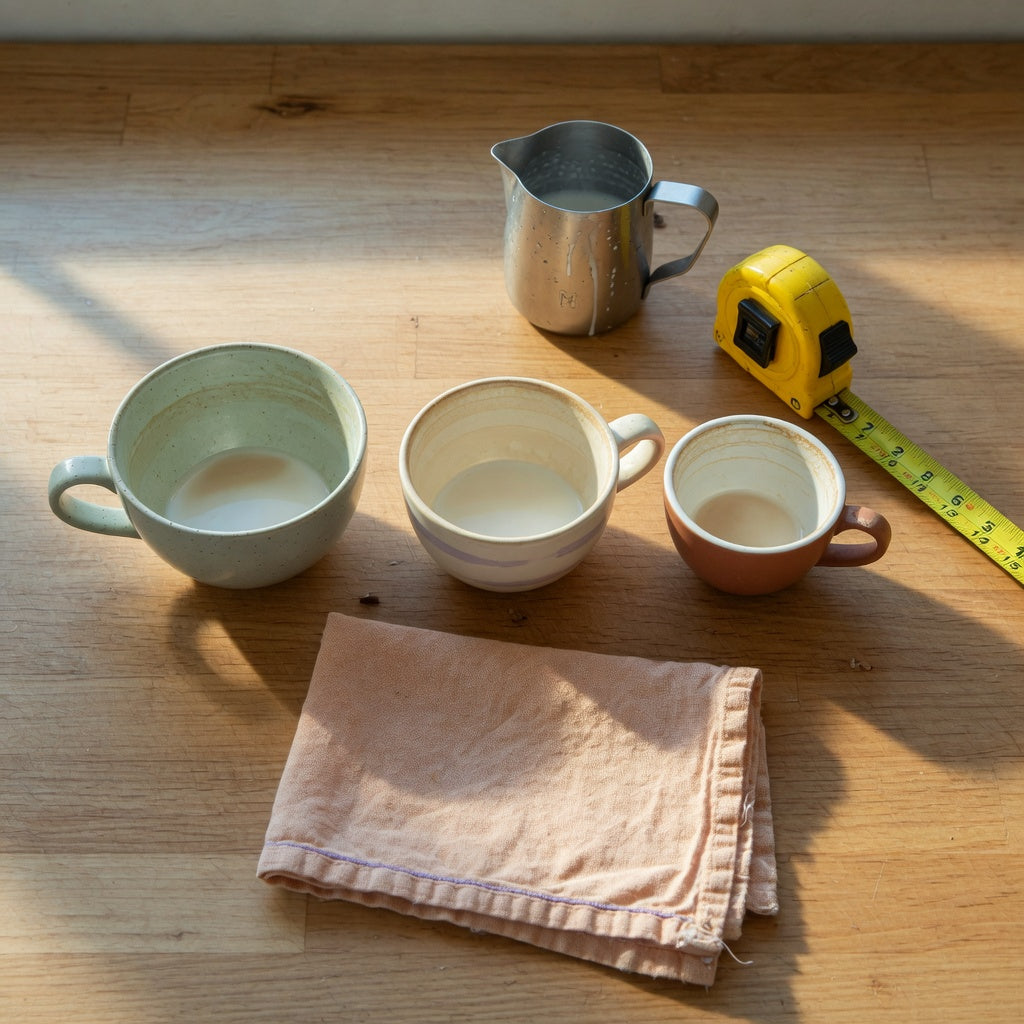
Ceramic Latte Cups Weekend Coffee Product Shortlist Guide (250-440 ml)
A scenario-based shortlist of the three ceramic latte cup capacities we stock — 250 ml, 400 ml, and 440 ml — with plain reasons to choose or skip each, plus the listing details worth verifying befo...
Read more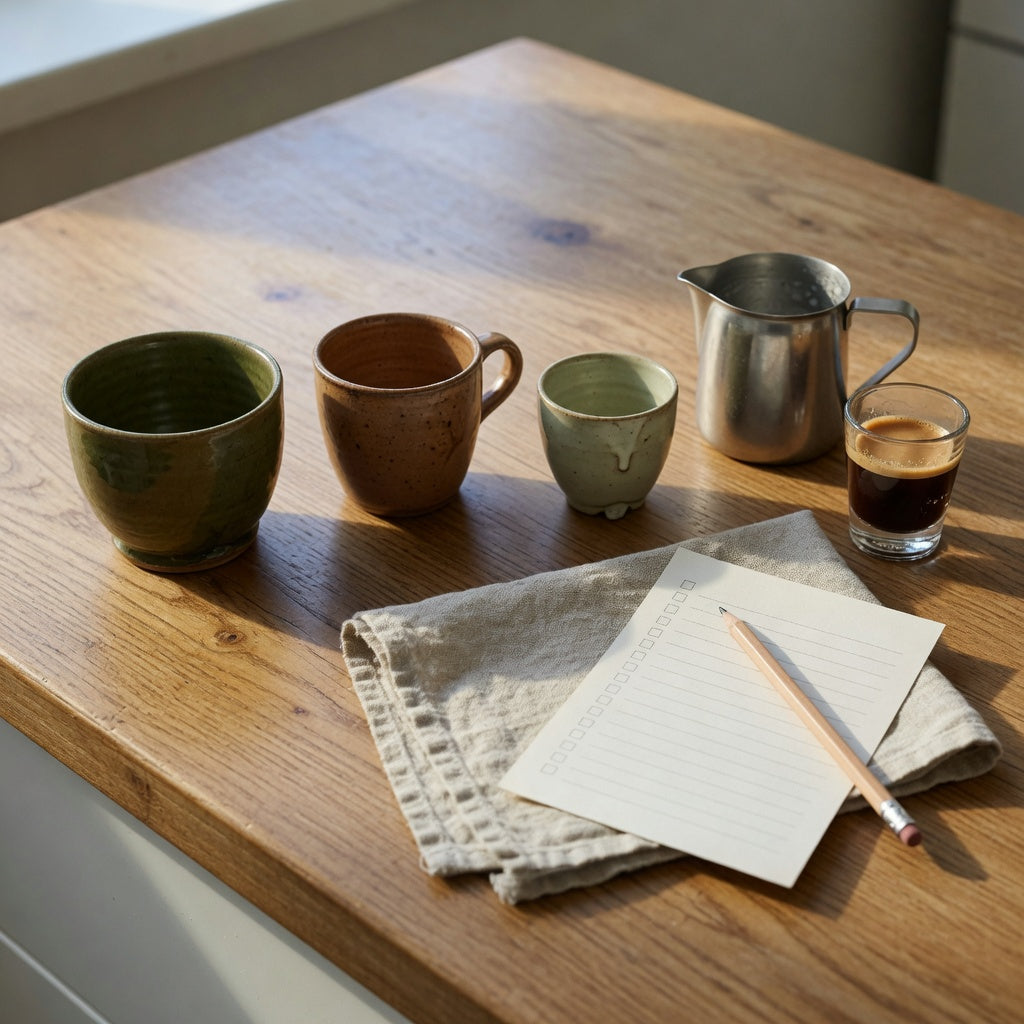
Ceramic Latte Cups: Weekend Coffee Practical Purchase Checklist
A decision-ready checklist for buying ceramic latte cups for weekend coffee: how listed capacity differs from what you actually pour, why handle geometry matters more as capacity grows, what FDA le...
Read more
Leave a comment
This site is protected by hCaptcha and the hCaptcha Privacy Policy and Terms of Service apply.