



Pottery Tea Cups Morning Routine Product Shortlist Guide (170–250 ml)
Reading time: about 9 minutes
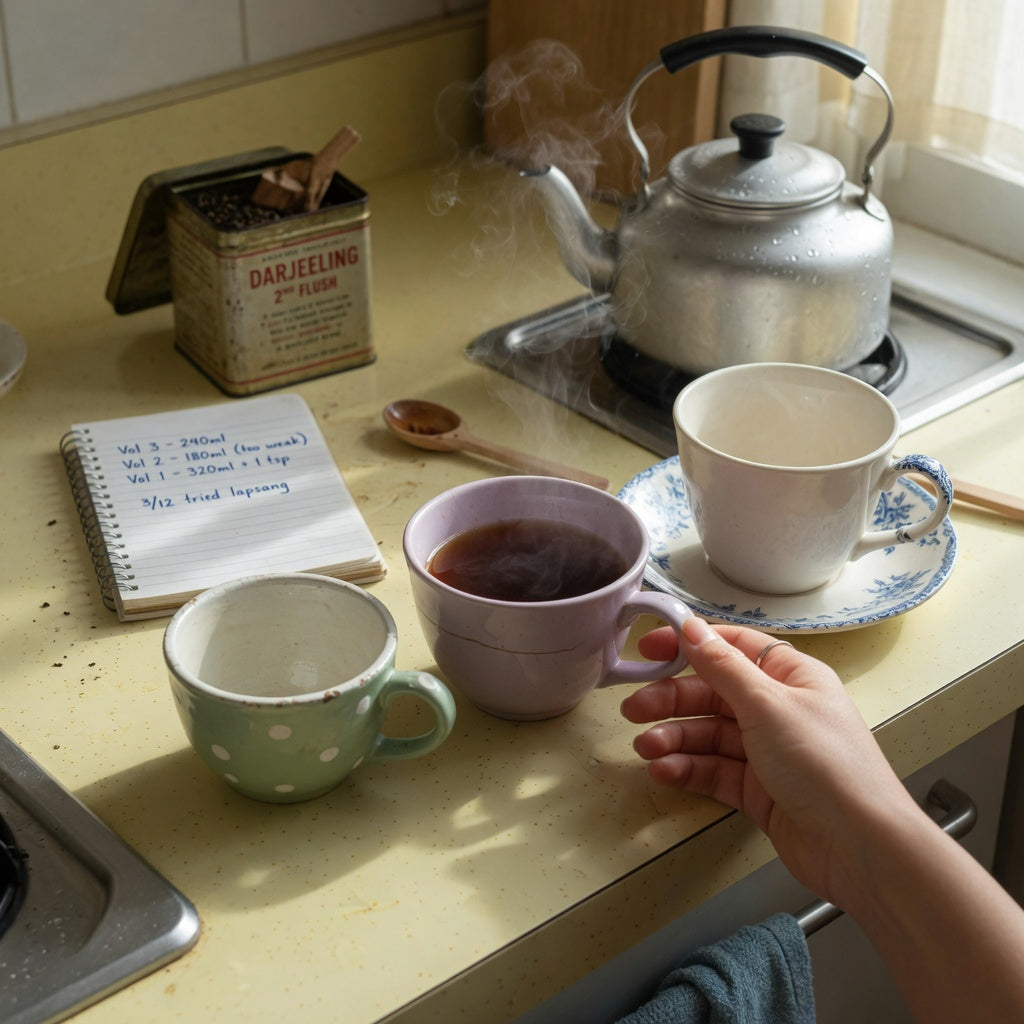
The kettle clicks off, you pour, and by the time you sit down the cup is already cooling faster than you expected. That is rarely a pottery problem. It is almost always a volume-and-shape mismatch with the way you actually drink between 6:30 and 8:00.
This pottery tea cups morning routine product shortlist guide is built on three numbers instead of aesthetics: how long your morning window is, how much you drink before you leave the kitchen, and whether you will genuinely get up for a refill.
We sell three ceramic cups in this range. In our store, the returns and the 'it's lovely but I never use it' emails almost always trace back to someone buying the shape they liked rather than the volume they drink. So here is the shortlist, with the reasons to choose or skip each one.
How much do you actually drink before the kettle goes cold?
Start with volume, because everything else follows from it. A cup that holds less than your usual pour forces a second trip to the stove; a cup that holds more than you finish leaves cold tea on the counter. The FDA's own working description of a cup or mug is a handled vessel that normally holds about 240 ml (8 fl oz). That gives us a reference line for our three sizes.
- Below the line — Retro, 170 ml: a short seated pour. One tea bag, one steep, finished while it is still hot.
- Just under the line — Pleated, 200 ml: a breakfast cup with one refill you actually get up for.
- Just over the line — Ball Handle, 250 ml: the cup that replaces a mug, for people who carry it to a desk.
Then be honest about refill tolerance. If you will not stand up again before 8 a.m., buy the larger cup. If you pour and forget, buy the smaller one — a 170 ml cup that goes cold wastes less tea than a 250 ml cup that goes cold.
| Cup | Listed capacity | Best morning scenario | Skip if |
|---|---|---|---|
| Retro coffee and tea cup | 170 ml | One short pour, drunk while hot | You routinely drink 200 ml or more before leaving |
| Pleated coffee and tea cup | 200 ml | Seated breakfast with one planned refill | You want one cup and nothing more |
| Ball Handle coffee and tea mug | 250 ml | Desk or sofa, replacing a standard mug | You prefer a handleless, cradled cup |
170 ml Retro: right for a two-sip window, wrong for a commute
The Retro coffee and tea cup is the smallest of the three at 170 ml, with a ceramic body and a deliberately retro form. It reads as a small cup rather than a shrunken mug, which matters if you drink it standing at a shared office counter and do not want to explain it.
Choose it if: you steep one bag of black tea or pull one short coffee, you drink standing up, or you like the idea of a second small pour mid-morning. Small cups stay hot to the last mouthful, which is the whole point.
Skip it if: your normal pour is a full mug, you walk your drink to a desk twenty minutes away, or you drink green tea across a long session and would be refilling five times. For that last case, a larger mug-style cup is the better tool.
200 ml Pleated: the refill cup for a seated breakfast
The Pleated coffee and tea cup sits at 200 ml in a ceramic body. The visible difference is the pleated exterior — vertical facets that catch light and give your fingers something to hold on to when the cup is warm. That texture is not decoration for its own sake; a faceted wall is easier to grip than a smooth one when you are not fully awake.
Choose it if: you sit down for breakfast, you drink roughly a small-to-medium mug, and you are willing to pour once more before you leave. It is the middle option for people who find 170 ml fussy and 250 ml too much to finish.
Skip it if: you want one cup and nothing more, or you drink from the cup for an hour while working — 200 ml will be cold long before you are done. Also skip it if you need a lid; none of these three is a travel cup.
250 ml Ball Handle: when the cup has to replace the mug
The Ball Handle coffee and tea mug is the largest at 250 ml, ceramic, with a ball-form handle as the obvious visual feature. It behaves like a mug in the hand while still reading as pottery on the shelf.
Choose it if: you drink 250 ml or more before 8 a.m., you take the cup to a desk or sofa, or you make tea in a basket infuser and want room for the leaves to move.
Skip it if: your hands are small, because a ball handle changes where your fingers sit — check the actual handle opening against your grip before committing. Skip it too if you want the handleless, cradled feel of a Japanese-style yunomi; a 250 ml handled mug is a different experience entirely.
What the glaze questions actually change about your shortlist
Capacity is a fact we can put on a listing. Glaze chemistry is not, and any store that settles it in one sentence is guessing. Here is what public guidance actually supports.
- The FDA notes that lead in a glaze is bound into the surface when a piece is fired at the right temperature for the right time, and that improperly fired pottery can leach lead into food and drink. No amount of washing or boiling removes lead from a piece.
- The FDA compliance guideline for cups and mugs is 0.5 micrograms of lead per millilitre of leaching solution, with a separate cadmium guideline for small hollowware.
- The FDA's higher-concern list includes handmade ware with a crude look or irregular shape, antiques, damaged or heavily worn pieces, flea-market and street-vendor finds, and bright orange, red or yellow decoration.
- 'Lead free' is a label, not a lab report. The FDA states that ware showing extractable lead under its test method should not carry that label at all.
Before you buy, look at the surfaces that touch tea and lips. An even interior glaze matters more than a decorative exterior. Pinholes, bare clay spots on the rim, or a chip at the lip are worth asking about. Fine crackle in a glaze is not the same as a crack you can feel with a fingernail; ask whether the crackle is intentional and whether the glaze is stable. If a piece carries a 'not for food use' warning, believe it and keep it on a shelf.
Ask the maker what temperature the work is fired to, whether the glaze is described as food safe, and whether any test report refers to the same clay and glaze as the cup you are buying rather than a sample from years ago. We list capacity and ceramic body for our cups; we do not turn a glaze conversation into a safety guarantee.
Handle, rim and wall: the three things photos hide
Hot liquid plus a thin wall equals a hot hand. Three physical details decide whether a pottery cup is pleasant at drinking temperature.
- Handle opening: a ball or loop handle can look generous in a photo and still be tight for a thumb. If you have broad hands, this is the first thing to verify.
- Wall thickness: thicker walls hold heat longer but feel heavier against the lip; thin walls drink cleaner but pass heat through faster.
- Rim finish: a rounded rim is easier on the mouth than a sharply trimmed edge — worth checking if you sip slowly rather than gulping.
If you drink with two hands wrapped around the cup, a handle is beside the point and you should be shopping handleless. If you drink while typing, the handle stops being optional.
Scenarios where this pottery tea cups morning routine product shortlist guide says skip
Some mornings are not pottery mornings, and pretending otherwise is how cups end up in a cupboard.
- Skip all three if you need a lid and a fifteen-minute commute. An open ceramic cup is the wrong tool for a bag.
- Skip the 170 ml if you routinely drink 400 ml before you leave the house.
- Skip any cup with metallic lip decoration if you reheat in a microwave — ask the maker before microwaving any cup with metallic or overglaze decoration.
- Skip unmarked handmade ware from an unknown maker if documented food-contact safety matters to you.
If you want to see the whole set of shapes side by side before narrowing down, browse the unique coffee mugs collection. That is also where we group the handleless and mug-style options that do not appear in this three-cup shortlist.
A two-minute check at the counter before you buy
- Fill your current cup to the level you actually drink, then pour that water into a measuring jug. That number is your real target, not the capacity printed on the mug you own.
- Time how long the drink stays hot enough to enjoy. Under ten minutes points you toward the 170 ml; over twenty points you toward the 250 ml.
- Wrap your hand around your current cup and note whether you use the handle at all.
- Read the listing for glaze and care statements, and email the maker if the wording is vague.
- Decide your refill rule out loud — one pour, or one refill — and buy the cup that matches it.
Frequently asked questions
Is a 170 ml pottery tea cup too small for a coffee morning?
It is smaller than the roughly 240 ml the FDA treats as a typical cup, so it suits one short coffee or one tea bag rather than a full mug. If you drink more than about 200 ml before leaving the house, the 200 ml or 250 ml option in this pottery tea cups morning routine product shortlist guide will get used more often.
Can these cups go in the dishwasher or microwave?
We publish capacity and ceramic body, and appliance status depends on the specific glaze and firing, so check the current listing or ask before you buy. As a general rule, keep any metallic or overglaze decoration out of the microwave.
How do I check whether a pottery glaze is food safe?
Ask the maker what temperature the piece is fired to and whether the glaze is described as food safe, then ask whether any test report covers the same clay and glaze as the finished cup. Treat 'lead free' as a claim that should be backed up, not as proof on its own.
Will a pottery cup change how my tea tastes?
We cannot make that claim, and the sources we checked do not settle it either. What we can tell you is that glazed versus bare clay on the drinking surface is a maker-specific question — worth asking if you drink delicate teas where you notice every difference.
Should I buy the 200 ml or the 250 ml if I am undecided?
Measure your usual pour first. If it lands near 200 ml and you will refill once, take the Pleated. If it lands near 250 ml or you carry the cup away from the kitchen, take the Ball Handle and check the handle opening against your grip.
More from our blog
Ready to pick your mug? Two ways to save on today's order:
Ordering 1–3 mugs? Get an extra 10% off your 1st order with code 10_OFF Apply 10% Off & Shop Wooden-Handle Mugs →
Gifting 4+ mugs? Buy 3, Get the 4th Free applies automatically at checkout (no code needed; offers do not stack) · Free standard shipping (Nov pre-Christmas delivery: 15–20 calendar days US) · Free replacement if chipped in transit.
Popular mug buying guides: Ceramic Mugs with Lids Compared · Wooden-Handle Tea Infuser Mugs Compared · Christmas & Secret Santa Mugs 2026 · Espresso & Cortado Cups Guide · Cup & Saucer Gift Sets · All 25 Mugs Spec Table · Mug Size Guide · Shipping & Promo FAQ
FIRST ORDER 10% OFF (CODE: 10_OFF) · OR BUY 3, GET THE 4TH FREE


Read more
Wide Based Coffee Mugs Morning Routine Product Shortlist Guide
A scenario-first shortlist that starts with how much you really pour before 9 a.m., how many refills you will tolerate, and how much clearance your coaster and brewer leave. Three capacities, each ...
Read more
Large Round Coffee Mugs Morning Routine Product Shortlist Guide
A practical, scenario-based shortlist for 400–480 ml rounded mugs: match listed capacity to your usual pour, brewer clearance, milk habit, and how often you refill before 9 a.m.
Read more
Leave a comment
This site is protected by hCaptcha and the hCaptcha Privacy Policy and Terms of Service apply.