



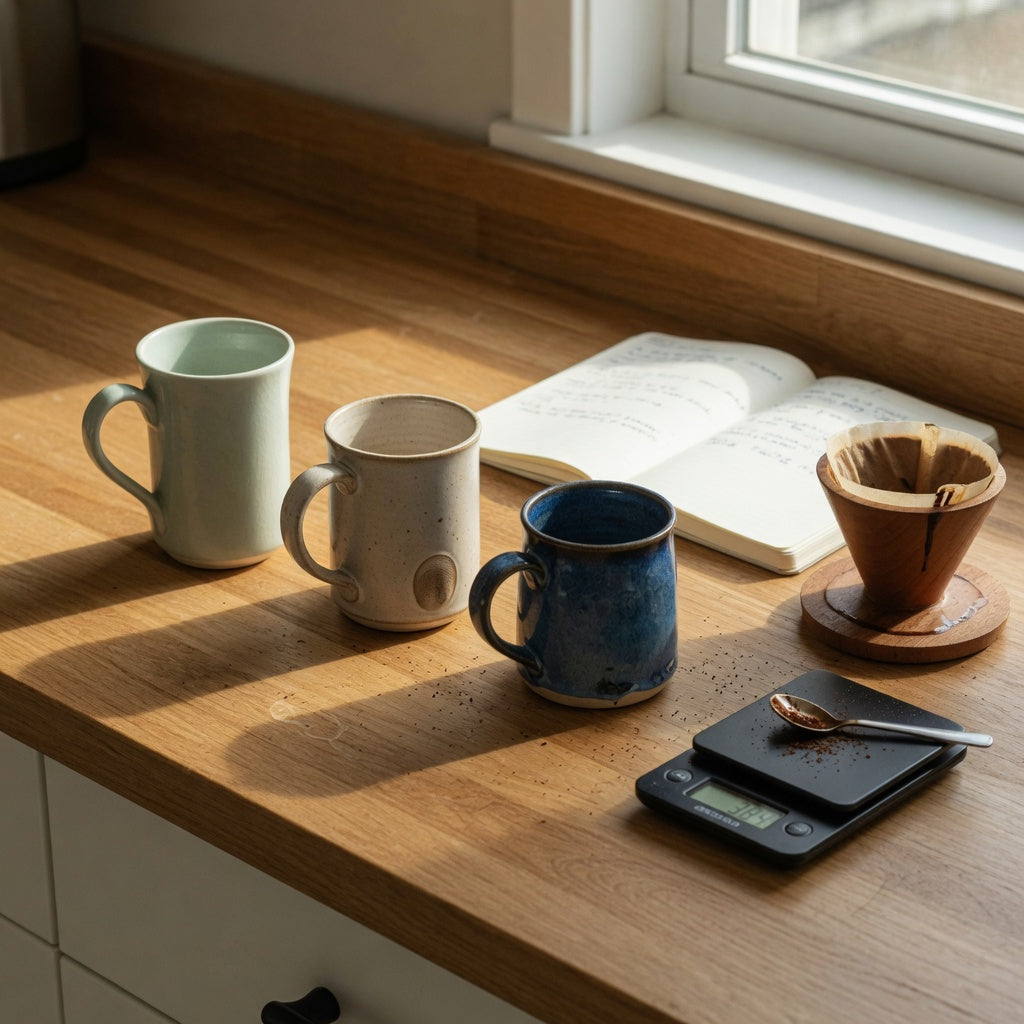
Wide Based Coffee Mugs Morning Routine Product Shortlist Guide
Reading time: about 12 minutes
The spill almost never happens while you are drinking. It happens sideways: you reach across the desk for a charger, your sleeve catches the handle, and the mug goes over before you have decided to move your hand. That ten-second window is what a broad foot is built to survive, and it is why this wide based coffee mugs morning routine product shortlist guide starts with your pour volume and your counter space instead of a feature grid.
We sell ceramic drinkware, so we have a bias — but we also handle the returns. The pattern is consistent: mugs come back over fit far more often than over glaze. A foot that overhangs a coaster rim, a body that fouls a drip tray, a handle that crowds the knuckles. Those are the failures worth shopping against.
Does a wider base actually keep a mug upright on a crowded desk?
Mostly, yes, within limits worth stating plainly. A mug tips when its combined center of gravity, ceramic plus liquid, travels past the outer edge of the surface touching the table. Widen that contact patch and you raise the tilt angle the mug can absorb before it commits to falling. That is the whole mechanism, and no label on the box changes it.
Four other variables decide whether it tips anyway:
- Height. A tall body lifts the center of gravity even with a broad foot. Height and base width pull against each other.
- Fill level. A brim-full mug stacks mass high up. The same mug, half empty, shrugs off the bump that would have finished it.
- Foot flatness. A foot ring that rocks on the countertop wobbles first and falls second. Set a new mug on a glass table and press the rim gently with one finger before you trust it.
- Handle geometry. A handle that projects far from the body catches sleeves, cables, and chair arms, and it shifts the balance point sideways every time something brushes it.
Then there is the mix-up that sends more mugs back than any other: a wide foot and a wide mouth are separate features, and both get sold as wide. The foot governs stability. The rim governs how fast the coffee cools and whether a pour-over cone sits level on it. A stable mug can have a narrow opening, and a wide opening can sit on a small foot. Decide which one you need before you compare anything.
How much do you pour before 9 a.m. — and how many refills will you tolerate?
Capacity eliminates more candidates than base shape does, so settle it first. Three questions we ask shoppers before recommending a shape:
- What counts as one pour for you? A cortado, a 12 oz drip, and a 16 oz batch brew are three different purchases.
- How many refills will you tolerate? If the answer is zero, buy capacity. If the walk back to the kettle is part of the ritual, a smaller mug keeps every cup genuinely hot.
- How long does the mug sit? A drink finished in eight minutes loses little heat. One that idles beside a laptop for ninety minutes needs a smaller starting volume, not a bigger one.
Surface area explains the trade-off. A wide, open mug exposes more liquid to room air than a narrow mug at the same capacity, so pairing a broad body with a broad rim buys you stability at the cost of warmth. If you want the last third of the cup to still be hot, buy the smallest capacity that avoids a second trip. If you would rather compare silhouettes and glazes side by side before choosing a number, our unique coffee mugs collection lists each shape with its stated capacity.
The wide based coffee mugs morning routine product shortlist: which capacity fits which morning
We carry three capacities, and each maps to a recognizably different morning. The volumes below are the numbers we can state with confidence. Foot diameter, empty weight, and handle opening vary by shape, so read the spec block on the live listing — those measurements decide whether a mug clears your coaster and your fingers.
| Mug | Listed capacity | Morning it suits | Honest reason to skip it |
|---|---|---|---|
| Ball Handle Coffee & Tea Mug | 250 ml (about 8.5 fl oz) | Espresso-length drinks, cortado, flat white, a quick cup of tea | You drink 12 oz or more in one sitting |
| The Flow Coffee & Tea Mug | 400 ml (about 13.5 fl oz) | One standard brew plus a splash of milk, single desk session | You brew 16 oz batches or load the mug with ice first |
| The Rock Coffee & Tea Mug | 480 ml (about 16.2 fl oz) | A full 16 oz batch and an uninterrupted work block | You sip slowly for two hours, or your side table is narrow |
250 ml Ball Handle — the eight-minute morning
Built for people who drink one small, strong coffee and get on with the day. At 250 ml there is little headroom above a cortado or an AeroPress shot topped with hot water, and that is a quiet advantage: small mugs are hard to overfill, and the overfilled mug is the one that ends up on the floor.
- Choose it if your first drink is espresso-based, you take tea in small cups, or you want the drink finished before it cools anyway.
- Skip it if your baseline is a 12 oz drip, you build large iced coffees (ice eats interior volume fast), or you resent a mid-task walk to the kettle.
Confirm the current base measurement and handle opening on the Ball Handle Coffee & Tea Mug page before you order, especially if your coaster has a raised lip.
400 ml The Flow — the single-fill default
400 ml works out to roughly 13.5 fl oz: a standard 12 oz brew with room for milk and enough headspace that carrying it from kitchen to desk does not slosh over the rim. In our experience this is the capacity that fits the most mornings without forcing a second decision at 7:40.
- Choose it if you make one good cup before work, want to add milk without re-measuring, or alternate between coffee and tea depending on the day.
- Skip it if you routinely brew 16 oz through a machine, or you fill mugs with ice first — displacement will leave you short of liquid.
Check the foot diameter and empty weight on the The Flow Coffee & Tea Mug listing; a heavier body feels steadier on a desk but loads a weak wrist on the way to it.
480 ml The Rock — the no-refill deep work block
480 ml is a shade over 16 fl oz, so a full batch brew goes in one pour and one trip. Filled to the brim that is roughly half a kilogram of liquid before you count the ceramic — worth thinking about if you carry the mug one-handed up stairs or have grip or wrist limits.
- Choose it if you start a task and refuse to break it, brew 16 oz at a time, or want one vessel that covers both coffee and a long tea session.
- Skip it if you nurse a drink for two hours, your desk is cramped, or you hoped to use it in a car. This is flat-surface drinkware, not a travel mug — treat it as desk and kitchen gear unless the listing says otherwise.
Verify the base measurement and handle clearance on the The Rock Coffee & Tea Mug product page before committing.
Will a wide mug clear your coaster, drip tray, and cup holder?
Fit, not breakage, is the top reason wide drinkware comes back to us. Grab a tape measure and take three numbers on your own counter:
- Coaster interior. Measure the flat center, not the outer edge. A foot that overhangs a raised rim rocks every time you set the mug down, which cancels out the stability you paid for.
- Brewer clearance. Measure from the drip tray to the spout, and from the spout to the machine back wall. Wide bodies foul the tray housing even when they are shorter than a travel tumbler.
- Cup holder width at its narrowest point. Console holders taper, so the top measurement lies. If the foot exceeds the bottom diameter, the mug wedges and tilts. Treat wide ceramic mugs as desk gear unless the maker explicitly lists cupholder compatibility.
Pour-over drinkers get one extra check: set the cone or AeroPress on the dry rim before brewing. If it rocks, the mouth is narrower than the brewer base and hot water will find that gap. Our ceramic wide bottom coffee mugs shape and fit guide goes deeper on rim-versus-foot geometry.
Why does a full mug feel heavier, and why does water pool in the base?
Two physical details show up after a few weeks of use, and neither appears in a marketing photo.
Leverage. As the body widens, the horizontal distance from your grip to the liquid's center of mass grows, turning the mug into a longer lever. The same mass feels heavier in a wide mug than in a narrow tumbler. Look at the handle opening before buying and ask whether three or four fingers fit comfortably, and whether your knuckles clear the table when you set it down.
Foot ring drainage. Many ceramic mugs finish with a recessed foot so the glaze line sits cleanly and the mug rests on a ring rather than a full disc. Inverted in a dishwasher rack, that recess becomes a shallow cup and holds rinse water. Tip it out and dry the foot before the mug goes back on the shelf, or you will find a faint ring on the cabinet a week later.
On care, we quote dishwasher and microwave guidance from each product's own listing rather than applying one rule across the catalog, because glazes, trims, and foot finishes differ between shapes. Read the care block on the exact page you are buying from.
Ceramic, vacuum steel, or a lid: what actually changes your morning?
If your drink needs to stay hot for two hours in a cold car, a double-wall vacuum-insulated steel mug is the right tool, and we will say so rather than imply a ceramic foot changes thermodynamics. Heat retention is a function of material, wall construction, lid, and exposed surface. We do not claim insulation benefits for our ceramic shapes, and we would be skeptical of anyone who does.
Lids deserve their own caution. Splash-resistant and leak-resistant are not the same claim, and a lid that survives a jostle in a cup holder may still release liquid when the mug goes fully over. If a lid matters to your commute, ask the seller which specific claim applies before you buy — that question is the difference between a damp bag and a dry one.
How much should glaze safety affect the purchase?
Stability is the fun part of this category. Glaze safety is the part that matters more. FDA guidance notes that lead from improperly fired pottery glazes can leach into food and drink, and that washing, boiling, or other household steps will not remove lead from the piece. The agency flags handmade, antique, damaged, and brightly orange-, red-, or yellow-decorated wares as higher concern, and describes ordinary commercial factory tableware as much less likely to present the problem. For cups and mugs, the FDA action level is 0.5 micrograms of lead per milliliter of leaching solution across any of six tested units, using methods that include ASTM C738.
The practical version: production ware with a documented food-contact glaze is a low-drama purchase. A one-off from a market stall with no firing records stays a display piece until the maker tells you otherwise, and anything stamped not for food use should never hold your coffee.
Frequently asked questions
Does a wide base keep coffee hot longer?
Not by itself. Heat loss depends on material, wall thickness, rim diameter, whether there is a lid, and how much liquid surface meets room air. A wide-bottomed mug with an equally wide opening can cool faster than a narrow mug of the same capacity. If warmth is your priority, buy the smallest capacity that avoids a refill.
Will a wide bottom mug fit my car's cup holder?
Usually not, and cup holders are not one standard size. Measure yours at the narrowest point rather than at the rim, because most consoles taper toward the base. Unless a maker explicitly lists cupholder compatibility, plan to keep a wide ceramic mug on flat surfaces.
Is a 480 ml mug too big for one person?
It is fine if you genuinely drink 16 oz before the coffee goes cold. It is the wrong buy if you sip slowly for two hours, because the larger open surface gives heat somewhere to escape and a full mug carries roughly half a kilogram of liquid from counter to desk.
Why does water collect in the base after dishwashing?
Recessed foot rings trap rinse water when the mug sits upside down in the rack. Tip the mug out, dry the foot with a towel, and store it upright or on its side. A quick shake handles shallow recesses; deep ones need the towel.
What should I check before ordering a wide based mug?
Treat this wide based coffee mugs morning routine product shortlist guide as a filter, not a verdict. Confirm three things on the live listing first: the foot diameter against your coaster's flat center, the empty weight if you carry the mug one-handed, and the handle opening against your grip.
Match the mug to your morning, then verify three numbers
Work in this order and you will not overthink it:
- Write down the volume of your actual first pour, not the one you plan to start making.
- Cross out any capacity that forces a refill before 9 a.m.
- Measure your coaster's flat interior, your brewer clearance, and your cup holder at its narrowest point.
- Confirm foot diameter, empty weight, and handle opening on the exact product page you are buying from.
A small espresso morning points to the 250 ml Ball Handle. One solid cup at a desk points to the 400 ml Flow. A full batch and no interruptions points to the 480 ml Rock. Still torn between two silhouettes? Browse the full mug collection and compare each listed capacity against the mug you already reach for every morning — buy for the habit you have, not the one you keep meaning to build.
More from our blog
Ready to pick your mug? Two ways to save on today's order:
Ordering 1–3 mugs? Get an extra 10% off your 1st order with code 10_OFF Apply 10% Off & Shop Wooden-Handle Mugs →
Gifting 4+ mugs? Buy 3, Get the 4th Free applies automatically at checkout (no code needed; offers do not stack) · Free standard shipping (Nov pre-Christmas delivery: 15–20 calendar days US) · Free replacement if chipped in transit.
Popular mug buying guides: Ceramic Mugs with Lids Compared · Wooden-Handle Tea Infuser Mugs Compared · Christmas & Secret Santa Mugs 2026 · Espresso & Cortado Cups Guide · Cup & Saucer Gift Sets · All 25 Mugs Spec Table · Mug Size Guide · Shipping & Promo FAQ
FIRST ORDER 10% OFF (CODE: 10_OFF) · OR BUY 3, GET THE 4TH FREE


Read more

Latte Mugs Tall Morning Routine Product Shortlist Guide (400–480 ml)
A practical shortlist for tall latte mugs, built around morning drink volume, foam headroom and refill habits. We compare The Flow 400 ml, Morning and Night 440 ml and The Rock 480 ml, with a plain...
Read more
Pottery Tea Cups Morning Routine Product Shortlist Guide (170–250 ml)
Three ceramic cups, three morning timings. This shortlist matches our 170 ml Retro, 200 ml Pleated and 250 ml Ball Handle cups to how much you drink before the kettle cools — and says plainly which...
Read more
Leave a comment
This site is protected by hCaptcha and the hCaptcha Privacy Policy and Terms of Service apply.