



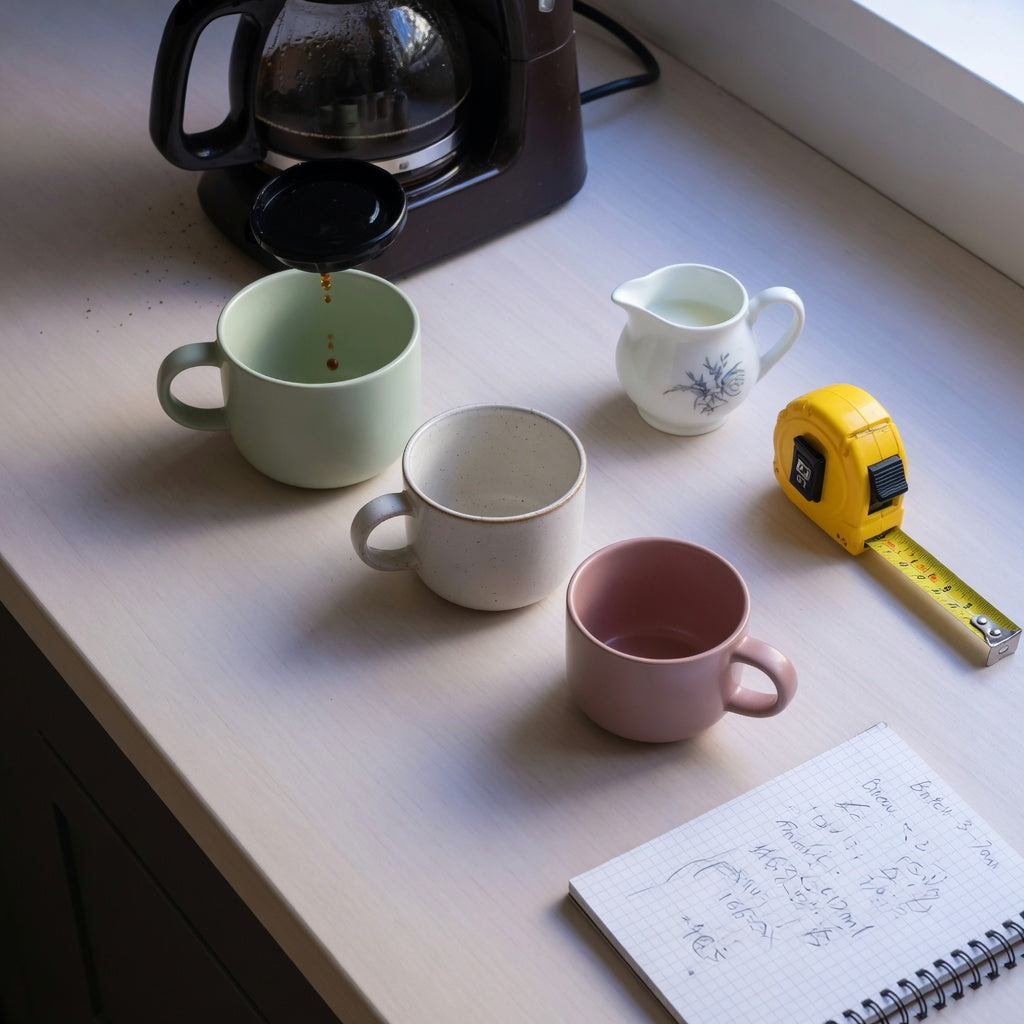
Large Round Coffee Mugs Morning Routine Product Shortlist Guide
Reading time: about 10 minutes
The coffee is ready, the milk is out, and the mug you reached for is still in the dishwasher. That is the moment a large round coffee mugs morning routine product shortlist guide should solve for. Not a shelf display. A workday pour at 6:45, a second cup at 9, and a vessel that fits under the brew basket without a juggling act. In our store, we keep this shortlist to three listed capacities because most shoppers are deciding between usable volumes, not thirty finishes. The three we compare here are listed at 400 ml, 440 ml, and 480 ml, and each has a rounded silhouette you can see in its product photos.
Why does your usual pour matter more than the mug's brim capacity?
Start with what you drink before 9 a.m., not with the biggest number on the page. A mug listed at 480 ml does not give you 480 ml of comfortable drinking room once milk, foam, or a tea bag goes in. It gives you a maximum. The useful number is your normal pour plus what you add, with a finger-width or two of headroom so the first step does not slosh over the rim.
Use one conversion consistently. NIST lists 1 U.S. fluid ounce as 29.57353 mL. That puts the listed capacities at roughly 13.5 fl oz for 400 ml, 14.9 fl oz for 440 ml, and 16.2 fl oz for 480 ml. Now do the morning math: a 12 fl oz coffee plus 2 fl oz of milk is about 14 fl oz before foam. That total is close to the 440 ml mug and leaves more room in the 480 ml one. A 14 fl oz pod plus a generous cream pour is a tighter fit in either; the 480 ml option is the safer of the three.
What does large round mean when the shortlist tops out at 480 ml?
By the old 8 to 12 fl oz mug standard, 400 to 480 ml is large. By jumbo 20 to 24 fl oz standards, it is not. We would rather say that plainly than let the word large do too much work. If your morning requirement is one 20 oz fill, no refill, and a mug that stays warm through a meeting, this shortlist is the wrong size class. Browse the unique coffee mugs collection and filter by the listed capacity before you fall for a finish.
Round also needs a definition. A short, wide body and a tall, narrow body can hold the same volume and behave differently under a brewer, in a cabinet, and in your hand. Capacity does not tell you height. It does not tell you filled weight. It does not tell you whether a dripper will balance on the rim. Those are listing details or questions for the seller, not facts you can infer from a number.
What earns a spot on a large round coffee mugs morning routine product shortlist guide?
Our test is simple: match the reader's morning to the listed capacity, then name the reason to skip it. A shortlist with no skips is just a catalog. Here is how the three options sort out.
| Morning scenario | Option and listed capacity | Why choose it | Skip it if |
|---|---|---|---|
| One 10 to 12 fl oz black coffee, little or no milk, and you want the smallest listed volume in this group. | The Flow, 400 ml (about 13.5 fl oz) | Its listed capacity covers a modest pour with a little headroom; it is the least volume to manage if you rarely finish a bigger cup. | You brew 14 fl oz and add milk, want a 16 fl oz single pour, or need two 10 oz cups without a refill. |
| A 12 to 14 fl oz coffee with a modest milk or cream pour, or a tea routine that benefits from a middle volume. | Morning and Night, 440 ml (about 14.9 fl oz) | The middle listed capacity gives more room than 400 ml without jumping to the largest option; a sensible one-mug compromise. | You pour a full 14 fl oz pod and then add a generous amount of milk, or you know you want a clear 16 fl oz fill. |
| A black coffee or latte near 16 fl oz, fewer refill trips, and you accept a fuller mug. | The Rock, 480 ml (about 16.2 fl oz) | It is the largest listed capacity here and the closest fit to a 16 fl oz single pour. | You need a true 20 to 24 oz jumbo, have low brewer clearance, a tight cabinet, or the listing's published height and handle measurements do not suit your space or grip. |
If your answer is none of these, that is useful information. A different silhouette, a larger volume, or a very specific handle opening may matter more than capacity. The collection link above is the better next step than forcing the wrong mug onto the shortlist. What we will not do is call a 400 ml mug a jumbo or imply that listed capacity equals a comfortable fill.
One more boundary: if you need a sealed commuter mug for a train or a car commute, check for a lid and leak rating. A coffee mug's capacity says nothing about whether it is leakproof, and an open mug is not a substitute for a travel vessel.
Will the mug clear your brewer, cabinet, and car holder?
Measure before you choose a finish. Capacity is not a fit specification.
- Brewer clearance: put your current mug under the spout with the brew basket in place. Measure from the counter to the spout. A low drip tray can make the clearance tighter than the machine's exterior suggests.
- Cabinet height: measure the shelf gap if you store mugs upright. A rounded body can look shorter than it sits.
- Desk and coaster footprint: check the base diameter against your coaster and the space beside your keyboard.
- Dripper fit: a wide rim may not support a V60-style dripper, and an AeroPress needs a stable rim rather than a deep well. Check the rim diameter before you plan a pour-over routine.
- Car holder: if the mug travels, measure the holder opening. A broad base can be stable on a counter and useless in a cup holder.
If the product listing does not publish height, base diameter, or rim size, ask before ordering. We cannot turn a capacity in milliliters into a clearance in inches, and neither can a product photo.
What do we check in hand before we recommend daily use?
Handle room, balance, heat, and care marks decide whether a mug survives a routine. Three fingers through the opening without scraping knuckles is a practical minimum for most adults. Filled weight is dry weight plus the drink, so it rises with capacity; if grip strength is a concern, a smaller listed volume is often the more useful choice than the biggest one in the group. For these three mugs, confirm handle dimensions and dry weight on the current product page or ask us, because capacity alone does not establish either.
Heat behaves in two directions. A full mug has more liquid mass to hold warmth, but a broad open surface also lets heat escape faster. A wide mouth helps aroma and makes a latte easier to sip; it does not keep coffee hot like a lidded travel mug. If you use a mug warmer, a flat base contacts the plate better than a pronounced foot or ridge; check the base photos or dimensions.
Care is a listing-by-listing question. Follow the maker's microwave and dishwasher marks for the exact mug. Material names do not settle appliance safety: enamelware can have a metal core and a hot exterior, glass can be thermal-shock sensitive, and glazed stoneware or porcelain can vary by body and decoration. Three habits prevent most avoidable damage:
- Do not plunge hot ware into cold water or set it on a cold wet surface.
- Do not use a mug for direct stovetop heat unless the maker explicitly allows it.
- Keep metallic rims, gold luster, and unmarked enamel out of the microwave until the maker confirms otherwise.
Those rules apply to ceramic and enamel drinkware generally. They are not a claim about the exact construction of the three mugs in this shortlist.
How do lead and cadmium limits apply to a mug you use every morning?
Food-contact safety deserves a better answer than a decorative label. FDA applies a lead action level of 0.5 µg/mL of leaching solution to ceramicware cups and mugs under CPG 545.450. Its cadmium action level is 0.5 µg/mL for small hollowware and 0.25 µg/mL for large hollowware. FDA describes cups and mugs as small hollowware normally holding about 240 mL, with the lead guideline applied to any one of six units tested. That category is about use, not whether the mug feels oversized in your hand.
A lead-free label is not a leach-test report. FDA has reported imported traditional pottery labeled lead free that still contained extractable lead, in some cases above the CPG 545.450 action levels. If food-contact safety is a deciding factor, ask for the maker's leach-test documentation rather than relying on the phrase on the box. Yellow, orange, red, and heavily decorated glazes are reasonable places to ask the question. Metallic rims and gold luster also need a separate microwave check. Decorative ceramicware that is not intended for food should carry the required warning; do not turn an ornamental piece into a daily coffee mug.
We do not certify glazes in this article, and a product photo cannot tell you whether a mug passed a leach test. That is a question for the current listing or the seller.
Frequently asked questions
What belongs on a large round coffee mugs morning routine product shortlist guide?
Put your usual pour first, then fit, then refill tolerance. For this shortlist, compare 400 ml, 440 ml, and 480 ml against what you actually drink before 9 a.m., and measure brewer clearance before you choose. A mug that misses your pour size or your cabinet will not become practical because the glaze is beautiful.
Will a 480 ml mug fit under my coffee maker?
Capacity does not tell you height, and height is what decides brewer clearance. Measure from the counter to the spout with the brew basket in place, then compare that measurement with the listing's published height. If height is not listed, ask before ordering; a low drip tray can make a large mug unusable even when the volume seems right.
Are these three large round mugs microwave and dishwasher safe?
Check the care marks on each current product page or ask us; capacity alone does not establish microwave or dishwasher safety. Do not assume it from the shape, size, or finish. Metallic rims, gold luster, and some enamel finishes should stay out of the microwave unless the maker says otherwise.
Is 400 ml enough for coffee with milk?
400 ml is about 13.5 fl oz. A 12 fl oz coffee with a small splash of milk can work, but 2 fl oz of milk or foam pushes the fill line close to the rim. If your normal drink is closer to 14 fl oz before foam, the 440 ml or 480 ml option is more forgiving.
Can I use a large round mug for soup or oatmeal?
Volume-wise, a 480 ml mug can hold a small serving, but check handle balance and filled weight before you treat it as a soup bowl. A broad mug also cools faster than a lidded container. If you need to carry soup to work, an insulated food jar is the better tool; a coffee mug is for eating at the table.
What is the next measurement to take before you choose?
Write down three numbers: your usual coffee volume in fluid ounces, the milk or foam you add, and the clearance from your counter to the brewer spout. Add your refill habit. If you drink one 10 to 12 fl oz cup, start with The Flow at 400 ml. If a modest milk pour is part of the routine, compare Morning and Night at 440 ml. If a 16 fl oz single pour and fewer refills matter more than a near-full mug, look at The Rock at 480 ml.
Open each product page, read the listed capacity, and check the published height, handle measurements, and care marks before you order. If you need a jumbo volume or a different silhouette, use the unique coffee mugs collection instead of stretching this shortlist past its limits. The right mug is the one that fits your pour and your counter, not the one with the biggest number.
More from our blog
Ready to pick your mug? Two ways to save on today's order:
Ordering 1–3 mugs? Get an extra 10% off your 1st order with code 10_OFF Apply 10% Off & Shop Wooden-Handle Mugs →
Gifting 4+ mugs? Buy 3, Get the 4th Free applies automatically at checkout (no code needed; offers do not stack) · Free standard shipping (Nov pre-Christmas delivery: 15–20 calendar days US) · Free replacement if chipped in transit.
Popular mug buying guides: Ceramic Mugs with Lids Compared · Wooden-Handle Tea Infuser Mugs Compared · Christmas & Secret Santa Mugs 2026 · Espresso & Cortado Cups Guide · Cup & Saucer Gift Sets · All 25 Mugs Spec Table · Mug Size Guide · Shipping & Promo FAQ
FIRST ORDER 10% OFF (CODE: 10_OFF) · OR BUY 3, GET THE 4TH FREE


Read more

Pottery Tea Cups Morning Routine Product Shortlist Guide (170–250 ml)
Three ceramic cups, three morning timings. This shortlist matches our 170 ml Retro, 200 ml Pleated and 250 ml Ball Handle cups to how much you drink before the kettle cools — and says plainly which...
Read more
15 oz Ceramic Coffee Mugs Morning Routine Product Shortlist Guide
A scenario-based shortlist of three ceramic mugs — 400 ml, 440 ml, and 480 ml — matched to your real morning pour, your milk and foam allowance, and how often you are willing to walk back for a ref...
Read more
Leave a comment
This site is protected by hCaptcha and the hCaptcha Privacy Policy and Terms of Service apply.