



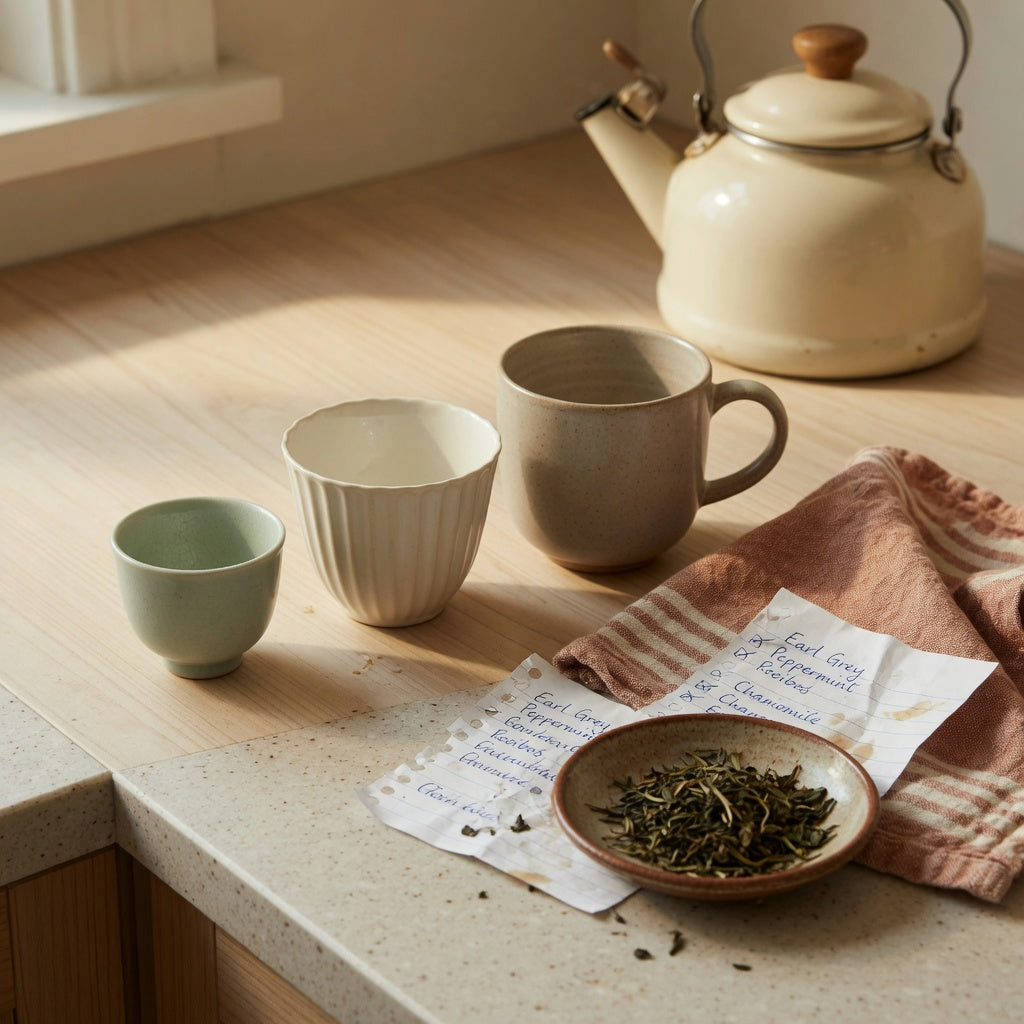
Pottery Tea Cups First Time Buyer Product Shortlist Guide: 170-250 ml
Reading time: about 11 minutes
A cup arrives, you fill it, and by the second week it has drifted to the back of the cabinet. That is the usual fate of a first pottery tea cup, and it rarely has anything to do with the glaze. It is the size, the handle, or the care routine not matching how the buyer actually drinks tea. Our team packs and ships ceramic drinkware every week, and the follow-up questions we get are remarkably consistent — which is why this pottery tea cups first time buyer product shortlist guide is built around eliminating options rather than admiring them.
Three cups, three capacities, one decision. Below is a scenario-based shortlist for our 170 ml, 200 ml, and 250 ml cups, the listing details worth verifying before you pay, and the details we will openly tell you we cannot confirm from a product photo.
What a first pottery tea cup has to survive in its first two weeks
The romance phase ends fast. Here is what actually decides whether a cup stays in rotation:
- Kettle trips. A small cup means more refills. If you work at a desk and your tea goes cold while you type, a 170 ml pour can mean four trips before lunch.
- The dishwasher question. Most first-time buyers assume the dishwasher is fine until they read the care note — or discover there isn't one.
- Heat at the rim. A thin wall with a narrow rim gets hot quickly. A thicker wall stays comfortable longer but carries more weight in the hand.
- Cabinet stacking. Pottery rims chip against the mugs they share a shelf with, and cups with a narrow foot that will not nest are the usual casualties.
None of that shows up in a styled lifestyle photo. All of it is decided by capacity, wall, handle, and care instructions — the four variables this shortlist is organized around.
Pottery tea cups first time buyer product shortlist guide: four listing details to verify first
Product pages are generous with adjectives and stingy with specifications. On any pottery tea cup, ours included, verify these four before the cup earns a place on your shortlist.
- Glaze on the surfaces that touch tea and lips. Look at the interior wall, the bottom of the cup, and the rim edge. Bare clay on a drinking surface is a question for the seller, not a charming rustic detail.
- Lead and cadmium language — and whether a finished-piece test sits behind it. Per the FDA, lead in glaze or decoration can leach if a piece is not made and fired properly, and firing at the right temperature for the right time binds essentially all of it into the glaze. The FDA guideline is 0.5 micrograms of lead per mL of leaching solution for cups and mugs, and 0.5 micrograms per mL for cadmium in small hollowware under 1.1 liter. A "lead free" badge with no test behind it is a claim, not a result.
- Any "not for food use" wording. Decorative ceramic that looks like tableware is treated as tableware unless it carries the required permanent warning or has a hole bored through the food-contact surface. See that language and you are buying a shelf piece, not a drinking cup.
- Fine crazing versus a real crack. Intentional crackle reads as a pattern of tight, even lines across the glaze. A chip, a hairline running through the body, or exposed clay at the rim is damage. Ask which one you are looking at, and do not talk yourself into a beautiful broken cup.
One more signal carries weight: an identifiable maker. The FDA lists handmade pottery with a crude or irregular shape, antiques, worn pieces, flea-market finds, and unidentifiable makers among the higher-concern categories for lead. And no amount of washing, boiling, or scrubbing removes lead from a piece that contains it. That is not a reason to fear handmade cups — it is a reason to buy from someone who answers questions.
Is 170 ml, 200 ml, or 250 ml right for how you actually drink tea?
Capacity sorts a shortlist faster than any other number, because it is a number instead of an impression. The FDA describes a typical cup or mug as small ceramic hollowware for hot drinks, normally about 240 ml (8 fl oz) and made with a handle. Use that as a reference point, not a rule — pottery tea cups often run smaller, and small is sometimes the entire reason people buy them.
- 170 ml — the tasting pour. Fit for a tea tray, a small pot on the counter, light oolongs and greens you re-steep, or a coffee you drink standing up. Wrong for anyone who fills a mug and walks it to a desk.
- 200 ml — the hedge. Enough volume to feel like a proper cup of tea, small enough that you finish it while it is still hot. This is where most first-time buyers land when they genuinely do not know their pour size.
- 250 ml — the daily driver. Closest to the FDA's 240 ml reference and the most conventional of the three. Black tea, tea with milk, a refill at a keyboard.
Here is the trade-off that never makes the bullet list: a small cup holds heat better but empties sooner, so you boil more water. A larger cup keeps you seated, but the last third usually goes lukewarm. Pick the annoyance you can live with, not the size that photographs best.
Three routines, three cups: which to choose and which to skip
We would match rather than rank these. Each one has a routine where it makes sense and a routine where a different size serves you better.
| Cup | Listed capacity | Choose it if | Skip it if |
|---|---|---|---|
| Retro Coffee & Tea Cup | 170 ml | You pour small, re-steep often, or are building a tea tray | You want one cup for a long desk session |
| Pleated Coffee & Tea Cup | 200 ml | You want a daily tea cup smaller than a mug, with visible texture | A handle is non-negotiable and you have not confirmed one |
| Ball Handle Coffee & Tea Mug | 250 ml | You want a handled cup close to standard mug size | You are shopping for a small tasting cup |
Retro Coffee & Tea Cup, 170 ml — for the tray, not the commute
Your situation: short pours, a small pot on the counter, a cup you refill rather than carry. Why it fits: at 170 ml the pour stays small and the tea stays hot to the last sip, which is exactly what a tray setup wants. Why to skip it: if a full mug at a desk is your normal, 170 ml will read as a sample cup and you will be walking back to the kettle all morning. Next step: open the 170 ml Retro Coffee & Tea Cup listing and look for an interior shot, a rim close-up, and a straight-on view of the form. If you already know you want more volume, our green tea mug shortlist covers larger formats.
Pleated Coffee & Tea Cup, 200 ml — the least risky first buy
Your situation: you want one cup that handles everyday tea without committing to mug volume, and the pleated form is what caught your eye. Why it fits: 200 ml sits between a tasting cup and a mug, the safest landing spot when you have not yet measured your own pour. Why to skip it: if a handle is a dealbreaker, do not assume the pleats include one — check the listing before you commit. Next step: view the Pleated Coffee & Tea Cup for a side-on photo, interior glaze detail, and any handle in the form, then compare it against the 250 ml option below.
Ball Handle Coffee & Tea Mug, 250 ml — for the desk and the second cup
Your situation: black tea, tea with milk, a cup that moves from kitchen to desk without a saucer. Why it fits: 250 ml is the closest of our three to the standard cup size the FDA describes, and the ball handle is part of the visible form — the most conventional first pottery cup of the set. Why to skip it: on a tea tray it is oversized, and a loop handle can look roomier in a photo than it feels with your fingers through it, so confirm the opening first. Next step: look at the Ball Handle Coffee & Tea Mug. If your usual drink is a large black tea, the black tea mug shortlist compares bigger formats instead.
Still torn between forms? Browse the full unique coffee mugs collection and notice which capacity you click on twice. That is usually your real answer.
When a listing goes quiet on glaze, firing, or appliance care
This is the step most first-time buyers skip, and it is what separates a confident purchase from a hopeful one. Our listings confirm listed capacity, a ceramic body, and the visible form of these three cups. They do not establish glaze chemistry, lead-free status, firing temperature, finished-piece leach testing, dishwasher or microwave compatibility, handle opening, or wall thickness. So ask the seller, in writing:
- Which surfaces touch tea and lips, and are they fully glazed?
- Was a finished piece from the same clay and firing tested, or is the claim based on raw materials?
- What temperature or cone is the cup fired to?
- Is it dishwasher safe, microwave safe, or hand-wash only?
- Is there metallic or overglaze decoration anywhere, especially near the lip?
- What are the handle opening, rim thickness, and exact capacity?
No answers means unknown, not a bargain. A cup with no maker, no care note, and no food-contact statement has not earned your money yet.
Pottery tea cup care when the maker's note is thin
Care guidance should follow the maker, not the category. A glaze, an overglaze, and a clay body all change the answer, and dishwasher or microwave safety is product-specific rather than a pottery-wide rule.
- Hand wash with mild detergent and a soft sponge until the listing or maker says otherwise.
- Avoid thermal shock: no boiling water into a cold cup, and no hot cup straight onto a cold stone counter. Pre-warm with a splash of hot water first.
- Keep abrasive scouring pads off glaze and decoration; they dull the surface long before the cup actually fails.
- Retire any cup with a crack, a chip, or exposed clay on the drinking surface — from daily use, not just from the display shelf.
- Treat a home lead swab as a screening tool, not a lab test. It does not replace a finished-piece leach test.
- No metal decoration in the microwave, ever.
Should this be a daily drinker or a shelf piece?
Some pottery tea cups are display objects that happen to hold liquid. If a listing carries decorative-only language or heavy metallic decoration, decide now that it lives on a shelf and you will not be disappointed later. For the daily rotation, favor a plain glazed interior, an intact rim, and a care note you can actually follow.
Two claims we will not make on your behalf: that a particular clay changes how tea tastes, and that a cup is authentic to a regional style. We have not found a standards or food-science source that settles the flavor question, and provenance is a separate judgment from safety. Verify food contact, then enjoy the rest as preference.
Frequently asked questions
Is a 170 ml pottery tea cup too small for everyday use?
It depends on your pour. At 170 ml it suits small tea servings, tea-tray sessions, and re-steeping, but it will feel cramped if you carry a full mug to a desk. For a standard morning tea, our 250 ml Ball Handle mug is the more natural fit.
How do I check a handmade pottery tea cup is food safe before buying?
Start with the food-contact surface: interior glaze, rim, and any bare clay. Then look for an identifiable maker, a care note, and a statement that a finished piece was tested. A pottery tea cups first time buyer product shortlist guide is only as good as the listing behind it, so if those details are missing, ask before you pay.
Can I put a pottery tea cup in the dishwasher or microwave?
Only if the maker or listing says so. Dishwasher and microwave safety are product-specific, and metallic or overglaze decoration usually rules out the microwave. When the listing is silent, hand wash and treat microwave use as unconfirmed.
What if a listing says lead free but shows no test?
Treat it as an unverified claim. The FDA states that ceramicware with extractable lead should not be labeled lead free, so the term is regulated — but a badge on a product page is not a finished-piece leach test. Ask which piece was tested and by what method.
Should I buy the 200 ml Pleated cup or the 250 ml Ball Handle mug first?
Choose the 200 ml Pleated cup if you want a daily tea cup smaller than a mug and a handle is not a dealbreaker. Choose the 250 ml Ball Handle mug if you want a handled cup close to standard mug size. If you are still unsure, buy the size you already reach for, then add the other format from our collection of unique coffee mugs later.
More from our blog
Ready to pick your mug? Two ways to save on today's order:
Ordering 1–3 mugs? Get an extra 10% off your 1st order with code 10_OFF Apply 10% Off & Shop Wooden-Handle Mugs →
Gifting 4+ mugs? Buy 3, Get the 4th Free applies automatically at checkout (no code needed; offers do not stack) · Free standard shipping (Nov pre-Christmas delivery: 15–20 calendar days US) · Free replacement if chipped in transit.
Popular mug buying guides: Ceramic Mugs with Lids Compared · Wooden-Handle Tea Infuser Mugs Compared · Christmas & Secret Santa Mugs 2026 · Espresso & Cortado Cups Guide · Cup & Saucer Gift Sets · All 25 Mugs Spec Table · Mug Size Guide · Shipping & Promo FAQ
FIRST ORDER 10% OFF (CODE: 10_OFF) · OR BUY 3, GET THE 4TH FREE


Read more
15 oz Ceramic Coffee Mugs First Time Buyer Product Shortlist Guide
A first-mug shortlist that starts with usable fill, not the biggest number on the page. We compare three verified CoffeifyMug capacities, flag the listing details still worth confirming, and match ...
Read more
Latte Mugs Tall Gift Choice: Practical Purchase Checklist
A gift checklist for tall latte mugs that starts with the recipient's machine clearance and daily routine, then narrows to 400, 440, or 480 ml — plus the care questions to confirm before checkout.
Read more
Leave a comment
This site is protected by hCaptcha and the hCaptcha Privacy Policy and Terms of Service apply.