



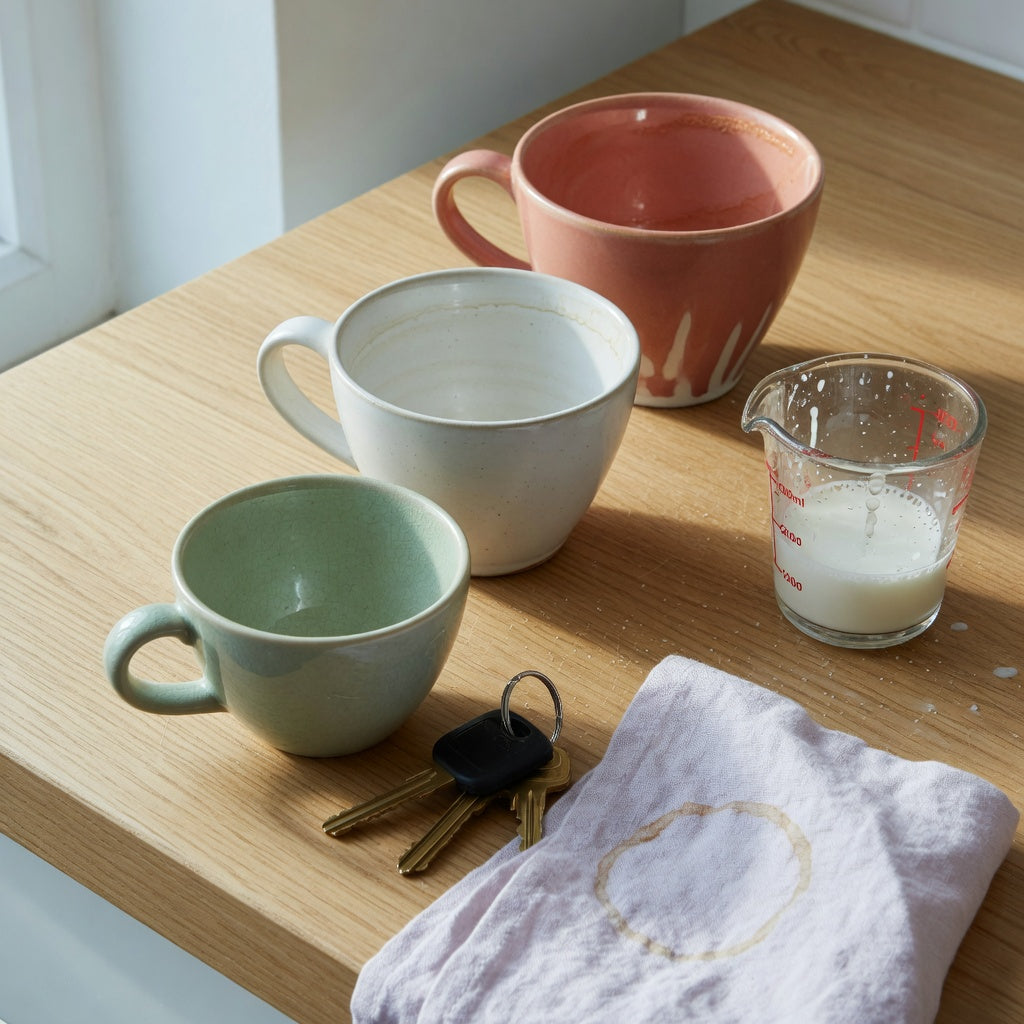
Ceramic Latte Cups First Time Buyer Product Shortlist Guide
Reading time: about 10 minutes
Why two cups labeled 10 oz pour like different drinks
Two boxes land on the same afternoon. Both cartons say 10 oz. One cup takes your full latte with a thumb's width to spare; the other is at the lip the moment the milk goes in. Nobody lied — the two sellers measured different things, and neither listing says which. That mismatch is the most common reason a first ceramic latte cup disappoints, and it is where this ceramic latte cups first time buyer product shortlist guide starts.
Three numbers hide behind one ounce figure:
- Brim-full capacity — the volume to the absolute lip. Nobody carries a cup filled that way.
- Working fill — what you can actually walk across a kitchen with.
- Foam headspace — the room microfoam needs. Not drink, but it still occupies the cup.
The FDA's own working description of a cup or mug is small ceramic hollowware that normally, though not exclusively, holds about 240 mL (8 fl oz) and is made with a handle. That is a convention, not a spec anyone enforces. So a café's 12 oz latte and a listing's 12 oz cup are not the same promise.
The practical move, and the one we suggest to customers before they browse anything, is to measure your pour once. Pull your normal shot, steam your normal milk, tip both into a measuring jug, and write the number down. That figure — not the label — is what your shortlist should be built around, and it usually turns out smaller than people guessed.
Ceramic latte cups first time buyer product shortlist guide: eight listing details to verify
Walk the product page for these in order. Where the page is silent, treat the detail as unknown rather than as the friendlier answer, and ask the seller before you order.
- What the number measures. Brim-full, a marked fill line, or capacity that includes foam? If the listing does not say, it is unanswered.
- Interior profile. A rounded, bowl-like bottom gives steamed milk somewhere to settle and makes a pour pattern easier to draw. Straight-walled interiors drink perfectly well but are less forgiving for art.
- Rim diameter and thickness. A thin, wide rim pours cleanly. A thick rolled rim feels good on the lip but can drag the milk on the way out.
- Handle opening. How many fingers clear it when the cup is full and heavy? A handle that fits an empty cup can pinch at full weight — that is the most common reason a cup comes back to us.
- Base diameter and weight. This is your desk footprint, your shelf clearance and your drying-rack real estate in actual numbers.
- Glaze statement. A food-contact statement is the floor. A published lead and cadmium test result is better, and uncommon.
- Care marks. Microwave and dishwasher suitability belong to the specific piece, not the category.
- What is in the box. Cup only, or cup and saucer? Never infer a saucer from a styled photo.
250 ml, 400 ml and 440 ml: footprint and handle geometry
We stock three ceramic latte cups, and the only figures we will state outright are the listed capacities: 250 ml, 400 ml and 440 ml. Everything else — exact base width, wall thickness, handle opening — is on the live product page, and it is worth reading before you commit.
| Cup | Listed capacity | Drinks it suits | Verify on the listing |
|---|---|---|---|
| Ball Handle | 250 ml | Small latte, flat white, cortado-plus, tea | Handle opening and full-cup weight — the smallest vessel here still gets heavy when it is brimming |
| The Flow | 400 ml | A 10–12 oz latte, latte-art practice | Base diameter and interior curve, since this is the capacity most first-time buyers actually land on |
| Morning and Night | 440 ml | Large latte, long morning cup, two-person households | Shelf height and base width — big cups fail on storage more often than on drinking |
Handle geometry is the detail buyers underweight. We keep a 400 ml cup filled with water behind the counter so people can lift it at full weight, and the reaction is almost always the same: the handle matters more than the pattern. Grip the handle of your current mug at home, note where the knuckle sits, and compare that against the opening described on the page.
On mass: a heavier, thicker-walled cup feels steadier and takes longer to warm through, while a thin-walled cup preheats in seconds under the hot tap. We will not tell you one material holds a latte hot dramatically longer than another, because the independent testing on that is thin and contradictory. Judge the weight in your hand, not the adjective on the box.
Three buyer scenarios — and where we would steer you
All three cups sit in our unique coffee mugs collection, so you can see the glazes side by side. Style is taste. Fit is not.
You drink one small milk drink at a desk with no spare counter
Take the Ball Handle at 250 ml. It is the smallest listed capacity of the three, so it takes the least room beside a laptop, a notebook and a charging cable, and a small cup gets finished while the drink is still at its best.
Skip it if your milk pour is 8 oz or more, or if you like a thick foam cap. At 250 ml listed, headspace eats into a drink that was already on the small side.
You are learning latte art and your drinks land around 10–12 oz
Take The Flow at 400 ml. That capacity leaves usable room for both the milk and the surface you are trying to draw on, and the middle-of-the-set footprint sits at a normal place setting without crowding the plate.
Skip it if you routinely build 16 oz drinks, or if you want something that travels. This is a table cup, not a commuting cup.
You want one large cup that gets refilled, or you are buying for a household of two
Take Morning and Night at 440 ml. The largest listed capacity here suits a long morning drink, a big milky latte, or a shared kitchen where the same cup gets topped up. It doubles as a generous tea cup.
Skip it if you have small hands, a shallow shelf or a cramped sink. A full 440 ml cup is heavy in the hand, and a wide base claims more drying-rack space than most people budget for.
Glaze, lead, and what a "lead free" claim does not prove
This is the part of a listing that matters most and gets checked least. The FDA's action level for leachable lead in ceramic cups and mugs is 0.5 micrograms per milliliter of leaching solution, applied to any one of six units tested. For cadmium, the level is 0.5 micrograms per milliliter for small hollowware and 0.25 micrograms per milliliter for large hollowware.
Two things are worth knowing before you trust a badge on a product photo:
- Glaze that is not fired properly may not fuse fully, so lead can stay extractable. The FDA has reported pottery labeled "lead free" that still released extractable lead at or above its action levels, and it treats that labeling as potentially misleading.
- Washing, boiling or any other kitchen step cannot remove lead from a ceramic piece. Once it leaches, it leaches.
The FDA flags handmade, antique, damaged, flea-market and brightly orange-, red- or yellow-decorated pieces as higher concern, while describing everyday commercial factory pottery as much less likely to have a problem. A routine factory-made cup is not a high-risk purchase — but most product pages still do not publish batch lead and cadmium results, which means that detail is genuinely unknown to you. If it matters, ask before you buy, and treat a friendly reply as more useful than a decorative seal.
Microwave, dishwasher, and the cracked-glaze rule
In our experience the microwave question and the metallic-trim question are the same question. The FDA notes that microwaves are reflected by metal and pass through ceramic and glass, which is exactly why a gold rim, metallic band or luster decoration rules a cup out of the microwave regardless of what the body is made of.
What we tell people at the counter:
- Plain glazed ceramic with no metallic decoration is the safest case for a short reheat.
- If the listing prints no microwave claim, do not assume one. Reheat the milk in a jug instead.
- Treat a dishwasher claim as belonging to that specific piece. Heavy stoneware can crowd a rack and knock against neighbouring glassware mid-cycle.
- Retire chipped or crazed cups. Damaged ceramic is one of the higher-concern categories the FDA names, and a web of fine cracks in the glaze is not something to keep drinking from.
One habit worth building: rinse the cup with hot tap water before you pour. Ten seconds, and the first third of your latte stops dumping its heat into cold ceramic. Use hot tap water rather than a kettle straight off the boil, since a sudden temperature jump is unkind to glaze over time.
When a ceramic latte cup is the wrong purchase
Plenty of people buy one and then discover they wanted something else. Be honest with yourself here.
- You commute with your coffee. A handled ceramic cup is a table cup. It does not seal, and it does not belong in a bag.
- You mostly drink iced lattes. Thick, wide ceramic sweats and holds cold poorly; a tall glass does that job better.
- You want double-wall insulation. Double-wall ceramic exists, but buyer reports across the category repeatedly mention leaking between the walls and a changed hand feel. We do not sell our cups on that promise, and we would not shortlist one without a clear warranty.
- You want four identical cups this week. Check current availability in the collection before you fall for a specific glaze — matching multiples are the first thing to move.
- You drink 12 oz drip coffee rather than milk drinks. Different job, different vessel; a straight-sided mug is the closer match.
Frequently asked questions
Is 250 ml too small for a latte?
250 ml is roughly 8.5 fl oz to the brim, so once foam headspace is taken out you are drinking closer to a small latte or a flat white than a café 12 oz drink. If your measured milk pour is 8 oz or more, start at 400 ml instead.
How do I check whether a ceramic latte cup is food-safe before ordering?
Look for a plain food-contact statement first, then ask the seller whether they hold batch lead and cadmium results. The FDA action level for leachable lead in cups and mugs is 0.5 micrograms per milliliter, and a "lead free" badge alone is not proof — the agency has found labeled pottery that still leached above its limits.
Which of the three cups should a first-time buyer order first?
The short version of this ceramic latte cups first time buyer product shortlist guide: start at 400 ml if you drink 10–12 oz milk drinks, drop to 250 ml if you drink small ones, and only go to 440 ml if you genuinely finish a large cup. Buying for the drink you make most often beats buying for the occasional one.
Can I put a ceramic latte cup in the microwave and the dishwasher?
Only if that specific piece says so on its listing. Metallic trim or a gold rim rules out the microwave entirely, since microwaves reflect off metal. If no care claim is printed, hand-wash it and reheat your milk separately.
Why did my new cup chip in the first month?
Usually stacking, not the glaze. Ceramic cups knocked against each other in a drying rack or cupboard chip at the rim and handle, and a sudden temperature change can craze the surface. Store them unstacked or with a cloth between, and stop using any cup with a visible crack.
Before you check out, run your own three-point test: your measured pour against the listed capacity, your knuckle against the described handle opening, and the base width against the shelf or desk where the cup will actually live. If one of those fails, the glaze will not save it. Browse the full ceramic mug collection with those three numbers in hand, and read each listing as if the missing detail were the deciding one — because it usually is.
More from our blog
Ready to pick your mug? Two ways to save on today's order:
Ordering 1–3 mugs? Get an extra 10% off your 1st order with code 10_OFF Apply 10% Off & Shop Wooden-Handle Mugs →
Gifting 4+ mugs? Buy 3, Get the 4th Free applies automatically at checkout (no code needed; offers do not stack) · Free standard shipping (Nov pre-Christmas delivery: 15–20 calendar days US) · Free replacement if chipped in transit.
Popular mug buying guides: Wooden-Handle Tea Infuser Mugs Compared · Christmas & Secret Santa Mugs 2026 · Espresso & Cortado Cups Guide · Cup & Saucer Gift Sets · All 25 Mugs Spec Table · Mug Size Guide · Shipping & Promo FAQ
FIRST ORDER 10% OFF (CODE: 10_OFF) · OR BUY 3, GET THE 4TH FREE


Read more
Ceramic Latte Cups Replacement Purchase Practical Purchase Checklist
A replacement cup should fix the flaw that retired the last one, not repeat it in a new colour. This is the ceramic latte cups replacement purchase practical purchase checklist our team uses before...
Read more
Cute Espresso Cups Home Coffee Station Product Shortlist Guide
A scenario-based shortlist for cute espresso cups on a home coffee station: what 170, 200, and 250 ml ceramic cups are actually good for, and what to measure before you buy.
Read more
Leave a comment
This site is protected by hCaptcha and the hCaptcha Privacy Policy and Terms of Service apply.