



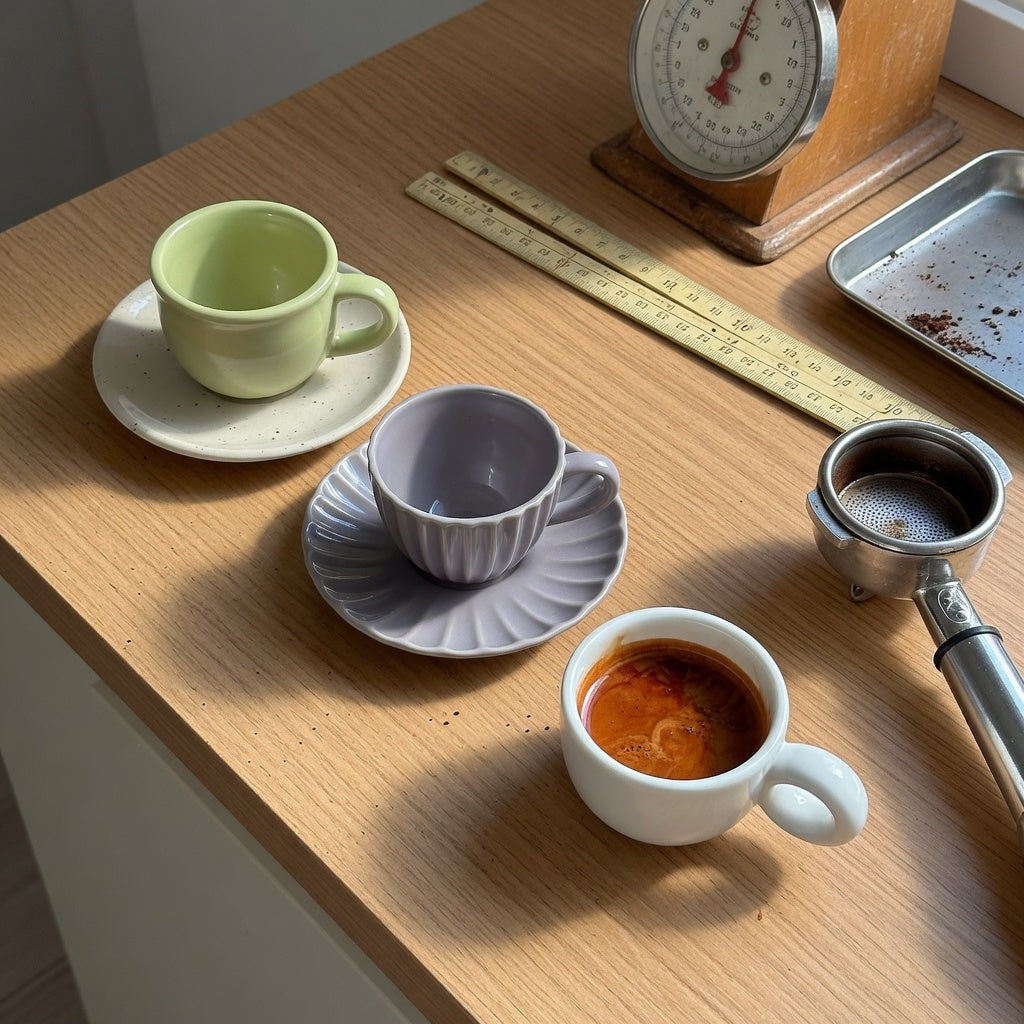
Cute Espresso Cups First Time Buyer Product Shortlist Guide for Real Use
Reading time: about 10 minutes
A customer once sent us a photo of a shot that had climbed to the rim of a 60 ml demitasse. The espresso was fine; the cup was too small. That is the first lesson in our cute espresso cups first time buyer product shortlist guide: the listing photo sells a mood, but capacity, rim width and spout clearance decide whether you reach for the cup tomorrow morning. We stock three compact ceramic cups at 170 ml, 200 ml and 250 ml, and none is a traditional 50 ml tazzina. That is deliberate. Here is how we help a first-time buyer sort them.
What capacity actually fits the shot your machine pours?
Espresso volumes get quoted loosely, so treat any single number with suspicion. A classic Italian single is often described as about 25 ml. Specialty recipes commonly land around 25–35 ml. The traditional demitasse most people picture holds around 50 ml. Competition and training material sometimes references cups up to roughly 90 ml, which is close to the ceiling for anything you would still call an espresso cup.
Notice what that means for a home setup. Most of us pull doubles, and a double is not twice a 50 ml cup — it is thirty-some milliliters of liquid plus crema, in a cup that needs headroom so the crema can form instead of hitting the rim. Our three cups are compact ceramic vessels, but each is larger than a traditional single-shot cup. We limit claims about them to the listed capacity, the ceramic body and the visible form.
A quick test we suggest to every first-time buyer: pull your normal shot into the cup you already own, then look at how much empty wall is left. If the coffee sits within a centimeter of the rim, the cup is too small for the way you drink. If two-thirds of the cup is empty, it is too big, and the shot will cool fast in all that air.
- About 50 ml: the classic single-shot demitasse. Lovely to look at, genuinely tight for most home doubles.
- 90–180 ml: the practical home band for a double with headroom, plus space for a splash of milk.
- 200–250 ml: milk-drink and tea territory — macchiato, small cappuccino, flat white, or a cup of tea at the desk.
Which listing details should a first-time buyer verify before adding to cart?
Here is the honest split. We can tell you the listed capacity and ceramic body of our three cups because those are the facts we hold. Everything else — machine clearance, saucer inclusion, dishwasher guidance, glaze composition, food-contact wording — has to come from the live product page or from us directly. We would rather flag that than guess on your behalf.
| Cup | Catalog facts we can stand behind | Verify on the current listing |
|---|---|---|
| Retro Coffee & Tea Cup | 170 ml listed capacity; ceramic body | Height under your machine spout, inner rim width across both streams, saucer inclusion, dishwasher guidance, food-contact wording |
| Pleated Coffee & Tea Cup | 200 ml listed capacity; ceramic body | The same checks, plus wall thickness and approximate weight if you prefer a heavier feel |
| Ball Handle Coffee & Tea Mug | 250 ml listed capacity; ceramic body | Handle opening for finger room, overall height including the handle, weight when full, care instructions |
Two of those checks catch more returns than any other. The first is spout-to-tray clearance: measure the gap between your portafilter spout and the drip tray with a ruler, then compare it to the cup height on the listing. We keep a ruler at the counter for exactly this conversation. Nobody publishes a standard for it, so it stays a per-machine measurement. The second is rim width: a dual-spout or bottomless portafilter throws two streams, and they need to land inside the opening rather than on the rim of a narrow cup. If you weigh shots, add your scale's height to the total before deciding.
One more check applies to any decorated ceramic cup, ours included. The FDA says lead in ceramic glaze is bound when pottery is fired correctly, but if it is not properly fired the lead may not fuse and can contaminate food; the FDA also warns that some traditional pottery labeled lead free has still shown extractable lead, and that ceramicware meant only as decoration must be identified so it is not used with food. A cup you drink from should be identified for food use. If a listing is vague about that, ask before you buy.
Which of the three cups fits your actual morning?
Capacity only means something next to a use case. These are the three situations we see most often at the counter.
You pull doubles and want a demitasse look: Retro Coffee & Tea Cup, 170 ml
Our smallest cup, and the closest thing we stock to a classic espresso silhouette. At a listed 170 ml it is still generous next to a 50 ml demitasse, which is exactly why it works for home doubles: the shot lands with crema room instead of climbing the wall. Choose it if you drink straight espresso or a small macchiato and want the cup to feel like an espresso cup rather than a mug. Skip it if you want the tiny-cup look of a traditional Italian bar, or if you regularly drink 200 ml-plus milk drinks — you will be refilling constantly. Check the Retro cup's current listing details.
You drink cortados and small cappuccinos: Pleated Coffee & Tea Cup, 200 ml
The middle option, and the most versatile of the three if your morning splits between espresso and milk. A cortado is usually somewhere around 120 ml in total, so a 200 ml cup leaves room to work without overflowing, and a small cappuccino fits too. The trade-off is real: for a straight single shot, 200 ml of ceramic is a lot of empty air, and the coffee cools faster than it would in the Retro. Choose it if milk drinks are the majority of what you make, or if you want one cup that can take a splash without a second pour. Skip it if you only ever pull straight espresso. See the Pleated cup here.
You want one cup for coffee and tea: Ball Handle Coffee & Tea Mug, 250 ml
At a listed 250 ml this is a small everyday mug wearing cute clothes, not a demitasse. That is not a criticism — it is the reason it belongs on a first-time shortlist for anyone who drinks tea half the day or carries coffee to an office desk. A single shot will look lost in it, and the crema will spread thin across a wide surface. Choose it if you want one cup by the kettle that handles a lungo, a milky coffee, or a teabag. Skip it if espresso is the point. View the Ball Handle mug's capacity and care notes.
If none of those three fit and you want to see the wider shape range first, the unique coffee mugs collection shows the full set of forms side by side.
Does a cute cup hide the crema?
Sometimes, yes. Crema is the visual check most of us use without thinking — color, thickness, how it holds together — and it reads best against a plain white interior. A dark glaze, a busy floral pattern, or a colored inside swallows that contrast. If watching the shot land matters to you, check the interior color in the product photos rather than the exterior, which is usually what the hero image shows.
Wall thickness matters too. Thick ceramic holds heat longer than thin, which is why a heavier cup feels better with a short shot, but it also takes longer to warm up — preheat with hot water from the kettle for thirty seconds and the difference is noticeable. The other route to heat retention is double-wall glass, which we do not stock; it works, but it is a different material with its own fragility, and we would rather not compare a product we do not sell against one we do.
What about handles, saucers and a small kitchen?
Small cups have small handles, and small handles are the most common complaint we hear after a purchase. Finger room is not something a listing always states, so look at the handle-to-body gap in the photos and compare it with the width of your own finger. A handle that only fits a fingertip is fine for a ristretto you drink standing up and annoying for a cappuccino you carry to a desk.
Saucers earn their place: they catch the drip from the spout and give you somewhere to park a spoon. They also double the shelf space each cup takes. If your cupboard is tight, stacking matters more than matching — check whether one cup nests inside the rim of another before you buy four, and if you are honestly short on space, buy two good cups instead of a set of six you have to Tetris into a cabinet.
Cute espresso cups first time buyer product shortlist guide: what to do in two minutes
If you want the decision compressed into a sequence, this is the order we run through with customers:
- Measure your usual pour. Weigh or eyeball the volume your machine puts in the cup now, double shot included.
- Measure spout-to-tray clearance. Cup height plus a little wiggle room has to fit under the spout; if you use a scale under the cup, add its height.
- Check the rim width across two streams if you use a dual-spout or bottomless portafilter.
- Pick your band: 170 ml for espresso-led mornings, 200 ml for cortado and small cappuccino, 250 ml for coffee and tea in one cup.
- Read the interior color, not just the exterior, if you enjoy seeing crema.
- Confirm food-contact status and care instructions on the listing, and ask if either is missing.
For a deeper comparison of ceramic options beyond these three, our ceramic espresso cup shortlist guide covers the same capacity logic from a different angle, and the affogato cup size breakdown is useful if dessert coffees are part of the plan. If you are still deciding between a small cup and a full mug, the cute ceramic coffee mug guide covers the larger end of the shelf.
Frequently asked questions
Is a 170 ml cup too big for a single espresso?
It is bigger than a classic 50 ml demitasse, so a single shot will sit in a wide pool with a lot of empty wall above it. That is fine if you mostly pull doubles or add a splash of milk, and less good if you want the concentrated, hot, tiny-cup experience. If single shots are your whole routine, look for something closer to 60–90 ml instead.
Will these cups fit under my espresso machine?
We cannot answer that for your machine, and we will not pretend to — clearance is not standardized. Measure the gap between your spout and the drip tray, then compare it with the cup height on the listing. If you use a scale under the cup, add the scale's height to the total before deciding.
Should I buy a set or just one cup?
Buy two of the same cup first. Two lets you pull back-to-back shots and compare, and it tells you whether the handle and weight suit you before you commit to four or six. A set makes sense for gifting, or for a household where two people drink espresso at the same time.
What is the most common first-buyer mistake?
Buying on looks before capacity. The whole purpose of a cute espresso cups first time buyer product shortlist guide is to rank cups by the shot you actually pull rather than by the photograph, because a cup that overflows or swallows your espresso stops being cute by the second morning.
Can I use a cute espresso cup for tea or a long black?
You can, within reason. The 250 ml Ball Handle mug handles tea comfortably; the 170 ml and 200 ml cups are better kept for short drinks and milk coffees, where a smaller volume keeps the drink hot. If tea is half of what you drink, buy the larger cup and accept that straight espresso will look small in it — our full ceramic mug lineup is the place to compare the other shapes.
Ready to pick your mug? Two ways to save on today's order:
Ordering 1–3 mugs? Get an extra 10% off your 1st order with code 10_OFF Apply 10% Off & Shop Wooden-Handle Mugs →
Gifting 4+ mugs? Buy 3, Get the 4th Free applies automatically at checkout (no code needed; offers do not stack) · Free standard shipping (Nov pre-Christmas delivery: 15–20 calendar days US) · Free replacement if chipped in transit.
Popular mug buying guides: Wooden-Handle Tea Infuser Mugs Compared · Christmas & Secret Santa Mugs 2026 · Espresso & Cortado Cups Guide · Cup & Saucer Gift Sets · All 25 Mugs Spec Table · Mug Size Guide · Shipping & Promo FAQ
FIRST ORDER 10% OFF (CODE: 10_OFF) · OR BUY 3, GET THE 4TH FREE


Read more

Cute Espresso Cups Gift Choice Product Shortlist Guide: 3 Sizes
A scenario-based shortlist built on 170, 200, and 250 ml ceramic cups — with explicit reasons to choose or skip each one, plus the measurements to take before you pay.
Read more
Ceramic Latte Cups Gift Choice Practical Purchase Checklist
A capacity-first gift checklist for ceramic latte cups: how 250, 400 and 440 ml change the drink, the handle fit and the desk footprint, plus the glaze, lead and care questions to settle before you...
Read more
Leave a comment
This site is protected by hCaptcha and the hCaptcha Privacy Policy and Terms of Service apply.