
Ceramic Tea Mug First Time Buyer Product Shortlist Guide: 3 Picks
Reading time: about 8 minutes
A mug can look right on a phone screen and still be wrong at the first kitchen-counter pour. A buyer expects a modest everyday cup, then notices the page listed 400 ml; another likes a rounded silhouette but has no published measurements proving it will clear a crowded cabinet shelf. This ceramic tea mug first time buyer product shortlist guide starts with the four facts that can be compared without guessing: ceramic material, listed capacity, visible form, and handle shape.
Because we sell and handle this category, our team has learned to separate a visible feature from an ergonomic promise. We can describe an elongated body or an open loop handle from a listing. We cannot promise exact shelf fit, weight, rim feel, or comfort in every hand unless those details are stated.
Which four listing facts earn a place on the shortlist?
During our listing checks, we use the same sequence every time. It keeps a first purchase grounded in verifiable details rather than assumptions created by styling photos.
- Ceramic material: Each of the three current product pages identifies the mug as ceramic. Do not silently translate that into a more specific ceramic category or attach performance claims that the listing does not make.
- Listed capacity: The three options cover 300 ml, 350 ml, and 400 ml. Those 50 ml and 100 ml differences are more useful than vague labels such as small, medium, or large. Measure your ordinary pour once and compare it with the stated number.
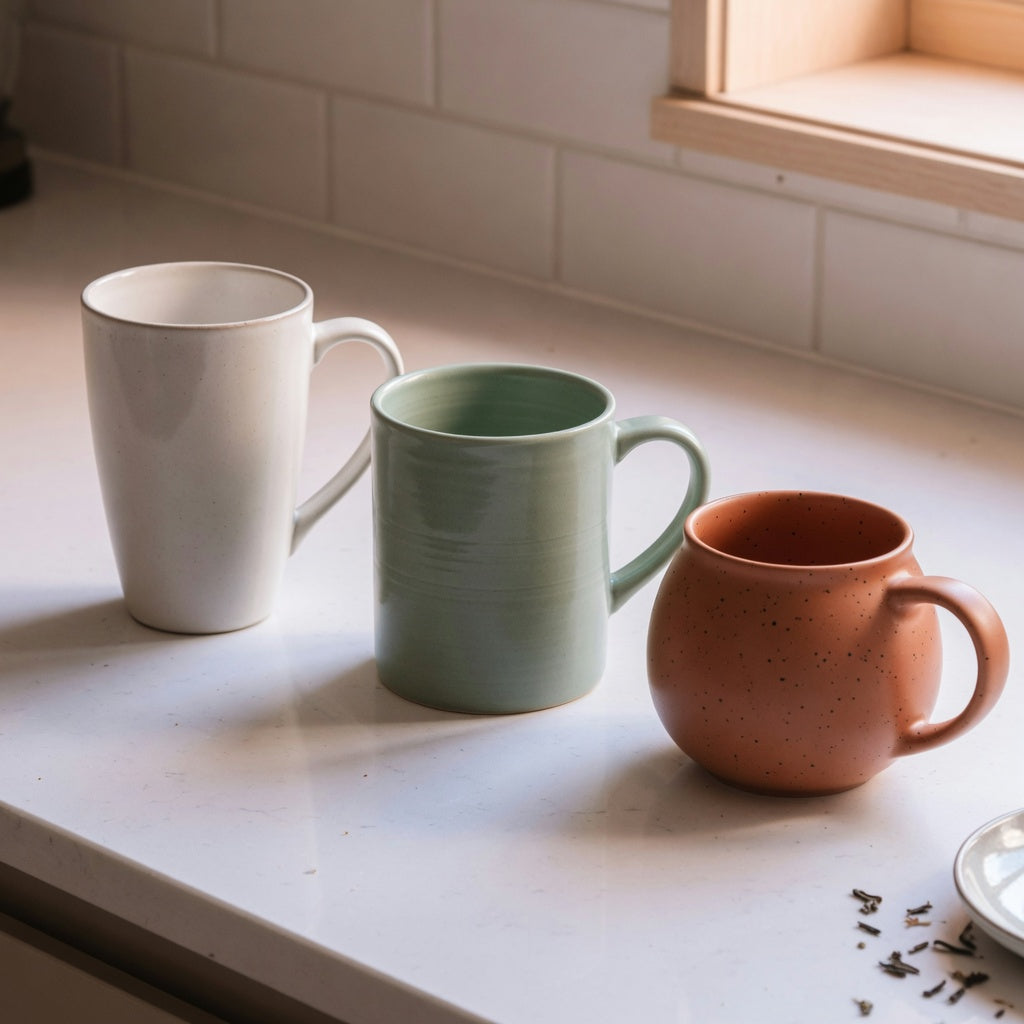
- Visible body form: The current choices are rounded, elongated, and upright cylindrical. Use the side-view images to decide which silhouette you prefer, but do not treat a visually compact form as proof of exact height, width, or cabinet clearance.
- Handle shape: The listings show an open loop, a contoured handle, and a classic loop form. Shape is a valid comparison point. Universal comfort, finger clearance, and grip fit are not, unless handle-opening measurements are provided.
Several details remain unknown from the source facts used for this comparison: exact mug weight, wall thickness, rim thickness, overall dimensions, base diameter, and handle-opening measurements. We would not label one option lightweight, space-saving, or better for small hands without evidence for those claims.
Ceramic tea mug first time buyer product shortlist guide: 300, 350, or 400 ml?
Start with capacity, then use form and handle shape as the tie-breakers. This produces a short, practical comparison without pretending that one mug is universally better than the others.
| Current option | Listing-backed details | Best starting situation | Reason to skip |
|---|---|---|---|
| The Flow Coffee Tea Mug | Ceramic, 350 ml, elongated flowing form, contoured handle | Your usual serving is close to 350 ml and you prefer a shaped profile | You need 300 or 400 ml, or require verified overall dimensions |
| Morning Night Coffee Tea Mug | Ceramic, 400 ml, upright cylindrical form, classic loop handle | You want the largest listed capacity among these three | Your normal serving is smaller or you prefer a rounded profile |
| Round Coffee Tea Mug | Ceramic, 300 ml, rounded bowl-like form, open loop handle | Your usual serving is close to 300 ml and you favor a rounded silhouette | You regularly use 350 or 400 ml, or need proof of compact dimensions |
This is a fit comparison, not a quality ranking. The right row is the one that matches your ordinary serving and preferred visible form with the fewest unresolved questions.
Which mug fits a measured 350 ml kitchen-counter pour?
If a measuring cup shows that your normal tea serving is close to 350 ml, The Flow Coffee Tea Mug is the direct capacity match. Its listing identifies ceramic material, while the product views show an elongated, flowing body and a contoured handle.
- Choose it if: You want the midpoint capacity in this group and specifically prefer an elongated form over a rounded or straight-sided mug. The contoured handle also gives you a visibly shaped alternative to the two loop-style handles.
- Skip it if: Your regular serving is closer to 300 or 400 ml, or you need published height, width, weight, or handle-opening measurements before ordering. The photos establish the form, not exact hand fit or shelf fit.
For an ordinary morning setup, this is the most logical option for a buyer who already knows that 350 ml suits the routine. It should not be selected merely because the sculpted profile looks distinctive.
Is 400 ml the better match for an office desk?
The Morning Night Coffee Tea Mug has the largest listed capacity in this three-product shortlist at 400 ml. The listing identifies ceramic material, and its visible form is upright and cylindrical with a classic loop handle.
- Choose it if: Your measured serving is around 400 ml and you prefer a straight, upright silhouette. It provides 50 ml more listed capacity than The Flow and 100 ml more than the Round mug.
- Skip it if: You normally stop at 300 or 350 ml, or the taller-looking cylindrical form is not what you want beside a monitor or notebook. A side-view image does not confirm the precise desk footprint.
Desk suitability here comes from matching the listed capacity and preferred form to your routine. We are not using the photograph to make unsupported claims about stability, balance, or how the handle will feel during a long work session.
Does a 300 ml rounded mug suit a smaller serving or gift?
The Round Coffee Tea Mug is the smallest listed option at 300 ml. Its ceramic body, rounded bowl-like form, and open loop handle make it the clearest match for someone who already uses a shorter serving and prefers a softer silhouette.
- Choose it if: You know the buyer usually pours close to 300 ml and likes rounded mug forms. For a gift, those two known preferences give you a concrete reason to select it.
- Skip it if: The recipient regularly uses 350 or 400 ml, or you are assuming that lower capacity automatically means a better fit for smaller hands. The handle-opening dimensions and overall measurements are not established by the comparison facts.
This distinction matters during gift buying. A rounded mug may look visually compact in an unboxing, but appearance alone cannot confirm finger clearance, cabinet fit, or the recipient's preferred grip.
Which buyers should leave this three-mug shortlist?
These products are being compared as ceramic coffee-and-tea mugs for ordinary serving. They are not the right category for a buyer who needs a sealed commute vessel, insulated drinkware, or integrated brewing hardware.
- Skip all three if your normal serving is greater than 400 ml.
- Pause if exact overall dimensions, mug weight, rim thickness, or handle clearance will decide the purchase and those specifications are not available.
- Choose another product category if portability or an integrated brewing component is the primary requirement.
- Avoid buying solely by color or styling if you have not checked the listed capacity and visible handle shape.
Calling out these limits is part of a useful recommendation. A ceramic mug can match an ordinary kitchen or office routine without being the right vessel for travel, brewing, or a buyer who needs precise ergonomic measurements.
How can you make one decision in two minutes?
- Measure one ordinary serving. Use the amount you actually pour, not the maximum amount you imagine using occasionally.
- Keep the closest listed capacity. That leaves the 300 ml Round, 350 ml Flow, or 400 ml Morning Night mug as the initial match.
- Choose the visible form. Decide among rounded, elongated, and upright cylindrical without inferring unpublished dimensions.
- Compare the handle shapes. Select open loop, contoured, or classic loop according to visual preference while treating exact grip comfort as unknown.
- Write down any decisive unknown. If you need weight, wall thickness, overall dimensions, or handle clearance to approve the purchase, do not fill that gap with an assumption.
The useful work in a ceramic tea mug first time buyer product shortlist guide is elimination. Capacity removes options that do not match your serving, form separates the remaining silhouettes, and handle shape gives you one final visible comparison.
If none of the three combinations fits, browse our unique coffee mugs collection and apply the same four checks to the other current listings. Keep only options with a confirmed material, suitable listed capacity, preferred visible form, and handle shape you are willing to try.
Frequently asked questions
How do I use a ceramic tea mug first time buyer product shortlist guide?
Measure your ordinary serving first, then compare that number with the listed capacities. Use visible form and handle shape to separate options with a suitable capacity, while leaving unpublished dimensions and ergonomic details marked as unknown.
Is a 300 ml, 350 ml, or 400 ml ceramic tea mug best?
There is no universal best capacity. The 300 ml Round mug suits a serving near 300 ml, The Flow matches a serving near 350 ml, and the 400 ml Morning Night mug is the largest listed option in this shortlist.
Does a rounded ceramic mug automatically fit smaller hands better?
No. A rounded body and lower listed capacity do not establish the dimensions of the handle opening or the amount of finger clearance. Use the visible open loop as a style comparison, not as a guarantee of hand fit.
Can the Flow, Morning Night, and Round mugs be used for tea as well as coffee?
Yes. The current listings present all three as coffee and tea mugs. This comparison covers their ceramic material, listed capacity, visible form, and handle shape for ordinary serving without adding brewing-accessory claims.
What should I do if none of these three ceramic mugs fits my routine?
Do not force a choice based on appearance alone. Open the full unique coffee mugs collection, measure your usual serving, and repeat the material, capacity, form, and handle checks. Pause on any option where a missing specification is essential to your decision.
More from our blog
Read more
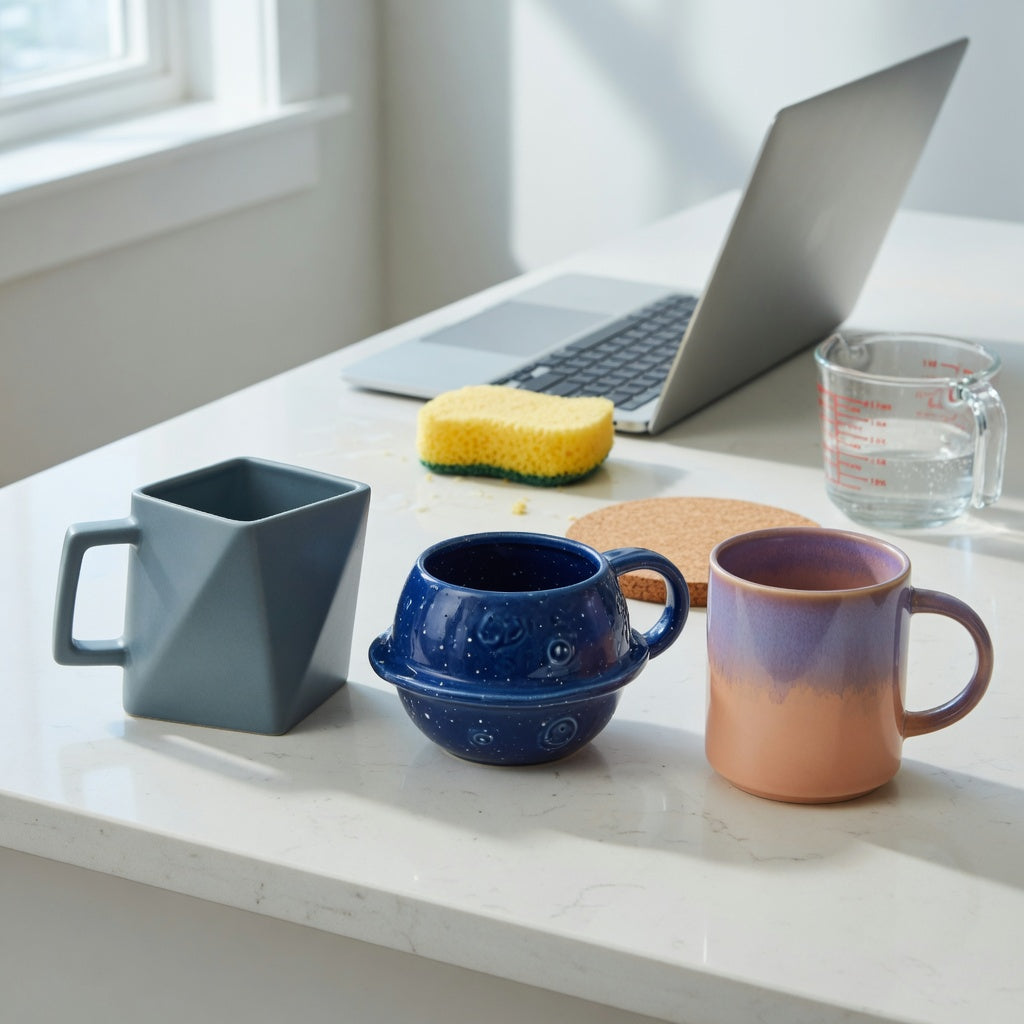
Geometric Coffee Mug First Time Buyer Product Shortlist Guide
Compare the Rhombus, Planet, and Gradient mugs by listed capacity, ceramic material, visible shape, desk fit, and care. We also explain which missing details should pause a first purchase.
Read more
Emerald Green Coffee Mug Weekend Coffee Product Shortlist Guide
Compare the current emerald and round mug options for porch pour-overs, brunch, and couch-side coffee. This shortlist explains the capacity, visible form, handle, and color trade-offs that should d...
Read more
Leave a comment
This site is protected by hCaptcha and the hCaptcha Privacy Policy and Terms of Service apply.