
Piccolo Cup Everyday Mug Rotation Product Shortlist Guide: 3 Sizes
Reading time: about 9 minutes
Three mugs can fit on a kitchen shelf yet only one may earn a place in the daily rotation. One needs too many refills, another holds more coffee than you finish, and a third has a handle that competes with the cabinet door. This piccolo cup everyday mug rotation product shortlist guide starts with those ordinary points of friction, then compares three compact options by listed capacity, refill habits, and storage needs.
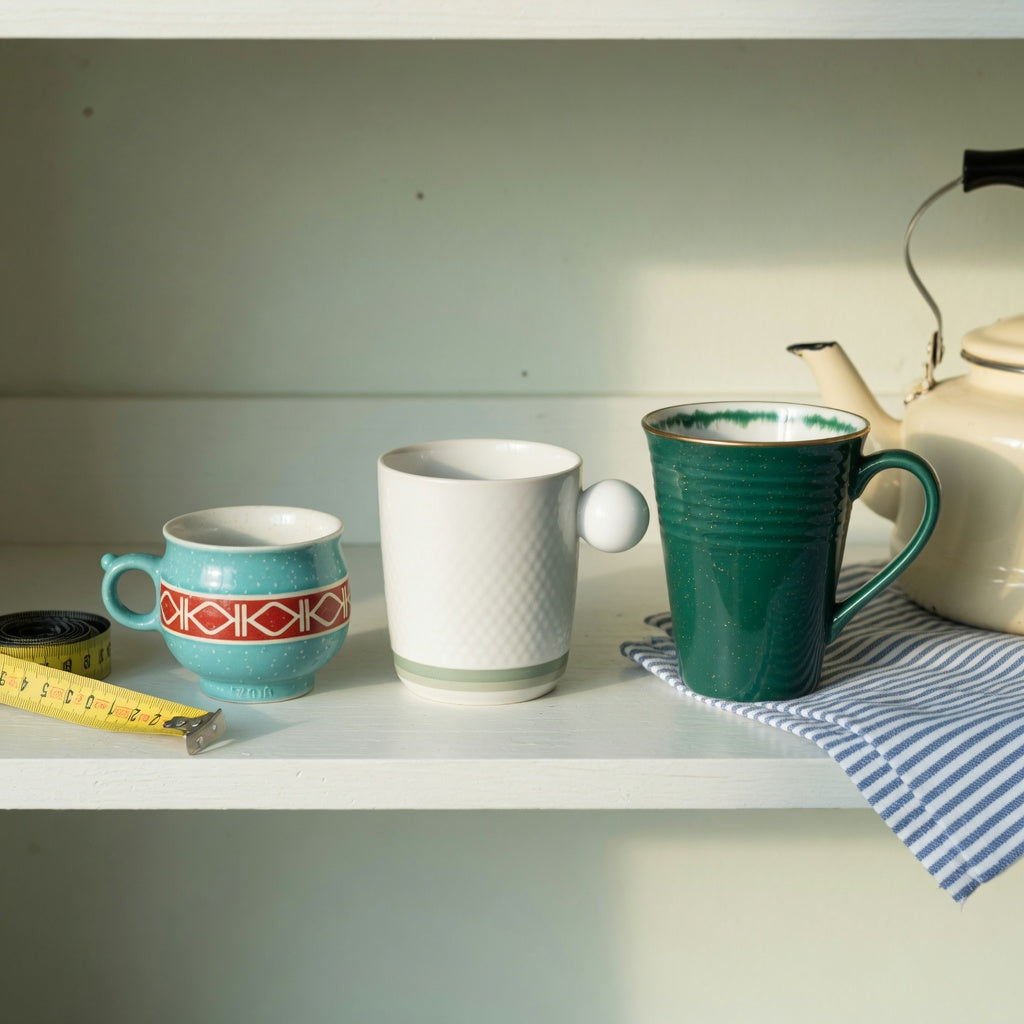
At CoffeifyMug, we keep this comparison tied to facts we can verify. The Retro coffee tea cup has a listed 170 ml capacity, the Ball Handle coffee tea mug holds 250 ml, and the Emerald coffee tea mug holds 270 ml. We do not present any of them as a certified piccolo cup, prescribe a fixed milk-to-coffee ratio, or claim cafe testing. They are compact cup choices for shoppers who find a conventional large mug excessive for some parts of the day.
You can also compare them within our collection of unique coffee mugs. Keep in mind that capacity does not reveal exterior width, height, material, stackability, or appliance compatibility. Those details must be checked separately rather than inferred from the milliliter figure.
Piccolo cup everyday mug rotation product shortlist guide by use case
A practical rotation is built around repeated behavior. Before comparing colors or handle profiles, we ask shoppers to identify the drink that appears most often during a normal week. A cup used twice every morning has different demands from one brought out for an occasional after-dinner coffee.
- Measure the pour you actually finish. Use room-temperature water to reproduce your normal fill line in your current mug, then transfer it to a marked measuring jug. Do not use the brim as the target; a working drink needs enough space to carry without spilling.
- Count expected refills. A 170 ml cup makes more sense if the kettle or coffee machine is nearby and a second short pour is part of the routine. A 270 ml cup reduces refill frequency relative to the other two, but it may still be too small for a long drink.
- Map the storage slot. Measure usable shelf depth, height, and side-to-side clearance with the cabinet door closed. Include the handle in the measurement instead of measuring only the cup body.
- Confirm care requirements. Dishwasher and microwave suitability cannot be determined from capacity or appearance. Check the relevant product information before making either feature a deciding factor.
This process keeps the shortlist commercial without turning it into a ranking. The right option is the one that matches the task it will perform most often.
170 ml, 250 ml, or 270 ml: which capacity earns a daily slot?
The 100 ml difference between the Retro and Emerald is noticeable in a short-drink routine. The difference between the Ball Handle and Emerald is only 20 ml, so handle style and storage clearance may matter more than capacity in that comparison.
| Option | Reader situation | Reason to choose | Reason to skip |
|---|---|---|---|
| Retro, 170 ml | You make a short coffee or tea, finish it promptly, and can refill without disrupting your routine. | It has the lowest listed capacity in this three-product shortlist, making it the clearest choice for deliberately small servings. | Skip it if your usual finished drink approaches 170 ml, includes generous add-ins, or needs to last through a long meeting. |
| Ball Handle, 250 ml | You want a middle capacity and are specifically drawn to a ball-handle profile. | It adds 80 ml over the Retro while remaining 20 ml below the Emerald. That puts it between short servings and the largest option here. | Skip it if side clearance is tight or you know you prefer a conventional handle. Confirm the full exterior width before assigning it a narrow shelf slot. |
| Emerald, 270 ml | You want the largest listed capacity in this compact group and would rather refill less often. | It holds 100 ml more than the Retro and 20 ml more than the Ball Handle, giving it the most room of the three. | Skip it if 270 ml is still below your normal pour or if ice takes up a large part of the cup. A larger mug would be more practical. |
Capacity does not dictate the recipe. A shopper might use any of these for coffee, tea, or another suitable drink without following a prescribed ratio. The useful question is simpler: does your normal serving fit with carrying room left below the rim?
Which option suits short pours, desk refills, and shared kitchens?
For a short first cup followed by another later, start with the Retro. The 170 ml capacity supports a rotation based on smaller, freshly poured servings. It is not a good fit for someone who dislikes returning to the kettle or brewer.
For a home-office drink that should cover one work block, compare the Ball Handle and Emerald. The 250 ml Ball Handle suits a measured serving that fits comfortably within that capacity, while the 270 ml Emerald provides 20 ml more room. Neither should be chosen on capacity alone if the desk is crowded; check exterior dimensions and consider where the handle will sit beside a keyboard, notebook, or monitor stand.
For a shared kitchen with different drink habits, do not force one capacity to serve everyone. A 170 ml Retro can cover the short-pour slot while a 270 ml Emerald covers the person who pours more. A mixed rotation often makes more sense than buying several identical cups that only suit one household member.
For ice-heavy drinks or long breakfast servings, skip all three if necessary. Ice reduces the space available for liquid, and 270 ml is the largest verified capacity in this shortlist. Our unique mug collection is the better next step if your measured serving does not fit these compact choices.
For gifting, choose only when you know something about the recipient's routine. The Ball Handle has the most visibly distinctive handle concept of the three, but that does not guarantee it will suit every grip or cabinet. The Emerald gives more capacity, while the Retro commits more clearly to short drinks. If you only know the recipient likes coffee, capacity and storage remain unresolved.
Shelf depth, door clearance, and handle space
In our experience handling cup comparisons, capacity is often mistaken for footprint. A lower milliliter figure does not prove that a cup is shorter, narrower, or easier to stack. Body shape, rim width, base shape, and handle projection can change how much cabinet space a cup actually uses.
- Measure from the back of the shelf to the nearest obstruction, including a closed door or raised cabinet lip.
- Measure vertical clearance under the shelf above. Use the lowest point if supports or hinges intrude into the space.
- Measure the full width of a cup that already fits, including its handle. This gives you a practical comparison reference for the Ball Handle design.
- Check the space beneath your coffee machine or brewing setup if the cup must sit directly under a spout. Compare against listed exterior dimensions rather than capacity.
Do not assume any of these products is stackable unless the product information says so. Stacking a cup that was not designed to nest can put pressure on the rim or create an unstable cabinet arrangement. For a high-frequency rotation, easy one-handed access is usually more useful than squeezing one extra item into a precarious stack.
What should you verify before dishwasher use or gift unboxing?
Material and appliance compatibility are not part of the verified capacity facts used in this comparison. A glossy surface, thick-looking wall, or mug-shaped profile is not proof of dishwasher or microwave suitability. Review the care information on the selected product page, and do not make repeated dishwasher cycles part of the plan unless that use is explicitly supported.
When our team examines a cup after unboxing, we focus on a few specific areas rather than judging it from a distance:
- Inspect the rim under direct light for chips or rough points.
- Place the cup on a flat, dry counter and check whether the base sits steadily.
- Look at the handle connection for visible cracks or separation without pulling or stress-testing it.
- Check the exterior and interior finish for scratches or transit damage.
- Confirm that the received style and listed capacity match the order before first use.
For a gift, perform this check while keeping the packaging and product documentation together. Follow the store's applicable process before washing or using an item that appears damaged. If dishwasher use is confirmed, load the cup according to its care directions and avoid contact with heavier items that could strike the rim or handle during a cycle.
A five-minute shortlist check before ordering
- Measure your usual finished serving instead of estimating from the size of your current mug.
- Decide whether repeat refills are welcome, acceptable, or irritating.
- Remove any option that cannot hold the measured serving with practical carrying room.
- Check cabinet, machine, and desk clearance using exterior dimensions, especially around the handle.
- Confirm material and care information required for your household before selecting the product.
The purpose of this piccolo cup everyday mug rotation product shortlist guide is to remove choices that conflict with daily behavior. If you consistently finish a short serving, 170 ml deserves attention. If you need a middle volume, compare 250 ml. If fewer refills matter most, test 270 ml against your measured pour.
Frequently asked questions
What should a piccolo cup everyday mug rotation product shortlist guide compare?
It should compare listed capacity, normal serving volume, refill frequency, handle clearance, storage dimensions, and confirmed care requirements. This shortlist covers the Retro at 170 ml, Ball Handle at 250 ml, and Emerald at 270 ml without treating any of them as a formally certified piccolo cup.
Is a 170 ml cup enough for everyday coffee?
It can be if you normally finish a short serving and do not mind refilling later. Measure your usual pour first. If it sits close to the cup's listed capacity or includes substantial milk, water, or other additions, the 250 ml or 270 ml option will provide more room.
Is 250 ml or 270 ml better for an office desk?
Choose by measured serving and refill access, not by a 20 ml difference alone. The 250 ml Ball Handle may suit someone who prefers that handle style, while the 270 ml Emerald offers slightly more volume. Check exterior dimensions before assuming either will occupy less desk space.
Can the Retro, Ball Handle, and Emerald go in a dishwasher?
Do not infer dishwasher compatibility from the product names, appearance, or capacities. Confirm the care directions on the relevant product page before washing. This article does not claim a dishwasher-cycle rating or appliance certification for any of the three.
Which of these cups is best for iced coffee?
None may be suitable if you use a large amount of ice, because ice occupies part of the listed capacity. The Emerald offers the most room at 270 ml, but a larger mug is the more practical choice if your measured iced drink exceeds that compact format.
Before ordering, write down three numbers: your normal pour, your available shelf width, and your clearance height. Match those figures against the product information, then choose the linked option whose capacity fits without relying on assumptions. If all three fail the test, move to the broader CoffeifyMug collection and select a larger format.
More from our blog
Read more
Peppermint Tea Mug Everyday Mug Rotation Product Shortlist Guide by Size
Compare The Flow 400 ml, Morning and Night 440 ml, and The Rock 480 ml by refill patterns, liquid load, handle checks, and storage limits. Each option has a clear reason to choose it and a reason t...
Read more
White Pottery Coffee Mugs Everyday Mug Rotation Product Shortlist Guide
Use cabinet measurements, cleaning habits, and design preferences to compare three white pottery mugs. Each pick includes a clear reason to choose it, skip it, or continue to the broader collection.
Read more
Leave a comment
This site is protected by hCaptcha and the hCaptcha Privacy Policy and Terms of Service apply.