
Peppermint Tea Mug Shared Household Practical Purchase Checklist
Reading time: about 9 minutes
At a shared kitchen counter, the mug that feels generous to one person can feel needlessly heavy to the other. One household member pours a modest serving and drinks it nearby; another carries a fuller mug to an office desk. This peppermint tea mug shared household practical purchase checklist keeps that disagreement focused on two useful variables: how much each person actually pours and how the handle feels under that liquid load.
At CoffeifyMug, we separate published product facts from comfort judgments that depend on the shopper. The verified catalog points used here are specific: The Flow holds 400 ml, Morning and Night holds 440 ml, and The Rock holds 480 ml. Their catalog descriptions support tea use. Capacity can be compared directly, but it does not prove that a particular handle will suit small hands, large hands, a two-finger grip, or a full-hand grip. Each person still needs to make that assessment independently.
Which listed capacity fits each person's actual pour?
Start with the tea already being served in your home. Do not estimate from the size of a kettle, teapot, or current mug. Pour one normal serving into a marked measuring jug and record the amount. Repeat the check for the second person rather than averaging two different habits into one number.
- Measure the amount each person normally pours on an ordinary day.
- Record how much empty space each person prefers above the liquid.
- Compare the measured serving and desired headspace with the listed capacities.
- Make two individual choices if the serving amounts are meaningfully different.
A listed capacity is a useful comparison point, not a prescribed fill line. Someone who pours close to 400 ml may prefer more than a 400 ml vessel because filling near the top leaves little room for carrying the mug across a kitchen. We do not prescribe a fixed headspace because careful counter drinkers and people walking to another room often prefer different amounts.
| Mug | Verified capacity | Reader situation | Trade-off |
|---|---|---|---|
| The Flow | 400 ml | The measured serving plus preferred headspace fits comfortably below 400 ml. | It is the lowest-capacity option here, so it leaves the least room for a larger-than-usual pour. |
| Morning and Night | 440 ml | A 400 ml mug feels close to the limit, while 480 ml is more volume than the person expects to use. | It adds 40 ml over The Flow but gives up 40 ml compared with The Rock. |
| The Rock | 480 ml | The person regularly serves a larger amount or wants more headspace above a measured pour. | A fuller serving creates more liquid weight for the hand and handle to support. |
Consider a household where one person measures a 320 ml serving and another measures 440 ml before allowing for headspace. Buying the same capacity for both may solve only one person's problem. Shared storage does not require identical mug choices.
What do 40 ml and 80 ml mean in the hand?
The three capacities increase in even steps. Morning and Night holds 40 ml more than The Flow, The Rock holds 40 ml more than Morning and Night, and The Rock holds 80 ml more than The Flow. Those differences look small on a product page, but they matter once liquid weight is added.
For a water-based drink, an additional 40 ml represents roughly 40 grams of liquid, while 80 ml represents roughly 80 grams. This is an estimate of the liquid only, not a product weight specification. The empty weight, handle geometry, and balance of each mug are not established by capacity, so we do not use volume alone to promise comfort.
- For a smaller counter-side serving: the lowest capacity may avoid carrying liquid that the person did not plan to drink.
- For a larger desk-side serving: the 480 ml option can accommodate more liquid, provided the user is comfortable holding that fuller load.
- For a grip-sensitive user: judge the handle with the usual serving weight in mind, not from an empty-mug impression alone.
How can two people assess handle comfort without invented specs?
Capacity does not reveal handle opening size, finger clearance, handle thickness, or the balance point of a filled mug. We will not assign those traits to The Flow, Morning and Night, or The Rock without verified measurements. Instead, our practical approach starts with a mug each person already finds comfortable.
- Fill the familiar mug with the person's measured serving amount.
- Pick it up using the grip that person naturally uses, without repositioning the fingers for the test.
- Count how many fingers sit inside the handle and note whether any knuckle presses against the mug body.
- Hold it for about 30 seconds over the counter, then carry it to the table or desk where it is normally used.
- Notice wrist angle, finger pressure, and whether the grip changes as the mug is moved.
- Compare that familiar handle shape with the current product-page images, and contact our team if exact handle measurements are essential to the purchase.
This test does not make an online comfort decision certain, but it gives both people concrete language for comparing handles. One person might want room for three fingers, while another may prefer a compact two-finger grip. Saying that before buying is more useful than agreeing that a handle merely looks large or small in a photograph.
Peppermint tea mug shared household practical purchase checklist
We use this peppermint tea mug shared household practical purchase checklist to keep capacity facts separate from individual comfort preferences. Run through it once for each tea drinker rather than completing one form for the whole home.
- Measure the usual serving: use a marked jug and record each person's amount separately.
- Allow personal headspace: decide how much open room feels comfortable for carrying the mug without assigning the same rule to both people.
- Remove undersized options: exclude any listed capacity that cannot hold the measured serving and the person's preferred headspace.
- Account for liquid load: remember that the difference between 400 ml and 480 ml can mean roughly 80 grams more liquid when both are filled to their listed capacities.
- Recreate the normal grip: use an existing mug to record finger count, knuckle clearance, wrist angle, and comfort after a short hold.
- Choose independently: do not force both people into the same capacity for the sake of a matching shelf.
- Confirm current details: review the product page before ordering and do not assume unlisted material, care, insulation, travel, or brewing features.
After both people have completed the list, compare the remaining shapes in our unique coffee mugs collection. Treat the collection as a group of individual choices, not a requirement to create a matching set.
Which household situation points to each mug?
A measured smaller pour: The Flow 400 ml
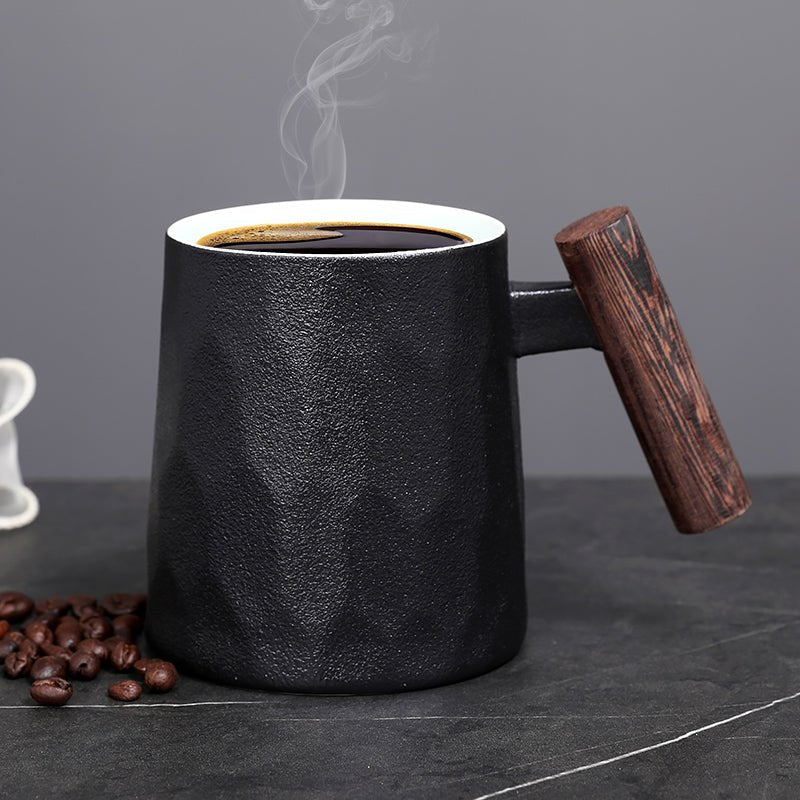
If one person's normal serving and preferred headspace fit within 400 ml, The Flow coffee tea mug is the lowest-capacity option in this comparison. It suits the shopper who has measured a smaller pour and does not want to choose extra volume without a reason. The trade-off is less room for an occasional larger serving, and its handle still needs a personal comfort check.
A middle-capacity decision: Morning and Night 440 ml
If 400 ml feels too close to the measured requirement but 480 ml is unnecessary, the Morning and Night coffee tea mug provides the 440 ml middle step. Its position is concrete: 40 ml above The Flow and 40 ml below The Rock. That makes it a logical capacity choice, but not automatically the best handle for every user.
A larger regular serving: The Rock 480 ml
If the measured serving and desired headspace need the largest listed option, The Rock coffee tea mug offers 480 ml. It fits the person whose real pour justifies the added volume. That person should also test a similarly loaded mug at home, because a full 480 ml serving contains roughly 80 grams more liquid than a full 400 ml serving.
Two drinkers with opposite preferences
A household can reasonably choose The Flow for one person and The Rock for another, or select Morning and Night for only the drinker who needs the middle capacity. These are product options to evaluate separately. Matching is a style preference, not a capacity or handle-comfort requirement.
Where does this three-mug comparison stop being useful?
This shortlist is not enough for a shopper whose deciding requirement is a travel lid, insulation, a particular material, a specific care method, built-in brewing hardware, or exact handle dimensions. Capacity and catalog-supported tea use are the verified product facts behind this comparison. We do not make wellness, heat-retention, brewing-performance, or unlisted care claims.
If any unverified feature is essential, select a different mug style whose current listing explicitly confirms it or ask our team before purchasing. A larger tea mug is also a poor choice for someone who dislikes the weight of a fuller serving, even if the extra capacity looks appealing online.
Frequently asked questions
How do I use the peppermint tea mug shared household practical purchase checklist?
Measure each person's usual serving, add the amount of headspace that person prefers, and compare the result with 400 ml, 440 ml, and 480 ml. Then assess handle comfort using a familiar mug filled with the same serving amount. Complete the process separately for each household member.
Is a 480 ml mug better than a 400 ml mug for peppermint tea?
No capacity is universally better. The 480 ml option makes sense for a larger measured serving or more desired headspace, while 400 ml may better match a smaller serving. The larger option can also place up to roughly 80 grams more liquid in the hand when both mugs are filled to their listed capacities.
Does a larger capacity guarantee a more comfortable handle?
No. Capacity does not establish handle opening, finger clearance, thickness, or filled balance. Compare the current product images with a mug whose grip already works for you, and ask for measurements if handle fit is a firm requirement.
Do The Flow, Morning and Night, and The Rock support tea use?
Yes. The catalog descriptions for all three support tea use. We rely on that stated use and their listed capacities, but we do not claim special peppermint-tea brewing performance.
Should two people in one household buy matching mugs?
Not unless matching matters to both shoppers and the same capacity genuinely suits their separate serving habits. One person can choose 400 ml while another chooses 440 ml or 480 ml. This comparison does not assume that the products are purchased as a set.
Measure both servings, write down each person's natural grip, and open the three product pages side by side. Eliminate capacities that do not provide the required room, then make the final choice only after each person has considered the handle under their usual liquid load.
More from our blog
Read more
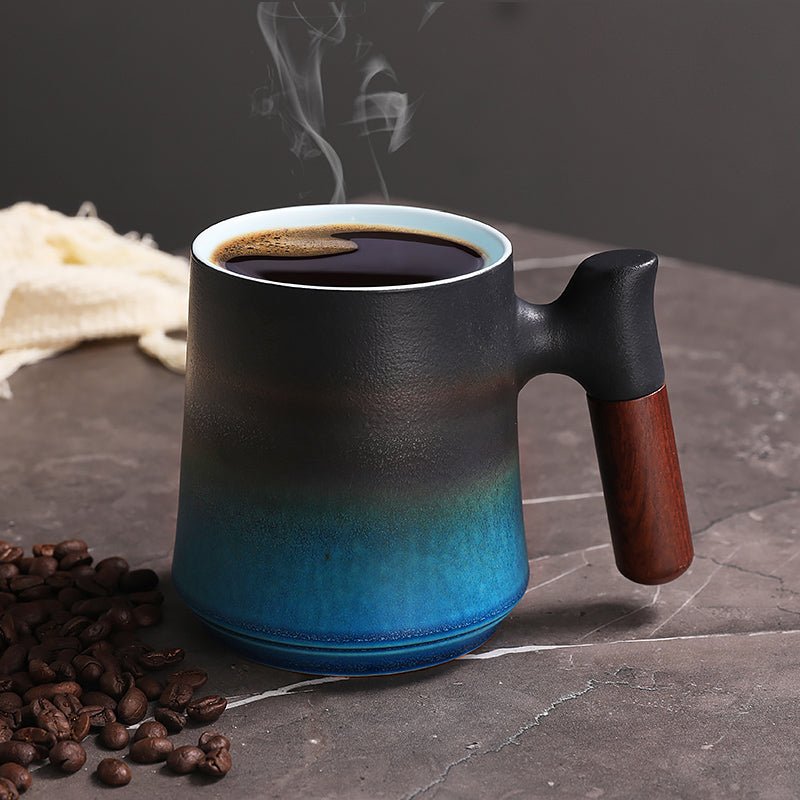
Two Tone Ceramic Coffee Mugs: Shared Household Purchase Checklist
Measure brewer and cupboard clearance, assign a distinct finish to each drinker, and verify care instructions before buying. This checklist compares three CoffeifyMug product paths without treating...
Read more
Breakfast coffee cup shared household practical purchase checklist
Compare verified 170 ml, 200 ml, and 350 ml capacities, then check refill habits, table footprint, cupboard clearance, materials, and care before choosing individual cups for a shared breakfast table.
Read more
Leave a comment
This site is protected by hCaptcha and the hCaptcha Privacy Policy and Terms of Service apply.