
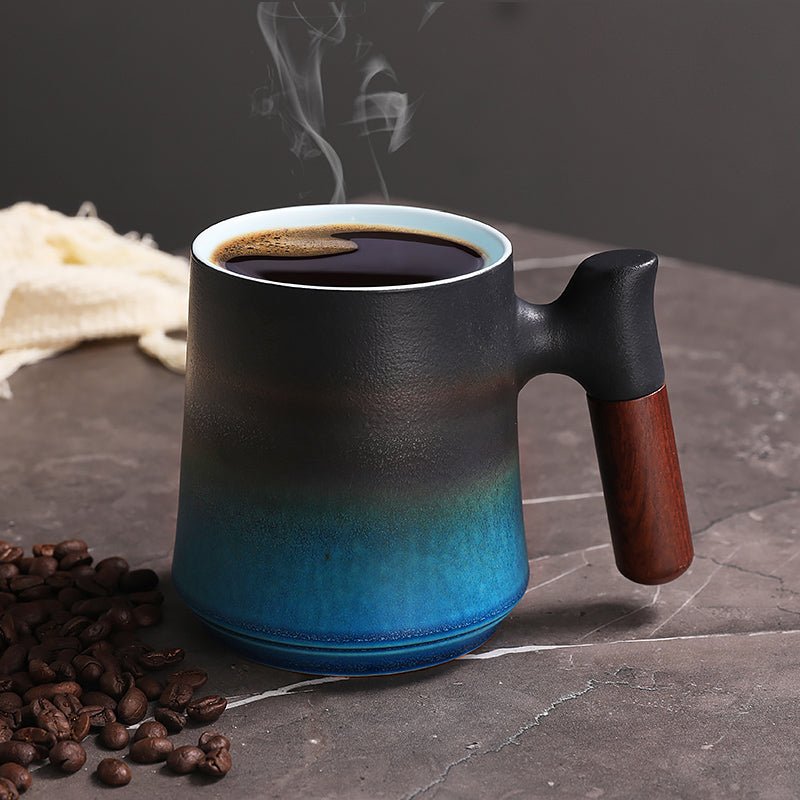
Two Tone Ceramic Coffee Mugs: Shared Household Purchase Checklist
Reading time: about 9 minutes
At 7:20 a.m., one mug is under the brewer, another is beside a laptop, and a third has already been claimed for tea. The problem is usually not that a shared kitchen lacks mugs. It is that the available mugs do not match each person's serving size, grip, storage space, or visual preference. This two tone ceramic coffee mugs shared household practical purchase checklist turns those differences into decisions before another mug reaches the cupboard.
We sell and handle ceramic drinkware, so our checks start at the points that reveal daily-use problems: the rim, both handle joins, the foot ring, and the transition between finishes. We also separate confirmed product details from general ceramic guidance. The linked CoffeifyMug pages let you inspect each design and any listed specifications; where capacity, dimensions, care compatibility, or finish construction are not stated, we recommend verifying rather than guessing.
two tone ceramic coffee mugs shared household practical purchase checklist
Use this as a worksheet for individual drinkers, not as a reason to make everyone use the same mug. One person may prioritize a tall silhouette, another may want a green visual cue, and someone else may need a mug that fits beneath a low brewer spout.
- Record the normal serving. Pour each person's usual coffee or tea into a measuring jug. Include the milk, foam, or ice they normally add rather than measuring black coffee alone.
- Measure brewer clearance. Check the distance from the drip tray to the lowest point of the spout. A mug that fits in the cupboard can still be too tall for the machine.
- Measure the storage space. Record the distance from the shelf surface to the shelf above, plus the usable depth. Check the mug's widest point as well as its height.
- Define the preferred grip. Note how many fingers the drinker puts through the handle and whether their knuckles need extra clearance. Product photos show handle shape, but they cannot confirm personal hand fit.
- Assign a visual cue. Choose a gradient, color, pattern, or noticeably different height that can be recognized on a crowded counter.
- Agree on care limits. Decide whether hand-washing is realistic and whether microwave or dishwasher compatibility is essential. Confirm those points on the relevant product page before ordering.
This process may lead to three different choices. That is useful information, not a failure to coordinate. The linked products are separate buying routes, and this article does not imply that they are packaged or sold together as a matching set.
Which mug shape fits the brewer, desk, and cupboard?
Height and capacity are related, but they are not interchangeable. A tall, narrow mug can hold less than a shorter, wider one. Compare listed capacity with the drinker's measured serving, and compare listed dimensions with the actual brewer and cupboard measurements.
| Reader situation | Why this route may fit | Product next step | Confirm before buying |
|---|---|---|---|
| The drinker wants a taller silhouette and has enough brewer and shelf clearance. | The product title explicitly identifies a tall format, making it the relevant shape to inspect first. | Review the White Golden Waves Tall Coffee Tea Mug. | Exact height, usable capacity, maximum diameter, handle clearance, and care instructions. |
| The drinker recognizes personal items by a gradual color transition. | A gradient provides a different visual route from a plain single-color mug or a repeating motif. | Inspect the Gradient Coffee Tea Mug. | Dimensions, capacity, finish appearance in all product photos, and stated care compatibility. |
| The drinker wants green as the ownership cue and prefers a wave-themed design. | The color and motif named on the page create a clear basis for comparison with the other two options. | Open the Green Waves Coffee Tea Mug. | Whether the wave detail is visual or tactile, plus dimensions, capacity, and care instructions. |
Do not use the word tall as a substitute for a capacity figure, and do not estimate dimensions from a styled photo. A camera angle can make a mug look wider or shorter than it is. If a required measurement is not shown, confirm it before checkout, especially for built-in coffee machines and closely spaced cupboard shelves.
Can color and finish prevent shared-kitchen mix-ups?
Two-tone finishes are most useful when each regular drinker can identify a mug without picking it up. Try a simple test: place the shortlisted product photos side by side and ask each person to select one from the distance between the kitchen door and the counter. If two choices blur together under warm kitchen lighting, height or pattern may be a better ownership cue than color alone.
- For a gradual color cue: The Gradient Coffee Tea Mug is the logical page to inspect because the finish concept is built into its product name.
- For a color-and-motif cue: The Green Waves Coffee Tea Mug gives the shopper two identifiers to compare: green and waves.
- For a height-and-design cue: The White Golden Waves Tall Coffee Tea Mug provides a taller product route with a white and golden waves description.
- For color-blind users or dim kitchens: Do not rely on color alone. Assign ownership by silhouette, cupboard position, or a clearly different pattern.
Keep the claim boundaries clear. A wave design is not automatically textured or easier to grip. A gradient is not guaranteed to conceal scratches, and the word golden does not prove either the presence or absence of metallic material. Product descriptions and care instructions should settle those questions.
If the three linked designs do not create enough distinction, compare other shapes and finishes in our unique coffee mugs collection. Start with each person's functional requirements, then use appearance to narrow the shortlist.
What should you verify about dishwasher, microwave, and daily care?
General ceramic care guidance: Read the product-specific instructions before using any mug in a dishwasher or microwave. Ceramic as a broad material category does not guarantee that every decorative treatment has the same care compatibility. We do not assign dishwasher-safe or microwave-safe claims to the linked products here unless those claims appear on their pages or packaging.
- Dishwasher use: Confirm that it is permitted. If it is, leave enough space that the rim and handle cannot knock against neighboring dishes during the cycle.
- Microwave use: Look for an explicit instruction. Do not make the decision from a metallic-looking color or the word golden alone.
- Temperature changes: Avoid moving a very cold ceramic mug directly to a boiling-hot fill or placing a very hot mug onto a cold, wet surface. Sudden temperature changes can stress ceramic.
- Routine inspection: Check the drinking rim, both handle joins, foot ring, and glazed surface. Chips, cracks, or unexpected fine glaze lines deserve attention before the next use.
- Cleaning method: Use a nonabrasive sponge unless the product instructions approve something stronger. Abrasive pads can mark some glazed finishes even when the ceramic body remains intact.
In our handling workflow, the handle joins and rim receive particular attention because they are contact points during lifting, drinking, washing, and storage. This does not mean the linked products have defects. It is a practical inspection habit for any frequently used ceramic mug, especially one moving through repeated shared-household dishwasher loads.
Which households should choose another material or shape?
Two-tone ceramic addresses visual ownership and style. It does not provide impact resistance, spill prevention, guaranteed cup-holder fit, or extended heat retention. Another category is the more honest recommendation in several situations.
- Frequent commuting: Choose an insulated travel mug with a secure lid if the drink regularly leaves the kitchen or needs to sit in a vehicle cup holder.
- Drop-prone users or hard outdoor surfaces: Stainless steel or another less breakable material is more practical than ceramic.
- Long meetings: An insulated vessel will generally suit someone whose main requirement is keeping a drink hot for an extended period.
- Very small cupboards: Look for a mug specifically described as stackable. Do not assume decorative mugs will nest securely.
- Specific grip requirements: Prioritize confirmed handle dimensions and a shape the user can test. A preferred color cannot compensate for an uncomfortable grip.
Individual decorative mugs are also the wrong route for a household that wants a completely uniform, matched cupboard. Shared households often benefit from controlled variety, but that visual mix is still a matter of preference.
A five-minute cupboard audit before checkout
Keep the two tone ceramic coffee mugs shared household practical purchase checklist open while you compare the product pages. Every regular drinker should be able to answer these five questions with a clear yes or no.
- Does the listed capacity accommodate the person's normal measured serving, including milk, foam, or ice?
- Do the listed height and width fit the brewer, cupboard, and usual desk or side table?
- Can the person identify the chosen finish without relying on a tiny detail?
- Do the stated dishwasher and microwave instructions match the household's real routine?
- Is ceramic appropriate for where this person drinks, or would an insulated or less breakable vessel work better?
If all five answers are clear, open the relevant individual product page and review its current options. If the functional requirements are settled but none of the three finishes fits, return to the unique coffee mugs collection and compare additional silhouettes without assuming that several individual designs form a set.
Frequently asked questions
What belongs on a two tone ceramic coffee mugs shared household practical purchase checklist?
Record each person's normal serving volume, brewer clearance, cupboard clearance, grip preference, visual cue, and care requirements. Match those measurements to information stated on the product page. Do not infer capacity from height or care compatibility from the finish color.
Are the Gradient, Green Waves, and White Golden Waves Tall mugs sold as a set?
This article treats them as individual product choices, not as a bundled set. Review each product page for its current purchase format and options. A shared household can select different mugs without expecting coordinated packaging.
Can I put a two-tone ceramic mug in the dishwasher or microwave?
Only follow dishwasher or microwave instructions explicitly provided for that product. The ceramic body, glaze color, or word golden is not enough to determine compatibility. If the guidance is unclear, confirm it before using the appliance.
Is a tall ceramic mug automatically better for iced coffee?
No. Tall describes shape, not guaranteed capacity or ice clearance. Compare the listed capacity and dimensions with the amount of coffee, ice, and milk the person actually uses, and make sure the filled mug remains comfortable to carry.
Which mug is best for someone who frequently drops cups?
A ceramic mug may not be the best choice for that person, regardless of finish. A less breakable material is more practical around tile floors, patios, or rushed mornings. Reserve ceramic for users and locations where breakage risk is acceptable.
Put each person's current favorite mug beside a measuring tape, record the serving volume and three key clearances, and then open the linked product pages in separate tabs. Choose the Gradient, Green Waves, or White Golden Waves Tall route only after its confirmed details match a real household preference.
More from our blog
Read more
Piccolo Cup Shared Household Practical Purchase Checklist: 170-270 ml
Compare verified 170 ml, 250 ml, and 270 ml cup capacities against each person's real pour, headspace needs, grip preference, storage, and care routine. This checklist also flags the product detail...
Read more
Peppermint Tea Mug Shared Household Practical Purchase Checklist
Compare The Flow 400 ml, Morning and Night 440 ml, and The Rock 480 ml using measured serving volume and a simple grip test. This checklist separates verified capacity facts from personal handle co...
Read more
Leave a comment
This site is protected by hCaptcha and the hCaptcha Privacy Policy and Terms of Service apply.