
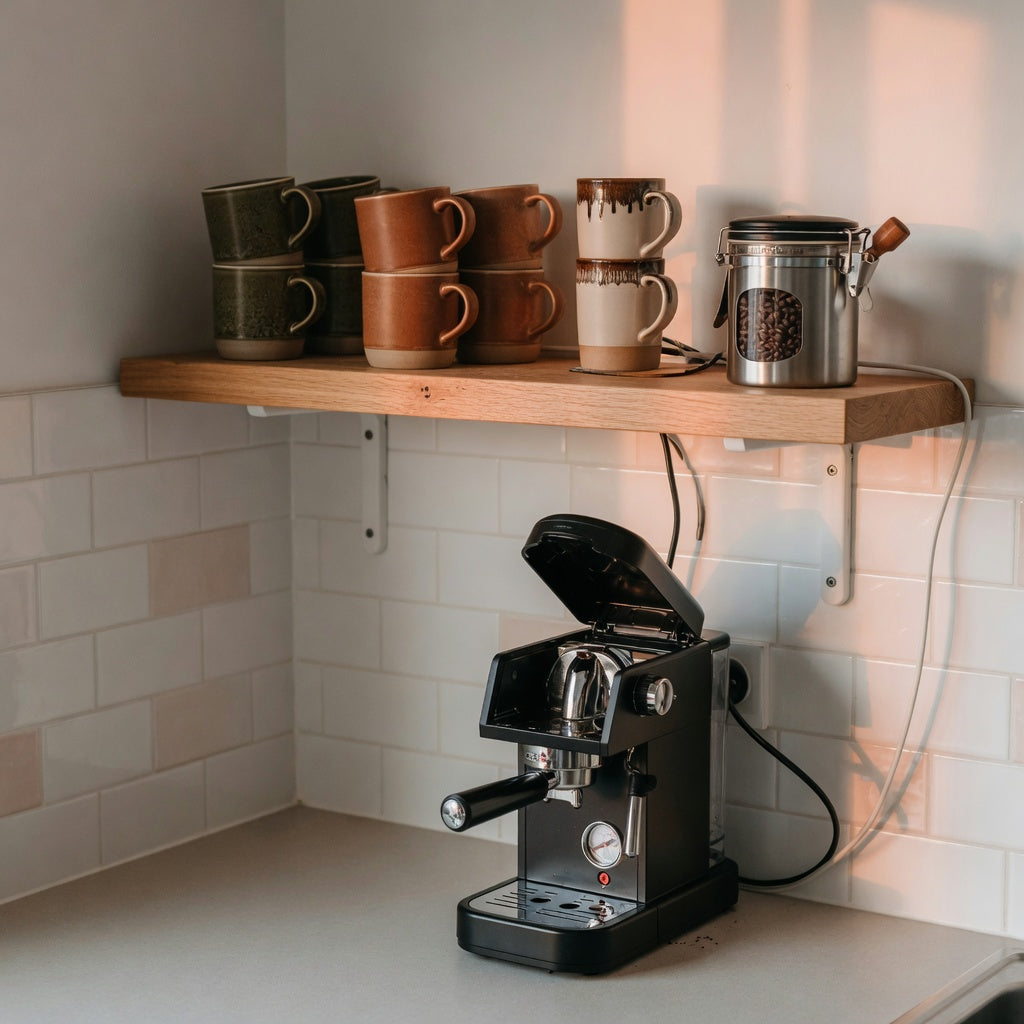
Open Shelf Coffee Corner Ideas With Mugs: What Buyers Should Compare
Reading time: about 9 minutes
A customer sent us a photo last month that we now keep pinned by the packing bench: a brand-new floating shelf, twelve stoneware mugs in a neat row, and a visible bow running through the middle of the board. Nothing broke. But the shelf was never rated for what she stacked on it, and she found out the hard way. That photo is why our team gives every shopper the same starting advice — the best open shelf coffee corner ideas with mugs are settled by load, clearance, and layout first. Styling is the easy part.
We ship mugs every weekday — plain daily drivers and the statement pieces in our unique coffee mugs collection alike — and the same planning questions surface in nearly every order conversation. This guide collects them: the weight math, the three measurements that prevent re-drilling, the display method that matches your mug count, where the machine actually goes, and the rental-safe routes that won't end in a call to your landlord.
How much weight will your coffee shelf actually carry?
Start with arithmetic, not aesthetics. A typical 14–16 oz stoneware mug commonly lands between 1 and 1.5 pounds, and after unboxing hundreds of them we can tell you the chunky diner-style shapes sit at the top of that range. Eight mugs is already 8–12 pounds before a bean canister, a sugar jar, or a pour-over rig joins them. Then add grab loads — a one-handed yank on a wedged mug sends a small shock through the fasteners every single morning.
So check the shelf's stated weight rating, then check your wall. Anchoring into studs beats hollow-wall anchors, and a rating means nothing without fasteners that match the wall type. One honest caveat we give in-store: floating shelves with hidden hardware often carry less than the same-length shelf on visible L-brackets, because the hidden rod bears on a narrow strip of the board. Heavy stoneware collection? Visible brackets are the safer buy.
Shelf height and mug clearance: the three measurements that prevent re-drilling
Three numbers save most people from patching extra holes. Take them before you order anything.
- Counter to first shelf. Our working rule of thumb is 15–18 inches over a coffee station — low enough to reach a mug without a step stool, high enough to clear most machines. Taller households can push higher; that's a preference call, not a standard.
- Machine footprint with the lid open. Espresso machines and some grinders have lids that swing up. Measure with the lid raised, not closed, and leave an inch or two of spare air above it.
- Vertical mug clearance. Most standard mugs run roughly 3.5–4.5 inches tall; leave at least an inch of headroom above your tallest piece for dusting and grabbing. If you're eyeing a taller silhouette — the Landscape Tall Coffee Tea Mug is one our customers ask about for exactly that vertical presence — take its height and capacity from the current listing rather than a guess, then plan spacing around it. The same caution applies inside cabinets: tall mugs don't always fit under a low shelf or soffit, so measure where they'll actually live, not just the wall.
Where should the machine go? Outlets decide before style does
The machine goes where the power is, not the other way around. Before you commit to a wall, check three things: which outlet the corner actually reaches, whether the cord can run without stretching across a sink or a burner, and whether anything else shares that circuit. A shelf plan built around a dead outlet fails on day one. If the nearest outlet sits beside the sink, it's likely GFCI-protected, and new wiring is an electrician's job — not a weekend decor project. Route cords along the backsplash line or inside a stick-on channel so nothing dangles behind your mug row.
Which mug display method fits your collection?
We set up these five methods on our own display wall before recommending any of them. Treat the capacities as planning heuristics from that wall, not manufacturer specs.
| Display method | Rough capacity per shelf foot | Best for | The trade-off |
|---|---|---|---|
| Open row, mugs facing out | ~3 | Showcasing favorite glazes | Any second row goes invisible |
| Two-high stacks | ~5–6 | Daily heavy rotation | Bottom mug hides until you lift the stack |
| Shelf riser | ~5–6 across two levels | Doubling a shallow shelf | Busier look; dust collects underneath |
| Under-shelf hooks | ~3–4, frees the board | Freeing up shelf surface | Constant load on handles; risky for heavy stoneware |
| Picture ledge | Mugs usually won't fit facing out | Pods, scoops, small jars | Often just 3–4 inches deep — too shallow for a handled mug |
Hooks deserve a special warning. Hanging puts a permanent, concentrated load on the handle — fine for a lightweight mug, harder to defend for thick stoneware you lift every morning. If your mugs are heavy, display them flat. And if shelf depth is your open question, we measured how mug depth, spacing, and load interact on pared-down shelving in our minimal coffee shelf mugs comparison.
Which mugs actually earn display space on an open shelf?
Open shelves turn mugs into decor, so pick pieces that hold up from across the room. Two jobs matter most. Silhouette first: a tall profile adds rhythm to a flat row, which is why the tall Landscape mug from the measuring section shows up in so many of our shelf-spacing conversations. Color second: one saturated accent can anchor six neutrals. When a shopper wants that single deep-green moment, we point them to the Emerald Coffee Tea Mug — then tell them to confirm glaze finish and care details on the listing, since finish affects how a piece photographs on the shelf and how it should be washed.
The honest trade-off: a colored accent won't replace a matched set. If your goal is calm uniformity, buy the set first and let one accent do the color work. Capacity is a separate decision entirely — looks and liquid volume don't track — so read what to verify before ordering 16 ounce ceramic coffee mugs if you pour big servings.
Three open shelf coffee corner ideas with mugs, sized to your wall
Wall width decides the layout more than any mood board does. Match your wall to one of these three setups:
Under 3 feet of wall
One floating shelf, two-high stacks at the back, your tallest mug at one end for vertical rhythm, machine below. Skip the riser here — a doubled-up shelf in 3 feet starts to feel cramped fast.
3 to 5 feet
Two shelves, staggered: the lower board holds daily rotation within arm's reach, the upper board holds display-only pieces and canisters. A riser works on the upper shelf, where grabbing speed doesn't matter.
More than 5 feet, or a blank wall with no counter
Pair a picture ledge for pods, scoops, and jars with one real shelf for mugs, mounted over a side table or rolling cart. A mug tree on the cart covers overflow without any extra drilling.
If your corner is more about snugness than storage — a chair, a lamp, one good mug — the priorities shift toward seating and light. We covered that angle in our cozy ceramic coffee corner guide.
Renting? What works when you can't drill
A lease changes the math. These no-drill routes work, with limits we'd rather state up front:
- Leaning ledge on the counter. A picture ledge stood against the backsplash holds a light row of mugs and looks intentional. Trade-off: it eats counter depth.
- Peg rail. Fine for a few lightweight mugs, and patching small nail holes is usually lease-friendly — confirm with your landlord first.
- Adhesive hooks and rails. A handful of light mugs, no more. Full stoneware sets overwhelm adhesive ratings, and a falling ceramic mug is a safety problem, not just a broken mug.
- Cart plus mug tree. Zero wall load, and everything rolls out of the way on cleaning day.
Steam, grease, and dust: keeping displayed mugs pour-ready
Open storage trades dust protection for looks, so plan for it. Keep the display out of the grease and steam radius of an adjacent stovetop — a shelf directly over or beside the range will coat everything you own. Give displayed mugs a quick rinse before pouring; we consider that non-negotiable for any mug that has sat out more than a day. A weekly dry dust plus a monthly wash keeps the shelf honest, and check the care notes on each listing before running pieces through the dishwasher — glaze and decoration details vary between products, and the listing is the source of truth, not a general rule from a decor blog. One more corner resident: if beans live there too, keep them in an airtight canister away from the machine's heat and out of direct light.
Frequently asked questions
How many mugs fit on a 3-foot floating shelf?
Roughly three per foot in a single front-facing row, so about 9 across 36 inches. Stacked two-high, plan on 5–6 per foot, or around 15–18 if the board is deep enough. Measure your mug diameter against shelf depth before trusting any estimate.
How do I use open shelf coffee corner ideas with mugs in a rental?
Lean a picture ledge on the counter, hang a lightweight peg rail, or run a cart with a mug tree beside it. Adhesive hooks work for a few light mugs only — heavy ceramic exceeds what most adhesive ratings will responsibly hold, and a falling mug is the real risk.
How high should a coffee shelf be above the counter?
We suggest 15–18 inches for the first shelf over a coffee station as a starting point. Measure your machine with its lid open, then confirm at least an inch of clearance above your tallest mug on the shelf above.
Is it safe to hang heavy stoneware mugs from under-shelf hooks?
For lightweight mugs, yes — space hooks about 3–4 inches apart and match the hook gap to your handle thickness. Heavy stoneware puts a constant, concentrated load on the handle, so we recommend displaying those flat instead.
How do I keep mugs on open shelves from getting dusty or greasy?
Locate the shelf away from the stovetop, dust weekly, and rinse a mug before pouring if it has sat out overnight. For washing frequency and method, follow the care notes on the product listing rather than general advice.
Your 60-second checklist before you drill anything
- Measure wall width, height, and outlet locations — the machine goes where the power is, not the other way around.
- Weigh two or three of your mugs on a kitchen scale and multiply by your collection size. Compare that total to the shelf's stated rating.
- Measure your tallest mug with the handle up and your machine with the lid open.
- Pick a display method that matches your mug count, not your saved photos.
- Decide drill versus no-drill based on your lease and wall type.
Once the numbers check out, pick the pieces: start with a reliable everyday row, then add one or two statement mugs from our unique coffee mugs collection to anchor the shelf. Still torn between two setups? Send us your wall measurements — we answer layout questions with a tape measure in hand every day.
Read more

Ball Handle Mug Gift: Grip, Capacity, and Care Compared
A ball handle mug gift succeeds or fails on details most listings skip: finger clearance around the sphere, capacity matched to the drink, glaze care labels, and shipping protection. Here's the com...
Read more
Unique Ceramic Mugs for Tea Drinkers: What to Compare Before Buying
A store-floor comparison for tea drinkers: mug size by tea type, what makes a glaze food-safe, how wall thickness and lids change heat retention, when an infuser earns its keep, and the handmade tr...
Read more
Leave a comment
This site is protected by hCaptcha and the hCaptcha Privacy Policy and Terms of Service apply.