
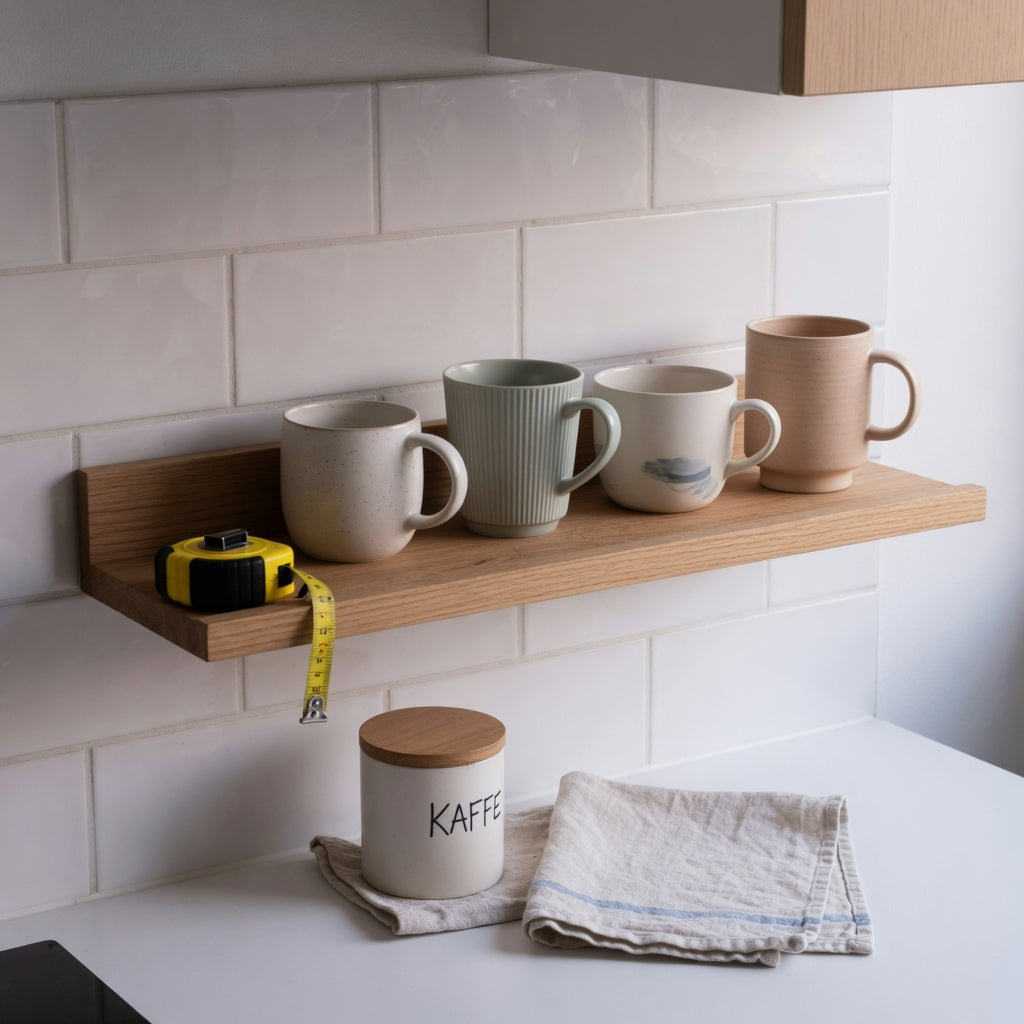
Minimal Coffee Shelf Mugs: Depth, Spacing, and Load Compared
Reading time: about 10 minutes
The nested cabinet stack is where this decision starts
Two mugs nested in the upper cabinet, handles locked, and the cup you want is the one that slides out and clips the faucet. We pack ceramics for a living, and customers tell us what pushed them to shop: rarely décor, almost always a daily set that needs to live somewhere visible and reachable. That is why interest in minimal coffee shelf mugs usually begins with a cabinet complaint, not a design board. The practical questions follow fast — will a pair sit still on a shallow ledge, clear the cabinet above, and still read as a set when two more arrive next month?
A rack cannot fix mismatched footprints. Start with the cups you already grab, then stress-test the plan against a mixed run from our unique coffee mugs. If diameters and handle heights jump around, one skinny ledge will punish you. The shelf is the environment; the mug is what has to live there without teetering.
Picture ledges, hook rails, and cubbies each filter mug shapes
Format is a filter before it is a style choice. It decides which silhouettes belong on the wall.
- Floating picture ledges. The Scandi and Japandi default. Mugs rest on their feet, handles forward or to the side. Trade-off: a small base or a tall, top-heavy profile is easier to nudge off, and a packed row of oversized pieces does not belong here.
- Hook rails and hook-and-shelf combos. The handle does the holding, so weekday grab-and-go is quicker. Handle-less cups, travel tumblers, and squat espresso pieces will not hang, or they hang at odd heights. Hook spacing matters more than the wood species in the listing photo.
- Cubby and grid shelves. Every mug gets a stall — safer for heavier ceramics and for walkways that get bumped. Visual weight runs higher, dusting is slower, and the look leans café-storage rather than quiet coffee bar.
If the wall only takes a narrow ledge, shop mug shape before you shop more mugs. A rounder foot plants wider on a shallow board. Compare our round coffee tea mug against the landscape tall coffee tea mug, and read height, base diameter, and handle projection off each current listing. Those three numbers decide collisions. The lifestyle photo does not.
We would rather sell two mugs that sit still on the shelf you already own than a matched set of six that only works in a product photo.
How much depth do minimal coffee shelf mugs actually need?
Shoppers ask us this weekly, usually after a near-miss on the counter. Usable depth is not the number printed on the front edge. A lip, a raised rail, or a thick finish can steal a quarter-inch a mug foot needed, so measure from the lip to the wall, not from the board tip.
Everyday ceramics in the 8–16 oz range sit calmer when the full base lands on the board with a little shelf showing in front of the foot. Oversized pieces and most travel cups need more than a picture-ledge profile. Mixing sizes? Measure your largest base and buy for that piece, not for the espresso cup in the middle.
Handle clearance is the detail generic roundups skip:
- Outward-turned handles look graphic and photograph well, but they eat width — which is how a “six-mug” rail becomes a four-mug rail once real ceramics go on it.
- The gap between hooks must fit handle projection plus a finger of air, or neighboring cups kiss every time someone reaches.
- Under-cabinet mounting needs vertical room for the tallest mug plus fingers to lift it. A taller profile can sit on the board and still clip the cabinet bottom.
Capacity talk that ignores mug size is marketing. Four large mugs can outweigh eight small ones and still look emptier. Compact-cup households should read what to check on 8 ounce coffee mugs first — small cups hang closer and leave breathing room. Bigger pours mean the same rail may only carry a short run of 16 ounce ceramic coffee mugs.
Oversized cups and travel tumblers break skinny ledges
A quiet coffee station is easy to sketch when every mug matches. Real kitchens are not that. One jumbo cup changes the line, blocks the next handle, and often sits near the front edge because its base runs wider.
The honest setup for oversized ceramics is a cubby, a deeper hardwood board, or a hook genuinely sized for the handle. A slim picture ledge — MALMBÄCK is the model that comes up most in these conversations — is a fair, affordable test for a small, even collection and the wrong tool for a mixed wall of big pottery. Before forcing a large cup onto a 4-to-5-inch board, see what to compare on 20 ounce coffee mugs, and be willing to give those pieces a deeper home.
Metal drinkware adds a wrinkle. Stainless and coated cups can weigh less, but a smooth base slides on a slick painted ledge more readily than a ceramic foot ring. A small front rail or a lightly textured finish does more work up there than another coat of gloss.
Wood, bamboo, or powder-coated steel near kettle steam
Kitchens punish display pieces in ways living-room shelves never see. Kettle steam, backsplash overspray, and drip trails all land on the same 18 inches of wall.
Solid wood — oak, walnut, fir, bamboo — photographs as the Japandi default, and it drinks stains when unfinished or lightly sealed. A ring under a wet mug base is not a ceramic defect; it is the board telling you the finish is too open. Bare wood means returning mugs fully dry and wiping spills the same day. MDF with a paper wrap is the budget lookalike, and one standing puddle near a swollen edge ends the argument.
Powder-coated steel and brushed stainless shrug off splash and wipe clean. The trade-off is visual temperature: they read industrial or café unless you warm them with ceramics and a wood counter. Coating tends to chip at the screw holes when a rack is over-tightened on install — a mounting mistake, not a reason to avoid metal.
Blunt limits: this category is not for a twenty-mug collection on one 24-inch decorative ledge, handle-less tumblers on a hook rail, or unfinished pine parked above a steaming machine. Those jobs want closed cabinets, a deeper cubby, or a different drinkware setup.
Mount for a loaded row, not the empty shelf photo
Empty racks are light. A loaded row of porcelain is not, and listings quoting the shelf’s empty weight answer the wrong question. Use the manufacturer’s maximum load, then stay under it — six mugs with air between them beats twelve mugs and a slow sag.
The mounting order we walk customers through:
- Find studs and hit at least two on a long span. Drywall anchors are a backup for light, even loads, never the plan for a full handmade collection.
- Match hardware to the rack’s back. French cleats spread the load and lift off for painting; keyhole hangers demand precise screw placement and resent being yanked forward.
- Level the board, then test with your heaviest mug at the outer ends. End-loading is where cheap brackets rotate.
- Renting? Skip mystery adhesive strips in a humid kitchen — they let go without warning. Ask for small-hole permission, use a freestanding countertop cubby, or accept that nothing matches a stud-mounted hardwood shelf for a heavy row.
A reader recently asked how to mount a display shelf roughly 4.5 inches deep and about 15 lb empty. Treat that as a furniture install, not a picture-frame install: pre-drill, match screw length to the wall type, and never cantilever extra mugs off hooks that were not part of the original design.
Style the wall without rebuilding the cabinet problem
Minimal only works when you leave air. Handles that kiss look busy even when the glaze is calm. Group by color family or season rather than “every mug we own,” and let overflow stay in the cabinet — that is storage; the shelf is for the working set. Use the top of a hook-and-shelf unit for a canister, a scale, or a folded cloth, never a second stacked row. Want more capacity? Add a second shorter shelf with a clear gap, or edit the collection.
The same mug can work across aesthetics: Japandi and Scandi stations want even heights and negative space, modern farmhouse tolerates visible grain and a thicker edge, and industrial coffee bars can take a full steel grid. Crowding is what breaks all three.
Buy ready-made, order handmade, or build: match the format to the collection
The whole point of minimal coffee shelf mugs is editing — the working set on the wall, the rest out of sight. Ready-made ledges and stainless grids are the fast path for four to eight even mugs this weekend. Handmade hardwood racks with custom hook spacing win when the collection is already odd-sized. Building only pays off if you will actually hit studs and finish the wood against kitchen moisture — a bare board above the kettle is a future stain ring.
| Your situation | Shelf format that fits | Mug next step |
|---|---|---|
| Even set of 4–6 daily ceramics, Scandi wall | Narrow picture ledge with a lip | Choose a rounder silhouette and confirm base diameter on the listing |
| Mixed heights, including a taller profile | Deeper wood board or a cubby | Verify height on the landscape-tall listing before any under-cabinet mount |
| Grab-and-go routine, sturdy handles on every cup | Hook rail with honest spacing | Keep handle-less travel pieces off the rail |
| Renter, no drilling allowed | Freestanding countertop cubby | Keep the working set small so the cubby never crowds |
Frequently asked questions
Will a narrow floating shelf hold several porcelain mugs without sagging?
It can, within the shelf’s published load rating and with bases fully on the board. Sagging is usually a span-and-hardware problem, and tip-overs happen when usable depth is shallower than the mug foot or the load sits forward of the brackets. Test the heaviest mug at each end after install.
What depth and hook spacing do standard and oversized mugs need?
Measure your largest base diameter and your widest handle-to-handle pair, then buy for those numbers. Everyday 8–16 oz ceramics often manage on a modest ledge, while oversized and travel pieces usually need extra depth or a hook they genuinely hang from. Tight hook spacing is the usual reason a six-mug rail only fits four.
How do I keep mugs from falling off a floating coffee mug shelf?
Hit studs, use the hardware the rack was designed for, and level it before loading. A small front lip does more than any decorative finish, and a light downward press at the ends will expose rotating brackets immediately. Renters should never rely on adhesive strips in a humid kitchen as the primary hold.
What should I compare before buying minimal coffee shelf mugs?
Compare silhouette, base diameter, handle projection, and height against the shelf you already have, plus how the foot sits — a slick, heavy base on a shallow painted ledge behaves differently from a cup with a defined foot ring. Verify every one of those details on the current product listing instead of assuming any two mugs will sit the same way.
Are hook racks better than cubbies in a small kitchen?
Hooks win on fast access and a lighter visual line, provided every mug has a sturdy handle. Cubbies win when kids, guests, or a tight walkway mean things get bumped. Neither replaces a cabinet for rarely used pieces, and four working mugs on a short rail usually looks more minimal than a grid packed to the edges.
Before you drill, run this five-point check
- Measure usable depth from the lip to the wall, not the board tip.
- Measure your largest base and your widest handle-to-handle pair.
- Check under-cabinet clearance with the tallest mug plus a finger of air.
- Compare your filled mug count against the shelf’s published load rating.
- Confirm height, diameter, and handle projection on each mug’s current listing before checkout.
When the numbers line up, pick two shapes and live with them on the shelf you own before adding more. A sensible place to start is our current coffee mugs — a pair first, then decide whether the wall wants another hook or a deeper board.
Read more

Brunch Tray With Coffee Mugs: What to Compare Before You Buy
Most searches for a brunch tray with coffee mugs mix gift baskets, matching serving sets, and folding bed trays. We compare tray size for coffee for two, stability, food-contact materials, and mixe...
Read more
Guest Tray Ceramic Cup: What to Compare Before You Buy
A guest tray ceramic cup has to hold a real pour, sit level beside a kettle, and survive the morning wash without staining the tray. We compare body material, glaze safety, foot rings, and rim care...
Read more
Leave a comment
This site is protected by hCaptcha and the hCaptcha Privacy Policy and Terms of Service apply.