
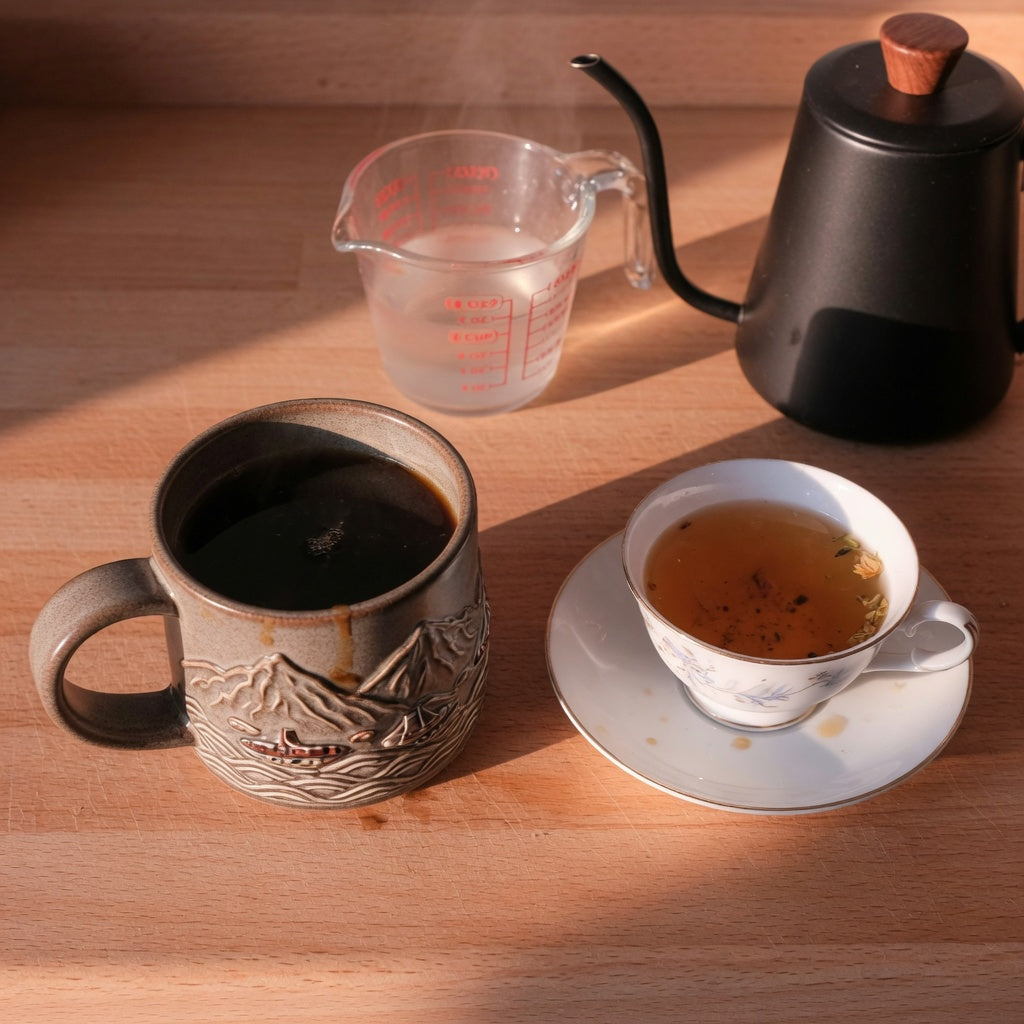
Mountain Tea Cup vs Coffee Mug Size: Oz, ML & Fit Compared
Reading time: about 9 minutes
Mountain tea cup vs coffee mug size: the numbers first
The sizing question lands in our inbox in a few phrasings, but the most common one comes from a gift buyer hesitating at checkout:
“I love the mountain design — but will it actually hold a whole cup of coffee?”
Fair worry. Two vessels can look nearly identical in a product photo and hold drinks that differ by half a cup. So before any specific design enters the picture, here is the honest baseline for mountain tea cup vs coffee mug size:
- Traditional teacups usually hold 6 to 8 fluid ounces, roughly 180 to 237 ml.
- Everyday coffee mugs commonly run 10 to 14 fluid ounces, about 300 to 415 ml.
- The “cup” printed on American recipes and measuring cups is defined as 8 fluid ounces, approximately 237 ml. A classic teacup sits close to one measured cup; a typical mug holds comfortably more.
Those ranges describe the market, not a single mug on our shelf. Wall thickness, base shape, and how full a person is actually willing to pour all move the real number. One calibration point worth carrying with you: when health guidance refers to a standard “cup” of coffee, it means that 8-ounce measure, not the vessel on your desk.
Why does tea traditionally come in a smaller cup than coffee?
No official rulebook decides this. The size gap grew out of how the two drinks get consumed, and after years of watching customers use both, we would sum it up in three lines:
- Heat management. Tea is brewed hot and sipped slowly, often across 20 or 30 minutes. A smaller volume stays warm through that session; a brimming oversized mug goes lukewarm before the last third is gone.
- Strength control. The same dose of leaf tastes noticeably stronger in 6 ounces than stretched across 14. Small pours keep flavor consistent from first sip to refill.
- Refill habits. Tea culture is built on small pours topped up with fresh hot water. Coffee culture is closer to one big serving, poured once and finished.
Neither approach is wrong. It just explains the mismatch you have probably lived: tea forced into a big mug ends up weak and cold, while a coffee drinker handed a dainty teacup is back at the kettle three times before 9 a.m.
How do sculpted mountain mugs change the capacity math?
Sculpted drinkware bends the numbers: raised relief, layered glazes, and shaped interiors all interact with usable volume, and the silhouette can promise more than the vessel delivers. Seven checks we walk customers through before they order anything in this style:
- Brimful vs usable capacity. A mug filled to the lip is a spill waiting to happen. The number that matters is volume to a sensible fill line, which is nearly always less than the printed maximum.
- Where the sculpting sits. Relief on the outside walls does not displace liquid. Detail molded into the interior does, and deep interior ridges can shave real volume off the nominal size.
- Handle fit. Two fingers should slide through with room to spare. A tight handle turns a full, hot mug into a pinch risk.
- Weight when full. Water is heavy: fourteen fluid ounces of it weighs roughly 415 grams, close to a pound, before the ceramic adds its own weight.
- Cabinet clearance. Sculpted handles and irregular profiles rarely stack. Four of them can occupy the shelf space of eight plain mugs, so measure shelf height first.
- Dual-unit labeling. Listings that publish capacity in both ounces and milliliters are far easier to compare than listings that round everything to “large.”
- Care instructions. Dishwasher and microwave suitability depend on the glaze and construction of the specific piece. In our experience, assuming instead of checking is one of the most common reasons sculpted mugs come back to us.
One detail shoppers rarely think about until the sink: glaze can pool in interior crevices on sculpted pieces, so hand washing runs slower than it does with a plain glazed mug. If the whole household is dishwasher-only, weigh that before the purchase, not after.
One mug or two? Matching size to your actual morning
Standing in front of the shelf, most buyers turn out to be one of three people:
- The one-big-coffee person. A single large coffee at the desk, no refills wanted. A standard or larger mug earns its space, and sculpting is fine as long as the listed capacity holds to your fill line.
- The several-small-teas person. Hot tea nursed all morning, and it must still be hot at the end. A smaller cup refilled once or twice genuinely works better than one big pour.
- The both-drinks person. One piece that reads as coffee at 7 a.m. and tea at 4 p.m. without looking out of place at either.
For that third customer, the piece we reach for in our store is the Mountain Sea coffee tea mug. The name promises both jobs. What we will not do is quote a capacity figure from memory, because listings get revised and the only number that counts is the one on the current spec sheet. Before ordering, scroll to the specifications on that product page and confirm three things: measured capacity in both ounces and milliliters, whether the figure is brimful or taken to a fill line, and the exact care guidance for the finish. Treat any piece in this style, this one included, as a mug you verify rather than assume — it is not a stackable everyday-set mug, and it is not an espresso vessel. If you would rather weigh several designs against each other first, our unique coffee mugs collection keeps the sculpted pieces in one place.
Typical sizes at a glance: teacup, standard mug, oversized, sculpted
Here is the comparison we sketch on notepads for customers who want the whole picture in one look:
| Vessel | Typical capacity | Fits well | Watch out for |
|---|---|---|---|
| Porcelain teacup | Usually 6–8 oz (~180–237 ml) | Black and green tea, short herbal pours | Coffee drinkers face constant refills |
| Standard coffee mug | Commonly 10–14 oz (~300–415 ml) | Drip coffee, generous breakfast tea | Tea can cool before the last third |
| Oversized mug | Often 16 oz and up (~475 ml and more) | Long desk sessions, soups, big servings | Heavy when full; hogs cabinet space |
| Sculpted dual-purpose mug | Varies by design — check the listing | One piece for both coffee and tea | Usable capacity can trail the silhouette |
The table zooms out to styles rather than specific designs. For the finer points behind it — rim shape, lip thickness, how each style holds heat — our coffee mug vs tea mug size comparison goes deeper.
Greek mountain tea (sideritis): what size cup matches the brew?
A large share of people shopping mountain-themed mugs are not just buying the artwork. They drink actual mountain tea — Greek sideritis and similar whole-herb brews — and those are conventionally served in smaller cups, refreshed with more hot water as you go. That habit is worth borrowing even for ordinary tea, and it reduces to one rule: match the vessel to the dose.
If your tea's packaging recommends an amount per 8-ounce cup, brewing into a 14-ounce mug stretches the flavor thin. Either scale the herb up for the bigger volume, or brew into a smaller cup and top up with fresh hot water. We will not hand you a universal ratio, because every producer cuts and dries its herb differently. The packet is the authority, and your cup size is simply the variable you scale around. Torn between two of our mountain designs? The Great Mountain mug comparison covers how each one fits a coffee-versus-tea routine.
When is a bigger coffee mug the wrong choice?
We sell mugs, and we will still tell you when bigger works against you:
- Slow sippers at a cold desk. A large pour that takes 40 minutes to finish ends lukewarm no matter how charming the design.
- Crowded kitchens. Sculpted handles and wide profiles rarely stack, and cabinet space is finite.
- Gifting to dishwasher-only households. If a listing's care notes call for hand washing and the recipient will not do it, the mug becomes a display piece. Check before you gift.
- Small-drink drinkers. Espresso and cappuccino servings run a couple of ounces; neither a teacup nor a standard mug is the right tool there. If you like a hot drink bigger than a teacup but smaller than a mug, a breakfast-cup style fills that gap — we chart it in our breakfast cup vs coffee mug size guide.
A 60-second checklist before you order any mug
- Write down what you actually drink most mornings: one big coffee, several small teas, or both.
- Convert it. One US cup equals 8 fluid ounces, about 237 ml; two cups is 16 fluid ounces, roughly 475 ml.
- Open the listing and find the measured capacity in both ounces and milliliters.
- Note whether that figure is brimful or taken to a fill line, and whether the interior is sculpted.
- Run the physical checks: two-finger handle clearance, weight when full, shelf height in your cabinet.
- Read the care notes — dishwasher, microwave, hand wash — before the mug meets your routine, or a gift recipient's.
Every sculpted piece we carry lives in the unique coffee mugs collection, and the specification on each current listing outranks any number quoted anywhere else — including in this article. Run the listing against the checklist above and the size question answers itself.
Frequently asked questions
Is a tea cup smaller than a coffee mug?
Almost always, yes. Most teacups hold roughly 6–8 fluid ounces while most everyday mugs hold 10–14. Specialty pieces like breakfast cups and oversized tea bowls overlap with mug territory, so trust the listed capacity rather than the shape.
How do I compare mountain tea cup vs coffee mug size before ordering?
Read the specification section of the listing rather than the photos. Confirm the capacity in both ounces and milliliters, check whether the number is brimful or measured to a sensible fill line, and look for sculpted interior detail that could reduce usable volume.
Does mug size change how strong my tea tastes?
Yes. The same dose of leaf spread through 14 ounces of water tastes noticeably lighter than through 6. Either increase the herb for a bigger mug, or brew into a smaller cup and refill with hot water — which is exactly why tea was traditionally served in smaller vessels.
Are sculpted mountain mugs dishwasher and microwave safe?
That depends on the glaze and construction of the specific mug, so treat the care notes on the current product listing as the final word before buying. As a habit, handle sculpted or hand-finished ceramics more gently than plain glazed mugs, and never assume microwave suitability if a design includes metallic paint or accents.
What size cup should I use for Greek mountain tea?
Follow the herb-to-water guidance printed on your tea's packaging, then match your vessel to that water volume. Many people who drink herbal mountain teas prefer a smaller cup refilled with fresh hot water rather than one large pour, because it keeps the brew hot and the flavor consistent.
Read more
Quiet Coffee Routine Ceramic Mug: What Buyers Should Compare
Weight, wall thickness, rim shape, glaze safety, and honest heat behavior — what actually separates a calm-morning ceramic mug from an ordinary one, written by the team that checks these mugs befor...
Read more
Elk and Moon Ceramic Mug Gift for Coffee Lovers: What to Compare
An elk and moon ceramic mug gift for coffee lovers only works if the animal, the pour size, and the care line match the person opening it. Here is the counter checklist we use before we call one gi...
Read more
Leave a comment
This site is protected by hCaptcha and the hCaptcha Privacy Policy and Terms of Service apply.